Tag: community

  • Monthly Round-Up – April 2026

    Monthly Round-Up – April 2026

    This article is written by a DSA member and does not formally represent the views of MADSA as a whole or its subgroups. 

    Welcome to Vol. 9 of the monthly round-up! The content in this publication overlaps with our DSA newsletter and monthly General Membership Meetings. To sign up for the newsletter or check out an upcoming General Membership Meeting, visit: https://madison-dsa.org/events/

    Members Work Towards A May Day Success

    Photo from The Capitol Times, featuring Voces De La Frontera.
    MADSA members tabling at the Library Mall rally.

    Throughout the start of 2026, and especially in April, MADSA worked towards supporting a major economic blackout on May Day, with the goal of “No Work, No School, No Shopping!”. MADSA members planned a community pancake breakfast, wrote rally speeches, created signage, liaised with unions, attended coalition events and worker assemblies, and held many conversations with coworkers and loved ones around shutting down their workplaces in support of the historic day.

    May Day is International Workers’ Day, and in Wisconsin, it is also A Day Without Immigrants, organized for years by Voces de La Frontera. This year, Voces led the day with key demands around rights for immigrant workers and a just economy for all. MADSA supported by hosting a successful community pancake breakfast in the morning, and collecting over $2,000 in donations towards Voces’ work. Next, at 11am, there was a rally by UW staff and students, which joined up with a 12pm rally at Library Mall. At 1pm, the rally marched to the Capitol, where the crowd heard speeches and music organized by Voces and their allies. In a huge win, Madison Teachers Inc. (MTI) was successfully able to preemptively shut down Madison Metropolitan and Sun Prairie school districts by collecting enough signatures from staff pledging not to work on May 1. Students and teachers from West and East High Schools marched to the capitol during the day to join up with the main rally.

    The day saw roughly 3,000 attendees in Madison, with participation from MADSA, UW-Madison’s YDSA, a variety of socialist and communist organizations, and many unions in the area. Milwaukee also had a huge day of action, and gubernatorial candidate Fran Hong made stops to both cities.

    May Day 2026 reflected a sense of shared struggle and power among working class people, explicitly connecting with the long history of labor battles in the U.S. and around the world. As MADSA and other organizations continue to grow, workers will hopefully build towards a larger economic shutdown on May Day 2027, and eventually develop the solidarity and power required for a general strike.

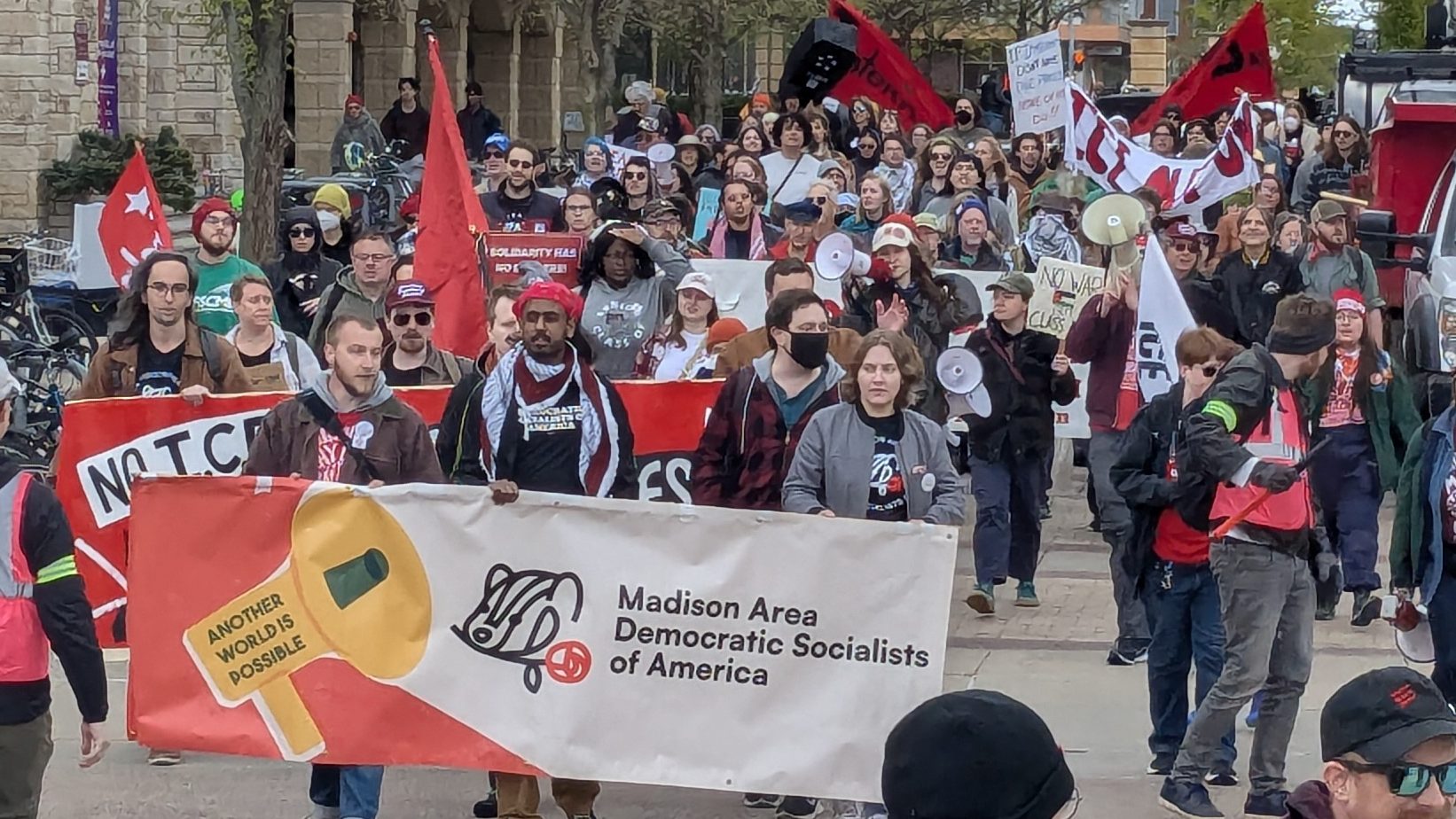
    • The image shows protesters marching in State Street. Three people at the front of the group hold a wide banner that says Madison Area Democratic Socialists of America.
    • Image shows several rows of tables in a dimly lit non-denominational church space, filled with people listening to a speaker who is outside of the shot.

    For more May Day coverage, Voces de La Frontera’s Facebook page and Instagram have many photos and videos of actions all over Wisconsin. 

    MADSA Approves a New Office Space

    On April 26th, MADSA called a meeting to discuss the chapter’s need for a larger office to accommodate our growth in members and resources. Members held a small potluck, and formally approved a proposal to rent a larger office space, which also grants consistent access to a meeting space for our large monthly general membership meetings. More details will be shared once this is finalized!

    Members also reflected on the chapter’s relationship with the Social Justice Center, where MADSA currently rents a small amount of space. Members voted to continue renting the space, as part of our desire to maintain a positive and supportive relationship with the SJC. 

    Canvassing & Tabling for Endorsed Candidates

    Members and other volunteers have begun canvassing for Fran Hong and Juliana Bennett’s campaigns. There are opportunities to canvass in several Madison neighborhoods, as well as tabling at the Farmer’s Market each week. Juliana’s campaign will be having a weekend of canvass action on May 23 and 24. Sign up here!

    ICE Out Work Continues

    MADSA continues to coordinate information about trainings and events, and neighborhood group chats, via the Strike Out ICE hub, here

    Additional Organizing

    Other important efforts this month included the following:

    • MADSA had its first AfroSocialists/Socialists of Color Coffee Hangout at Qamaria Yemeni Coffee.
    • In the lead-up to May 1st, MADSA members showed up to the May Day Strong Solidarity School focusing on organizing tactics, as well as two Madison Worker Assemblies and a coalition meeting for event planning.
    • NoAppetiteForApartheid (NA4A) had a planning meeting for a summer film event.
    • The Comms Committee put on its first skills training, with the goal of building comms skills among chapter members. A comrade taught some key principles of graphic design. 
    • MADSA had a Powerpoint to the People event where members could share socialist education through short presentations.
    • MADSA continues to prepare for the Queer Liberation March, scheduled for June 13th. 
    • Southern Dane County Branch had their monthly meeting on 4/29.

    Social Events

    We continue hosting recurring social events. Currently, we have DSA 101, MADSA Run Club, and the Rosebuddies program on the calendar. May also features a board game night planned for 5/4, and a new reading club for Ursula K. Le Guin’s The Dispossessed starting Sunday 5/30.

    Protest Song of the Month

    In honor of the Day Without Immigrants and Voces’ organizing role in our community, I’ll be featuring two songs this month.

    First, a lament – ICE, El Hielo by La Santa Cecilia, heard here. The music video features several actors who are living in the US as undocumented workers. The song tells of three workers contributing to the economy while living under the oppressive fear and restrictions that come with being undocumented.

    Next, for something higher energy – La Cumbia De La Migra by Los Jornaleros del Norte, a protest band proudly consisting of day-laborers. This song is ICE Out in purest form!

    And that concludes our monthly round-up!

  • Monthly Round-Up – February 2026

    Monthly Round-Up – February 2026

    This article is written by a DSA member and does not formally represent the views of MADSA as a whole or its subgroups. 

    Welcome to Vol. 7 of the monthly round-up! The content in this publication overlaps significantly with our DSA newsletter and monthly General Membership Meetings. To sign up for the newsletter or check out an upcoming General Membership Meeting, visit: https://madison-dsa.org/events/

    ICE Out Hub / Strike Out ICE!

    MADSA has launched a centralized resource for community defense and related organizing in Madison. Members in the February GMM debriefed about MADSA’s ICE-related efforts so far, and approved a proposal for Strike Out ICE!

    MADSA’s goals are to support other groups already doing this work – especially Voces de la Frontera – while also developing networks of mutual aid, supporting MADSA members in becoming active organizers, and building towards a national general strike on May 1st. What is most exciting to this author is that the strike plan is a movement backed by real strategy and community ties, not just a random internet call to action. The chapter is working on political education, building community bonds, spreading the word among coworkers and friends, and coordinating with other organizations, including unions. The strike could be a historic step in taking back the people’s power across the nation and in turning the tides of politics in the United States, if people embrace the spirit of making real, concrete demands, and shutting down the economy to ensure they are met.

    You can check out the hub here: https://madison-dsa.org/ice-out-hub/ The hub also contains weekly strike reports, and members will receive these reports in their email inboxes as a newsletter.

    I encourage all members to take action today, whether that’s joining a neighborhood group chat, attending an educational meeting about strike history or organizing skills, being trained as a legal observer, or talking to people in your life about the strike. And remember – millions of people participating imperfectly will always outweigh a few dozen participating perfectly. Embrace uncertainty and imperfection as a normal part of your political process! 

    MADSA Endorses Heidi Wegleitner for Re-Election

    Members voted in the February meeting to endorse Heidi’s re-election campaign for Dane County Board. Heidi has served as a delegate to the South Central Federation of Labor, is in a leadership role with the United Legal Workers union in Madison, and has a long history of fighting for housing rights. She will be running in District 2, which includes most of the Isthmus north of E. Washington Avenue, including neighborhoods around James Madison Park, Tenney Park, and Demetral Park. Elections will take place on April 7th, 2026.

    Additional Organizing

    Other important efforts this month included the following:

    • No Appetite for Apartheid held a launch party, and is now regularly hosting Grocery Scouting with DSA. At these 1 hour events, you can meet a MADSA member at a specific grocery store and learn how to spot products for boycotting, and how to build your voice for pressuring stores to stop carrying companies that are complicit in the subjugation of Palestinian people.
    • Phil Gasper held a talk on Trotsky’s Marxism at the Madison Public Library.
    • Southern Dane County Branch successfully had its own membership meeting.
    • There is now a working group meeting regularly about Fran Hong’s campaign.
    • A temporary working group is aiming to establish a physical office for MADSA to help with our growing size and work load.
    • Some chapter members have been seeking to grow community ties through art and music, and are building towards a community art build in March, as well as fostering a stronger chanting and music presence at protests.

    Social Events

    We continue hosting recurring social events – New Member Orientations, DSA 101, Coffee with Comrades, and the Rosebuddies program. A highlight from February was a special Galentine’s day event on February 13th! 

    The chapter also has a newly-started reading group for The Communist Manifesto, meeting on Saturdays at 10am.

    Protest Song of the Month

    MADSA members highlighted a few songs this month as part of the budding art and music efforts in the chapter. A recent feature was a modernized version of The Internationale, with lyrics updated in 2020 by Billy Bragg. Check it out here – song starts at 3 minutes in!

    And that concludes our monthly round-up!

  • Monthly Round-Up – November 2025

    By a Comrade

    This article is written by a DSA member and does not formally represent the views of MADSA as a whole or its subgroups. 

    Welcome to Vol. 4 of the monthly round-up! The content in this publication overlaps significantly with our DSA newsletter and monthly General Membership Meetings. To sign up for the newsletter or check out an upcoming General Membership Meeting, visit: https://madison-dsa.org/events/

    Behind-the-Scenes in a Growing Org

    Over the past year, the DSA has had a huge boom in membership nationally, a surge in membership here in Madison, and an increase in name recognition after Zohran Mamdani’s recent high-profile win in NYC (as well as other wins across the nation!). MADSA saw several new work groups form throughout 2025, as well as new projects, book clubs, potential candidate endorsements, and events for members and the community at large. These efforts all remain underway!

    As MADSA has scaled up, we’ve also contended with more mundane operational questions– How do we handle marketing and social media posts, now that there are so many more events? How are we feeling about our electoral endorsement process when it’s for re-elections? How can we keep developing comradeship among members? What is a good venue for our monthly meeting?!

    Here is a small behind-the-scenes look at some changes as we expand:

    • The Communication Committee (Comms) is working on appointing “liaisons” within each working group and project, so that Comms can stay better oriented to the chapter’s marketing/posting needs;
    • Comms and Executive Committee are also working on increasing direct posting access for various Working Groups so that they are not solely reliant on Comms for posting information about events and actions;
    • The Electoral Working Group has been exploring endorsement for several candidates running in state and local races, as well as discussing and reviewing the endorsement processes themselves;
    • Various members continue their efforts to revitalize Red Madison for internal and public readership – this has included identifying people who are open to contributing, as well as making calls for submissions at our general meetings;
    • The chapter will be publishing a resource to prepare for the 2026 Chapter Convention, where members will continue shaping the direction of MADSA;
    • The chapter has been experimenting with a few different venue options for GMMs to accommodate our new numbers and the geographical distribution of our membership.

    It is our hope that these changes will support the continued growth of the chapter, both in scope and in activity levels. 

    Social Events

    Our chapter had two reading groups wrap up in November:

    • Skyscraper Jails, discussed in the Abolitionist Working Group meetings;
    • Wretched of the Earth, discussed on Sundays, in a hybrid virtual/in-person format.

    We continue hosting recurring social events – New Member Orientations, Coffee with Comrades, Crafting with Comrades, MADSA Run Club, and the Rosebuddies program. 

    As the year comes to an end, we’ll be reaching out to members and asking about their experiences in MADSA this year, and their socialist resolutions for 2026. We’re also planning a New Year’s party on New Year’s Eve, details forthcoming!

    Protest Song of the Month

    For a November protest song, I’d like to highlight an artist from an indigenous background and ties to the Midwest – John Trudell. John was a Santee poet, musician, actor, speaker, veteran, and activist, at one point chairing the American Indian Movement (AIM). Here is the Listening / Honor Song, a spoken word piece over traditional music. The lyrics can be found here

    And that concludes our monthly round-up!

  • Jail Communications Campaign Victory

    By the Jail Communications Coalition

    We fought hard, we fought smart, and we won! The Abolitionist Working Group and our community coalition for free jail communications campaigned against a 3-5 year, exploitative contract between the Dane County Sheriff and Smart Communications, which the Dane County Board of Supervisors voted to reject on September 18, 2025. 

    The contract would have meant continued financial exploitation of jail residents and their families, keeping human connection for those awaiting trial behind a paywall and denying jail residents physical mai through the dehumanizing and inefficient practice of mail scanning. We are celebrating and learning from this win, and continuing to fight for the rights of jail residents and their families to stay connected. 

    Getting Started 

    We began thinking about the jail communications contract process in July of 2024, when a comrade remembered that the current jail communications contract was going to expire soon. In response, we began a long period of intensive research on the request for proposal (RFP) process, the County’s current jail communications system, alternatives to for-profit jail communications corporations, successes in other communities, and probable positions of current Board members. 

    As we expected, the sheriff’s office fumbled the opportunity to present a more just communications system. The County Board was informed of the end of the current contract too late, forcing an extension of the contract to allow time for the RFP process, committee discussions, and votes on the contract. The RFP process resulted in only two proposals, and the chosen proposal by Smart Communications was sent to Board committees this June. AWG was ready to oppose the contract and sprung into action. 

    Our Coalition

    This victory would not have been possible without a coalition of community members working together or the extensive preparation that the Abolitionist Working Group did leading up to this summer. When the contract was sent to the Public Protection & Judiciary Committee (PP&J), there was very little notice to the board or community, and an immediate response was required. Thankfully, we were ready. Members of MADSA’s Abolition Working Group turned out to a PP&J committee meeting to testify, where we met like-minded community members opposing the jail communications contract also ready to advocate. A Signal chat was formed among these community members, and advocates across the left joined in to form a loose coalition, including community organizers from MADSA, LGBTQ Books to Prisoners, the Politicized Healers Network, and many other local advocates. Working as a coalition, we benefited from a diverse array of experience, skills, and contact with County Board Supervisors, and together, we fought against this contract every step of the way. 

    The coalition included people with lived experience and loved ones impacted by the justice system. It included social workers with expertise about addiction, nonprofit workers with expertise about navigating the carceral system, and business leaders with expertise designing and administering RFP processes. It included people with established relationships with board members, and others who had never spoken at a board meeting. We didn’t have a name, or a charter, or a long list of logos from sponsoring organizations. What we did have as a coalition was energy and focus towards a specific goal, one that motivated us to work across political differences to create a unified front against exploitation. 

    This loose coalition started building working relationships and together synthesized an ask: that the board deny the Smart Communications contract and instead adopt a system of jail communications that would be free to residents and their families and that would be accountable to tax payers. We identified possible barriers – the upcoming county budget process, the sheriff’s unfounded claims about drug trafficking, and bias against justice-impacted community members. From our long-time fight against the building of a new jail, we also knew that connecting with county board supervisors from outside of Madison would be essential. 

    We would need to rely on all of our diverse areas of expertise, because in a budget year, fighting against a contract that would have paid the county for a monopoly on jail residents communication and data was going to be an uphill battle. This work required us, as a coalition, to trust one another, be open to new ideas, respect each other’s expertise, and celebrate each other’s efforts. We had to be agile as conditions and timelines changed, engage fully in the work when we were able, and recognize that we didn’t need to agree on every word or idea to share the same vision and goal. Being in a coalition required more work, but we accomplished so much more than we could have alone. The sum was greater than the parts. 

    Our Tactics

    Our subsequent efforts were strategic and unfolded as we went: 

    • We intentionally recruited community members through social media and activist networks from a variety of districts in the county to register and speak at committee meetings
    • We documented which supervisors were for and against us, making note of the particular issues and concerns folks had and what arguments might sway those who were uncertain
    • We developed relationships with board members who were on our side to equip them with arguments against the Smart Communications Contract
    • We published in Tone and the Cap Times to appeal to the broader community 
    • We developed a list of plain-language talking points, each with specific details and citations, and organized to ensure that a variety of talking points were presented at every opportunity for public comment
    • We didn’t wait for the all-board meeting, but instead showed up at every committee meeting leading up to the board vote. Close to 20 community members spoke against the contract at each committee meeting, 50+ community members registered opposition and even more folks contacted their supervisors directly, saying “vote no”. 
    • We conducted extensive research about
      1. The harm caused by charging for communications
      2. Alternatives to charging for communications, and
      3. How other activists have fought and won the right to communication for incarcerated people elsewhere. 

    And finally, after an already long fight, when the full county board vote was delayed by two weeks, our coalition made one final push to convince board members that this contract was not in the best interests of our county. Knowing that board members had already heard emotional and ethical appeals, the coalition focused on showing the Board that they had other options. County supervisors needed to know about the abundance of alternatives and how other counties and states are implementing communication at no-cost to incarcerated people and their families. 

    A team of four from this coalition, including DSA members Aedan and Brenda, spent a week and a half creating a presentation focused on 11 specific, well-researched examples of communities where jail and prison communications systems are administered without fees to residents and their families. The presentation also included data from government and nonprofit reports, peer-reviewed research, and news articles. Most notably, this presentation highlighted work in La Crosse County, WI, Champaign County, IL, and Elkhart County, IN after Aeden conducted interviews with county board members, detention center personnel, and sheriff departments who testified about the benefits of offering free phone calls in their facilities. 

    We invited all Dane County Supervisors to the webinar, and 8 joined the call, along with 2 lieutenants from the sheriff office, the sheriff himself, and a high-ranking staff member for County Executive Melissa Agard. Due to rules about public record and when and how the board convenes meetings, we offered the presentation as a webinar instead of a discussion, and board members were invited to reach out privately with any clarifying questions. The presentation slides and a recording were sent immediately following to all the board supervisors.

    The Result

    During the summer, and in response to our advocacy, both the Public Protection & Judiciary and Personnel & Finance Committees had voted to send this contract to the full board with recommendations to deny the contract, based on several concerns, including:

    • The harm caused by fee-based jail communications systems and the isolation they inflict on both jail residents and their loved ones
    • A lack of data privacy and ambiguity in this contract about data ownership
    • Ethical and financial concerns about Smart Communications and their leadership in particular
    • The risk of lawsuit based on Smart Communications pattern of violating 1st and 4th amendment rights
    • The lack of notice and transparency from the sheriff’s department in the RFP process.

    Our summer of advocacy efforts, and year of research prior, then culminated in September. On September 4, 2025 the full Dane County Board planned to take up the issue for discussion. Just hours before the meeting, Sheriff Barett, who had previously claimed denying residents physical mail was non-negotiable, introduced a new contract that eliminated mail scanning. This in itself was a win and showed the power of our community’s voice. It also threw off-guard both community members prepared to give comments and the board supervisors prepared to discuss and vote on the former contract.

    We spoke up against the contract anyway. Every public comment given was strongly opposed to the contract. Already frustrated by Sheriff Barett’s late submission of this substitute contract, the Board voted to table the item and re-take the issue at the September 18 meeting, not only in light of community members’ concerns, but also to give Supervisors a chance to read the contract before voting. At the Board’s meeting on September 18, 2025, further public comment wasn’t allowed based on procedural rules, and it was during those two weeks between meetings that we presented to the board about alternatives. 

    Board members, having been educated by members of the community at large and our coalition in particular, stood to voice their discomfort with for-profit jail communications and the poor data privacy practices that this contract would include. During debate, multiple supervisors asserted that the county needs to improve communication for incarcerated people without causing financial burden, referencing the information and examples our coalition shared. Finally, two issues went to vote. First, whether to adopt the sheriff’s revised contract and second whether to approve the proposed contract. Both versions of the contract were denied by the Dane County Board of Supervisors in a landslide. 

    What’s Next

    In an ideal world, the jail wouldn’t exist. We would have strong community-directed systems that promote real healing and accountability without the carceral state. Humans in our county would not be kept in a cage, however gilded the new jail will be, simply because they’ve been accused of wrong-doing and don’t have money for bail. This is a world we will continue to fight for. And because of this specific push against one particularly exploitative part of the injustice system, we have a real shot at making sure incarcerated members of our community have the right to connect with their loved ones. 

    With the current contract set to expire, and with county board members engaged and committed to adopting a more ethical communications system, we look forward to working together as a coalition to continue resisting exploitative practices and advocating for systems that affirm the dignity of our jail residents and their families.