Tag: Elections

  • Bobby Gronert: Why MADSA should endorse Francesca Hong for Governor

    Bobby Gronert: Why MADSA should endorse Francesca Hong for Governor

    Comrades of UW-Madison YDSA and Madison-Area DSA,

    As we approach one of the biggest decisions in the history of Madison-Area DSA and UW-Madison YDSA, we want to share our thoughts on the question of endorsing Francesca Hong.

    This question comes at a time of crisis. Wealth continues to accumulate in the hands of those who already have it, as life gets worse for those destitute and barely getting by. No longer able to satisfy our bloodlust purely overseas, Nazi admirers have been armed by the state and sent to walk our streets; “a force of the unemployable terrorizing the employed”, to paraphrase Will Menaker. Liberal institutions, the entire system of liberal democracy, seems to only continue to be swept away by the rising fascist tide. Actions like NSPM-7, which designates “anti-capitalist” groups as domestic terror organizations, are already putting socialists in the crosshair, and it’s only a matter of time until they act on their ambitions and use their Gestapo to come after us too

    We did not choose the troubling circumstances we find ourselves in. While the fascists are organized in their cruelty, staying passive is recklessness bordering on negligence. For these reasons, although we hold some reservations about Fran’s campaign, we strongly encourage MADSA to vote to endorse her for Governor of Wisconsin.

    To fight this regime, we need to organize working people from the Mississippi River to the Monongahela Valley. In Fran’s campaign, we have been presented an opportunity to do just that in Wisconsin. Just as Bernie Sander’s 2016 campaign grew DSA from 8.5k on election day to 21k in 2017, or how Zohran’s upstart Mayoral bid doubled NYC DSA’s membership rolls, Fran’s statewide campaign will not just grow MADSA’s organizing in Madison — it will empower rural working communities to join our fight too.  

    As co-chairs of YDSA’s Electoral Working Group at UW-Madison, we can seamlessly integrate Fran’s campaign into our campus organizing alongside our campaign for Common Council District 8. This will demonstrate our maturity and seriousness to students desperate for a legitimate way to fight fascism. In this country, many see elections and police-approved protests as their only way to participate in politics.  A statewide socialist campaign would mobilize this mass of politically unorganized young and working folks, and would draw together a coalition hungry for change into an actionable, growing, and revolutionary movement statewide.

    By harnessing the potential of Francesca Hong’s gubernatorial campaign, we could create a statewide socialist movement that transcends the rural-urban divide by connecting DSA chapters across the entire state. We envision a future of constant cooperation between Madison and Milwaukee DSA, YDSA Chapters at Superior, Oshkosh, Parkside, Stout, and even high schools around the state. Though we were pleased to see 150 people in the room for Fran’s Candidate Forum during the most recent General Meeting, 150 people in Madison will not win this fight, and will not satisfy us.  We hope to see 150 DSA members in a room in Platteville, as a working class movement does not win back Southwestern Wisconsin for the Democrats, but wins it for DSA. With the Fran already amassing over 1,500 volunteers for her campaign, she presents a clear first step in this vision.

    Minnesota Gov. Tim Walz recently said that our only way to fight this fascist tide is “in the courts and at the ballot box.” As Democratic Socialists (emphasis on the D), we know the ballot box not to be the only expression of working class democracy, and the courts not to be an ally of the working class at all. Organizing doesn’t stop at the ballot box, and the momentum we bring to this campaign doesn’t either. DSA must not be just an organization, but be the organization behind this campaign, defining its policy, its strategy, and providing a healthy source of manpower and enthusiasm. 

    Just as our campaign won’t die on April 7th, we must make sure that Fran’s does not meet its end on August 11th or November 3rd. We will rally for Fran when she produces tangible wins for working people, and ensure these wins are seen as products of the socialist movement. If Fran delivers on universal childcare, guaranteed paid leave, free school means, legalizing cannabis, and criminal justice reform, they will be seen as victories of socialism, not the Democratic Party. And when she fails to deliver, we will stick to our principles as a chapter and hold her accountable. 

    As Eugene Debs once said: “I can see the dawn of the better day for humanity. The people are awakening. In due time they will and must come to their own.” The tradition of socialism in Wisconsin has remained dormant for too long. We must fight to re-awaken the masses.

    A new era for Wisconsin socialists is here.

    In solidarity, 

    Bobby Gronert and Wesley Hoy

    Co-Chairs of the UW-Madison YDSA Electoral Working Group

    Carter Burg contributed to this piece.

  • Member of PSOL in Brazil Visits Madison DSA

    Member of PSOL in Brazil Visits Madison DSA

    In December 2025, MADSA was visited by Peter B., a Brazilian socialist member of PSOL (Partido Socialismo e Liberdade/Socialism and Liberty Party). Peter has been living in New York for the past year and paid a visit to Madison, Wisconsin, as part of his effort to promote the First International Antifascism Conference, being held in Porto Alegre, Brazil, from March 26-29, 2026. This conference is being organized by his party, PSOL, as well as PT (Worker’s Party; party of current president Lula da Silva) and PC do B (Communist Party of Brazil)

    Peter has been an active socialist organizer in Brazil for many years and officially joined PSOL in 2009. Before joining PSOL, Peter was active in the student movement, as well as the broader youth movement in Brazil. He also worked as the chief of staff for a Brazilian congresswoman. Comrades in MADSA sat down with Peter for an intimate talk about what it has been like for Peter living in the United States and observing the actions of DSA. We also engaged in conversation about electoral politics, the rise of the far-right, the importance of internationalism, the various ways PSOL differs from DSA, and the differences between our respective countries. 

    PSOL is the second largest left party in Brazil and is positioned to the left of PT, the Workers Party. PT is the current largest left party, but is not an openly socialist party. PSOL currently has 12 congress members in Brazil out of a congress of over 500 members. 

    Brazil and the United States

    In the spirit of internationalism, Peter expressed that he and his comrades in Brazil are concerned about the rise of right-wing politics in the United States. They are especially concerned about the politics of Trump and the far-right. The realities of Brazil and the United States are intertwined, with far-right sentiment becoming a growing problem in both countries, as well as around the world. With these concerns in mind, socialists are frequently asking themselves: What are the best actions socialists can be taking to combat fascism in their country? For American socialists, do we feel DSA is prepared nationally to combat these issues? What about the issues in our local communities and how they are connected to international politics?

    If Americans think their recent political issues are unique to their own country – everything from political assassinations to coup attempts – Brazil is more alike than most might know. Jair Bolsonaro, previously mentioned as the former right-wing president, is currently in jail for orchestrating his own version of a January 6th-style attack, which occurred on January 8th, 2023. After left-wing president Lula da Silva was inaugurated, Bolsonaro supporters attacked federal government buildings in retaliation, hoping to begin a military intervention. Bolsonaro and his supporters were unsuccessful, but unlike the United States, the Brazilian courts sentenced Bolsonaro to a 27-year prison sentence for plotting a coup. 

    Political assassinations have been on the minds of Americans for the past year, from the attempt on Donald Trump to the United Healthcare CEO to Charlie Kirk. On the other side of the aisle, many have overlooked the assassinations of Minnesota House of Representatives Speaker Melissa Hortman and her husband, as well as the attempt on the lives of Minnesota State Senator John Hoffman and his family. 

    Peter remembers a particularly difficult time in PSOL: the assassination of Marielle Franco, a Black socialist city councilor, who was a member of PSOL. Franco, who was outspoken against police brutality, was killed by two former police officers. Peter mentioned a foundation created in her name that acts as a place for members of PSOL to organize, promote political education, carry out seminars, panels, studies, research, publications, and more. 

    Some other similarities between the United States and Brazil are obvious: both countries are bourgeois democracies where money in politics plays a big role in influencing elections and forcing organizers to find different spaces to put forward alternatives to the status quo. One major difference is Brazil does not have a bipartisan system and allows for many different parties to represent the people within congress. Peter believes it is good for socialists to have their own party. 

    Another difference is that Brazil has public funding for elections, which had been a major demand from left parties in Brazil in past years. This demand was won, but Peter acknowledges that there are still contradictory problems with money in politics. For example, Peter notes that politicians in Brazil are quick to spend massive amounts of money on running elections and building parties, but then turn around and claim there is not enough money to fund public education and other important needs for the working class. At this point in the talk, a MADSA member mentioned that Zohran Mamdani’s winning campaign was helped along using New York City’s public elections fund matching campaign, where individual dollar donations were bolstered by a public matching fund, allowing Zohran to stay competitive in the race.

    A major concern with politics in the United States is lack of voter participation. Many citizens regularly sit out elections and most people do not feel well represented by the major parties. In Brazil, voting is mandatory. Despite this obligation, around 20-30% of all voters in Brazil do not actually participate in elections. For comparison, in the 2024 general election, 36% of Americans did not vote. Mandatory voting, Peter argues, creates an environment of vigorous political debate prior to elections. It could also be potentially difficult for an individual in Brazil to apply for a public sector job if they did not have a record of participating in elections, which acts as another incentive to get people to vote and become politically aware and engaged.

    The work of DSA and socialists in office

    Comparisons between DSA as a political organization and PSOL as a legal party were brought up throughout the talk. Peter noted that DSA engages in candidate development and endorsement procedures, with a focus on questionnaires and candidate forums to try and ensure that DSA-endorsed candidates abide by the socialist strategy of the DSA. However, as members of DSA, we know that the process of engaging in electoral politics differs greatly from chapter to chapter, with large chapters like NYC-DSA seen as a powerhouse of electoral strategy whereas smaller chapters engage in electoral work with perhaps a more critical eye, considering the small numbers. The current endorsement processes MADSA is engaged in have been heavily debated and discussed among members, with most members seemingly eager to make the best possible decision in how to engage in campaigns and whether or not these campaigns will promote socialism at large.

    In Brazilian politics and elections, Peter relays how PSOL will run dozens of candidates at the same time at the state level. He finds that it is sometimes more difficult to individually interview every possible candidate and analyze their political beliefs, but this is perhaps in reality a far more simple process considering PSOL is an established legal party with strong leadership and a clear program. While there is no way to directly prevent opportunists from running as members of PSOL, the party structure having a coherent program for addressing issues in Brazil helps to create strong candidates in general, with less of a need to individually vet every candidate.

    While living in the United States during the past has been undoubtedly difficult for socialists, we experienced a glimmer of hope with the campaign and successful election of Zohran Mamdani, a cadre member of NYC-DSA who beat back incumbent mayor Eric Adams (who has a history of collaborating with Donald Trump and other conservative groups) and former governor Andrew Cuomo (who has a history of assaulting women). According to Peter, who had an up-close view of NYC-DSA’s historic campaign to elect Zohran, there was nothing quite like the Mamdani campaign. It was a very politicized, high-spirited campaign, focused on a working class affordability agenda while also connecting the issues of New Yorkers to issues to the world, such as Palestinian liberation and fighting the far-right.

    The Mamdani win showed that not only can socialists effectively message about bread-and-butter issues such as affordability, they can also highlight internationalism as a positive aspect of the campaign, as well as shining a light on the problems with conservatism in the United States. The unique circumstances of Zohran battling against two unpopular politicians too eager to uplift right-wing causes (most notably Zionism) made a strong case for socialism as the true alternative to “business as usual” politics in New York City. Can this be replicated around the country?

    A MADSA member brought up recent electoral political disagreements in NYC-DSA regarding New York City Councilmember Chi Osse’s attempt to potentially challenge Hakeem Jeffries, current Minority Leader of the House of Representatives, in his district. Peter, as an observer, felt that DSA’s political culture surrounding this particular moment was impressive. Around 300 members of DSA attended an in-person discussion about Osse’s potential campaign challenge and over 800 members attended online on Zoom. Peter noted positively that mayor-elect Zohran Mamdani attended in-person as a regular member of NYC-DSA and spoke against Osse’s candidacy. Afterwards, despite the mayor-elect making his preference known, Osse still received 45% support from NYC-DSA members. To Peter, this showed that despite NYC-DSA having just rallied for over a year to support Mamdani’s campaign, members were not afraid to disagree with Mamdani and argue against his point of view. This event also showed that despite his position in the executive office, Mamdani behaved as just another member of DSA, as a cadre member would be expected to act. 

    DSA has had electoral victories in the past, and Zohran is not the first win we’ve had to celebrate in the last few years. Despite the growing number of DSA electeds, the eternal question remains: What does it mean to be a socialist in office? How can we use elections to advance a socialist strategy? Peter B. shared his beliefs that a representative in government should be a member of a socialist organization, and not just a paper member. This representative should ideally be going to meetings and participating in the organization. Any representative should use their office to help grassroots movements, organize new movements, and help unions organize. Further, a socialist representative should always “talk the truth to society, to the working class.” Members of MADSA have recently expressed similar feelings about socialist electeds, including strong beliefs that an elected candidate should be using their time in office to advance the labor movement, evangelize about socialism, and be a participating member of DSA. 

    An example of how PSOL has used representatives in office to mobilize the working class was through their 2019 fight against a very conservative pension reform bill, put forward by former right-wing president Jair Bolsonaro. In reaction to this bill, the PSOL congresswoman that Peter worked for launched a campaign to register households as committees to organize against the bill. Although the bill passed, they managed to register and organize over 2,000 households nationally, getting these groups politically engaged at a grassroots level. 

    The importance of internationalism

    At the heart of Peter’s visit to Madison and his travels in the United States was the concept of internationalism. Peter expressed his strong belief in internationalism. To him, it is important because capitalism is an international system, and so defeating capitalism requires international organizing. The crisis of capitalism is a global problem impacting the lives of most of the world’s people, and we should think about our fight against capitalism on a global scale. International issues tend to touch on every country in some way, whether that be the climate crisis, the development and adoption of AI in the workplace, or warfare. 

    Palestine is another international issue that has seemingly galvanized a large part of the world’s population, uniting everyone in their belief in Palestinian liberation and the end to forever wars. Peter brought up the Global Sumud Flotilla, consisting of over 40 vessels carrying 500 people from around the world, sailing to try and deliver aid to Palestinians, as well as continue the struggle for Palestinian liberation. According to Peter, three members of PSOL were part of the flotilla, and this risky initiative was important for putting the attention back on the genocide and the falsities of the “ceasefire” negotiations.

    More specific to DSA, Peter noted that a member of PSOL attended the 2025 DSA National Convention in Chicago, and after this member spoke against Trump, their visa was revoked. Engaging in internationalism is a risky endeavor, but the working people of the world owe it to each other to extend solidarity with one another in the fight against global capitalism.

    The First International Antifascism Conference…

    …which is being held in March 2026 in Brazil, is a broad initiative organized by the left parties in Brazil, alongside many unions and the MST (Movimento dos Trabalhadores Ruais Sem Terra/Landless Workers Movement). MST is a historic mass movement of rural workers fighting for land reform and against injustice in rural areas. The event is anticipated to attract people from over 40 countries, with individuals ranging from elected officials, rank and file union members, social movement activists, and more. 

    The conference is open to anyone who wishes to attend. Registration for the event can be found here: https://antifas2026.org/en/

    MADSA was very happy to host Peter B. for a few days and talk with him personally about his political beliefs, the realities of being a socialist in Brazil, and the current socialist movement in the United States. MADSA as a chapter recognizes the importance of internationalism, fighting fascism, and being in solidarity with the workers of the world!

  • Can MADSA Make Better Possible? Francesca Hong and Madison Area DSA’s Electoral Strategy

    The past decade of the Democratic Socialists of America has been defined by shockingly successful moonshot campaigns that catapulted socialism into national conversation, leaving organizers scrambling to meet the moment without sacrificing their principles. First, we had Bernie’s 2016 presidential campaign and its 2020 encore, and then just a few months ago, Zohran Mamdani shattered expectations with his election as  mayor of New York City. Now, it might be Wisconsin’s turn: MADSA member and State Rep. Francesca Hong announced her bid for Governor at our September General Meeting. Since then, there has been widespread debate in the chapter, but one thing we all seem to agree on: this race could be a huge opportunity for socialists in Wisconsin. The question is – are we ready?

    MADSA members have been thinking about this race in the context of our preference for “cadre campaigns,” where we slowly and deliberately build our organization from the ground up by sending candidates into office who are drafted to represent DSA’s politics in office. I believe this is the best strategy for building our independent electoral apparatus, and laying the groundwork for a party – but it’s not the only strategy. In some ways, our relationship to Fran’s campaign might look more similar to the Bernie campaigns, where DSA reverse-engineered a socialist organization out of an electoral campaign. The comet’s going to pass whether we like it or not, and we know people are already watching it. We also know that the only thing that can win socialism is a mass working class organization, so we need to make sure that when people look around with new eyes, they find us and the movement we’re building. That means the question of whether this race will advance the class struggle can only be answered by our ability and willingness to rise to the occasion and build that movement.

    In my mind, the decision to get involved in any electoral campaign (or other organizing project) should come back to three simple questions (distilled by comrade Marianela D’Aprile):

    1. Does it make more socialists?
    2. Does it build the power and organization of the working class? 
    3. Does it build the power of DSA? 

    I believe that Fran and her campaign team want the answers to be yes, but I don’t think it’s entirely up to them– it’s up to us. There’s a very real chance that we get to live in a world where Fran runs as an extremely open socialist everywhere, endorses all of our downballot candidates, uses her platform to uplift DSA’s priorities, and encourages people to join DSA at campaign events. In that world, we are firing on all cylinders for most of 2026. We’re running her canvasses in Madison and across the state, including in districts where we don’t have enough of a footprint to run downballot candidates, and using them to recruit like crazy – since we’ll be the field leads, and hosting the after-canvass cookouts. We’ll be expanding our membership, expanding and deepening our coalition relationships, and building internal infrastructure – and potentially building toward a statewide DSA legislative campaign. Win or lose, a race like this can change the landscape of WI politics for the better, and build DSA’s capacity to take on state-level policy fights – and other struggles – in the future. Some of it will be on Fran, but a lot of it will come down to whether or not MADSA and our comrades around Wisconsin have the capacity to use this campaign to make more socialists, empower our class, and build our organization.  For the record, I want to be convinced, because I fear the gravitational pull of a statewide race will be too much to resist for the majority of the chapter. We might as well try to get the best endorsement situation we can.

    Below I’ve laid out my understanding of the state of the race, our relationship with Fran and her campaign, and the chapter’s strengths and weaknesses. Finally, I propose what an ideal campaign would look like, and what commitments it will take from Fran AND from MADSA to get us there. If we don’t feel like those commitments are possible, then we shouldn’t endorse. If they are, we may very well be foolish not to.

    Some context: as the co-chair of the chapter and active member of the Electoral Working Group, I have been privy to many conversations about and with Fran. I have also been involved in several DSA campaigns, including as a DSA rep to a campaign coalition team. There are definitely aspects to this campaign and our political terrain that I don’t have insight into, and I encourage other comrades to elaborate upon or argue with what I’ve laid out here. I do think this reflects the gist of the conversations about Fran’s campaign in EWG, and I hope this will be a useful framework for chapter members thinking about this huge decision in the coming weeks. Thank you to comrades Wesley, Justin, Adithya, Athnie, and others for your contributions!

    The Fran We’re Dealt

    In assessing this race, it’s helpful to understand MADSA’s current relationship with Fran. It is true that Fran is not a homegrown cadre, drafted by our organization to represent us in the Assembly as part of our political strategy. Despite this, we maintain a positive, but limited, relationship with her, and she behaves in office as we’d hope any socialist would – introducing legislation like the Economic Justice Bill of Rights, elevating the demands of organized labor and social movements, and taking the fight to the Democratic Party when necessary. To be frank, I think the reason we’re so distant is that for most of Fran’s time in office, MADSA hasn’t had the electoral or legislative capacity to build the relationship to the point where it would have been mutually beneficial.

    Some background: Fran was elected in 2020 at the top of a crowded field that included at least one other DSA member, Marsha Rummell. (MADSA did not endorse in that race, but did endorse Fran’s current chief of staff, Nada Elmikashfi, for State Senate District 26). After the election, Fran joined DSA. Fran was re-elected in 2022 and again in 2024, which is when MADSA endorsed her for the first time and about when she joined the WI Legislative Socialists Caucus. We didn’t get involved in the field for her 2024 State Assembly race, as she was a popular incumbent with no primary challenger. Instead, we endorsed on paper and threw our weight behind another race that needed more capacity, Maia Pearson’s unsuccessful challenge to incumbent Rep. Shelia Stubbs. I believe it was a mistake not to get more involved in Fran’s campaign, or at least bring her into greater communication with the chapter, as doing so would have given us more opportunities to deepen our working relationship. 

    Despite this, she was involved in MADSA’s 2024 priority campaign: Free School Meals for MMSD, and played a crucial role in connecting that local coalition to a state-level one. Occasionally, Fran has attended chapter and working group meetings and participated in DSA events, most notably the YDSA Organizing Fair shortly after the 2024 election, and the Hands Off Medicaid Town Hall earlier this year. We have reason to believe that she’d be willing to have a stronger relationship with us, if our chapter 1) had more capacity – and a strategy – for state-level legislative work and 2) had a formal communication channel with Fran and her office that could keep her in the loop on chapter priorities and facilitate her giving regular reports to MADSA membership. As a popular and highly-motivated activist Assemblywoman, Fran has a lot of political capital – much more than MADSA. She also has a lot of voices in her ear, and unfortunately, we haven’t been strong enough to earn a place amongst the loudest ones. 

    Unfortunately, the fact that she has political capital above and beyond MADSA’s means that her decision to run for governor is not an expression of DSA’s democratically-decided strategic priorities. I won’t lie – it’s not ideal that we’re getting involved so late and have so few cadre in the commanding heights of the campaign. As we know from her work in the legislature, Fran is a great fighter, but I think it’s safe to say that this is not a fight MADSA would have picked. If we’d been a factor in Fran’s decision to run for governor, we probably would have come out against it, both because of scale and because of the contradictions inherent to governing as a socialist executive under capitalism. There is a non-zero chance that Fran could win! That does feel like a bridge we’ll have to cross when we come to it, but we do owe it to ourselves to be serious about what that will entail, before the rubber hits the road. If we’re lucky, we can get some progressive stuff done with her as Governor, but there is a real tension implicit in having to govern, as we’re seeing with Zohran in NYC. We need to make sure having a socialist executive won’t backfire or fracture our movement, and see our role as creating the conditions in which a socialist executive can succeed.

    My belief is that the strength of any socialist elected depends on the strength of the movement that supports them, their ability to elevate movement demands, and how well they communicate back to the movement about the compromises they are forced to make – because there will be compromises. Even if Fran was the ideal cadre candidate in every conceivable way, there would be decisions she’s forced to make where there’s no good option. If we get involved in this race, we should get realistic about what we hope to achieve on the inside, and where she’ll need movement pressure from the outside – both to advance a popular mandate for socialist transitional demands, and to defend that mandate from the backlash of capitalists and their allies in the state and federal government. 

    Can MADSA Meet the Moment?

    While the weakness of the relationship with Fran is partially due to the weakness of our chapter in the past, our chapter is in a vastly different place than it was even a year ago. Our membership has nearly doubled since November 2024, and our active membership, though harder to quantify, feels like it’s quadrupled. Dozens of new members are pouring in every month, bringing new ideas, skills, energy, and enthusiasm. New members are taking on new responsibilities, building an increasingly comradely and democratic culture. 

    We have a chapter that is committed to the ultimate vision of building an independent socialist party, and an Electoral Working Group eager to expand our electoral machine. And in Madison, we can prioritize non-partisan campaigns on a local level, and focus on a vision of building up cadre candidates — leaders developed through our ranks. Our working group is committed to only recommending endorsements for campaigns where DSA will have a significant impact. That vision has driven some skepticism about Fran’s campaign, since it is 1) a Democratic Party primary in a high-stakes general election 2) not a cadre campaign and 3) would require a massive commitment from the chapter, potentially taking away from other cadre candidates. This skepticism has allowed us to take seriously the opportunities and challenges offered by this race, and given us time to build the relationships we need to make it work.

    It has also forced us to take stock of what we have to offer, which at this point in MADSA’s development, could be quite a lot. Thanks in part to our recent local program canvassing, we have at least a dozen people who could be field leads tomorrow, and another dozen who could be running shifts by the end of the month. We have countless more people who could canvass and take on other field volunteer roles, and many who can bottomline town halls, socials, and fundraiser events. This will take a tremendous amount of training and development work, but luckily, we have a strong and constantly improving Membership Engagement Team which is building an onboarding pipeline in conjunction with the Political Education Working Group. We have a good track record of comradely coalition work and connections throughout Madison, and have members with connections to smaller towns and cities across the state, who could help host events, train field teams, and even seed DSA chapters in parts of Wisconsin where we’re still punching below our weight.

    While we bring a lot to the table, some things are still in the oven. Our Electoral Working Group was chartered just a few months ago, and although it is doing great work and holding 20+ member meetings on a biweekly basis, the group has quickly borne the stress of increased attention on DSA. We went from having no endorsement procedure to handling endorsements at four different levels of government in mere weeks, and will need to keep learning and adapting to changing circumstances. As of this week, we’re now officially in the process of drafting a 2026 Political Platform to replace the outdated version from 2021, which will hopefully guide our organizing work for the next year and give some direction to our small but growing stable of policy people. We also have a desire to develop a coordinating structure to build on our Endorsed Candidate Expectations and support communication between our endorsed electeds and the chapter, but no concrete plans just yet.

    All of that information and organizing infrastructure is still getting built, but the foundation is there, and could grow much stronger if we get involved in Fran’s campaign at a high level and bring all of that experience back into the chapter. Both our program/policy work and nascent SIOC team can also help us build a stronger relationship with Milwaukee DSA and other WI DSA chapters, to the point where we could lead the adoption of a Wisconsin DSA Platform and build campaigns around shared statewide priorities. A statewide race is the perfect foundation for that kind of Wisconsin-wide coordination, and would help us build the organizing relationships we’ll need if and when Fran wins the election (and if she loses, too).

    The State of Play

    It’s been a long few months since Fran first announced her candidacy for Governor, and some of the chapter’s initial apprehension seems to have shifted. Fran has a new campaign manager who is a DSA member, and seems to be drawing a lot of her high-level team from Milwaukee DSA. Several MADSA members are also involved in their capacity as individuals. As a result, we’re seeing improvements in her messaging around “democratic socialism,” which now has pride of place on the front page of her website. There definitely could be a greater emphasis on DSA and recruitment to DSA in her campaign comms, but signs are promising that she’d be willing to work with us to shape her messaging. She has expressed to both Milwaukee and Madison DSA that she’s interested in getting us involved in field organizing in a big way, and sees us a key potential partner in her campaign.

    There are also some external forces that may be affecting some of the positive developments, and could continue to push this campaign more into “socialist tribune” territory. The race is almost comedically stacked with good-enough, labor-friendly, progressive-ish Wisconsin Democrats, and the entrance of Mandela Barnes – a classic “progressive except for Palestine” who’s running like he’ll run away with the primary despite his reputation as a loser – makes it even easier for Fran to distinguish herself as not just another progressive, but the true fighter for Palestine and the only unapologetic socialist. To really take advantage of that opening, Fran needs to run like she’s not afraid to lose – because the way the winds are blowing, that’s the only way to win. If she positions herself hard against the establishment and ready to take the battle to both the Republicans who want to flood our state with masked ICE agents and the Democratic Party establishment that doesn’t have any solution for that or just about anything else, she can win over broad swaths of working class Wisconsinites who are sick of business as usual.

    With these positive developments, it is looking more likely that the campaign will be ripe with opportunities for socialists in Madison and Wisconsin to build our capacities. Specifically, it opens up avenues to 

    1) coordinate and collaborate with other DSA chapters around Wisconsin

    2) recruit and develop leaders in communities where we don’t have a strong presence yet, through field work and through building coalition relationships with other organizations involved in the campaign 

    3) shore up our policy knowledge, deepen our working relationship with the WI Legislative Socialists, and help us develop our state-level electoral/legislative strategy

    4) build up our campaigning capacity for future electoral and other work

    5) and above all, to articulate a socialist politics and a vision for our state that speaks to the needs of working-class Wisconsinites.

    Playing Our Hand 

    Now that we know what cards we’re holding, we need a gameplan. It’s up to the chapter to iron out what our involvement in the campaign could look like, but I think it’s shaping up like this:

    • MADSA grinds to deliver Madison for Fran and builds a city-wide base for her key campaign demands, on the strength of issue-forward slate canvasses for Fran and our downballot candidates 
    • DSA chapters cohere a statewide DSA network to coordinate around the Fran campaign, and work toward an in-person WI DSA conference. That network will:
      • Go absolutely beast mode on field in towns and cities around the state
      • Train up DSA field leads where we have chapters, and send experienced organized to seed and mentor chapters where we don’t
      • ID campaign volunteers to recruit to DSA
      • Host & run town halls on the key issues, and use them to identity volunteers and local leaders & help sharpen our messaging 
    • WI DSA can think about what kinds of campaigns we can lead around issues where Fran’s platform overlaps with ours. If we have that vision in place well before the election, we can bring leaders we meet and develop through the campaign into that work long-term, whether as DSA members or coalition partners.

    I’ve said that the ball is mostly in MADSA’s court, but there are definitely some things we need from Fran and her team to make this possible. At a basic level, that looks like her promoting DSA somewhat regularly, and getting some MADSA people getting involved at a high level in the campaign (especially in field but also in comms, fundraising, etc.). We also need her to commit to endorsements for our down-ballot races, so we can campaign for them as a slate and do joint canvasses in Madison and Milwaukee. Finally, it would be great if we could get Fran to do a little political education work with us while on the trail and in office. Hopefully we can come to a shared understanding of what DSA needs and wants from this campaign, and get everyone, including Fran, bought into the idea that DSA can and will throw down if we think we’re building socialism, but will also work very hard to keep the class struggle on track.

    Can we Make Better Possible?

    I’ve laid out what I think MADSA’s involvement in this race should look like in an ideal world, and what we need from Fran to make it possible. Now I want to lay out concretely what I think we need to put into this race in order to get out what we need from it. 

    First, we need to make sure our heads are in the game. We need the whole chapter locked in on being serious, curious, adaptable, and comradely, and thoroughly committed to constructive communication and organizational democracy. Getting involved in a high-profile race like this means a lot of people are going to be circling us, joining, and wanting a piece of what we have to offer. We need to keep our eyes on the prize (socialism!) and make sure that we’re not falling for any opportunistic pitfalls. This will take rigorous planning and creative problem-solving. Internally, we’ll need to set up a democratic structure that can hold the relationship with Fran and the campaign, but not too close to the chest. There should be opportunities for rank and file MADSA members to get involved in the campaign coordinating structure we develop. This will make this project successful, and can help us lay the groundwork for more democratic, accountable relationships with our member-electeds in the future.

    Secondly, we need to be ready to grind. This campaign only works if we are all in, and have a large proportion of the chapter ready to do the work – not just canvassing, but learning how to lead canvasses and phonebanks, cut turf, run events, fundraise, and do campaign comms. Having people learn those skills will build up our chapter’s capacity for future fights, but will also take countless hours of chapter member time away from other things we could be doing. If our members, and especially our electorally-inclined members and leaders, are not excited to do that work, they should say so, so we don’t overpromise and underdeliver. We’ll also need to be everywhere all the time, and be representing DSA in a positive way in coalition spaces, at canvass kickoffs, at campaign socials, and at the doors – and then, we’ll need to be identifying potential recruits like crazy and making sure our follow-up game is on point. This campaign gives us a great opportunity to talk to people in Madison and around the state who haven’t heard of DSA, and may be outside of our usual recruitment circles, and we should make sure we’re bringing them into a healthy and welcoming chapter with lots of ways to get plugged in. On top of the campaign work, we’ll need a summer of socials, trainings, and political education. 

    We also need to invest in our relationship with Milwaukee DSA and other WI chapters, and make sure we’re building member-to-member social ties and space for political discussion and creative collaboration, not just top-down coordinating bodies. A centralizing priority with such high stakes will be a great opportunity to do any repair work that needs to be done, and to start to articulate what a statewide DSA Program could look like. 

    Finally, we need to get aligned internally – or at least start the conversation – about what we want to see from Fran’s administration, and who we’d like to see in it. We need a sense of what we think we can accomplish with a woman on the inside, and what issues we expect to have to push her on from the outside.

    That’s a lot to think about, but luckily, we have some time. As of today, Fran is still in the petitioning process, and will have a questionnaire, an interview, and another candidate forum for her to tell us what she thinks. At the same time, we need to be talking amongst ourselves about what we think we can realistically deliver, how much we’re willing to sacrifice to do it, and whether we think it’s worth it in order to make more socialists, grow DSA, and build the power of the working class to defeat capitalism and win social, economic, and political democracy for all. I believe in our chapter’s democracy and our ability to make a strong, empowered, democratic decision about this endorsement, and I look forward to continued discussions about this over the weeks and months to come.

  • Shepherd Janeway for Madison School Board

    Shepherd Janeway for Madison School Board

    by Bonnie Willison for Madison Area DSA’s Electoral Working Group

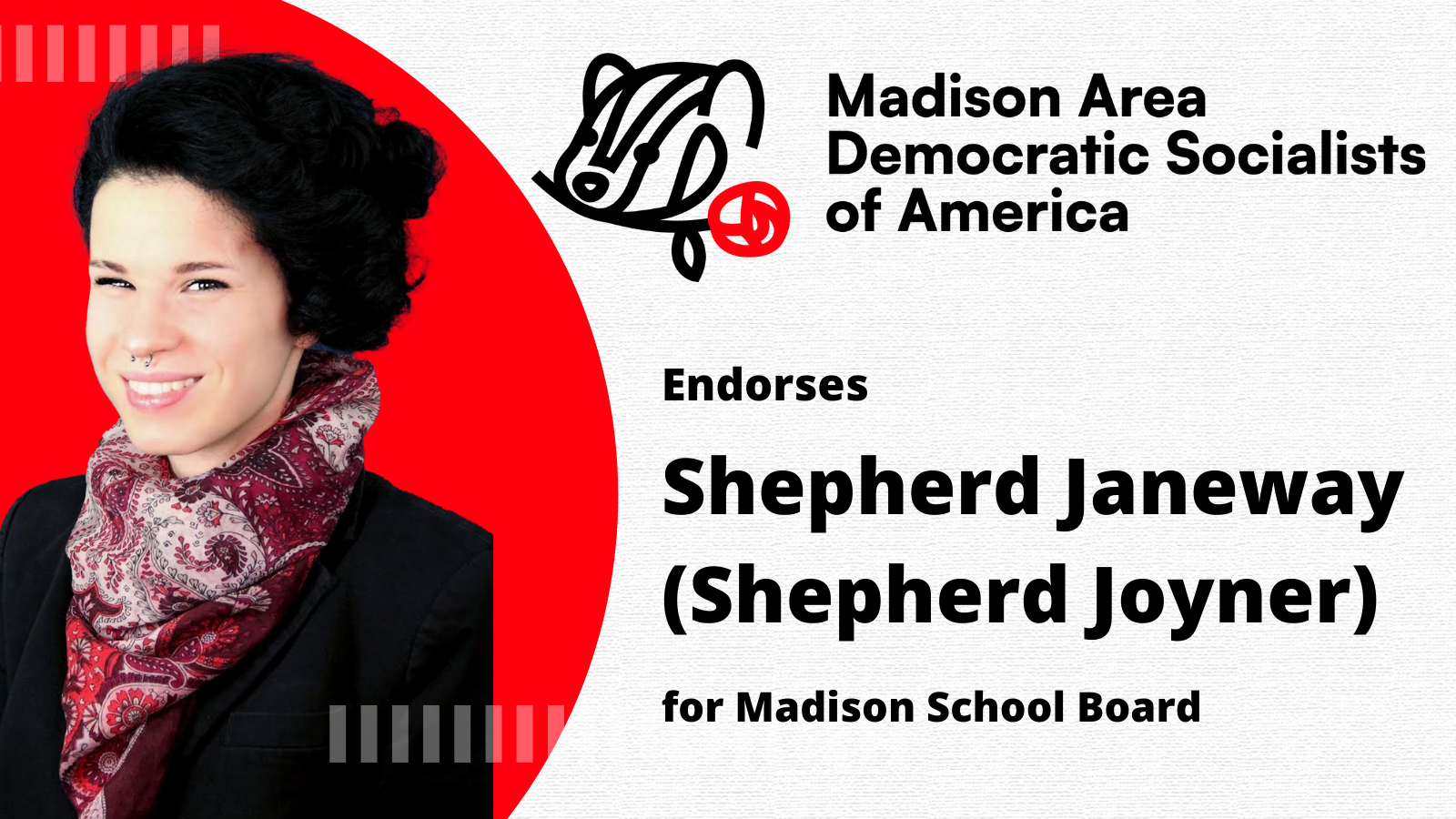
    Madison Area DSA is proud to endorse Shepherd Janeway (who will appear as Shepherd Joyner on the ballot) for seat 3 on the Madison School Board.

    Shepherd Janeway is a teaching artist with Whoopensocker, a UW-Madison program that uses creativity, expression, writing and collaboration to build self-empowered students. Through this work, Shepherd has gotten experience in Madison classrooms.

    Unlike their opponent Laura Simkin, Shepherd does not support returning School Resource Officers (SROs) to Madison’s schools. “I don’t believe in bringing school resource officers or armed law enforcement individuals into schools,” said Shepherd. “I believe that restorative justice practices and trauma-informed methods for behavior management are the way to address the root causes of the problems.” 

    “I don’t believe in bringing school resource officers or armed law enforcement individuals into schools,” said Shepherd. “I believe that restorative justice practices and trauma-informed methods for behavior management are the way to address the root causes of the problems.” 

    As someone who is Black and albino and attended public schools, Shepherd said they are familiar with the realities of racial inequality in the classroom. “We know that racial inequality contributes directly to an inequality of opportunities and resources in regards to education,” said Shepherd. As a result, students of color’s education suffers. Shepherd supports creating explicitly anti-racist policy and a clear protocol of response to racism.

    Shepherd’s other priorities are transparency, communication, staff retention, and COVID safety measures. They call for a more thoughtful and thorough approach to management of pandemic risks and better communication with parents.

    The election is on April 5. To vote early in-person from March 22-April 2, see these early voting locations. If you need to register to vote, bring proof of residence with you (although there is no voter registration on April 2, per state law).

    To vote early by mail, request an absentee ballot online by 5 pm Thursday, March 31, and return it via mail to the Clerk’s office before election day or in-person at your polling place on the day of the election.

    Here are some links to make sure you’re registered to vote (or update your address), answer questions you might have about voter ID, preview your ballot, find your polling place or request an absentee ballot.

    Follow Shepherd for School Board on Facebook

    More info: 

    Shepherd Janeway: Teacher, activist, educator

    Madison School Board candidates split on police in schools

    In Madison School Board forum, four candidates debate most pressing issues

  • Primary Season & Class in Madison

    Primary Season & Class in Madison

    by Julian Novack

    In every federal election, the Federal Election Commission (FEC) tracks donations to candidates – when an individual gives money to a candidate, it’ll ask their name, where they live, their occupation and employer. Normally this is rather mundane information, but for the 2020 Election it gives us a window into the politics of class in the Madison-area. Looking at what kinds of occupations support the Presidential candidates draws class lines and helps us to stake out what interests are being represented: normally working peoples’ interests are subsumed in the Democratic Party coalition, but with Bernie Sanders in particular there are clear poles of attraction in the 2020 Primary. We can also start to look at who Madison’s politicians are and who they support and start to ask how well they reflect those they represent.

    Voting in the United States is largely a class phenomenon: the less money you make, the less likely you are to vote. Many working-class people either expect that elections won’t change much about our lives, or we see what’s on offer and don’t vote as a protest. While there are more workers than managers, technicians or owners of capital, the low turnout among bottom earners means that a third of votes cast were by those making $100,000 or more. Income alone is only one way to look at class; most Americans have a negative net worth (we have debt) and the Top 1% sit on a hoard of wealth.

    The more formal education a person has, the more likely they are to have an investment in elections and policy. Non-voters tend to be more “liberal” than voters, though the word liberal here actually refers to working class issues (union organizing rights, public education, universal healthcare, etc.) and not attachment to the Democratic Party. In 1986, the economist John Kenneth Galbraith declared, “If everybody in this country voted, the Democrats would be in for the next 100 years,” – except that Democrats don’t offer the things most workers want either.

    Politics is always complicated, but in the crowded 2020 Democratic Primary you have the establishment candidates (Joe Biden, Pete Buttigieg, Amy Klobuchar, Kamala Harris), the “reform” candidates (Elizabeth Warren, Andrew Yang) and then Bernie Sanders, the self-proclaimed democratic socialist calling for a more dramatic change through a “political revolution” to remake politics, the economy, and the energy system. 

    In the establishment camp, Biden is the classic “back to normalcy” figure (“Nothing will fundamentally change”), representing the political establishment pre-Trump and rests heavily on his association to Barack Obama; Buttigieg and Klobuchar acknowledge some of the problems of neoliberalism but ultimately just offer a slightly updated version, with  a new sheen on market solutions – both oppose universal public healthcare, for example, but kinda like the idea; Harris attempted to take up Obama’s mantle with multi-racial elites and women. 

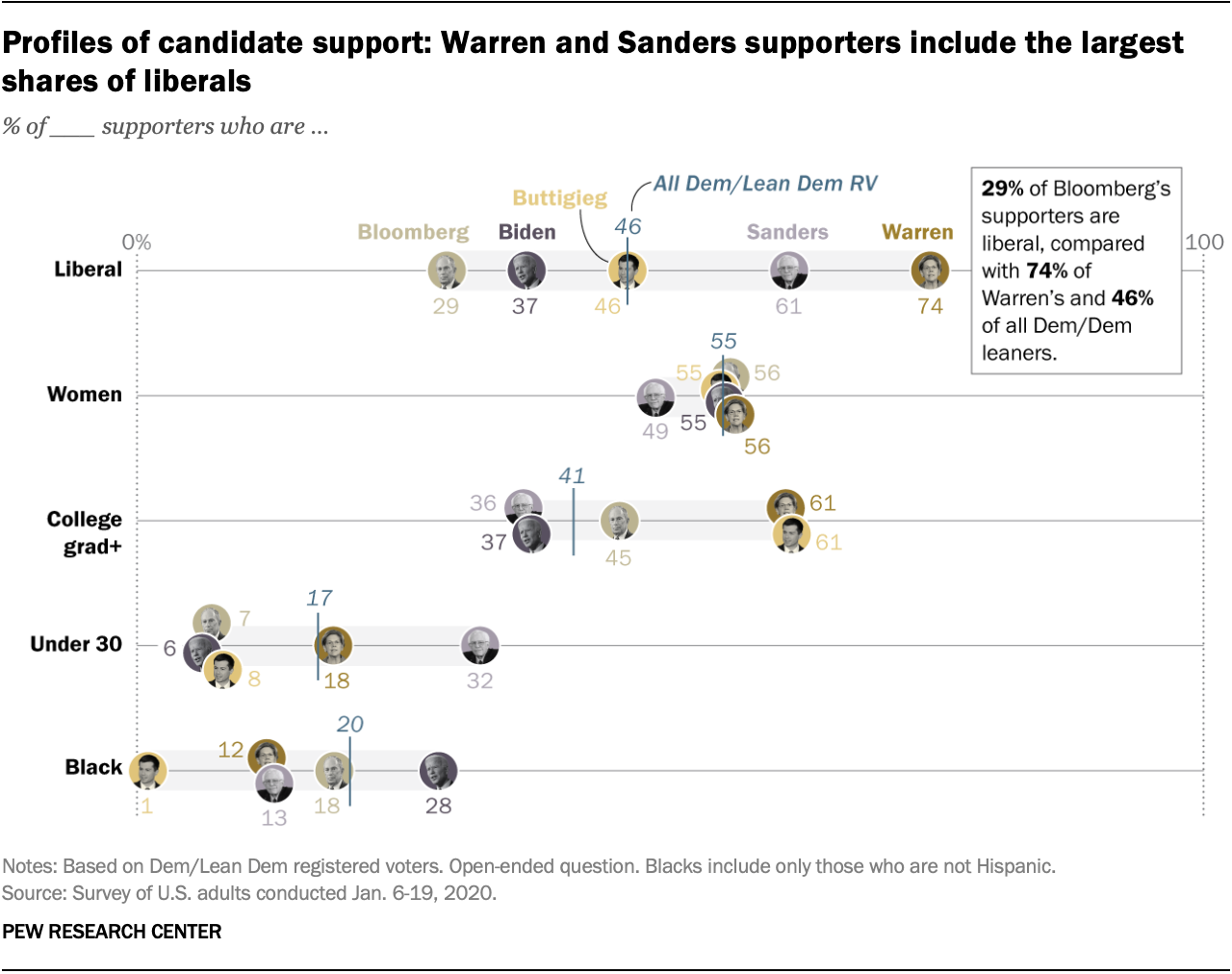
    Warren and Yang are more assertive on reforms and paint their solutions as rational policy changes; a technical fix. Deepa Kumar and Patrick Barrett write, “Warren’s strategy of change is built on the assumption that the political system is fundamentally sound and simply requires a very competent and morally decent executive with an excellent set of policy proposals and a team of smart policy makers.” Warren and Buttigieg share a base of support from highly educated voters, though they’re split with the conservative wing going for Buttigieg and liberal one for Warren. Sanders appeals most to working people, drawing heavy support from youth, Latinxs, workers making less than $55,000 a year, and workers without college degrees.

    There are also important identity representation issues: in our sexist society, many (particularly professional) women are interested in a female president and want that expressed through candidates like Kamala Harris, Elizabeth Warren, Tulsi Gabbard and Amy Klobuchar. Likewise, Andrew Yang is the first Asian American candidate for President, Sanders the first Jewish candidate, and Pete Buttigieg the first openly LGBTQ candidate. Clearly identity matters in the United States. At the same time, most candidates are maintaining the neoliberal consensus and not proposing anything altogether new – there’s no perfect alignment of identity and class, so take it with a grain of salt. At the time of this writing, nearly all of the other Democratic Presidential hopefuls who have dropped out have endorsed Joe Biden (Amy Klobuchar, Pete Buttigieg, Kamala Harris, Beto O’Rourke, Michael Bloomberg, John Delaney, Tim Ryan, and Deval Patrick). The only former candidate to have endorsed Bernie Sanders is Marianne Williamson, Oprah Winfrey’s spiritual guru. Elizabeth Warren ended her candidacy in early March but has not endorsed either Biden or Sanders.

    Profiles of candidate support: Warren and Sanders supporters include the largest shares of liberals

    Trends in Madison Area

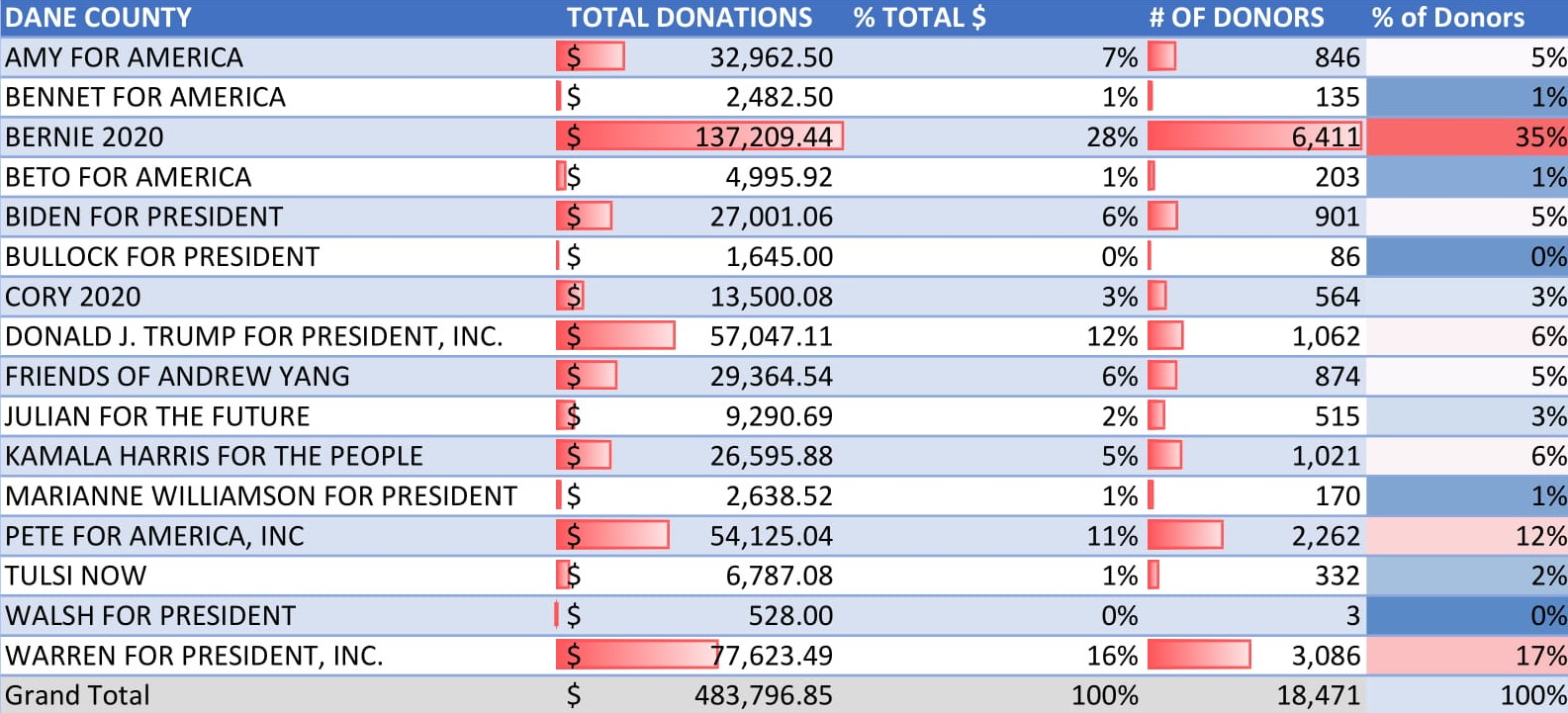
    Though voting may be anonymous (in theory), political donations are not. Pulling the data from the Federal Elections Commission (FEC), we can look at who’s donating to which candidates and political action committees (PACs) in Madison by location, employer, and occupation and start to draw conclusions from there. This gives us more precise information than looking at vote counts; no one has to donate, so if you do its affirmative and suggests you really want that candidate to move forward. I pulled the data for Madison and the surrounding towns, and for the large area employers. I’ll review the data and then offer some explanations for what it might mean.

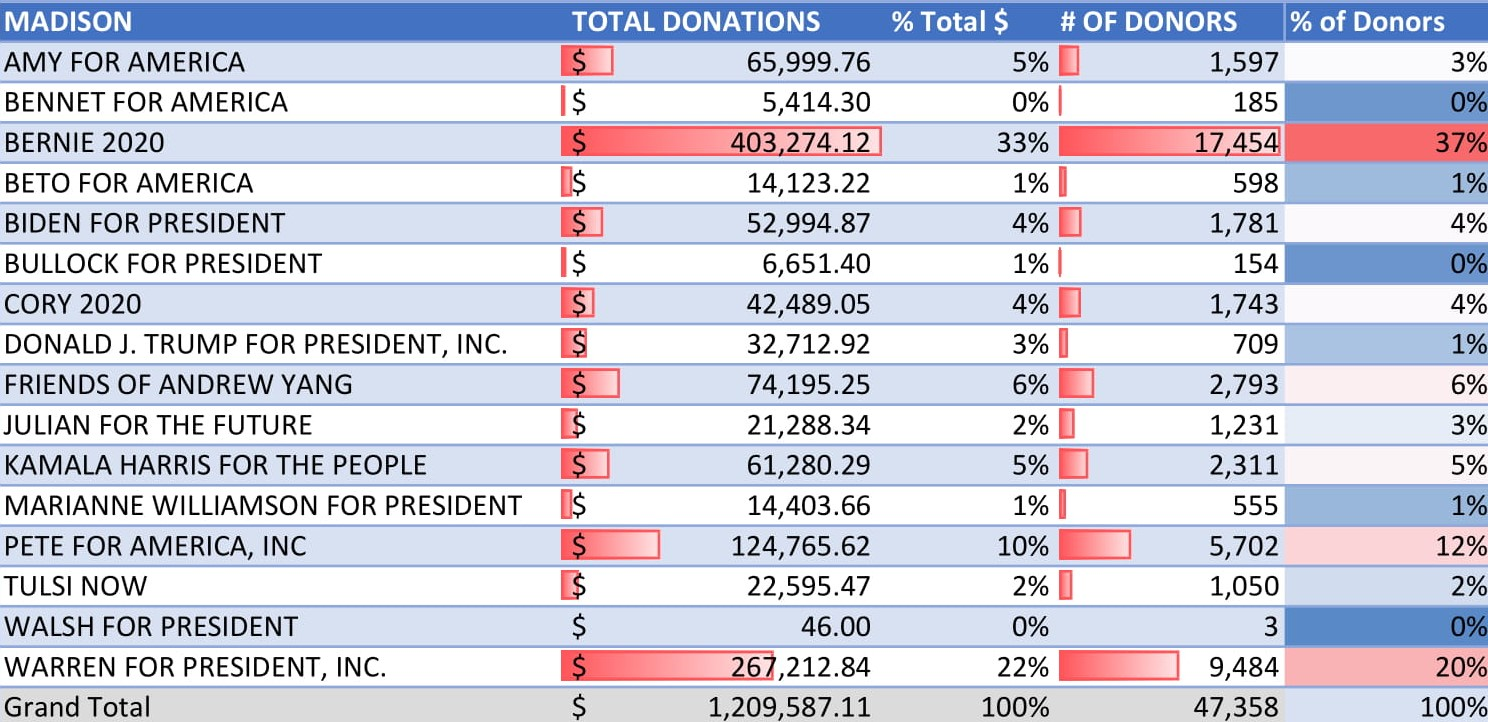
    Data for Madison, WI

    Data for Dane County cities Middleton, Monona, Verona, Stoughton, Waunakee, Cottage Grove, Fitchburg, Mount Horeb.

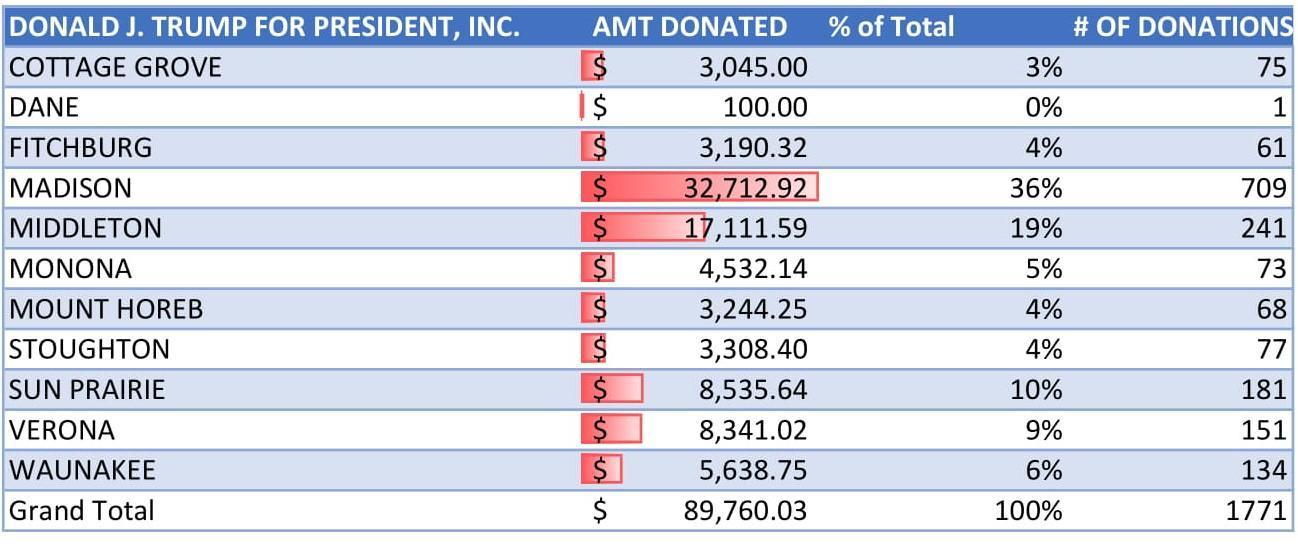
    True to its reputation, residents of Madison-proper donated twice as much money to presidential candidates as other towns in Dane County combined. Even still, Dane County and Madison have similar trends: 98% of individual donations to candidates went to Democrats in Madison versus 88% in the rest of Dane County. Sanders had the largest number of donations (37% and 35% in Madison and Dane County respectively), Warren second (20% and 17%), and Buttigieg third (12% and 12%). The major difference is that Dane County has a higher proportion of Trump donors than Madison (6% vs 1.5%), but Madison gave more than a third of all the money that went to Trump from Dane County. Madison isn’t all that different from the rest of Dane County: both Madison and the surrounding areas show the same political preferences, but people in Madison donate a shitload more money to politicians.

    Donations directly to presidential politicians through January 31st, 2020 were just shy of $1 million; money given to Political Action Committees (PACs) is more than double that at $2 million. PACs can take much more money than candidates themselves, which reveals something that we’d miss if we only look at direct contributions: rich people generally prefer to give a lot of money to action committees and political parties. In the US, the most an individual can give to any candidate is $2400, though the limits are much greater to parties and unlimited to Super PACs. Over $700,000 was given to the Democratic Party: The Democratic Party of Wisconsin and other various state Democratic Parties, the Democratic Congressional Campaign Committee (DCCC), Democratic Senatorial Campaign Committee (DSCC), Democratic National Committee (DNC). This is where big money goes: one CEO in Madison donated $10,000 to the Democratic Party of Wisconsin, an “Owner” $10,250, and a Programmer $10,000; a President of a venture capitalist firm donated $13,000 to the DNC.

    Other titles that gave $1000 or more to Democratic PACs are Administrator, Consultant, Attorney, Physician, Business Owner, Executive, Statistician, Chief Marketing Officer, Marketing Executive, Politician, President, Professor, Programmer, Psychologist, Contractor, Surgeon, Manager, Retiree. These are who you might call the real base of the “Democratic Party establishment”. Democrats also have many “feeder” groups, PACs that support specific types of candidates in the Democratic Party: Emily’s List promotes female Democrats running for office; 314 Action promotes science; House Majority gives out money to “win back congress”, It Starts Today gives money out to Democrats running for Congress,  MoveOn.org, etc. – these took in hundreds of thousands of dollars.

    Donations to The Republican Party are also significant. Out of $176,000 given, $58,000 went to the Republican Party of Wisconsin, $54,000 to the Republican National Committee, $32,000 to the National Republican Senatorial Committee; and $28,000 to the National Republican Congressional Committee. Who donates? “Business Owner” $5000; President $10,000; Founder $3000; CEO $2500; Engineer $2000; Sales $1000; Retiree $2400. Other notables: Chief Financial Officer; Consultant; Debt Collector; Attorney; Sales; Insurance. (Notice any similarities to Democrats?)

    Political Support by Occupation

    The data shows us that each candidate has a base that is commonly defined by occupation. Bernie Sanders has by far the most donors with over a thousand job titles listed. The most frequent donors to Sanders are Teachers, Nurses & Medical Workers, Students, Hospitality Workers (Bartenders, Waitstaff, Cooks, Baristas), Warehouse workers, Drivers, and Office Clerks. This contrasts with more traditional top supporters for Joe Biden (Attorney, Retiree, Sales, Physician), Warren (Project Manager, Professor, Retiree, Software Engineer) and Buttigieg (Manager, Attorney, Teacher, Professor, Engineer). Every candidate shows some support across class lines (Biden has some Clerks and Blue-collar Workers, for example, but they’re a minority). 

    If workers aren’t monoliths, how do some common job titles align politically? 

    • More than half of CEO’s donated to Trump, followed by Buttigieg (14%)
    • Lawyers donate to everyone, with Warren first (19%) and Sanders (15%), followed by Biden (13%) and Trump (12%)
    • Two-thirds of Clerical/White collar workers gave to Sanders and then Warren (14%)
    • Police give exclusively to neoliberal candidates (Buttigieg and Biden); State Troopers to Trump
    • Accountants: Trump and Sanders are the top recipients – Accountants seem to understand, “Tax law is class war”
    • Graduate Workers donated overwhelmingly to Sanders (75%) followed by Warren (14%).
    • Nurse donations were primarily to Sanders (37%), Warren (25%) and then Buttigieg (18%)
    • Teachers went for Sanders (42%), Warren (19%) and Buttigieg (10%).
    • Marianne Williamson’s top supporters were Artist, Feng Shui Master, Marketing Coordinator, Sales and Therapist. (The orbs have spoken.)

    Blue collar workers (Mechanics, Tradespeople, Factory workers, Drivers, Cleaners, Agricultural workers, etc.) are typically considered to be the “conservative white working class.” In Dane County, Bernie Sanders collected half of all donations from blue collar workers followed by Trump (13%), Yang (12%) and Warren (10%). For the rest of the centrist candidates, only Pete Buttigieg and Kamala Harris received over $100 in total donations from blue collar workers. That’s completely different from the standard narrative of the enlightened, educated liberals and conservative manual laborers – at least as far as donations go. Of all donations to Trump, blue collar workers contributed less than 3% (nearly all from the skilled trades), retirees gave close to half, and real estate, business owners and capital managers most of the rest. 

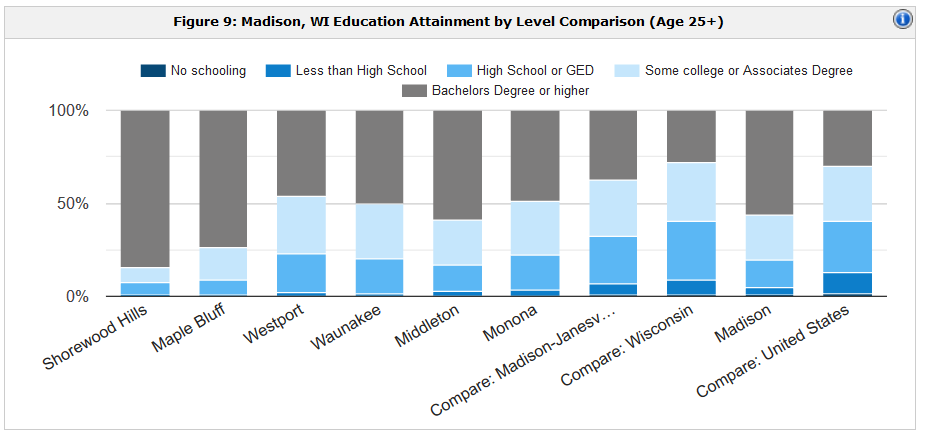
    What this shows is that there is a very real class dimension to the voters and their perceptions of the candidates. The broad and lower section of the working class goes overwhelmingly for Sanders in small amounts (median donation is only $15), while the more educated technicians go for Warren and Buttigieg; Biden’s most frequent donors are from the more historic political class of doctors, lawyers, system administrators, top business management and salespeople.Madison has a larger share of Warren supporters than the rest of the US as a whole, which makes sense since she appeals to highly educated liberals and offers a softer “structural change” than Sanders. More than 50% of Madison residents hold bachelor’s degrees, and 24% have masters degrees or higher. Those with postsecondary degrees are more likely to regard institutions in society as legitimate (because they’re trained that way) and to look for adjustments and technical solutions rather than social ones.

    This election is a unique opportunity to see how different classes express their interests (workers overwhelmingly for Sanders; technicians for Warren and Buttigieg, elites for Biden; Buttigieg and Trump), it shows the divisions among sections of the working class (white collar vs blue collar, skilled vs unskilled, etc.), and between workers: half of teachers and nurses are for Sanders, the other half are for technocratic candidates like Warren and Buttigieg.

    There are some important limits to these numbers. First, most people don’t donate to electoral campaigns. That means we have to be careful about saying this data represents the electorate (people who vote), and more importantly the general population (including the 50% of people, mostly workers, who don’t vote or are ineligible). But the proportions match up fairly well with the Democratic Primaries thus far: Sanders won between 20-50% in the primaries through Super Tuesday (median 26.5%), and in Madison he’s raised 32% of all political dollars.

    Second, many people who donate don’t want to give out information, so they report as “not employed”, “none of your business”, “n/a” and other creative middle-finger responses (I didn’t attribute these to any type of occupation). Third, this can’t tell us much about race or gender without some serious extrapolation. So, we should take this data as one useful element but understand that it’s a sample of voters who are skewed along class lines — overrepresented in the educated, administrators, technicians and elites, and underrepresented among most workers.

    Local Politicians & Bureaucrats

    If candidates express class interests, where do our local politicians align? Its no secret that real estate and tech companies drive much of the city’s policy, but who do our politicians support?

    County Supervisor donations

    Mayor Satya Rhodes-Conway donated to every neoliberal identity candidate (Klobuchar, Booker, Castro, Harris, and Warren), but gave most to Pete Buttigieg, the only LGBTQ candidate in the race and a personal contact of hers through the Mayors Innovation Project; Rhodes-Conway likewise campaigned for mayor as an LGBTQ candidate who wanted to address race disparity in Madison. Most city alders didn’t donate to a political candidate, save for Arvina Martin, who gave small amounts to Gillibrand, Harris and Warren, and Sally Rohrer, graduate student in public policy, who donated to Warren. Half of the twenty (20) city alders gave to the Wisconsin Democratic Party; the other half gave no political donations at all. 

    Greg Leifer, City of Madison Human Resources Labor Specialist, who sits opposite the City’s unions and is also negotiating for Willy Street Co-op against its workers’ union, donated solely to Joe Biden. That follows the pattern of union busters who support Biden.

    Trends at the County are similar: most County Supervisors gave to multiple candidates, primarily neoliberals. The only local politician to have given any money to Bernie Sanders was Heidi Wegleitner.

    This confirms most of what we knew about local politicians: the priorities are primarily identitarian neoliberalism, with some minor support for reform. The political preferences of seated politicians hardly represent what we see from the data above where there’s a plurality for Sanders, and large support for other reformers like Warren and Yang. In 2016 when Sanders won Wisconsin, most local politicians were astonished. Why? Because they’re a distinct political class managing local government on behalf of capital and they hardly represent the desires of people they govern.

    A party in waiting?

    Bernie Sanders did a lot of things for American politics since 2016, but one of the most significant is financing a Presidential campaign without any corporate dollars and maintaining his political platform without compromise. Those two things together have rallied millions of people who, as we can see from the above data , are not the traditional political actors of professionals, managers and elites.

    For Madison, Dane County and the State of Wisconsin, we can see that class politics are expressed much more clearly than during a regular election and that these interests are far and away not represented by politicians – not just at the State level with Republicans, but among Democrats locally who are tied to establishment politics and neoliberal capitalism.

    This also suggests another possibility: the potential for a party in waiting. Rather than accepting that local politics be dominated by the regular class of politicians we’ve had for decades, we can see that there’s an audience eager for an alternative if/when we can present them credibly: service workers, teachers, nurses, office clerks, university workers, drivers, warehouse pickers and receivers, and so forth. If we center the working class and oppressed as agents of change with a program to fight to better the lives of working people, fight racism, fight for a just ecological transition, we can already create a list of supporters from this election. The state is of course set up to keep the political structure as is, and we can’t expect that we’ll vote our way to socialism, but there is room to contest and organize for a different set of politics.