This article is written by a DSA member and does not formally represent the views of MADSA as a whole or its subgroups.
Welcome to Vol. 8 of the monthly round-up! The content in this publication overlaps significantly with our DSA newsletter and monthly General Membership Meetings. To sign up for the newsletter or check out an upcoming General Membership Meeting, visit: https://madison-dsa.org/events/
MADSA Annual Convention a Success
The chapter held our annual convention on the evening of Friday March 20th and the full day of Saturday, March 21st. MADSA members elected new leadership for the coming year, voted to continue many working groups, and debated and passed resolutions that will shape how the chapter does its work this year and beyond. Below are 3 key themes from this year’s convention.
1. Organizing Everyday People, Especially Labor
This convention passed several exciting proposals around mobilizing everyday worker power. One was a major resolution setting clear goals around a “rank and file” worker organizing strategy. In short, key goals include: increasing organizing discussions in people’s unionized and non-unionized workplaces; taking specific actions to help existing unions become more active and socialist; taking steps towards a mass labor action on May 1, and building further potential for mass labor actions; and leveraging MADSA’s worker power for building new unions, pulling existing union members towards socialism, and building coalitions within and between unions. The resolution emphasizes a move away from convincing formal labor leadership, and towards supporting rank-and-file workers in taking concrete steps for socialist organizing in their specific context.
The convention also ratified a Community Defense Working Group, which will be taking the main role in guiding MADSA’s STRIKE ICE OUT actions. The group will emphasize community education, non-violent neighborhood mobilizing, mutual aid, and strike preparation. Specific goals for the working group include providing materials and trainings, doing administrative tasks for maintaining neighborhood group chats across the city, encouraging in-person meetings between neighbors, disseminating information from other reliable sources (Voces, MTI, and Comite Sin Fronteras), supporting tenant organizing, and helping build towards a May 1st major labor action / general strike.
2. Electoral Work
Members voted to continue the Program Working Group, which is developing a formal platform with the key viewpoints and priorities of MADSA as a chapter. This work will be helpful in guiding MADSA’s collaboration with political candidates, and when deciding how to prioritize projects in the face of unprecedented growth in membership.
Members also passed a resolution to build DSA’s capacity as an independent political party. The resolution included a continuation of this past year’s electoral work, while also adding features like additional political education in the “off-season,” and collaboration with the Labor Working Group around research and explicit support of policy that improves labor rights.
Lastly, members passed a resolution reaffirming the chapter’s commitment to Palestinian liberation and anti-Zionism. This resolution mandates that any program, platform, and/or candidates endorsed by MADSA “must support the Boycott, Divestment, and Sanctions (BDS) movement, refrain from any and all affiliation with the Israeli government or Zionist lobby groups, pledge to oppose legislation that harms Palestinians and support legislation that supports Palestinian liberation.”
3. Improving Chapter Functions
Lastly, several convention items focused on improving the running of our chapter. A spirited discussion took place around the accessibility of meetings. One particular area of concern has been disability access, including – but not limited to – variable masking requirements at different meetings. Another topic was improving support for working parents within the chapter, who face additional barriers to participating in regular meetings. On Saturday, members discussed a proposal and an amendment around accessibility issues, and they ultimately decided to table the final vote until the April general membership meeting.
Several resolutions did pass related to the running of the chapter, including:
Changes to certain chapter rules and processes, including standing meeting rules;
Creating a cohort model for welcoming and onboarding new members to the chapter;
Creating some editorial practices and increased structure for Red Madison, to improve responsiveness and to foster more participation in the publication.
A resolution around creating a process for formal coalition-building with external groups did not pass, after significant discussion and debate.
MADSA Attends “No Kings”
Members of the chapter recently attended the No Kings protest on March 28th, with the goal of being a visible socialist presence, handing out materials, and talking to interested crowd members about action steps for being politically engaged and effective. In preparation for the march, MADSA had organizing meetings, an art build on 3/27, and a crowd canvassing training emphasizing “NO ICE, NO WAR, NO BILLIONAIRES!”
Several MADSA members gave speeches at the protest! You can see them here, and shorter clips will be posted on Instagram in the coming week.
ICE Out Efforts Continue
MADSA continues to coordinate information about trainings and events, and neighborhood group chats, via the Strike Out ICE hub. Check it out here, and keep your eyes out for the newsletter in your inbox!
A major next step in the process is the Madison Worker’s Assembly on April 4th. This is an opportunity for the community to come together and reflect on goals and strategies for mass labor action.
Additional Organizing
Other important efforts this month included the following:
Labor Working Group hosted a Strike Studies event on 3/2; the next one is on April 6th.
MADSA hosted a panel discussion titled Against Empire: A Socialist Conversation on Imperialism on 3/26 – a topic that is especially relevant given current events.
MADSA held an Affordable Housing Panel, featuring local organizers and elected officials on 3/27 – video here!
The Program Working Group had an event on one of the planks in MADSA’s developing platform – public transit! This took place on 3/31.
There was a one-off reading group on 3/23 focusing on two short texts by Alexandra Kollontai, focusing on the intersection of Marxism and feminism.
And coming soon:
MADSA is starting to prepare for another Queer Liberation March, with a meeting planned for 4/4.
DSA made plans to attend the upcoming May Day Strong Solidarity School, preparing for a May 1st day of mass labor action / general strike – this is scheduled for April 11th.
Social Events
We continue hosting recurring social events – DSA 101, Coffee with Comrades, and the Rosebuddies program. MADSA Run Club is making a return on Sundays as the weather warms up!
Protest Song of the Month
For this month’s song, have a 1913 tune by Joe Hill, We Will Sing One Song.
This article is written by a DSA member and does not formally represent the views of MADSA as a whole or its subgroups.
Welcome to Vol. 7 of the monthly round-up! The content in this publication overlaps significantly with our DSA newsletter and monthly General Membership Meetings. To sign up for the newsletter or check out an upcoming General Membership Meeting, visit: https://madison-dsa.org/events/
ICE Out Hub / Strike Out ICE!
MADSA has launched a centralized resource for community defense and related organizing in Madison. Members in the February GMM debriefed about MADSA’s ICE-related efforts so far, and approved a proposal for Strike Out ICE!
MADSA’s goals are to support other groups already doing this work – especially Voces de la Frontera – while also developing networks of mutual aid, supporting MADSA members in becoming active organizers, and building towards a national general strike on May 1st. What is most exciting to this author is that the strike plan is a movement backed by real strategy and community ties, not just a random internet call to action. The chapter is working on political education, building community bonds, spreading the word among coworkers and friends, and coordinating with other organizations, including unions. The strike could be a historic step in taking back the people’s power across the nation and in turning the tides of politics in the United States, if people embrace the spirit of making real, concrete demands, and shutting down the economy to ensure they are met.
You can check out the hub here: https://madison-dsa.org/ice-out-hub/ The hub also contains weekly strike reports, and members will receive these reports in their email inboxes as a newsletter.
I encourage all members to take action today, whether that’s joining a neighborhood group chat, attending an educational meeting about strike history or organizing skills, being trained as a legal observer, or talking to people in your life about the strike. And remember – millions of people participating imperfectly will always outweigh a few dozen participating perfectly. Embrace uncertainty and imperfection as a normal part of your political process!
MADSA Endorses Heidi Wegleitner for Re-Election
Members voted in the February meeting to endorse Heidi’s re-election campaign for Dane County Board. Heidi has served as a delegate to the South Central Federation of Labor, is in a leadership role with the United Legal Workers union in Madison, and has a long history of fighting for housing rights. She will be running in District 2, which includes most of the Isthmus north of E. Washington Avenue, including neighborhoods around James Madison Park, Tenney Park, and Demetral Park. Elections will take place on April 7th, 2026.
Additional Organizing
Other important efforts this month included the following:
No Appetite for Apartheid held a launch party, and is now regularly hosting Grocery Scouting with DSA. At these 1 hour events, you can meet a MADSA member at a specific grocery store and learn how to spot products for boycotting, and how to build your voice for pressuring stores to stop carrying companies that are complicit in the subjugation of Palestinian people.
Phil Gasper held a talk on Trotsky’s Marxism at the Madison Public Library.
Southern Dane County Branch successfully had its own membership meeting.
There is now a working group meeting regularly about Fran Hong’s campaign.
A temporary working group is aiming to establish a physical office for MADSA to help with our growing size and work load.
Some chapter members have been seeking to grow community ties through art and music, and are building towards a community art build in March, as well as fostering a stronger chanting and music presence at protests.
Social Events
We continue hosting recurring social events – New Member Orientations, DSA 101, Coffee with Comrades, and the Rosebuddies program. A highlight from February was a special Galentine’s day event on February 13th!
The chapter also has a newly-started reading group for The Communist Manifesto, meeting on Saturdays at 10am.
Protest Song of the Month
MADSA members highlighted a few songs this month as part of the budding art and music efforts in the chapter. A recent feature was a modernized version of The Internationale, with lyrics updated in 2020 by Billy Bragg. Check it out here – song starts at 3 minutes in!
This article is written by a DSA member and does not formally represent the views of MADSA as a whole or its subgroups.
Welcome to Vol. 5 of the monthly round-up! The content in this publication overlaps significantly with our DSA newsletter and monthly General Membership Meetings. To sign up for the newsletter or check out an upcoming General Membership Meeting, visit: https://madison-dsa.org/events/
MADSA Adds a New Branch
The chapter reported at our December General Membership Meeting that MADSA has nearly doubled in size since October 2024 – from 368 members then, to 643 members now! In last month’s round-up, I shared a bit about how this growth is impacting the internal policies and structure of our organization. This month, I’m pleased to share another example of structural changes, as our chapter voted to add a new branch – the Southern Dane County Branch!
This branch will still be a part of MADSA, but will have the power to host their own meetings and to coordinate local efforts to support the chapter’s goals. They will host regular meetings around Fitchburg/Verona to increase accessibility for current MADSA members and potential new joiners. They plan to work with MADSA’s existing committees and working groups, while also acting as an organizing hub for people who live in more suburban and rural parts of Southern Dane County, with a strong emphasis on electoral, organizing, and educational initiatives.
Our Electoral Work is Expanding
The nation has witnessed an increase in candidates running openly as socialists – often very successfully! With this development, we’ve seen more and more candidates on the local level. To meet the evolving political landscape, MADSA’s Electoral Working Group has updated our candidate endorsement process and published corresponding materials. The WG has added an endorsement deadline for 2026 elections, clarified the number of signatures required on endorsement petitions, and clarified interview questions for candidates. They also developed a sample questionnaire to demonstrate what types of answers candidates will need to provide during the process.
MADSA Endorses Candidate Bobby Gronert
The first candidate endorsed with this updated process is Bobby Gronert running for Common Council District 8! Bobby is a UW-Madison student and a member of the university’s YDSA chapter. His student-led campaign aims to work on affordable housing issues, tenants’ rights, and challenging fascism via local policies. Bobby was successfully endorsed by MADSA on December 13th, and the endorsement resolution included a pledge of 20-80 hours per month of volunteer support from the December date through election day, April 7, 2026. Bobby’s campaign is exciting news for the city of Madison, and it means new ties developing between UW’s YDSA and our MADSA chapter.
The chapter expects to work on endorsement considerations for the following candidates this season:
Heidi Wegleitner, re-running for County Board District 2, and re-applying for MADSA endorsement;
Juliana Bennett and Zoe Sullivan running for State Assembly District 76;
Francesca Hong running for Wisconsin governor.
New Working Group Chartered: Platform/Program Development
Lastly in this area, members at the December GMM approved a new working group dedicated to developing a clear platform for our chapter. The goal of the working group, slated to last 4 months, is to create a “comprehensive chapter program and/or platform” based on research and discussions with chapter members and with the broader Madison community. This will provide a more solid basis for organizing work, deciding on political endorsements, developing and supporting leadership in the chapter, and more.
Additional Organizing
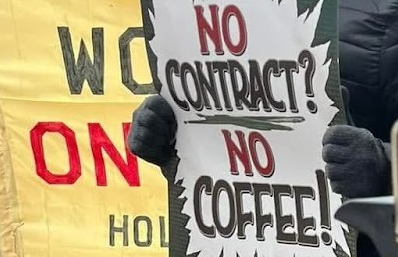
Some chapter members have been supporting the Starbucks union strike in November and December. Members signed up for picketing shifts and showed out with signs and warm coffee in the cold winter weather.
Boycott all Starbucks locations and products while the workers are striking; talk to people around you about joining the boycott – check out and sign the “No Contract, No Coffee” pledge;
Turn people away from non-striking / non-union Starbucks locations in the area;
Show up to the picket line and participate;
Bring treats (especially hot drinks) to the picket line for morale!
MADSA also hosted some talks and discussions this month, including:
A members-only debate on electoralism – what is the extent to which socialists should be engaging in electoral politics within our current capitalist system? What are the costs and benefits around the increase in electoral work this year?
Hosting a guest speaker from Brazil’s PSOL, who gave a talk on internationalism and resisting fascism;
Strategy discussion on supporting immigrants’ safety in Madison;
Check-in discussion on MADSA’s coalition work around housing issues and the Homeless Justice Initiative;
Planning around the 2026 Chapter Convention;
Internal debate on several bylaws as the chapter continues to grow.
We continue hosting recurring social events, including New Member Orientations, DSA 101, Coffee with Comrades, and the Rosebuddies program. Comrades also rang in the new year with a members-only New Year’s Eve party.
Protest Song of the Month
For a December protest song, I share The Homeless Wassail. Wassailing is an old English tradition of Pagan/non-Christian origin that now takes place during the countdown to Christmas. It originally involved the blessing of fruit-producing trees – especially in apple orchards – by singing, drinking, and making merriment. It changed over time to include house-visiting, and eventually the Christmas caroling we know today. The linked song highlights the deep pain, inequity, and injustice that continue in our communities.
by Madison Area DSA’s Electoral Politics Working Group
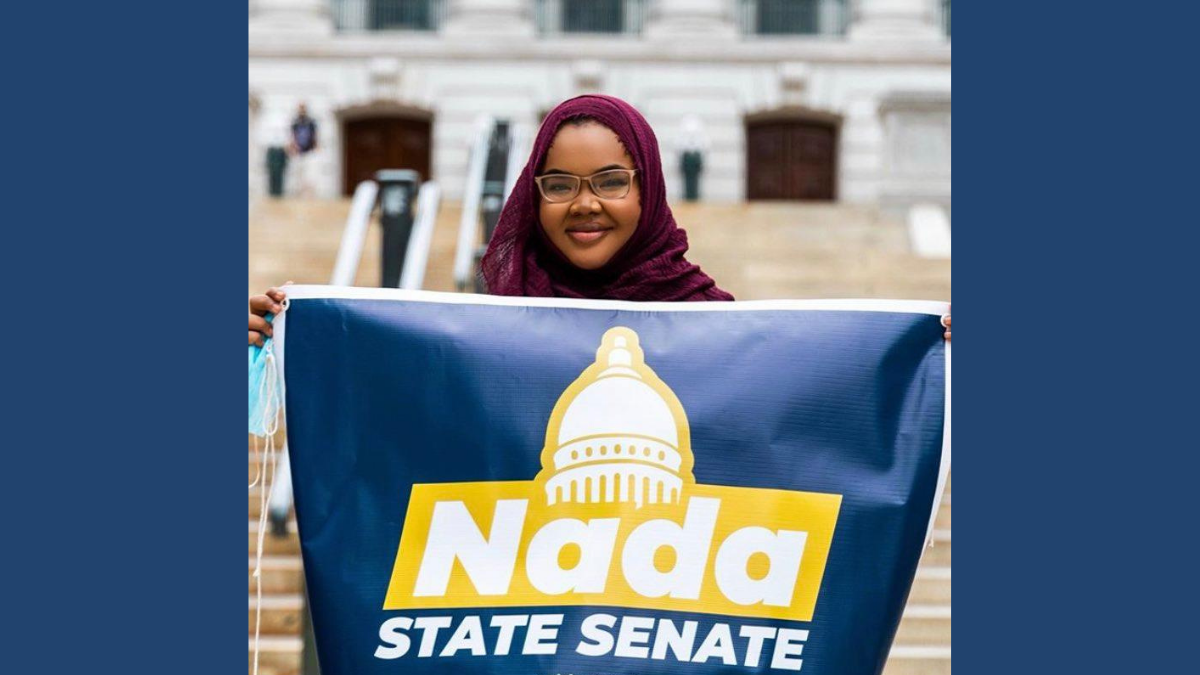
In just her first candidacy for public office, Nada Elmikashfi exposed all the ways in which politics as usual in Madison was never good enough. In her run for State Senate, she shook up a status quo that has held for far too long. Even if you put Fred Risser’s unbearably long tenure aside, it’s rare for any incumbent in Madison to face a challenge. That such a challenge came from a young Muslim immigrant working class woman of color with extremely good politics brought much needed new perspective, and a glimmer of hope into a city whose politics are often very myopic. She did this in lots of ways that are worth exploring, one of which is how she stood outside the business as usual of Madison progressive politics.
Most Madison campaigns fit inside extremely narrow ideological and temperamental bounds. Vague, polite, non-confrontational progressivism is the name of the game. Candidates do their best to exude the energy of that box-checking, post-2016 yard sign: “In this campaign we believe science is real, love is love, black lives matter, etc. etc.” The Madison Candidate wants you to know they’re on the right side of the issues, but they would prefer not to quarrel over them. No doubt some Madisonians would like to think that this is because there is broad political agreement within the city. Or perhaps, if there is disagreement it’s better for everyone to “take the high road,” because we’re all in this together aren’t we? But there are winners and losers in all politics. If no one is fighting it’s because someone has already won.
But there are winners and losers in all politics. If no one is fighting it’s because someone has already won.
When we can only conceive of politics as a polite affair where candidates not only can, but must elide their differences due to some notion that everyone wants what’s best, we lose sight of the fact that lives and livelihoods hang in the balance. In politics, there are real, material conflicts of interest that are going to be sorted out one way or another. Housing cannot become more affordable without hurting landlords’ bottom line. Lake levels can’t be lowered to stave off flooding without affecting the value of lakefront property. Racial justice cannot be achieved without hurting the profits of the prison industrial complex. If a candidate is a meaningful threat to those interests, powerful forces are going to fight back with everything they’ve got. If that fight does not manifest in the campaign, if everyone campaigning is on the same side, then it is pretty clear whose side that is.
Nada brought these conflicts to light by speaking honestly about what is happening politically in Wisconsin. She called out Kelda Roys for owning a real estate company and (through a combination of personal loans to her campaign and big dollar donations) essentially buying her way into the State Senate. She swiftly denounced a bill co-authored by a Democratic State Senator that would have been used to criminalize Black people. There are some who might dismiss this as unnecessarily antagonistic, but the antagonisms are present whether they are acknowledged or not. The ways in which established politicians reacted to Nada make this clear. Roys, despite declaring her candidacy months after Nada and others, claimed to be the only person running for Risser’s seat. Former Mayor Dave Cieslewicz wrote an entire blog post dedicated to calling Nada unserious. Tim Carpenter responded to Nada’s criticism by harassing her online to the point that he was reprimanded by the State Senate Minority leader. These antagonisms came out not just because of the policies that Nada stood for, but because of who she is.
Much of these reactions were based on racism, sexism, age-ism, anti-immigrant and anti-Muslim sentiment. A Madison born white male candidate with the exact same policies, levying the exact same criticisms would not have faced the same blowback. In this way, Nada’s identity cannot be extricated from her politics. There are meaningful political differences between a white man calling for racial justice and a Black woman doing the same and the differing reaction speaks to that.
Through being serious about the issues, honest about how our system works and just plain being herself, Nada put the Madison political establishment extremely off balance.
In addition to how politicians and pundits react to each other, identity shapes the ,way candidates react to events outside of their control as well. Kelda Roys, during the height of the George Floyd protests, was put in the absurd position of trying to make the case that she (as opposed to any of the numerous candidates of color running for the seat) would be the one to deliver on racial justice. Politics is above all about trust and credibility. Particularly in the absence of an established, cohesive political movement, identity plays a huge role in who has it and who doesn’t.
Through being serious about the issues, honest about how our system works and just plain being herself, Nada put the Madison political establishment extremely off balance. Even though she didn’t win her campaign, she’s already left an indelible mark on the city. Nada brought the politics back into Madison politics. Hopefully it is here to stay.
Members of Madison Area DSA formed the Electoral Politics Working Group to advance democratic socialism through local political bodies, including elected offices.To learn more about the efforts of the working group and to find out when they meet and how to get involved, visit our chapter website.
In every federal election, the Federal Election Commission (FEC) tracks donations to candidates – when an individual gives money to a candidate, it’ll ask their name, where they live, their occupation and employer. Normally this is rather mundane information, but for the 2020 Election it gives us a window into the politics of class in the Madison-area. Looking at what kinds of occupations support the Presidential candidates draws class lines and helps us to stake out what interests are being represented: normally working peoples’ interests are subsumed in the Democratic Party coalition, but with Bernie Sanders in particular there are clear poles of attraction in the 2020 Primary. We can also start to look at who Madison’s politicians are and who they support and start to ask how well they reflect those they represent.
Voting in the United States is largely a class phenomenon: the less money you make, the less likely you are to vote. Many working-class people either expect that elections won’t change much about our lives, or we see what’s on offer and don’t vote as a protest. While there are more workers than managers, technicians or owners of capital, the low turnout among bottom earners means that a third of votes cast were by those making $100,000 or more. Income alone is only one way to look at class; most Americans have a negative net worth (we have debt) and the Top 1% sit on a hoard of wealth.
The more formal education a person has, the more likely they are to have an investment in elections and policy. Non-voters tend to be more “liberal” than voters, though the word liberal here actually refers to working class issues (union organizing rights, public education, universal healthcare, etc.) and not attachment to the Democratic Party. In 1986, the economist John Kenneth Galbraith declared, “If everybody in this country voted, the Democrats would be in for the next 100 years,” – except that Democrats don’t offer the things most workers want either.
Politics is always complicated, but in the crowded 2020 Democratic Primary you have the establishment candidates (Joe Biden, Pete Buttigieg, Amy Klobuchar, Kamala Harris), the “reform” candidates (Elizabeth Warren, Andrew Yang) and then Bernie Sanders, the self-proclaimed democratic socialist calling for a more dramatic change through a “political revolution” to remake politics, the economy, and the energy system.
In the establishment camp, Biden is the classic “back to normalcy” figure (“Nothing will fundamentally change”), representing the political establishment pre-Trump and rests heavily on his association to Barack Obama; Buttigieg and Klobuchar acknowledge some of the problems of neoliberalism but ultimately just offer a slightly updated version, with a new sheen on market solutions – both oppose universal public healthcare, for example, but kinda like the idea; Harris attempted to take up Obama’s mantle with multi-racial elites and women.
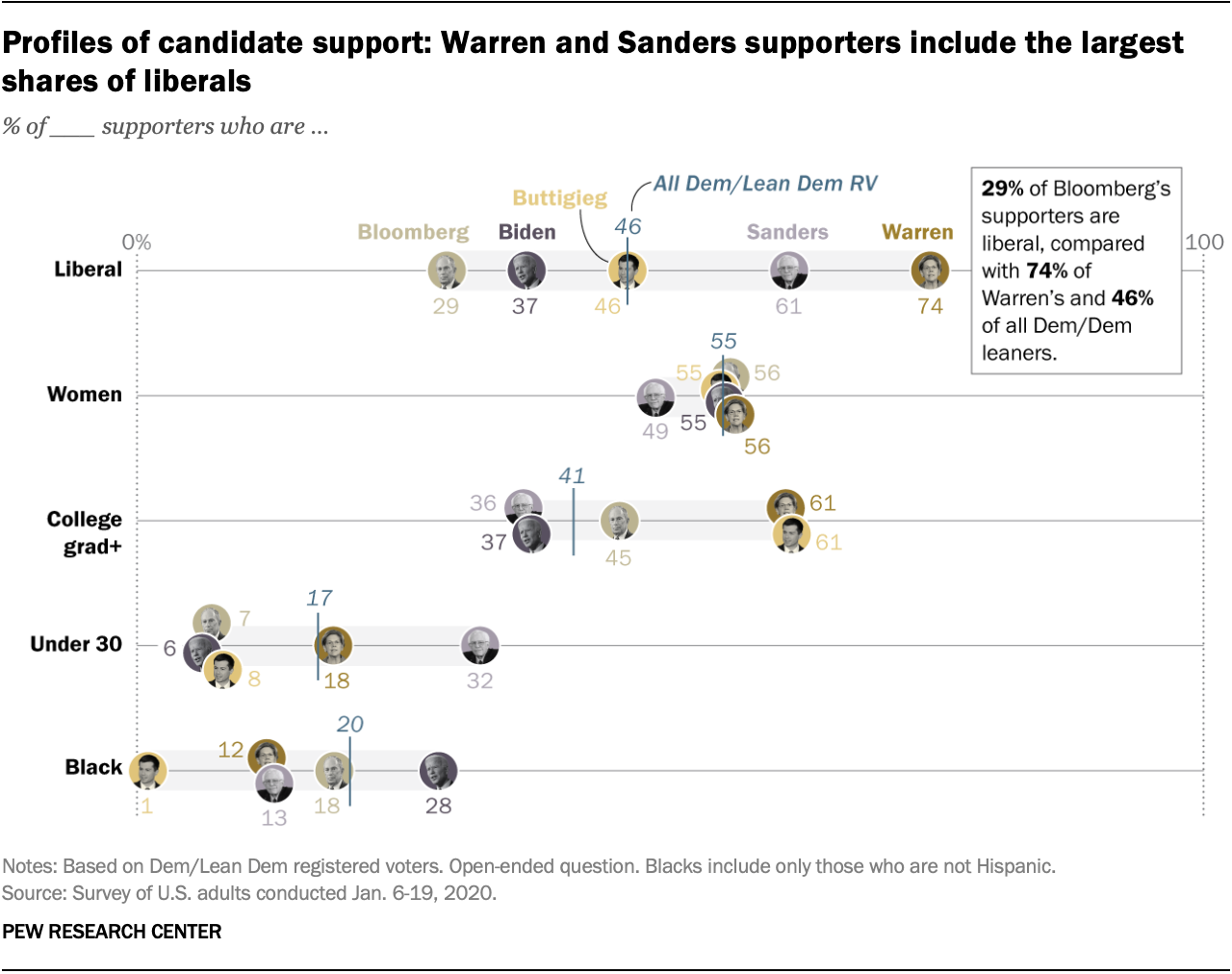
Warren and Yang are more assertive on reforms and paint their solutions as rational policy changes; a technical fix. Deepa Kumar and Patrick Barrett write, “Warren’s strategy of change is built on the assumption that the political system is fundamentally sound and simply requires a very competent and morally decent executive with an excellent set of policy proposals and a team of smart policy makers.” Warren and Buttigieg share a base of support from highly educated voters, though they’re split with the conservative wing going for Buttigieg and liberal one for Warren. Sanders appeals most to working people, drawing heavy support from youth, Latinxs, workers making less than $55,000 a year, and workers without college degrees.
There are also important identity representation issues: in our sexist society, many (particularly professional) women are interested in a female president and want that expressed through candidates like Kamala Harris, Elizabeth Warren, Tulsi Gabbard and Amy Klobuchar. Likewise, Andrew Yang is the first Asian American candidate for President, Sanders the first Jewish candidate, and Pete Buttigieg the first openly LGBTQ candidate. Clearly identity matters in the United States. At the same time, most candidates are maintaining the neoliberal consensus and not proposing anything altogether new – there’s no perfect alignment of identity and class, so take it with a grain of salt. At the time of this writing, nearly all of the other Democratic Presidential hopefuls who have dropped out have endorsed Joe Biden (Amy Klobuchar, Pete Buttigieg, Kamala Harris, Beto O’Rourke, Michael Bloomberg, John Delaney, Tim Ryan, and Deval Patrick). The only former candidate to have endorsed Bernie Sanders is Marianne Williamson, Oprah Winfrey’s spiritual guru. Elizabeth Warren ended her candidacy in early March but has not endorsed either Biden or Sanders.
Trends in Madison Area
Though voting may be anonymous (in theory), political donations are not. Pulling the data from the Federal Elections Commission (FEC), we can look at who’s donating to which candidates and political action committees (PACs) in Madison by location, employer, and occupation and start to draw conclusions from there. This gives us more precise information than looking at vote counts; no one has to donate, so if you do its affirmative and suggests you really want that candidate to move forward. I pulled the data for Madison and the surrounding towns, and for the large area employers. I’ll review the data and then offer some explanations for what it might mean.
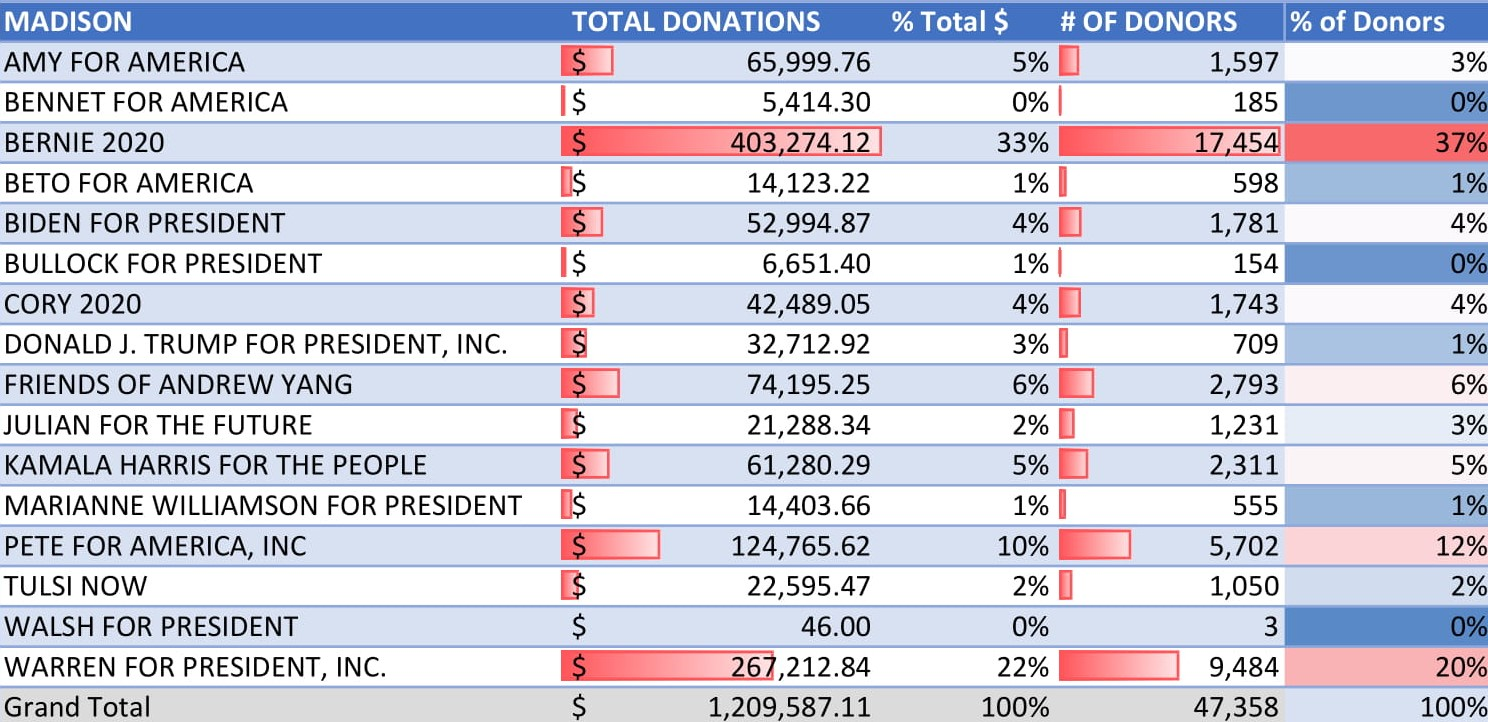
Data for Madison, WI
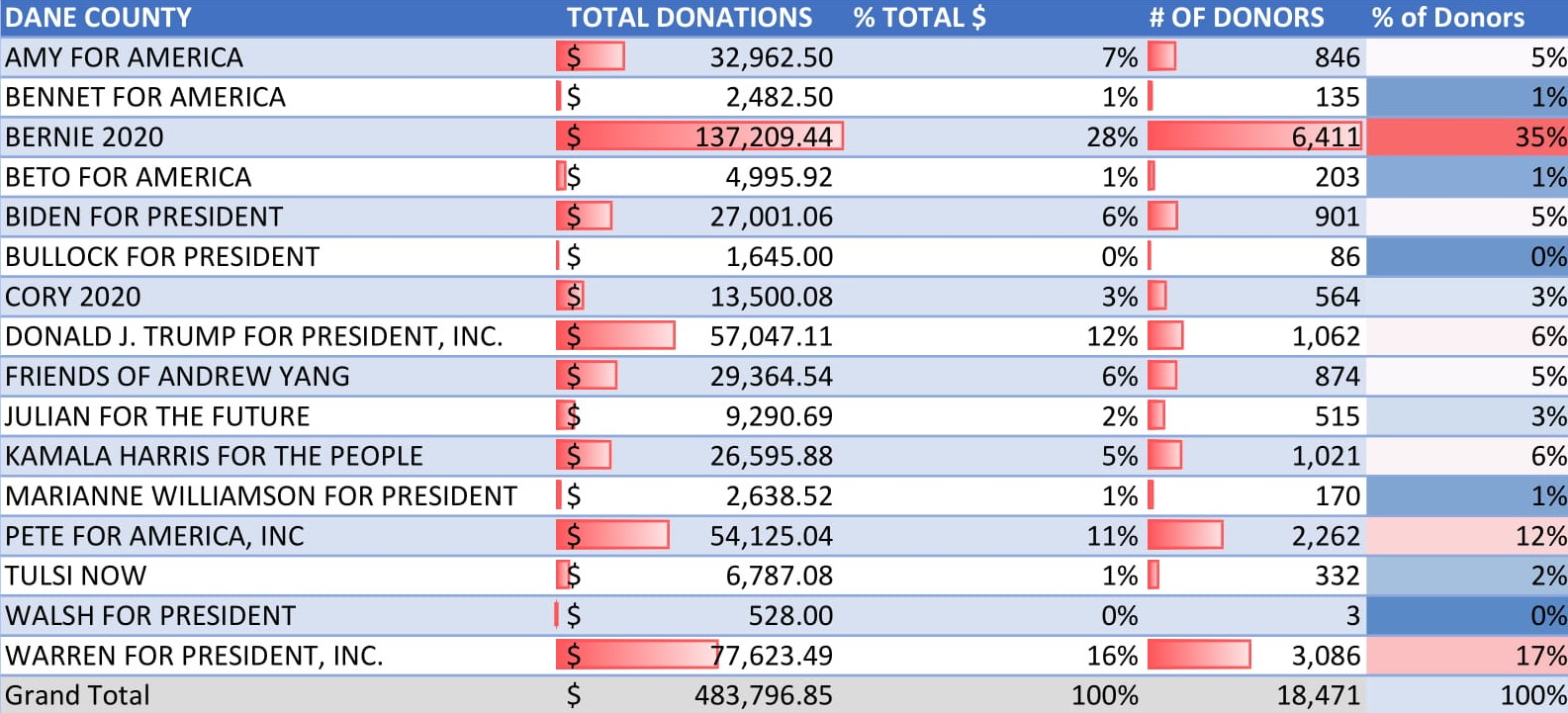
Data for Dane County cities Middleton, Monona, Verona, Stoughton, Waunakee, Cottage Grove, Fitchburg, Mount Horeb.
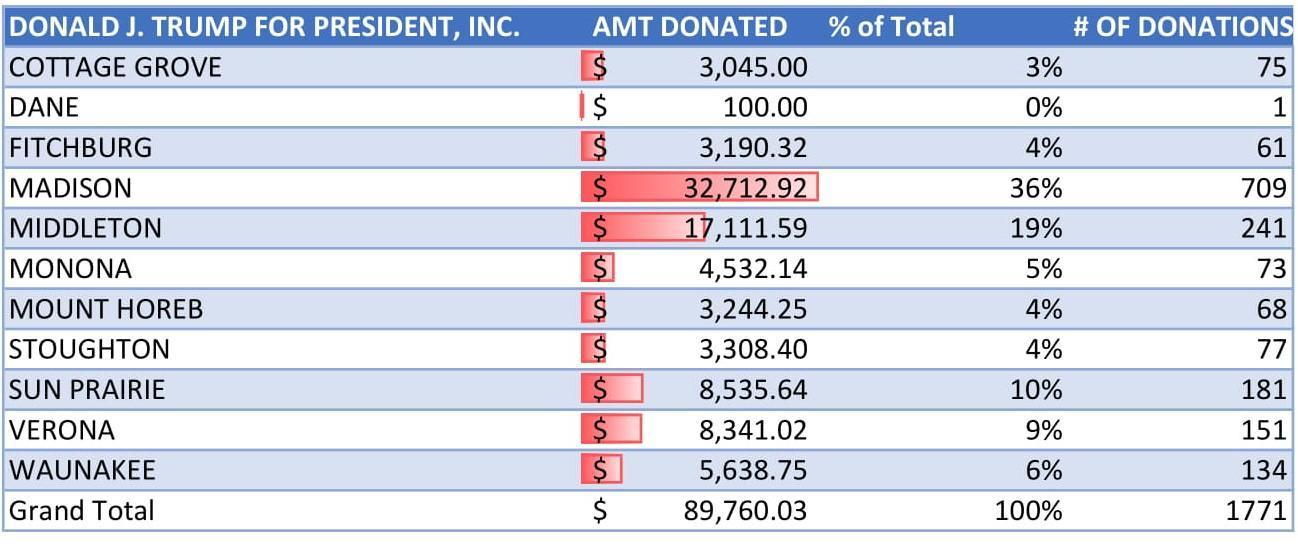
True to its reputation, residents of Madison-proper donated twice as much money to presidential candidates as other towns in Dane County combined. Even still, Dane County and Madison have similar trends: 98% of individual donations to candidates went to Democrats in Madison versus 88% in the rest of Dane County. Sanders had the largest number of donations (37% and 35% in Madison and Dane County respectively), Warren second (20% and 17%), and Buttigieg third (12% and 12%). The major difference is that Dane County has a higher proportion of Trump donors than Madison (6% vs 1.5%), but Madison gave more than a third of all the money that went to Trump from Dane County. Madison isn’t all that different from the rest of Dane County: both Madison and the surrounding areas show the same political preferences, but people in Madison donate a shitload more money to politicians.
Donations directly to presidential politicians through January 31st, 2020 were just shy of $1 million; money given to Political Action Committees (PACs) is more than double that at $2 million. PACs can take much more money than candidates themselves, which reveals something that we’d miss if we only look at direct contributions: rich people generally prefer to give a lot of money to action committees and political parties. In the US, the most an individual can give to any candidate is $2400, though the limits are much greater to parties and unlimited to Super PACs. Over $700,000 was given to the Democratic Party: The Democratic Party of Wisconsin and other various state Democratic Parties, the Democratic Congressional Campaign Committee (DCCC), Democratic Senatorial Campaign Committee (DSCC), Democratic National Committee (DNC). This is where big money goes: one CEO in Madison donated $10,000 to the Democratic Party of Wisconsin, an “Owner” $10,250, and a Programmer $10,000; a President of a venture capitalist firm donated $13,000 to the DNC.
Other titles that gave $1000 or more to Democratic PACs are Administrator, Consultant, Attorney, Physician, Business Owner, Executive, Statistician, Chief Marketing Officer, Marketing Executive, Politician, President, Professor, Programmer, Psychologist, Contractor, Surgeon, Manager, Retiree. These are who you might call the real base of the “Democratic Party establishment”. Democrats also have many “feeder” groups, PACs that support specific types of candidates in the Democratic Party: Emily’s List promotes female Democrats running for office; 314 Action promotes science; House Majority gives out money to “win back congress”, It Starts Today gives money out to Democrats running for Congress, MoveOn.org, etc. – these took in hundreds of thousands of dollars.
Donations to The Republican Party are also significant. Out of $176,000 given, $58,000 went to the Republican Party of Wisconsin, $54,000 to the Republican National Committee, $32,000 to the National Republican Senatorial Committee; and $28,000 to the National Republican Congressional Committee. Who donates? “Business Owner” $5000; President $10,000; Founder $3000; CEO $2500; Engineer $2000; Sales $1000; Retiree $2400. Other notables: Chief Financial Officer; Consultant; Debt Collector; Attorney; Sales; Insurance. (Notice any similarities to Democrats?)
Political Support by Occupation
The data shows us that each candidate has a base that is commonly defined by occupation. Bernie Sanders has by far the most donors with over a thousand job titles listed. The most frequent donors to Sanders are Teachers, Nurses & Medical Workers, Students, Hospitality Workers (Bartenders, Waitstaff, Cooks, Baristas), Warehouse workers, Drivers, and Office Clerks. This contrasts with more traditional top supporters for Joe Biden (Attorney, Retiree, Sales, Physician), Warren (Project Manager, Professor, Retiree, Software Engineer) and Buttigieg (Manager, Attorney, Teacher, Professor, Engineer). Every candidate shows some support across class lines (Biden has some Clerks and Blue-collar Workers, for example, but they’re a minority).
If workers aren’t monoliths, how do some common job titles align politically?
More than half of CEO’s donated to Trump, followed by Buttigieg (14%)
Lawyers donate to everyone, with Warren first (19%) and Sanders (15%), followed by Biden (13%) and Trump (12%)
Two-thirds of Clerical/White collar workers gave to Sanders and then Warren (14%)
Police give exclusively to neoliberal candidates (Buttigieg and Biden); State Troopers to Trump
Accountants: Trump and Sanders are the top recipients – Accountants seem to understand, “Tax law is class war”
Graduate Workers donated overwhelmingly to Sanders (75%) followed by Warren (14%).
Nurse donations were primarily to Sanders (37%), Warren (25%) and then Buttigieg (18%)
Teachers went for Sanders (42%), Warren (19%) and Buttigieg (10%).
Marianne Williamson’s top supporters were Artist, Feng Shui Master, Marketing Coordinator, Sales and Therapist. (The orbs have spoken.)
Blue collar workers (Mechanics, Tradespeople, Factory workers, Drivers, Cleaners, Agricultural workers, etc.) are typically considered to be the “conservative white working class.” In Dane County, Bernie Sanders collected half of all donations from blue collar workers followed by Trump (13%), Yang (12%) and Warren (10%). For the rest of the centrist candidates, only Pete Buttigieg and Kamala Harris received over $100 in total donations from blue collar workers. That’s completely different from the standard narrative of the enlightened, educated liberals and conservative manual laborers – at least as far as donations go. Of all donations to Trump, blue collar workers contributed less than 3% (nearly all from the skilled trades), retirees gave close to half, and real estate, business owners and capital managers most of the rest.
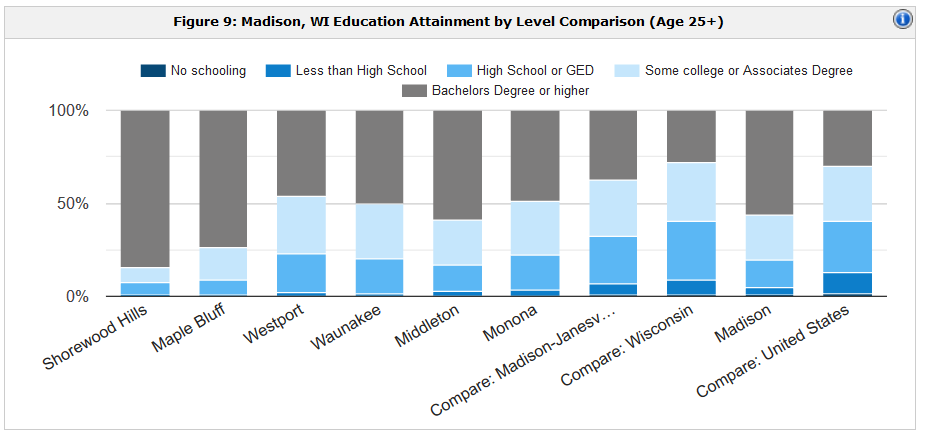
What this shows is that there is a very real class dimension to the voters and their perceptions of the candidates. The broad and lower section of the working class goes overwhelmingly for Sanders in small amounts (median donation is only $15), while the more educated technicians go for Warren and Buttigieg; Biden’s most frequent donors are from the more historic political class of doctors, lawyers, system administrators, top business management and salespeople.Madison has a larger share of Warren supporters than the rest of the US as a whole, which makes sense since she appeals to highly educated liberals and offers a softer “structural change” than Sanders. More than 50% of Madison residents hold bachelor’s degrees, and 24% have masters degrees or higher. Those with postsecondary degrees are more likely to regard institutions in society as legitimate (because they’re trained that way) and to look for adjustments and technical solutions rather than social ones.
This election is a unique opportunity to see how different classes express their interests (workers overwhelmingly for Sanders; technicians for Warren and Buttigieg, elites for Biden; Buttigieg and Trump), it shows the divisions among sections of the working class (white collar vs blue collar, skilled vs unskilled, etc.), and between workers: half of teachers and nurses are for Sanders, the other half are for technocratic candidates like Warren and Buttigieg.
There are some important limits to these numbers. First, most people don’t donate to electoral campaigns. That means we have to be careful about saying this data represents the electorate (people who vote), and more importantly the general population (including the 50% of people, mostly workers, who don’t vote or are ineligible). But the proportions match up fairly well with the Democratic Primaries thus far: Sanders won between 20-50% in the primaries through Super Tuesday (median 26.5%), and in Madison he’s raised 32% of all political dollars.
Second, many people who donate don’t want to give out information, so they report as “not employed”, “none of your business”, “n/a” and other creative middle-finger responses (I didn’t attribute these to any type of occupation). Third, this can’t tell us much about race or gender without some serious extrapolation. So, we should take this data as one useful element but understand that it’s a sample of voters who are skewed along class lines — overrepresented in the educated, administrators, technicians and elites, and underrepresented among most workers.
Local Politicians & Bureaucrats
If candidates express class interests, where do our local politicians align? Its no secret that real estate and tech companies drive much of the city’s policy, but who do our politicians support?
County Supervisor donations
Mayor Satya Rhodes-Conway donated to every neoliberal identity candidate (Klobuchar, Booker, Castro, Harris, and Warren), but gave most to Pete Buttigieg, the only LGBTQ candidate in the race and a personal contact of hers through the Mayors Innovation Project; Rhodes-Conway likewise campaigned for mayor as an LGBTQ candidate who wanted to address race disparity in Madison. Most city alders didn’t donate to a political candidate, save for Arvina Martin, who gave small amounts to Gillibrand, Harris and Warren, and Sally Rohrer, graduate student in public policy, who donated to Warren. Half of the twenty (20) city alders gave to the Wisconsin Democratic Party; the other half gave no political donations at all.
Greg Leifer, City of Madison Human Resources Labor Specialist, who sits opposite the City’s unions and is also negotiating for Willy Street Co-op against its workers’ union, donated solely to Joe Biden. That follows the pattern of union busters who support Biden.
Trends at the County are similar: most County Supervisors gave to multiple candidates, primarily neoliberals. The only local politician to have given any money to Bernie Sanders was Heidi Wegleitner.
This confirms most of what we knew about local politicians: the priorities are primarily identitarian neoliberalism, with some minor support for reform. The political preferences of seated politicians hardly represent what we see from the data above where there’s a plurality for Sanders, and large support for other reformers like Warren and Yang. In 2016 when Sanders won Wisconsin, most local politicians were astonished. Why? Because they’re a distinct political class managing local government on behalf of capital and they hardly represent the desires of people they govern.
A party in waiting?
Bernie Sanders did a lot of things for American politics since 2016, but one of the most significant is financing a Presidential campaign without any corporate dollars and maintaining his political platform without compromise. Those two things together have rallied millions of people who, as we can see from the above data , are not the traditional political actors of professionals, managers and elites.
For Madison, Dane County and the State of Wisconsin, we can see that class politics are expressed much more clearly than during a regular election and that these interests are far and away not represented by politicians – not just at the State level with Republicans, but among Democrats locally who are tied to establishment politics and neoliberal capitalism.
This also suggests another possibility: the potential for a party in waiting. Rather than accepting that local politics be dominated by the regular class of politicians we’ve had for decades, we can see that there’s an audience eager for an alternative if/when we can present them credibly: service workers, teachers, nurses, office clerks, university workers, drivers, warehouse pickers and receivers, and so forth. If we center the working class and oppressed as agents of change with a program to fight to better the lives of working people, fight racism, fight for a just ecological transition, we can already create a list of supporters from this election. The state is of course set up to keep the political structure as is, and we can’t expect that we’ll vote our way to socialism, but there is room to contest and organize for a different set of politics.