Tag: Feat-Feb

  • A Health Emergency Demands Treatment NOT Tax Breaks

    A Health Emergency Demands Treatment NOT Tax Breaks

    By Frank Emspak

    The COVID-19 virus shows the complete inability of the US health system to serve the majority of its citizens. The Trump administration’s responses have been tax cuts, interest rate cuts to help the stock market, and travel restrictions; we expect there will be bailouts for the airlines and other industries.

    The Democratic Socialists of America (DSA) and all progressives who seek to support workers have a responsibility when it comes to fighting the COVID-19 virus: It is up to us to make the demands needed to actually serve all working people. Progressives need to enunciate and fight for a plan to deal with the pandemic. One thing is clear: a tax break and a bail out of the cruise industry will not deal with the virus.

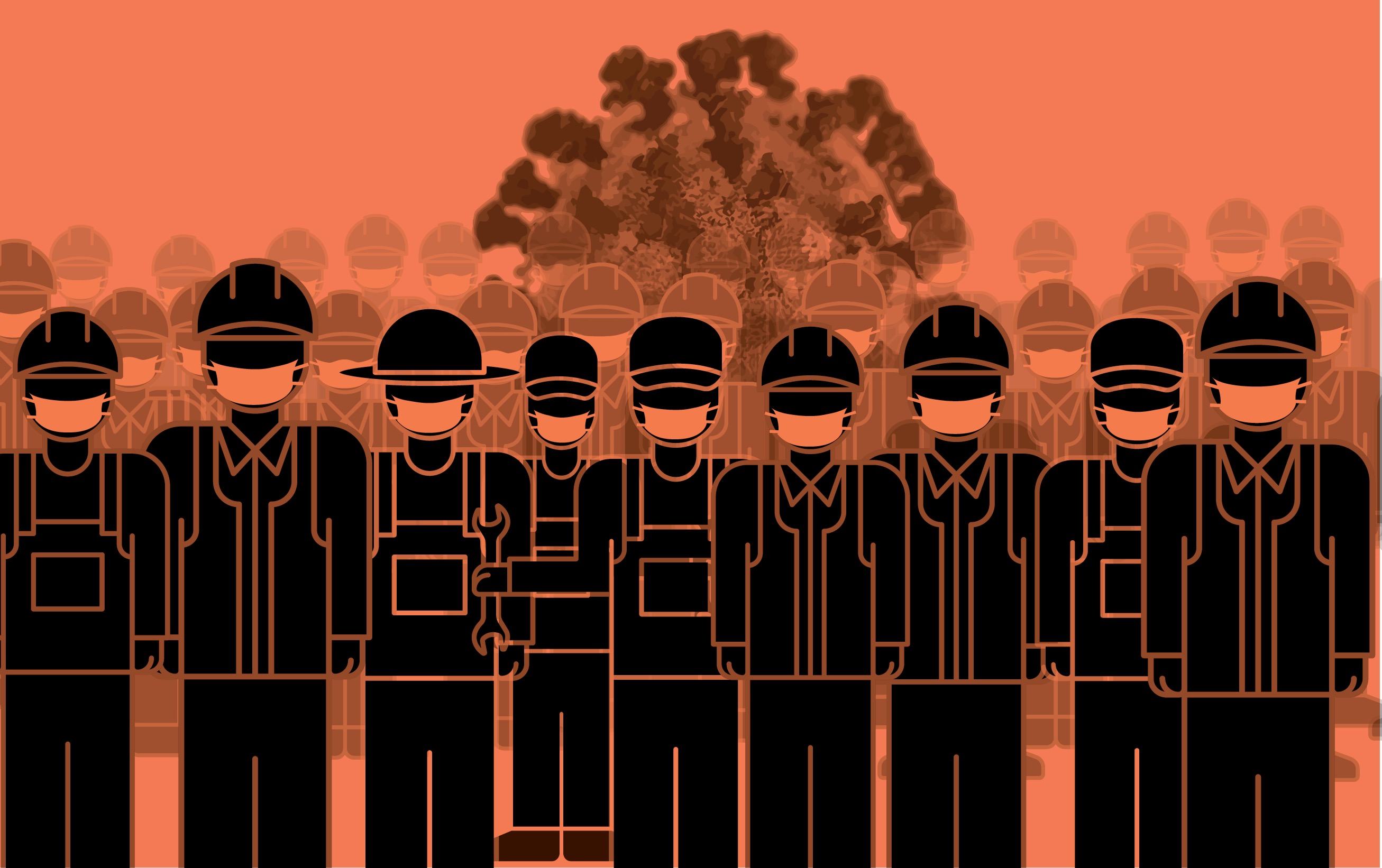
    Many DSA members are deeply involved in various community organizing efforts and can raise key demands on behalf of all workers. Any successful plan must be based on fulfilling several criteria designed to assure that all working people have access to needed services. As we take these first steps, we also must provide the needed support to first responders. All medical personnel, public employees, firefighters and workers routinely in contact with the public, such as flight attendants and airline pilots, need the supplies to protect themselves while they help others. Their unions are already in discussions with the employers to develop effective responses to the virus.

    What are the criteria for a plan that could respond to the needs of working people?

    1. Access to screening and treatment for every person in any given area. Access means the elimination of all barriers to screening and treatment whether financial, geographical or otherwise. One means of accomplishing such a project in our area is the re-establishment of the free Blue Bus health screening and treatment project. This project consisted of a blue bus, circulating through the community with appropriate medical staff and equipment on board to do screening and some initial treatment.
    2. Maintenance of income. All employees who have been asked to stay at home must be guaranteed their income. A majority of employees do not have two weeks of paid sick leave. This is true for workers in all industries, but especially in food service. A combination of existing unemployment compensation and new appropriations at the federal and state level are a means of financing this.
    3. Guarantee of employment. The employer will guarantee all workers asked to take a leave from their job that they will have employment upon their return. No negative remarks regarding such absences will be placed in any record of employment.
    4. Maintenance of Services: Many firms, especially firms in food service have no means to continue providing service if key employees are required to be absent. Therefore local government should establish a pool of trained workers who can replace key personnel for the duration. This group of workers could go from establishment to establishment based on need. (An example cashiers, line cooks, etc.). A similar system was employed during World War II to assure production in key industries. The US Employment service exists today. “The United States Employment Service (USES) is an agency of the federal government of the United States responsible for “assisting coordination of the State public employment services in providing labor exchange and job finding assistance to job seekers and employers” (Wikipedia)
    5. Amnesty: There can be no barriers to testing and treatment of all people in the area if the pandemic is to be contained. There needs to be explicit guarantees provided by officials at ALL levels that the screening and treatment system will not be employed to entrap individuals. This is a public health issue as well as a political demand. It is impossible to have an effective public health response if ten million people with unclear or no citizenship status refrain from screening for fear of deportation.

    At one time or other programs have been implemented to fulfill each of the needs defined above.

    Screening and Treatment: During the initial phases of the HIV-AIDs epidemic volunteer organizations led by gay and lesbian activists put together health care outreach systems. Often they worked with local hospitals and organizations like Physicians for Social Responsibility. Together they developed clinics roaming the target areas in a bus painted blue. They offered free screening, arranged for follow-ups and dispensed medicine. Nothing prevents a community from initiating such a system, assuming there is the political leadership to do so.

    Maintenance of Income programs are already in place. It is called unemployment insurance. Currently many are inadequate replacing only a fraction of the lost income; some have waiting periods. Both shortcomings can be addressed almost immediately. During natural disasters, governors have ordered changes in the system to eliminate waiting periods — this was the case in Massachusetts with the Blizzard of 1978. Congress could also immediately increase the funds available to states to finance the system so that it pays out 100% of the wages to any worker laid off or told to take time off due to the virus. The unemployment compensation system is already in place. It is a political challenge that must be overcome if we are to move forward.

    There is no need to create a bureaucracy to fulfill a pledge of an employment guarantee: make the employers responsible. Employers are always asking for less government intervention — now they can have it. Unions, civic leaders, church groups, workers’ centers, and state departments of labor can make sure employers follow through with this obligation.

    Maintaining Services. Publicly financed training programs exist throughout the country. The United States Employment Service is still in business. There are other progressive, often union-run employment agencies. These can be mobilized to organize and train a pool of workers who can replace those on leave. If we could figure out how to do this in World War II, certainly we can do it again.

    Amnesty. No one is going to go to a hospital or be screened if they believe that deportation and/or family separation will be the result of behaving in a responsible manner. The virus is a public health emergency. No group of people can be excluded from service or the whole idea of virus containment will be rendered useless. Encouraging people with questionable citizenship status to participate is an absolute necessity — and not simply for public health reasons. If the illness spreads widely, agricultural production will collapse in states like Wisconsin, which depend on an agricultural labor force, many of whom may have questionable status.

    This of course is a political question and forces all of us who want to deal with this epidemic to face the fact that to overcome the virus it is necessary to overcome the xenophobia, racism and short sightedness of the current immigration policies.

    COVID-19 raises other significant issues as well. Over the years the public health infrastructure of this country has been hollowed out.[1] Spending on public health remains three percent below what it was in 2009. The Wall Street Journal estimates that there are 59,000 fewer local public health workers now than ten years ago. In various states such as Washington and Kentucky health centers may be forced to close because of lack of funding.

    Provision of screening has also put into the spotlight the total unavailability of services. Three months after the virus was identified, the much-vaunted private insurance driven healthcare system in the US has not been able to provide the level of screening needed to even diagnose the extent of the virus. In the second week of March, restrictive rules by the federal government are still impeding the availability of screening. Hospitals have declined to test for the virus citing restrictive rules emanating from the Centers for Disease Control.

    If have insurance, the New York Times made another point:[2] most plans have deductibles. Those deductibles are generally not fulfilled this early in the year, so that one could be on the hook for the cost of your screening.

    Other countries that have ordered massive quarantines or shutdowns have focused their attention on providing care and treatment. They are not worried about a huge drop in personal income and the destitution of families.[3] European countries have “safety nets” in place guaranteeing income to those out sick. While the plans vary in the details, all are designed to prevent a recession as a result of income loss due to the virus.

    Industry bailouts, small business loans and a meager cut in payroll tax may be good campaign ideas, but they do nothing to address the immediate need for the provision of a robust and free medical response to this emergency. They do not meet the minimum needs of working people for job and income security. It will be up to us to raise these issues and push demands for all working people.


    [1] Wall Street Journal  “Health Agencies Are Stretched Thin” (Tuesday March 10, 2020 page A-5

    [2] New York Times, Coronavirus Highlights the Pitfalls of Deductibles” Tuesday March 10, Business section page  10.

    [3] New York Times;  “ Social Safety Net in Europe Eases Quarantine’s Toll” Tuesday March 10th, Business Section page B-6


  • The Afghanistan Papers: Another Blip in the History of a Forever War

    The Afghanistan Papers: Another Blip in the History of a Forever War

    By Ben Heili

    I remember my 14th birthday well. That day, my grandparents’ newspaper told me the USA had started to bomb Afghanistan—Operation Enduring Freedom, they called it. Something in my 14-year-old brain approved of that name at the time, and it turned out to be partially accurate — one thing that operation did is endure. One generation later, over 100,000 people have died in the conflict. 14,000 American troops and an undisclosed number of private contractors remain in Afghanistan. They project imperial power aimlessly 6,000 miles from home.  Their mission is pointless, devastating, and forgotten all at the same time.

    In the blur of December 2019, The Washington Post released a trove of documents known as the Afghanistan papers. I invite you to read their summary. These documents were released after a years-long FOIA (Freedom of Information Act) battle, and they revealed real opinions of US military leaders and other stakeholders throughout the long war. The goals were lies, the outcomes were lies, even the measurable accomplishments were lies. A series of leaders inherited a mess, painted it however best it would suit their careers, and soon after rotated elsewhere. “Every data point was altered to present the best possible picture,” said one colonel.

    In the wake of 9/11 and the intense militarization of U.S. culture, how did the military define “best?” This is a hard question to answer in a war defined by mission creep. It surely didn’t align with what was best for the invaded people of Afghanistan. For a while, finding Osama Bin Laden was a priority. Killing Taliban and Al-Qaeda leaders would bring prestige. Building a government in Kabul that could seem democratic and independent would earn medals. Building schools and bridges looked nice. Winning fights against insurgents earned accolades for valor, never mind where the insurgents had come from in the decades-long occupation. The only line connecting these goals stems from a ghastly colonial mindset: we know better than these people what’s best for these people.

    As these documents reveal, the resources set aside to fit the hero narrative of the day were nearly limitless. Of course there was the military material shipped over at great expense, then often burned. But the nation-building efforts were misguided and wasteful as well. “One unidentified contractor told government interviewers he was expected to dole out $3 million daily for projects in a single Afghan district roughly the size of a U.S. county.” How much housing could we build in Dane or Milwaukee county for $3 mill a day? How much renewable energy? How much public transit? Reinvested to help us thrive, that spending would certainly be attacked as wasteful. In service of empire, it goes unquestioned.

    Naturally, the revelations of the Afghanistan papers slid straight out of the public consciousness along with every other bombshell that week. We knew the truth of this already, felt it, didn’t we? War is old news, and this one is the oldest. Goalposts had already been moved, hidden, moved again, buried, all right out in the open. The war now runs solely on bureaucratic inertia and the need to build more swimming pools for North Virginia defense contractors. A few weeks later, Trump declared a new war with the assassination of Qassem Soleimani (remember that? I barely do). We can be thankful tensions subsided there for now, but the war drums are always beating.

    So what does it mean to be anti-war in the third decade of the forever war? What can we do? The specific culture of militarism that took root in the Bush years has made a permanent home in the hearts of many Americans. Worshipping the troops and devaluing the lives of non-white non-Americans did not die with John McCain. We need clear and consistent messaging outside of the corporate media that illuminates the real consequences of war. When a pruny oligarch wants to start a conflict, we must be clear that he wants hundreds or thousands of children to die for oil or lithium. When generals tut-tut a withdrawal from the Middle East, we must be clear about the generational harm that can never heal if we keep killing there. When (not if) a hypothetical President Bernie Sanders is pressured into unjust uses of military power, we must pressure him just as hard as anyone else. Finally, the war machine needs material. That material is made and transported by workers. And if organized workers can’t have an effect, what are we all doing here?

  • Wisconsin’s Brutal Cuts to Medicaid Prove Necessity of Medicare for All

    Wisconsin’s Brutal Cuts to Medicaid Prove Necessity of Medicare for All

    By Karl Locher

    During the infamous lame duck legislative session in the closing days of 2018, the Wisconsin legislature passed a breathtakingly reactionary agenda. The rapid move to limit the power of the incoming Evers administration was the object of significant attention in state and national news media. Indeed, as much as the Wisconsin Republican Party made great efforts to withhold information from the public during the legislative session, it was a nonetheless brazen – and largely successful – attempt to restructure Wisconsin’s government. The consolidation of power into the hands of a few members of the Wisconsin Republican Party was unquestionably an affront to democratic process.

    Amidst the outrage over the shamelessly undemocratic grab for power, the legislature and waning days of the Walker administration quietly made drastic cuts to Wisconsin’s Medical Assistance program, called BadgerCare Plus. Medical Assistance, known better as Medicaid, is the federal program to provide healthcare to the poorest Americans. The income eligibility requirements vary from state to state, and in Wisconsin vary depending on your family status. For example, as of 2020, in order for a childless adult to qualify for BadgerCare Plus, they must have an income of $1,063.33 or less per month.

    To understand why BadgerCare Plus is so vulnerable to swift and uncontested austerity measures, one needs to understand how it came to be a program in the first place. Medicaid was created in 1965 alongside the federal Medicare program. Unlike Medicare, Medicaid is largely administered by state governments in a shared cost model. This means that the federal government requires states to create their own Medicaid programs, including eligibility requirements and medical reimbursement rates, and in return, the federal government will cover a percentage of the cost of that program. Wisconsin followed the trend set by other states by privatizing the delivery of Medicaid coverage for most enrollees when it formed BadgerCare in 1999. In this model, the state pays Health Management Organizations (HMOs) and Managed Care Organizations (MCOs) to provide healthcare for BadgerCare enrollees. 

    The privatization of BadgerCare – and then eventually BadgerCare Plus – purported to save money for the state while delivering the benefits of commercial insurance to enrollees. Like many other neoliberal initiatives, HMOs and MCOs were sold as a shot of market innovation and consumer choice into a supposedly anachronistic government program. In reality, these two qualities of Medicaid – that it is a cost-share program and relies on privatized service delivery – created exploitable opportunities for profit-seeking at the expense of the quality and access to healthcare. Cost sharing puts states in the position of seeking to reduce their own budget burden while maximizing federal revenue for Medicaid services. Privatized service delivery creates an opportunity for a corporation to accept government reimbursement for services, and then to deliver as infrequently and as profitably as legally possible. 

    From the beginning, Medicaid was vulnerable to privatization efforts. Over the last forty years, programs that are devolved to state administration, like Medicaid, and are “means-tested” – meaning they require meeting certain income requirements in order to enroll as opposed to universal enrollment in services – have been the targets of corporate profiteering. Because these programs are shifted onto states, which have considerably lower capacity for revenue generation than the federal government, they are more prone to be thrown into crises of “sustainability” during downturns in consumption-driven sales tax revenue. Further, as “means-tested” programs, social welfare programs like Medicaid are construed as “handouts” to unproductive members of society and are politically vulnerable to schisms in class consciousness. Unlike Medicare, which is a widely perceived as a universal right for all, Medicaid is increasingly construed as both a drag on state budgets and an entrapment scheme for the working class whose livelihood should rely less on government programs and more on their employers’ begrudgingly paid benefits. 

    The result of the slow transformation of Medicaid into a market for private profit has been devastating to the livelihoods of poor and working-class people in Wisconsin. The recent changes to BadgerCare passed under the lame duck session will affect “childless adults” with incomes under 100% of the federal poverty level. What was formerly no-premium health insurance will now require monthly premiums in addition to copays for Emergency Room visits. Particularly devastating are that these fees must be paid by the 10th day of the month following a billing period. The bill cannot be paid in cash or in-person, it must be paid with a credit card or money order. If someone doesn’t pay, they will lose their coverage and be made ineligible to re-enroll for a 6-month period. For reference, about 150,000 people across the state will be affected by this change. 

    These measures are a deliberate attempt to strip the poorest Wisconsinites of health coverage and it will likely be very successful in doing so. There is voluminous data that poor people are underserved and intentionally exploited by banks and often cannot access the kind of payment services required to meet these copays. The obfuscation and complication of this payment scheme will result in thousands of people losing life-saving, crucial healthcare

    The lame duck session signals a new phase in the politics of austerity. State governments are moving beyond the point where services are merely handed over to private industry and are now taking unprecedented steps to cut social services altogether. The first step, of privatization, was crucial in taking a public good and turning it into a private commodity. In doing so,  state governments have changed public consciousness of programs like Medicaid so that they are not seen as rights – which can be fought over in public politics – but instead as private goods that are hidden from public consciousness and can be removed without political backlash.

    The lame duck session signals a new phase in the politics of austerity. State governments are moving beyond the point where services are merely handed over to private industry and are now taking unprecedented steps to cut social services altogether.

    The fate of BadgerCare – and Medicaid generally – is proof of the need for Medicare For All and a system of socialized medical services. The centrist suggestions of “medicare for all who want it” should be quickly dismissed as political dead-ends that would doom countless individuals to death by inadequate healthcare. The structural similarities between Medicaid and “medicare for all who want it” are uncanny. It is clear that an “optional” federal Medicare program would lead to private health providers and insurers simply opting-out of providing care. “Medicare for all who want it” would quickly devolve into a stigmatized program of insufficient healthcare comprised of a begrudging network of providers doing the legally mandated bare minimum. It isn’t difficult to imagine that this too, like Medicaid, would eventually be seen as a pariah in need of a private savior, before it’s supposed savior puts it to a quiet death.

    Socialized medicine, best represented through the Medicare For All movement, provides more than a technical solution that private health care has failed to deliver. Medicare For All could, for the first time, create a consciousness of health care as a public good and a universal right. This creates broader class consciousness, even if it is sometimes more like class unconsciousness. As people begin to view threats and injuries to such programs as an injury to their own well-being, they can see it also as an injury to their community and develop empathy for other people who also rely on the program. It is not coincidental that cuts and privatization efforts have been much less successful with universal programs like Social Security and Medicare than they have been for means-tested programs like Medicaid and TANF. As political centrists and leftists debate a – perhaps unfortunately – shared political path for the next four years, it is crucial that we build strength through the Medicare For All movement and that socialized medicine is a galvanizing principle of our politics.

  • Remembering the Uprising

    Remembering the Uprising

    By Paul Buhle

    The Wisconsin Uprising of 2011-12 was so unexpected, so inspired and inspiring, and the thumping defeat that followed so disheartening, that the whole series of events now threatened to become a phantom memory, almost unreal.

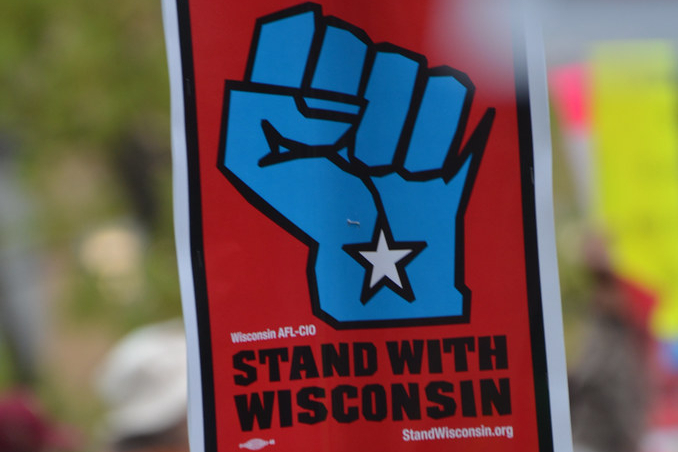
    The idea that crowds of 10,000, 25,000 or 125,000 and a few times upward of 200,000, could be protesting Act 10 (crafted to eliminate public unions through what amounted to the “right to work,” without being represented by them), that the Capitol building could be peacefully occupied during the first weeks of the demonstration, that people came from near and as far as New York or Los Angeles to join us—this was a moment for democratic socialism as well. It is easy to remember the firefighters entering the Capitol, led by bagpipers, or the singing with three generations of Wisconsin families sometimes joined together in chorus. I like to remember something else. Rank and filers from unions, especially health workers and public educators, brought very, very funny homemade signs satirizing Governor Walker and the Repugs. People would laugh, cheer the signs, and look forward to different ones on the days ahead.

    It was a spectacle of near-spontaneous ingenuity. And determination. 

    How this all came about and what it meant can be traced in John Nichols’ careful narrative history, Uprising. Or in the anthology of stories, photos and comics put together by Mari Jo Buhle and myself, It Started In Wisconsin: Dispatches from the Front Line of the New Labor Protests (2011).

    DSA members will want to read deeper than this brief recollection can offer. What needs to be said, briefly, is that the bipartisan approval of public unions can be traced all the way back to the 1930s and the (Wisconsin) origin of  the very non-radical AFSCME. The legislative approval of public employee unions, in 1959, was one of those developments making the 1960s-70s of Madison’s economics, politics and cultural life fairly unique, if fairly similar to some other college towns with an emerging left-of-center majority.

    The newer Republican leadership, emerging in the 1990s and later with the heavy financial backing of the Koch brothers, ended the semi-consensus on land conservation, public education and, of course, unions of any kind. Leading Democrats, having accepted and even supported NAFTA, saw their political base withering away, with the closure of factories and small downtowns, but seemed helpless to halt or even slow the process. Depressed rural areas fell under the spell of Fox News, while evangelical  white-flight zones, notably some Milwaukee suburbs, were already in political high gear. 

    A dozen Democrats walked out of the state Senate in January, 2011, sequestering themselves across the border in Rockford, Illinois (standard joke: worst vacation imaginable) so as not to provide the numbers needed to put Act 10 into effect. And the demonstrations began.

    We knew even then that the Republican intent was to destroy private-sector unions as well, despite Walker’s promise not to do so. Many union families, ill-educated by their unions as well as the media, seemed not to want to believe this. The “Right to Work” legislation for them followed, as expected.

    What is most memorable? Here, different participants will have different recollections. I remember the signs with Robert La Follette’s photo, a recollection of the great anti-war progressive and candidate for the presidency in 1924. I also remember the legions of senior citizens and retired unionists, from across Wisconsin and beyond: their unions were gone – along with the factories – but they wanted to go out with their boots on. And they did, old people in the bitter cold. They were joined on many days by crowds of teenagers, some of them from Madison schools, others coming from their neighborhoods and even other cities with their parents, grandparents and friends. Most of all, I remember the gendered nature of the workforce in the lead: women teachers and health workers. And the leadership role of my old union, the Teaching Assistants Association.

    We were to learn later that the union leaders of bigger unions, in suites of the Concourse Hotel, watched furiously, intent on gaining some bargain scraps from Walker but even more intent on getting us off the streets, to prepare for some future Democratic electoral sweep, the one that never came.

    Paul Buhle published the SDS magazine Radical America in Madison of the late 1960s and reported for several publications on the Uprising.

  • Homelessness: Austerity leads to Blindness

    Homelessness: Austerity leads to Blindness

    By Mary E. Croy

    Eight bills and not even a band aid in sight. As homelessness continues to soar in Wisconsin, the Republican led legislature refuses to take action. There have been eight bills proposed, and only one is even being considered in the current session. In the state budget, $3.7 million was allocated to fight this problem, but nothing has made it to the governor’s desk.

    Last June, the Assembly passed legislation, but it lingered in the Senate. Had it passed, more beds could’ve been provided before winter. However, excuses and dedication to austerity won the day. It is estimated that 20,000 children and adults are without a permanent residence in our state. In Madison an average of 225 people per day, including children, seek relief at the Beacon Shelter near downtown. 

    In Milwaukee, a tent city has begun under the Hoan Bridge. Ironic, since the bridge is named after a great Socialist mayor. 

    Homelessness exposes the racist nature of American society. For example, right here in Dane County, 5.1% of the population is African-American while 53% of the people who receive services for homelessness are African-American.

    Our state spending on the homeless population is approximately $3.3 million annually and it has been at this sum for decades. Neighboring Minnesota meanwhile spends $44.3 million.

    It is indeed a disgrace to our state and country to see people sleeping in the streets next to expensive restaurants, underneath the glaring lights of the capitol dome. 

    While Republicans and other neoliberals scream about cost, the statistics speak for themselves. It costs the public $35,600 every year to care for a homeless person, while that sum can be cut in half with decent, affordable housing.

    There’s a better way. In Vienna, Austria, public housing is considered the foundation for creating a livable and humane city. Socialists after World War I established a “social housing” policy that built not only apartments, but living spaces featuring kindergartens, health centers, playgrounds and workshops. They hired some of the leading architects to design beautiful buildings. Eligibility for public housing includes 80% of the population and this has led to a city where you cannot tell status by neighborhood. 

    How’s it funded? Sources are varied: the income tax, corporate tax and a payroll tax. In exchange, most citizens pay about 20 – 25% of their income on rent—a rate most Madisonians would kill for. 62% of Vienna’s citizens live in social housing. Because both middle class and lower income people can participate and you can keep your apartment even if your income goes up, a wide mix of people live in public housing without stigma. The city has panels that judge new developments, which means that energy efficiency, beauty and convenience for the residents can be emphasized. About one third of new apartment complexes in Vienna are publicly funded. The city owns about 25% of all housing, and indirectly controls another 200,000 units which are owned by limited profit companies that are strictly regulated with the city keeping final control over development. About 5,000 new, subsidized units are made available every year, and these are open to lower and middle income people. 

    It’s true that the problem of homelessness must be solved with a variety of tools, such as good mental health care, social support, innovative education and jobs, but affordable housing is essential in order to make our national disgrace a thing of the past. Red Vienna—the socialist movement that created one of the world’s most livable cities– can be a lesson for us as we build Red Madison.  

    Thanks to Madison Central Library Reference Desk for research assistance.

  • An Ecosocialist Madison Is an Equitable Madison

    An Ecosocialist Madison Is an Equitable Madison

    By Clare Michaud

    Imagining an ecosocially just world requires us to look at making radical changes to myriad aspects of our everyday (American) lives. Working toward an ecosocialist society would implicate everything from resource extraction and waste disposal to access to healthy food and clean water to the country’s approach to warfare, the consumption of goods, and treatment of indigenous people and lands. 

    Madisonians love to tout their commitment to sustainable lifestyle choices, and this ability to do so is bolstered by the City of Madison being recognized as the greenest city in the nation and appearing on several lists ranking it as a highly walkable city. Yet, these distinctions are pretty specific to Madison’s isthmus. Heading down South Park Street, or to Madison’s north side shows a very different way of life that does not as easily allow for bike commuting or accessing fresh food. The ability to make environmentally sustainable lifestyle choices is a class issue in Madison, and is something that is attainable for the residents who tend to be white, educated, and with a certain amount of wealth. 

    The ability to make environmentally sustainable lifestyle choices is a class issue in Madison, and is something that is attainable for the residents who tend to be white, educated, and with a certain amount of wealth. 

    The ability to live without a car on the isthmus, and instead rely on public transit, biking, and walking to get around, highlights the city’s concentration of resources to the downtown and near west- and east-side neighborhoods, where the cost of living is higher. Isthmus residents have bountiful access to various grocery store options: both supermarkets and smaller, more specialized food shops and co-ops are viable, in addition to a gamut of farmers’ market options that run on weekends and weekdays, throughout the spring and summer as well as with select winter options. 

    Purchasing food at smaller shops, the Willy Street Co-op, and directly from the producer at farmers’ markets is an excellent way of supporting local food producers and farmers; it helps to sustain those farmers’ and producers’ livelihoods during a time when farming as a profession is becoming less stable. Ten percent of Wisconsin dairy farms had to shut down in 2019 alone, due to China placing tariffs on U.S. agricultural exports as part of a 2018 trade war with the U.S. Ecosocial justice must address both the access to healthy living while also strengthening local economies; global capitalist gain has roots in imperialist exploration and exploitation, and this mindset lives on in actions such as trade wars for the sake of preserving global strength, which impact the livelihoods that are part of our local agricultural economy. Being limited to purchasing food from large-scale producers, too, has environmental impacts related to the shipping and transmission of goods; having better access to more local producers helps to support those producers while also leaving a smaller carbon footprint.

    With the city’s plan to expand Madison’s Beltline, Madison-area residents’ ability to access more resources will ease, but at what environmental cost? People who live in parts of the city where it’s necessary to drive to the nearest grocery store, for example, may benefit from the additional lanes, especially during evening commute times. However, building on the expressway encourages more individual drivers to be on the road. Instead of making changes to Madison’s transit options that promote having a car as a primary means of going between home, work, schools, and shopping centers, the city could take an approach that considers environmental impact, and create infrastructure that prioritizes buses, biking, and walking. During discussions about Beltline expansion, Alderman Grant Foster, from the 15th District, argued against the expansion and in favor of alternative transit options; he also brought up the point that if the Beltline is expanded, more traffic will be brought to city streets, an infrastructure that isn’t intended for that volume of traffic. Rather than expanding the Beltline, bus lines could be extended and added to better serve areas further from the isthmus. 

    Increased traffic on the Beltline means increased fuel emissions, creating a more prominent carbon footprint in Madison; it also means increased noise pollution. The upward trend toward living in urban areas is exacerbated by the way that modern cities are trending toward sprawl. Noise pollution contributes first and foremost to hearing health, but also is a strong factor in heart disease, learning problems in children, and in being a disturbance to sleeping, according to the World Heath Organization. 

    And Madison could become even noisier. Like expanding the Beltline, housing F-35 fighter jets at Truax Field would bring heavy noise pollution to the field’s surrounding neighborhoods, which are primarily occupied by minority and lower-income residents, including children. In the January issue of Red Madison, Allen Ruff wrote about the presence of F-35s driving the already-existing disparities between the community near Truax and the wealthy downtown and West-side communities. We must resist the use of the Truax Field for F-35s in order to put forth the effort to bridge the quality-of-life gap between Madison’s lower-income neighborhoods and its wealthier bubbles.

    The presence of F-35s poses serious and dangerous concerns for neighborhoods near Truax Field, and is also part of the larger problem of the U.S. military’s contribution to environmental destruction. The U.S. Department of Defense is the biggest contributor to pollution nationally and globally. Following in the history of imperialistic expansion and resource exploitation, the U.S. Military impacts environments all over the world, including in our backyard: bringing in F-53s alone would cause annual airfield CO2e emissions to increase by 135%. 

    Fostering an environmentally-centric society requires that we are able to advocate for fair and just use of the land. In November 2019, Governor Evers signed a bill (Assembly Bill 426) into law intended to criminalize and chill environmental protests and protect energy providers. The Center for Media and Democracy reported that “under the new law, peaceful protesters can now be charged with a felony punishable by up to six years in prison and a $10,000 fine if they trespass on property owned, leased, or operated by companies engaged in the distribution of oil or petroleum.” Wisconsin has followed nine other states in passing a bill that aims to prevent protests like the one that happened over the Dakota Access Pipeline. Assembly Bill 426 shows the Evers Administration’s prioritization for oil and gas companies over the environmental impact of natural resource extraction by these corporations, and is a strong step away from addressing this impact. The bill raised opposition from Tribal Nations, but these are cited as being largely disregarded during public hearings; an ecosocial society would prioritize Tribal Nations’ voices as a way to show respect for, solidarity with, and truly restore sovereignty to the Tribal Nations whose lands were seized and capitalized on by white settlers. 

    Fostering an environmentally-centric society requires that we are able to advocate for fair and just use of the land.

    Envisioning an ecosocialist future for Madison incorporates everything from transit to the consumption of goods to larger-scale initiatives being pushed forward by the U.S. Military and partnerships forged with oil and gas companies. An ecosocialist future should prioritize the health and livelihood of all people, rather than having opportunities to live without certain environmental stressors limited to the liberal bubble that is the isthmus.