Tag: history

  • Monthly Round-Up – March 2026

    Monthly Round-Up – March 2026

    This article is written by a DSA member and does not formally represent the views of MADSA as a whole or its subgroups. 

    Welcome to Vol. 8 of the monthly round-up! The content in this publication overlaps significantly with our DSA newsletter and monthly General Membership Meetings. To sign up for the newsletter or check out an upcoming General Membership Meeting, visit: https://madison-dsa.org/events/

    This photo depicts approximately 40 Madison DSA convention attendees with their fists raised. They are in a room with wood paneled walls.

    MADSA Annual Convention a Success

    The chapter held our annual convention on the evening of Friday March 20th and the full day of Saturday, March 21st. MADSA members elected new leadership for the coming year, voted to continue many working groups, and debated and passed resolutions that will shape how the chapter does its work this year and beyond. Below are 3 key themes from this year’s convention.

    1. Organizing Everyday People, Especially Labor

    This convention passed several exciting proposals around mobilizing everyday worker power. One was a major resolution setting clear goals around a “rank and file” worker organizing strategy. In short, key goals include: increasing organizing discussions in people’s unionized and non-unionized workplaces; taking specific actions to help existing unions become more active and socialist; taking steps towards a mass labor action on May 1, and building further potential for mass labor actions; and leveraging MADSA’s worker power for building new unions, pulling existing union members towards socialism, and building coalitions within and between unions. The resolution emphasizes a move away from convincing formal labor leadership, and towards supporting rank-and-file workers in taking concrete steps for socialist organizing in their specific context.

    The convention also ratified a Community Defense Working Group, which will be taking the main role in guiding MADSA’s STRIKE ICE OUT actions. The group will emphasize community education, non-violent neighborhood mobilizing, mutual aid, and strike preparation. Specific goals for the working group include providing materials and trainings, doing administrative tasks for maintaining neighborhood group chats across the city, encouraging in-person meetings between neighbors, disseminating information from other reliable sources (Voces, MTI, and Comite Sin Fronteras), supporting tenant organizing, and helping build towards a May 1st major labor action / general strike.

    2. Electoral Work

    Members voted to continue the Program Working Group, which is developing a formal platform with the key viewpoints and priorities of MADSA as a chapter. This work will be helpful in guiding MADSA’s collaboration with political candidates, and when deciding how to prioritize projects in the face of unprecedented growth in membership. 

    Members also passed a resolution to build DSA’s capacity as an independent political party. The resolution included a continuation of this past year’s electoral work, while also adding features like additional political education in the “off-season,” and collaboration with the Labor Working Group around research and explicit support of policy that improves labor rights.

    Lastly, members passed a resolution reaffirming the chapter’s commitment to Palestinian liberation and anti-Zionism. This resolution mandates that any program, platform, and/or candidates endorsed by MADSA “must support the Boycott, Divestment, and Sanctions (BDS) movement, refrain from any and all affiliation with the Israeli government or Zionist lobby groups, pledge to oppose legislation that harms Palestinians and support legislation that supports Palestinian liberation.”

    3. Improving Chapter Functions

    Lastly, several convention items focused on improving the running of our chapter. A spirited discussion took place around the accessibility of meetings. One particular area of concern has been disability access, including – but not limited to – variable masking requirements at different meetings. Another topic was improving support for working parents within the chapter, who face additional barriers to participating in regular meetings. On Saturday, members discussed a proposal and an amendment around accessibility issues, and they ultimately decided to table the final vote until the April general membership meeting.

    Several resolutions did pass related to the running of the chapter, including: 

    • Changes to certain chapter rules and processes, including standing meeting rules;
    • Creating a cohort model for welcoming and onboarding new members to the chapter;
    • Creating some editorial practices and increased structure for Red Madison, to improve responsiveness and to foster more participation in the publication. 

    A resolution around creating a process for formal coalition-building with external groups did not pass, after significant discussion and debate. 

    MADSA Attends “No Kings”

    This image depicts Madison DSA members at the recent No Kings protest. Some prominent signs say, "No ICE, No Wars, No Billionaires," and "Money for People's Needs, not endless wars and ice!"

    Members of the chapter recently attended the No Kings protest on March 28th, with the goal of being a visible socialist presence, handing out materials, and talking to interested crowd members about action steps for being politically engaged and effective. In preparation for the march, MADSA had organizing meetings, an art build on 3/27, and a crowd canvassing training emphasizing “NO ICE, NO WAR, NO BILLIONAIRES!” 

    Several MADSA members gave speeches at the protest! You can see them here, and shorter clips will be posted on Instagram in the coming week.

    ICE Out Efforts Continue

    MADSA continues to coordinate information about trainings and events, and neighborhood group chats, via the Strike Out ICE hub. Check it out here, and keep your eyes out for the newsletter in your inbox! 

    A major next step in the process is the Madison Worker’s Assembly on April 4th. This is an opportunity for the community to come together and reflect on goals and strategies for mass labor action.

    Additional Organizing

    This image is a promotional poster for the affordable housing panel from March 27th. It shows Ryan Clancy, Juliana Bennett, Bobby Gronert, Heidi Wegleitner, and Tex from Dane County Homeless Justice Initiative.

    Other important efforts this month included the following:

    • Labor Working Group hosted a Strike Studies event on 3/2; the next one is on April 6th.
    • MADSA hosted a panel discussion titled Against Empire: A Socialist Conversation on Imperialism on 3/26 – a topic that is especially relevant given current events.
    • MADSA held an Affordable Housing Panel, featuring local organizers and elected officials on 3/27 – video here!
    • The Program Working Group had an event on one of the planks in MADSA’s developing platform – public transit! This took place on 3/31.
    • There was a one-off reading group on 3/23 focusing on two short texts by Alexandra Kollontai, focusing on the intersection of Marxism and feminism. 

    And coming soon:

    • MADSA is starting to prepare for another Queer Liberation March, with a meeting planned for 4/4.
    • DSA made plans to attend the upcoming May Day Strong Solidarity School, preparing for a May 1st day of mass labor action / general strike – this is scheduled for April 11th.

    Social Events

    We continue hosting recurring social events – DSA 101, Coffee with Comrades, and the Rosebuddies program. MADSA Run Club is making a return on Sundays as the weather warms up!

    Protest Song of the Month

    For this month’s song, have a 1913 tune by Joe Hill, We Will Sing One Song.

    And that concludes our monthly round-up!
  • Monthly Round-Up – December 2025

    Monthly Round-Up – December 2025

    This article is written by a DSA member and does not formally represent the views of MADSA as a whole or its subgroups. 

    Welcome to Vol. 5 of the monthly round-up! The content in this publication overlaps significantly with our DSA newsletter and monthly General Membership Meetings. To sign up for the newsletter or check out an upcoming General Membership Meeting, visit: https://madison-dsa.org/events/

    MADSA Adds a New Branch

    The chapter reported at our December General Membership Meeting that MADSA has nearly doubled in size since October 2024 – from 368 members then, to 643 members now! In last month’s round-up, I shared a bit about how this growth is impacting the internal policies and structure of our organization. This month, I’m pleased to share another example of structural changes, as our chapter voted to add a new branch – the Southern Dane County Branch! 

    This branch will still be a part of MADSA, but will have the power to host their own meetings and to coordinate local efforts to support the chapter’s goals. They will host regular meetings around Fitchburg/Verona to increase accessibility for current MADSA members and potential new joiners. They plan to work with MADSA’s existing committees and working groups, while also acting as an organizing hub for people who live in more suburban and rural parts of Southern Dane County, with a strong emphasis on electoral, organizing, and educational initiatives. 

    Our Electoral Work is Expanding

    The nation has witnessed an increase in candidates running openly as socialists – often very successfully! With this development, we’ve seen more and more candidates on the local level. To meet the evolving political landscape, MADSA’s Electoral Working Group has updated our candidate endorsement process and published corresponding materials. The WG has added an endorsement deadline for 2026 elections, clarified the number of signatures required on endorsement petitions, and clarified interview questions for candidates. They also developed a sample questionnaire to demonstrate what types of answers candidates will need to provide during the process.

    MADSA Endorses Candidate Bobby Gronert

    The first candidate endorsed with this updated process is Bobby Gronert running for Common Council District 8! Bobby is a UW-Madison student and a member of the university’s YDSA chapter. His student-led campaign aims to work on affordable housing issues, tenants’ rights, and challenging fascism via local policies. Bobby was successfully endorsed by MADSA on December 13th, and the endorsement resolution included a pledge of 20-80 hours per month of volunteer support from the December date through election day, April 7, 2026. Bobby’s campaign is exciting news for the city of Madison, and it means new ties developing between UW’s YDSA and our MADSA chapter.

    The chapter expects to work on endorsement considerations for the following candidates this season:

    • Heidi Wegleitner, re-running for County Board District 2, and re-applying for MADSA endorsement;
    • Juliana Bennett and Zoe Sullivan running for State Assembly District 76;
    • Francesca Hong running for Wisconsin governor. 

    New Working Group Chartered: Platform/Program Development

    Lastly in this area, members at the December GMM approved a new working group dedicated to developing a clear platform for our chapter. The goal of the working group, slated to last 4 months, is to create a “comprehensive chapter program and/or platform” based on research and discussions with chapter members and with the broader Madison community. This will provide a more solid basis for organizing work, deciding on political endorsements, developing and supporting leadership in the chapter, and more. 

    Additional Organizing

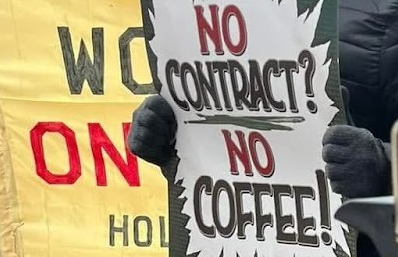
    Some chapter members have been supporting the Starbucks union strike in November and December. Members signed up for picketing shifts and showed out with signs and warm coffee in the cold winter weather. 

    Starbucks Workers United began striking on November 13th nationwide, and continue to do so in many locations, including State Street in Madison. If you’d like to support striking workers, here are some actions you can take:

    • Boycott all Starbucks locations and products while the workers are striking; talk to people around you about joining the boycott – check out and sign the “No Contract, No Coffee” pledge;
    • Turn people away from non-striking / non-union Starbucks locations in the area;
    • Show up to the picket line and participate;
    • Bring treats (especially hot drinks) to the picket line for morale!

    MADSA also hosted some talks and discussions this month, including:

    • A members-only debate on electoralism – what is the extent to which socialists should be engaging in electoral politics within our current capitalist system? What are the costs and benefits around the increase in electoral work this year?
    • Hosting a guest speaker from Brazil’s PSOL, who gave a talk on internationalism and resisting fascism;
    • Strategy discussion on supporting immigrants’ safety in Madison;
    • Check-in discussion on MADSA’s coalition work around housing issues and the Homeless Justice Initiative
    • Planning around the 2026 Chapter Convention;
    • Internal debate on several bylaws as the chapter continues to grow.

    We also shared our Madison DSA Wrapped with highlights from this year!

    Social Events

    We continue hosting recurring social events, including New Member Orientations, DSA 101, Coffee with Comrades, and the Rosebuddies program. Comrades also rang in the new year with a members-only New Year’s Eve party.

    Protest Song of the Month

    For a December protest song, I share The Homeless Wassail. Wassailing is an old English tradition of Pagan/non-Christian origin that now takes place during the countdown to Christmas. It originally involved the blessing of fruit-producing trees – especially in apple orchards – by singing, drinking, and making merriment. It changed over time to include house-visiting, and eventually the Christmas caroling we know today. The linked song highlights the deep pain, inequity, and injustice that continue in our communities.

    And that concludes our monthly round-up!

  • The Peculiar and Continuing Importance of Anti-Black Racism in the U.S.

    By Blair Goodman — Political Education Working Group, Madison DSA

    Madison, right now

    Across Dane County, our campaigns against jail expansion, corporate developers, and layoffs at TruStage all run into the same brick wall: a system that divides and disciplines labor along racial lines. Anti-Black racism isn’t an add-on to class struggle—it’s a core method by which exploitation keeps reproducing itself. This piece offers a framework for connecting those dots in our local work.

    1) Capitalism’s birth in racial slavery

    Modern capitalism was built through dispossession and enslavement—the twin thefts of land and labor. Plantations were early financial instruments linking human bondage to credit, insurance, and global trade.

    W. E. B. Du Bois’s Black Reconstruction showed that enslaved labor was integral to world capitalism, and that the Civil War’s “general strike of the slaves” was the first mass withdrawal of labor in U.S. history. He also named the wages of whiteness: the social privileges that kept white workers tied to their own exploitation.

    2) The logic of racial capitalism

    Cedric Robinson and Oliver Cromwell Cox argued that capitalism didn’t create racism—it modernized it. Racial hierarchy became a tool for managing labor, marking some workers disposable and others “deserving.” Whiteness functioned as property and as discipline: a counterfeit privilege that fragments the class.

    Each transition—from slavery to sharecropping, from industry to mass incarceration—reshaped rather than removed racial rule.

    3) Ruling-class strategies of division

    From Bacon’s Rebellion to Reaganomics, elites have used racial politics to stabilize profit.
    After Reconstruction, terror and “Black Codes” rebuilt cheap, coerced labor.
    In the industrial North, corporate leaders hired across color lines to break strikes and then incited mob violence to keep unions weak.

    The New Deal’s exclusions of agricultural and domestic workers preserved segregation inside the welfare state. Later, Nixon’s “Southern Strategy” and Reagan’s “welfare-queen” myth converted white resentment into a new austerity consensus.

    4) Anti-Black racism in the contemporary economy

    • Labor: Black and brown workers dominate low-wage logistics and care work; white workers are overrepresented in management and tech.
    • Policing and prisons: Incarceration functions as labor discipline under the 13th Amendment exception.
    • Finance: Redlined credit and predatory loans siphon wealth from Black communities; the 2008 crash transferred billions to banks.
    • Environment & health: Toxic exposure, food deserts, and hospital closures show how profit literally costs lives.

    Corporate “diversity” rhetoric and right-wing culture wars both mask this structure.

    Resistance—from teachers’ strikes to warehouse walkouts—shows multiracial solidarity can still rupture it.

    “Anti-racism isn’t a distraction from class politics—it’s how we build working-class power that can actually govern.”

    5) What this means for organizers

    • Integrate racial analysis into every campaign. Whether the issue is housing, healthcare, or wages, trace how racial inequality shapes the field of struggle.
    • Center Black working-class leadership. Leadership development and cadre training should deliberately cultivate Black and marginalized organizers—not tokenism, but strategy.
    • Reject false binaries. Universal demands (like Medicare for All) only transform society if implemented through racial justice.
    • Challenge whiteness as a relation. Build reflection and accountability—not guilt—into your organizing culture.
    • Connect local fights to systemic critique. Show how each campaign teaches lessons about racial capitalism and how collective action can dismantle it.

    The goal is not moral reconciliation but power: a unified multiracial working class capable of governing society in its own interest.

    6) Political education & collective memory

    • Pair readings of Black Reconstruction, Black Marxism, and Hammer and Hoe with local labor history.
    • Map your shop or neighborhood: who gets which jobs, services, protections—and why?
    • Debrief campaigns not only on tactics but on leadership and racial dynamics. Document lessons so they become chapter memory.

    Political education isn’t a classroom—it’s the loop between struggle and understanding.

    Use this next week

    • Bring this piece to your WG or union meeting; connect one paragraph to a current Madison fight.
    • Host a 60-minute discussion using the five organizer implications above.
    • Send local examples (housing, policing, labor) to #redmadison for follow-up coverage.

    Sources & further reading

    • W. E. B. Du Bois, Black Reconstruction in America (1935)
    • Oliver Cromwell Cox, Caste, Class and Race (1948)
    • Cedric J. Robinson, Black Marxism (1983)
    • Angela Y. Davis, Are Prisons Obsolete? (2003)
    • Keeanga-Yamahtta Taylor, From #BlackLivesMatter to Black Liberation (2016)

    About the author: Blair Goodman helps political education at Madison DSA. This piece is part of our ongoing effort to tie local campaigns to a rigorous understanding of racial capitalism.

    🗒 One-Page Printable Discussion Guide

    For WG meetings, study circles, or union caucuses (60 min)
    Goal: connect theoretical insight on racial capitalism to immediate campaigns in Madison.

    Agenda (60 minutes)

    • Opening check-in (10 min): one moment you’ve seen race and class intersect at work or in organizing.
    • Read-aloud (10 min): paragraph 5, “What this means for organizers.”
    • Small-group discussion (25 min):
      • How does anti-Black racism operate in our current campaign or workplace?
      • Which of the five organizer implications feels most urgent here?
      • What concrete change in practice could reflect that insight?
    • Report-backs (10 min): one takeaway per group.
    • Closing commitment (5 min): each participant writes one action step to test before the next meeting.

    Materials

    • Printed or digital copy of the essay
    • Whiteboard/poster paper for mapping examples
    • Optional: QR link to MADSA events page
  • Monthly Round-Up – October 2025

    By a Comrade

    This article is written by a DSA member and does not formally represent the views of MADSA as a whole or its subgroups. 

    Welcome to Vol. 3 of the monthly round-up! The content in this publication overlaps significantly with our DSA newsletter and monthly General Membership Meetings. To sign up for the newsletter or check out an upcoming General Membership Meeting, visit: https://madison-dsa.org/events/

    Union Efforts Continue in Madison

    In August we celebrated the successful union elections at Festival Foods, and Hilton Monona Terrace. Another union battle continues in Madison, however, led by healthcare workers at GHC, and supported by patients and community members.

    The GHC union effort was able to initiate a Special Member Meeting on October 13, where patients with GHC could express opinions on unionization, and conduct an “advisory” vote directing GHC to support the union. Members unanimously supported the union, and asked GHC’s board for transparency around how much money they’re spending on union busting.  Read more here! 

    Beating Back the Political Doom

    MADSA members have been creating more opportunities to learn and be in community, for members AND non-members. These are crucial antidotes to the doom, overwhelm, and helplessness that many people are feeling about the current state of the world. 

    This month, these events included:

    • A discussion with Copaganda author Alec Karakatsanis about policing, media, and narratives around safety;
    • A presentation, for people of all knowledge levels, on understanding the mechanisms of capitalist exploitation, titled Marx’s Capital and Global Capitalism Today;
    • An Organizing 101 workshop for people to learn about workers’ rights and the union process.

    The Electoral Working Group is also busy at work in this realm. Members of this WG have been canvassing local residents to learn more about the issues that matter most to them, and what solutions they hope to see. The working group also organized a public Madison Community Town Hall, with the goal of creating a space for community members to express grievances and connect around possible next steps.

    There was also fruitful internal discussion this month about a potential change to a MADSA voting policy, and how this interacts with the role of meetings in our organization. Some members made compelling points about meetings as a space for developing important leadership skills, refining our ideas and worldviews, changing each others’ minds, and strengthening community bonds; on the other hand, other members discussed concerns around accessibility and inclusivity, and encouraged the chapter to ensure that people can participate meaningfully in major decisions if they have limitations around meeting attendance. Debates like this reflect the chapter’s process of growth, and ongoing work around participatory and inclusive democracy. 

    Further Organizing Highlights This Month

    Our work continues in many ways thanks to our dedicated membership. Here are other key organizing efforts taking place this month in MADSA. This summary is not exhaustive! 

    • No Kings, No Bosses – The “No Kings” protests had a massive presence across the country this month, and this included Madison, WI! MADSA members showed up with a strong presence at the rally.
    • The petition process begins for potentially endorsing candidates in statewide elections. When MADSA endorses a candidate, it is not just a symbolic seal of approval; the chapter is also pledging to provide consistent labor and organization to help that candidate win and to collaborate with them throughout their term. Candidates who wish to gain backing from MADSA must go through a process that includes collecting petition signatures, meeting several times with various chapter bodies, and ultimately winning a chapter-wide endorsement vote. The candidate must demonstrate their commitment to following the expectations outlined in the chapter’s endorsed candidate policy, found here.
    • MADSA’s No Appetite for Apartheid contingent is supporting members in making a pledge to boycott Israeli products. Click here to take the pledge, and to get updates about stores who commit to being an Apartheid Free Store.

    Social Opportunities

    Our chapter has several ongoing reading groups, including:

    • Skyscraper Jails, discussed in the Abolitionist Working Group meetings;
    • Wretched of the Earth, discussed on Sundays, in a hybrid virtual/in-person format.

    We continue hosting recurring social events – New Member Orientations, Coffee with Comrades, Crafting with Comrades,  MADSA Run Club, and the Rosebuddies program.

    Protest Song of the Month

    The song I choose for this month is “Freedom Now” by Tracy Chapman! This song was dedicated to Nelson Mandela and his work in the anti-apartheid movement. I think that the sentiments in this song still resonate to this day.

    And that concludes our monthly round-up!

  • ­David Rovics Concert in Madison

    by Ida Bly

    David Rovics and Kamala Emanuel sang a concert in Madison on September 4th.They call their duo “The Ministry of Culture.” Madison DSA and WORT-FM helped sponsor this performance. This evening of folk-style music offered abundant moments of truth-telling and authenticity.

    There were about 35 people in attendance, in a range of ages, at Muso on Winnebago Street. Muso hosts acoustic music events without amplification. In this case, the pleasing harmonies contributed by Kamala Emanuel greatly enhanced the songs David sang while playing guitar. Attendees responded warmly to Rovics’ songs, including his most well-known song, “St. Patrick’s Battalion,” with driving rhythm and a refrain containing the lyrics: “we witnessed freedom denied…we fought on the Mexican side.” It’s the story of Irish immigrants who switched sides during the Mexican-American war of the 1840s. Having recently faced the choice of “death, starvation or exile” in Ireland, they found the Mexicans’ cause more compelling, staving off an invading army, in a parallel to their struggle against the British.

    Rovics and Emanuel also sang the tongue-in-cheek “I’m a Better Anarchist than You,” encouraging us to poke fun at ourselves, and to work across sectarian lines. Another popular song with a singable chorus was “If Only it were True,” which recounts the absurd right wing charges against Obama as being a tree-hugging, socialist, immigrant-loving, peace-loving Muslim. DSA members can identify with the song’s sentiment, given the bizarre, fact-free accusations of socialism slung as an insult toward various and sundry figures who are anything but.

    There were also new songs about Gaza, including “From Auschwitz to Gaza.” Another brand new song was “Zahid” about a US Veteran who is a beloved long-time local resident of Olympia, Washington, and uses a wheelchair, lingering now in ICE detention in solitary confinement in Tacoma. The concert also included the song, “In Wisconsin in 1854 (Song for Joshua Glover)” (see sidebar article).

    Prior to the main act, local singer Tom Wernigg opened the night with his country-tinged, humanistic, singable, and informative songs that have a deep vein of humor. He sang, “I don’t like genocide…under any guise”. The sarcastic “My Minivan…it’s my best friend” included the line, “I like my burgers with freedom fries.” We hope Tom in his signature hat will perform more often in Madison.

    Rovics and Emanuel concluded their performance to applause. Returning to the stage for an encore, they sang “Behind the Barricades“ [2001] acapella with the passage: “As the movement grows there will be hills and bends—But at the center of the struggle are your lovers and your friends—The more we hold each other up the less we can be swayed—Here’s to love and solidarity and a kiss behind the barricades.” It was a tremendous and satisfying finish to a great night.

    Muso performance space

    Muso created a magical and whimsical backdrop for the event. The proprietors have roots in the Act 10 uprising and long-running Solidarity Sing Along at the Wisconsin Capitol since 2011. Muso puts a strong emphasis on pure musical experiences, especially participatory events. The venue has continued to improve over the last year. We enjoyed comfortable seating augmented by luxurious sofas piled with comfortable pillows, a bookshelf-lined wall, fanciful stenciled woodwork and colorful paper mobiles. There was even a break between sets to enjoy refreshments and visit with others at the event. Muso has great potential for more political and socialist-themed gatherings.

    Music in Social Movements

    David Rovics is a singer with anarchist politics, connecting many movements over the decades. He describes his “songs of social significance” as being “about life on earth” or, variously, as “songs to fan the flames of discontent.” His works touch on dozens of contemporary struggles including immigration, war, labor, gentrification, capitalism, environmental struggles, high rents, and so on. He is particularly notable as a prolific song writer. Never shying away from difficult subjects, he also writes about bicycles, bonobos, and visions of a better world we can create.

    One of my favorite songs is “We Just Want the World” [1998]. It speaks to our fondest wishes: ”closing down munitions plants…shutting down the oil rigs/ And turning towards the sun…we don’t want your dead-end highway/ We just want the world.”

    His pieces have been called “song stories,” and in many cases use a specific event to symbolize a much larger issue. Rovics’ historical references have also been compared to what folk singer Utah Phillips called The Long Memory, a connected view of history that can help us see where we want to go. In this moment especially, we need singers and cultural workers to help illuminate our history because it is intentionally obscured by the ruling elites. David Rovics has a large catalog of music on Palestine, dating back at least twenty years but particularly voluminous in the last few years, with new songs coming out regularly on the topic.

    For his troubles, Rovics has suffered the demonetization of his YouTube channel in the last year, a major threat to a performer’s financial stability. Just this week, YouTube removed his song “I Support Palestine Action.” His events have been cancelled for political reasons, and he has endured government surveillance during his stops, even in New Zealand and Scandinavia. This reminds us of something we know very well from TV’s top comedians lately: cultural workers put themselves at risk. If our enemies know how powerful cultural workers can be, why don’t we?

    I first saw David Rovics perform in Madison at the First Congregational Church on the corner of University Avenue and Breese Terrace in the early 2000s, as part of the Earth Day to May Day events. He also performed at Wil-Mar Community Center around 2009 — on that visit his friend and legendary labor troubadour Anne Feeney was in the audience (his tribute to her: “I Dreamed I Saw Anne Feeney”). On August 25, 2024, Rovics and Kamala Emanuel played on the Madison Labor Temple lawn, with sponsorship of the Family Farm Defenders, with the Raging Grannies as an opener (See the Grannies’ video clip and lyrics listing from that event here).

    David Rovics was interviewed by Brian Standing on the WORT-FM show, The 8 O’Clock Buzz in 2024, touching on the role of music in protest gatherings, and that interview can be heard here:

    More recently, host Martin Alvarado interviewed David Rovics on Global Revolutions on WORT-FM radio on Mon. Sept. 1, 2025, in the 3rd hour, minute 2:04-2:27. The archive of this brief interview is still available for a while. In this interview, David reported witnessing a Labor Day Parade in Rockford, Illinois, on their way up to Madison to perform this year. Although it was a massive nationwide day of protest with the theme “Workers over Billionaires,” these cultural workers did not get invited to participate, enjoying it instead as spectators.

    It was a notable omission, especially because Rovics has made remarkable contributions to the labor movement’s songbook, writing original songs on topics such as Mother Jones (“Pray for the Dead and Fight Like Hell for the Living”), May Day (“The First of May,” and “When the Workers of the World Unite”), “The Battle of Blair Mountain,” the IWW “Ballad of a Wobbly, the Depression (“Union Makes Us Strong” [2010]), the Wisconsin Uprising “We Will Win (Song for Wisconsin)” [2011], and “Tax the Rich” [2011]. Rovics’ bluegrass classic, “Minimum Wage Strike,” is at least as relevant today as when he wrote it in 1998. His song “Joe Hill,” (written on the 100th anniversary of Joe Hill’s death in 1915) is about a labor organizer who was condemned to death by the state of Utah, and was executed by a state firing squad. How strange it is that the state of Utah may again execute someone by firing squad, if recent events at Utah State University play out as expected. The Death Penalty Information Center wrote a post about this. The current case is nothing like Joe Hill’s, and yet it is amazing how history echoes!

    Rovics’ song “Everything Can Change,” about organizing, has a valuable message. We need our organizations of course, but these are just part of larger movements. Our organizations ebb and flow, and only partly contain our capacious aspirations. We need art, music, feasts, festivals, and culture that can carry us from one organization, movement, and phase of life to the next. We need to build deep community that can sustain us for the long haul.

    It’s a mistake when our organizations forgo art and music. We deprive ourselves of the succor of music and poetry when our protest events do not include them. Author Barbara Ehrenreich, who was active in DSA, made the point that movements are more than their organizations, and need vital cultural elements to make them strong. The Poor People’s Campaign has made art and music an important component of their work. Preaching to the choir is not pointless, and even left-brained people need encouragement, connection, and learning –- preferably in handy formats to integrate into daily life, such as songs you can sing in the shower or while cleaning the house, as well as before the city council, at a protest, or on a picket line.

    Hearing Difficult Truths

    One of the motivations for listening to Rovics’ music is that hearing the truth brings cleansing release, even when it is challenging. Particularly now, one longs for the truth, as science is being sidelined, and the gains of the Enlightenment erode. One’s mind and senses feel polluted, as the disgusting residue of falsehoods accumulates. The obsequious worship of power pervades our airwaves and hardens our souls. There is also a struggle to make meaning of our experiences, living here in the heart of Empire, passing people sleeping on the street, taking in the horrors on TV and the crossing of red lines around the world. It is helpful to gather together to seek shared understandings.

    While cringing at the sorrows, we reach for the serenity of wisdom. I often think if I understood better how things got so bad, it might help me know how to move forward. This is why learning about socialism is so important now.

    David Rovics’ culture work includes essays published in Counterpunch and other places. David’s archive of music is accessible for free at www.davidrovics.com. He also has a presence on Blue Sky, Tiktok, X, Instagram, Threads, Facebook, Substack, YouTube and Songkick. You may tune into his podcast “This Week with David Rovics” – with music, history and current events here. He also has a new memoir out in the form of an audiobook, called My Life as a Protest Singer. To get full access to this and other special material, there is a subscription-based Community-Supported Art program available through his website.

    The morning after his performance in Madison, Rovics and Emanuel left for Woodruff, far in the north of Wisconsin, to continue to bring this music to new places, and new people. Rovics often performs for free in parks, at protest gatherings, and on picket lines. Having wrapped up the Midwest tour for now, the next stop is a tour of New York and New England starting in October.

    Sidebar: Song for Joshua Glover

    Rovics’ and Emanuel’s concert included a song written last year about Wisconsin history, “In Wisconsin in 1854 (Song for Joshua Glover).” It is about the Fugitive Slave Act period when the federal government forced local police to cooperate with slave catchers. But it is also a triumphant tale of rebellion by the local population against this unjust law. After a mob of Wisconsinites helped Glover escape from jail and leave the country, the state of Wisconsin declared the Fugitive Slave Act of 1850 unconstitutional in 1854. The people of Wisconsin made a singular, definitive pushback, and effectively ended this law through this one instance of cross-racial solidarity, and public collective disobedience. It usually takes more than one.

    Phil Busse (a Madison native) wrote a guest column that ran in the Wisconsin State Journal on May 5, 2025, “Arrest of Milwaukee judge hearkens back to 1850s” explaining how the Joshua Glover incident has important parallels to the immigration struggle embodied by the Judge Hannah Dugan case, set to go to trial in Milwaukee in December.

    In 2021, the city of Toronto commissioned a statue of Joshua Glover for a city park. The design is well worth looking up online, and includes Glover in a top hat and with Afrofuturist elements. After escaping the US, Glover lived out the rest of his long life in Canada but also suffered a short bout of imprisonment there, and was denied a proper burial. There have been recent tributes to Glover, including a commissioned song called “Freedom Heights” with a video version spliced with images of Toronto’s pro-basketball Raptors team members. There is also a new mural to Joshua Glover on the I-43 underpass in Milwaukee. There is a new mini-documentary film (“Liberty at Stake”) too. The Republican Party intentionally highlighted the Joshua Glover incident during their convention in Milwaukee in 2024, aiming to claim the abolitionist roots of their party’s founding in Ripon, Wisconsin. But it is an open question whether the Party would make the same effort today, less than one year later. In any case, it is an important historical incident that is too little known, even here in Wisconsin.

    Also relevant is David Rovics’ song “In Between Milwaukee and Chicago” written in the wake of the police shooting of Jacob Blake in Kenosha.

    On the topic of statues and murals, it is truly remarkable how many long-overdue historical markers went up only after the protests spurred by George Floyd’s death in May 25, 2020. I saw three examples of this on a recent visit to Jackson, Tennessee. Historical markers were recently put up there to the late-1800s lynchings on the courthouse lawn, the 1960’s Woolworth’s lunch counter sit-ins, and to honor their native son, Gil Scott-Heron, the world famous jazz poet and spoken word artist (“The Revolution Will Not Be Televised”). This history languished, ignored in plain sight, until the Black Lives Matter protests after George Floyd forced local communities to rectify their long silencing of history.

  • Reading Group Report Back: Vladimir Lenin’s Imperialism

    From April 20th to May 11th, comrades in MADSA completed a reading and discussion of Vladimir Lenin’s Imperialism, the Highest Stage of Capitalism. Originally written in the first half of 1916 and published as a pamphlet in mid-1917, Lenin’s work analyzing how and why imperialism emerges under capitalism remains a vital resource in developing a stronger understanding of key Marxist concepts and analyses.

    For most members of the group, it was their first time ever reading any literature written by Lenin. Most members felt the language of Imperialism was easy to understand and the text was a decent length with a good amount of content to analyze. Imperialism is backed up by quotes from other scholars Lenin was familiar with at the time of writing, as well as tables of data and other evidence for his claims that imperialism is the final (inevitable) stage of capitalism. 

    After reading Imperialism, the reading group members felt it was helpful to see how capitalism evolves into imperialism in phases. For some, it was helpful to see with clarity how capitalism evolves into imperialism, and it was easy to make comparisons with how the world functions in 2025. 

    As for the logistics of running the reading group, members felt it was great to have a member lead the discussion with key questions or main thoughts to get conversation started. Meeting in person was nice for interacting with comrades, but having it remain hybrid is best for engaging more members in the discussion and allowing flexibility for members who could not join in person. The length of Imperialism was ideal and it was easily divided into 30-40 page readings every week, which was manageable by everyone. 

    As for the future of chapter reading groups, members floated the idea of doing more political theory and history discussion in the Slack, so members can ask clarifying questions about topics, answer each other’s questions, or engage in friendly debate about readings. Having discussion questions assigned ahead of time could potentially help structure readings as well.

    Overall, the reading group went well and members were excited to continue reading anything in general. Members also felt keeping the reading group casual would allow for other members to explore things to read that aren’t just Karl Marx. 

    An important takeaway from reading Imperialism is Lenin’s theory that imperialism is the final stage of capitalism, that it was the natural final stage that arises out of the formation of monopolies, and that capitalism is at that stage has reached a dead end. As socialists, we were able to map out Lenin’s ideas neatly along the problems of the United States, which left us with a burning question: if we are living under the final dead-end stage of capitalism, what happens next? This question inspired us to seek out another work by Lenin, State and Revolution, to hopefully gain more insight into what Lenin believed would occur next. 

    With the MADSA chapter steadily growing in membership over the past few months, there has been talk about developing more chapter education initiatives, whether that be more Socialism 101 events or events designed to help people understand specific areas of political theory. It is important that comrades who have the time and energy to read and discuss theory also take the time to educate others, either through book/discussion group reports, posts to Red Madison, or helping to organize educational events. 

    We commend our comrades in the chapter for achieving the gargantuan task of completing a reading of Karl Marx’s Capital, as this work serves as the most fundamental basis for our understanding of capitalism and frames our beliefs as socialists. Comrades in the Imperialism reading group have expressed an interest in continuing to read fundamental works from European socialists like Marx, Lenin, Luxembourg, and others. We also agree that we should be taking time to source important works from non-Western/non-European points of view. We would like to invite our comrades to engage more in the chapter reading groups, whether that be posting in Slack to ask questions about our readings and findings, or joining the readings whenever they can.

    We were able to access Imperialism for free using the Marxists Internet Archive. A free PDF of Imperialism can be found here.
    An annotated version of Imperialism edited by MADSA’s own chapter member Phil Gasper can be found here for purchase.

  • Reading Group Report Back: Karl Marx’s Capital

    …by a reading group member

    From November 2024 to March 2025, Madison Area DSA embarked on an ambitious political education project. A reading group formed to tackle Paul Reitter’s 2024 translation of Capital. The challenges of this book were clear and immense from the beginning. Marx’s words measure to a total of 710 pages with over 100 more pages of introductions and endnotes. It tackles a vast array of topics starting with a theoretical analysis of value, a mathematical assessment of the working day, and a historic review of the working class’s conditions across Great Britain. To call this work a magnum opus feels like an understatement. 

    How did MADSA respond to the challenge? There are different measures of success that should be considered. Over a dozen members signed up in December to attend the weekly meetings. Attendance dwindled rapidly to a core four members who finished the text earlier this year. We held a majority of meetings in-person at the Social Justice Center, though occasionally some were converted to Zoom due to scheduling conflicts. By the end, a transition from Thursday nights to Saturday mornings was made to facilitate reading group members taking on other active organizing projects on weekday nights. 

    The drop in attendance was likely multifactorial. For some members, the scheduled in-person weeknight meetings were inaccessible. For others, missed meetings due to other end-of-year holiday obligations made it difficult to catch up. Because each chapter of Capital references previously introduced concepts, falling behind often meant being left behind. In response, reading group members employed a combination of audiobooks, physical books, and digital ebooks to read the material. This allowed time-strapped members to maximize opportunities to read between sessions. Basically, whenever I had free time this winter, I needed to crack open Capital to stay ahead. 

    Sessions originally consisted of facilitated meetings with a self-nominated leader agreeing to summarize key concepts and key vocabulary each week. The decline in membership led to a decline in formal structure. At the conclusion, the four remaining members brought an equal share of questions and key passages to the table for others to review and discuss. This second model reduced scheduling anxiety and remained effective because as members grew to understand and build off of each other’s strengths. In general, a key source of success was having a member already familiar with the text, this member provided valuable context at the beginning of each session and prepared us with signposts to pay attention to when we read the into the next section.

    In summary, I believe MADSA should form a Capital reading group every two years to maintain institutional knowledge of the key socialist theories among chapter members. Future reading groups will benefit most from regularly scheduled meetings that do not interfere with the end-of-year holidays. They should also seek to have members who are already familiar with the text to help draw attention to key ideas for new readers. It is worth considering the use of supplemental material, such as David Harvey’s chapter by chapter lecture series, which could reduce entry barriers or help members stay up to date despite occasionally missing a section. However, I believe there is significant benefit to engaging in the written metaphors and analogies Marx uses to explain his concepts. Members relying only on summarized material will miss the humor and jokes very much needed in the socialist vernacular to call out the contradictory monstrosity of capitalism. 

    The question of in-person versus video meetings remains up in the air. I invite current MADSA attendees of Imperialism, the Highest Stage of Capitalism reading group to contribute a follow-up report to Red Madison to help direct the chapter’s burgeoning political education committee on the best practices for maximizing access to important member education. 

    Finally, what other key theory should enter the MADSA reading group roster? In addition to reading European socialists like Marx and Lenin, MADSA should make dedicated space for non-European theory exploring the mechanisms of capitalist oppression. Given we organize within occupied Ho-Chunk land in the shadow of a massive land grant university, members would benefit from critical theories of settler colonialism. Reading groups for Fayez Sayegh’s 1965 thesis, Zionist Colonialism in Palestine and La Paperson’s A Third University is Possible represent exciting ways to build the membership’s capacity for material analysis and historical critique.