Tag: Local Politics

  • Monthly Round-Up – January 2026

    Monthly Round-Up – January 2026

    This article is written by a DSA member and does not formally represent the views of MADSA as a whole or its subgroups. 

    Welcome to Vol. 6 of the monthly round-up! The content in this publication overlaps significantly with our DSA newsletter and monthly General Membership Meetings. To sign up for the newsletter or check out an upcoming General Membership Meeting, visit: https://madison-dsa.org/events/

    MADSA Endorses Fran Hong for Governor

    Cheers erupted in the January 28th General Membership Meeting when over 100 people voted in favor of endorsing Francesca Hong in the upcoming Wisconsin gubernatorial race. The air in the meeting was electric and attendance was the largest in recent chapter history. Comrades engaged in rousing debate during the discussion block, on factors including election timing, chapter capacity, trust in structures of power, the opportunities and drawbacks that come with campaign organizing work, and the potential representation of socialism in WI. Ultimately, the chapter expressed readiness to put work into this campaign. 

    As the District 76 State Representative and a member of the Wisconsin Legislative Socialist Caucus, Fran has championed democratic socialist policies like universal childcare, public education and healthy school meals for all, paid family leave, and an Economic Justice Bill of Rights which guarantees the right to a unionized job. She continues to run as a proud democratic socialist on a platform of economic justice and workers’ rights. This campaign also means a huge opportunity for community-building; people will be connecting across Wisconsin through door-to-door canvassing, phone banking, town halls, and other volunteer opportunities during the campaign. The chapter looks forward to meeting new people, discussing the issues that matter to them, and promoting policies for building working class power. 

    Chapter Prepares for Upcoming Annual Convention

    The DSA follows a deliberative democratic decision-making process, empowering all members to have a say in local and national DSA action. The process has many benefits, including feeling a higher sense of ownership in the projects of the organization, building leadership and speaking skills among members, encouraging critical thinking, modeling active participation in decisions that impact us, maintaining a sense of accountability in leaders, and being able to focus on several areas based on the abilities and desires of membership. As our chapter has grown in size, we’ve seen new working groups, changes to the bylaws governing our chapter, expansion of certain roles, and lots of lively discussion in-person and in our online channels! We’ve been seeing more debate as well, which is a sign of healthy engagement.

    We have an opportunity for more change as our annual chapter convention is approaching. The dates have been finalized for March 20th and March 21st, 2026. The convention plays a huge role in chapter work for the rest of the year. At the convention, you will:

    • Hear reports from working groups in our chapter;
    • Vote on continuing existing working groups (rechartering);
    • Vote on new bylaw amendments and chapter resolutions (starting new campaigns, working groups, projects, etc.);
    • Vote for leadership positions – executive co-chairs, administrator, treasurer, communication and membership coordinators, “at-large,” Solidarity Captains, and the Community Accountability Committee (“CAC”). 

    There are several preparation meetings scheduled before the convention, where people can co-work on resolutions and get feedback. Here is the timeline leading up to convention:

    • Resolution Writing Workshop 1 – January 14th, which already took place this month!
    • Resolution Writing Workshop 2 – February 12th 6:30-8:30pm at Social Justice Center.
    • Due date for All Convention Materials – February 20th.
    • Due date for Amendments to Proposals – March 10th.
    • March General Meeting – convention agenda will be discussed – March 11th.
    • Convention Friday March 20th 6-9pm + Saturday March 21st 10am-4pm.

    Click here to see the full Convention Guide and/or RSVP – all members are strongly encouraged to attend so that they can participate in leading MADSA’s next steps for 2026!

    ICE Out: Working Towards Community Safety

    Alongside hope for Fran’s campaign, and focus for the upcoming convention, people’s hearts are burning with fear, sadness, and rage around state violence inflicted in the name of unjust “immigration enforcement” and protest “crowd control.” We are witnessing senseless deaths and extrajudicial kidnappings – flagrant human rights violations. 

    Socialists know that the horrors we are seeing today are not the result of one mad leader (nor his cabinet), but the result of over a century of festering capitalism, racism, and imperialism concentrating wealth and power to the few. MADSA released a statement, and is ongoingly deliberating on what our medium- and long-term role will be in supporting communities around safety and immigration rights in the face of escalating political violence. The previous section noted the highlights of our deliberative democracy structure, but the major drawback is that decisions tend to move more slowly than in a “top-down” structure. While that work is ongoing, MADSA and its members have organized and participated in several actions in January, and will continue to do so:

    • Members participated in the Ice Out Solidarity Vigil on January 9th after the killing of Nicole Good, as well as the following Ice Out rally on January 10th.
    • Members participated further in an Ice Out rally on January 25th in response to the killing of Alex Pretti. Member Sam D. gave a speech – click here for a link with captions
    • Members participated in an ICE Week of Action building up to a January 30th walk-out + march and the January 31st Madison Anti-ICE Community Meeting organized by MADSA. This included Know Your Rights training, group discussion, opportunities to generate concrete political demands, and information about next steps to build networks of community support. Organizers will continue to meet around this work. 
    • Members are also building to a national general strike on May Day, which will include demands around safety for immigrant communities and communities of color.

    Additional Organizing

    Other important efforts this month included the following:

    The Labor Working Group is launching the Madison Organizing Institute a 12-week long course designed for anyone who wants to build or strengthen a union in their workplace. The course will teach you about your organizing rights, skills for talking to coworkers, developing demands, and more. Click here for the link to sign up.

    No Appetite for Apartheid announced a launch party scheduled for February 7th, 6-8pm at James Reeb on E. Johnson. This event is open to the public, stating: “The goal of the No Appetite for Apartheid campaign is to make Madison a more ethical place to shop by removing all grocery items complicit in the violence against Palestinians.”

    A member announced an Artists’ Planning Meeting for February 1st with the goal of adding art programming to the upcoming Convention, and overall increasing art and music engagement in the chapter.

    MADSA has been more in touch with Milwaukee DSA in light of recent organization work, and the latter chapter published a podcast episode about successful labor organizing in Milwaukee. Listen to it here! 

    Social Events

    We continue hosting recurring social events – New Member Orientations, DSA 101, Coffee with Comrades, and the Rosebuddies program. We also look forward to various canvassing opportunities and electoral campaign-related events in February and beyond. 

    Protest Song of the Month

    For January, I present the Song of Choice by Peggy Seeger. This song uses an extended metaphor of dormant seeds to represent fascism, and urges the listener to pull the weeds before it’s too late. A snippet:

    “Early every year, seeds are growing

    Unseen, unheard, they lie beneath the ground.

    Would you know before the leaves are showing

    That with weeds all your garden will abound?

    If you close your eyes, stop your ears,

    Hold your mouth, how can you know?

    The seeds you cannot see may not be there;

    The seeds you cannot hear may never grow…

    In January you’ve still got the choice,

    You can cut the weeds before they start to bud!

    If you leave them to grow higher, they’ll silence your voice

    And in December you may pay with your blood!”

    And that concludes our monthly round-up!
  • Monthly Round-Up – November 2025

    By a Comrade

    This article is written by a DSA member and does not formally represent the views of MADSA as a whole or its subgroups. 

    Welcome to Vol. 4 of the monthly round-up! The content in this publication overlaps significantly with our DSA newsletter and monthly General Membership Meetings. To sign up for the newsletter or check out an upcoming General Membership Meeting, visit: https://madison-dsa.org/events/

    Behind-the-Scenes in a Growing Org

    Over the past year, the DSA has had a huge boom in membership nationally, a surge in membership here in Madison, and an increase in name recognition after Zohran Mamdani’s recent high-profile win in NYC (as well as other wins across the nation!). MADSA saw several new work groups form throughout 2025, as well as new projects, book clubs, potential candidate endorsements, and events for members and the community at large. These efforts all remain underway!

    As MADSA has scaled up, we’ve also contended with more mundane operational questions– How do we handle marketing and social media posts, now that there are so many more events? How are we feeling about our electoral endorsement process when it’s for re-elections? How can we keep developing comradeship among members? What is a good venue for our monthly meeting?!

    Here is a small behind-the-scenes look at some changes as we expand:

    • The Communication Committee (Comms) is working on appointing “liaisons” within each working group and project, so that Comms can stay better oriented to the chapter’s marketing/posting needs;
    • Comms and Executive Committee are also working on increasing direct posting access for various Working Groups so that they are not solely reliant on Comms for posting information about events and actions;
    • The Electoral Working Group has been exploring endorsement for several candidates running in state and local races, as well as discussing and reviewing the endorsement processes themselves;
    • Various members continue their efforts to revitalize Red Madison for internal and public readership – this has included identifying people who are open to contributing, as well as making calls for submissions at our general meetings;
    • The chapter will be publishing a resource to prepare for the 2026 Chapter Convention, where members will continue shaping the direction of MADSA;
    • The chapter has been experimenting with a few different venue options for GMMs to accommodate our new numbers and the geographical distribution of our membership.

    It is our hope that these changes will support the continued growth of the chapter, both in scope and in activity levels. 

    Social Events

    Our chapter had two reading groups wrap up in November:

    • Skyscraper Jails, discussed in the Abolitionist Working Group meetings;
    • Wretched of the Earth, discussed on Sundays, in a hybrid virtual/in-person format.

    We continue hosting recurring social events – New Member Orientations, Coffee with Comrades, Crafting with Comrades, MADSA Run Club, and the Rosebuddies program. 

    As the year comes to an end, we’ll be reaching out to members and asking about their experiences in MADSA this year, and their socialist resolutions for 2026. We’re also planning a New Year’s party on New Year’s Eve, details forthcoming!

    Protest Song of the Month

    For a November protest song, I’d like to highlight an artist from an indigenous background and ties to the Midwest – John Trudell. John was a Santee poet, musician, actor, speaker, veteran, and activist, at one point chairing the American Indian Movement (AIM). Here is the Listening / Honor Song, a spoken word piece over traditional music. The lyrics can be found here

    And that concludes our monthly round-up!
  • Shepherd Janeway for Madison School Board

    Shepherd Janeway for Madison School Board

    by Bonnie Willison for Madison Area DSA’s Electoral Working Group

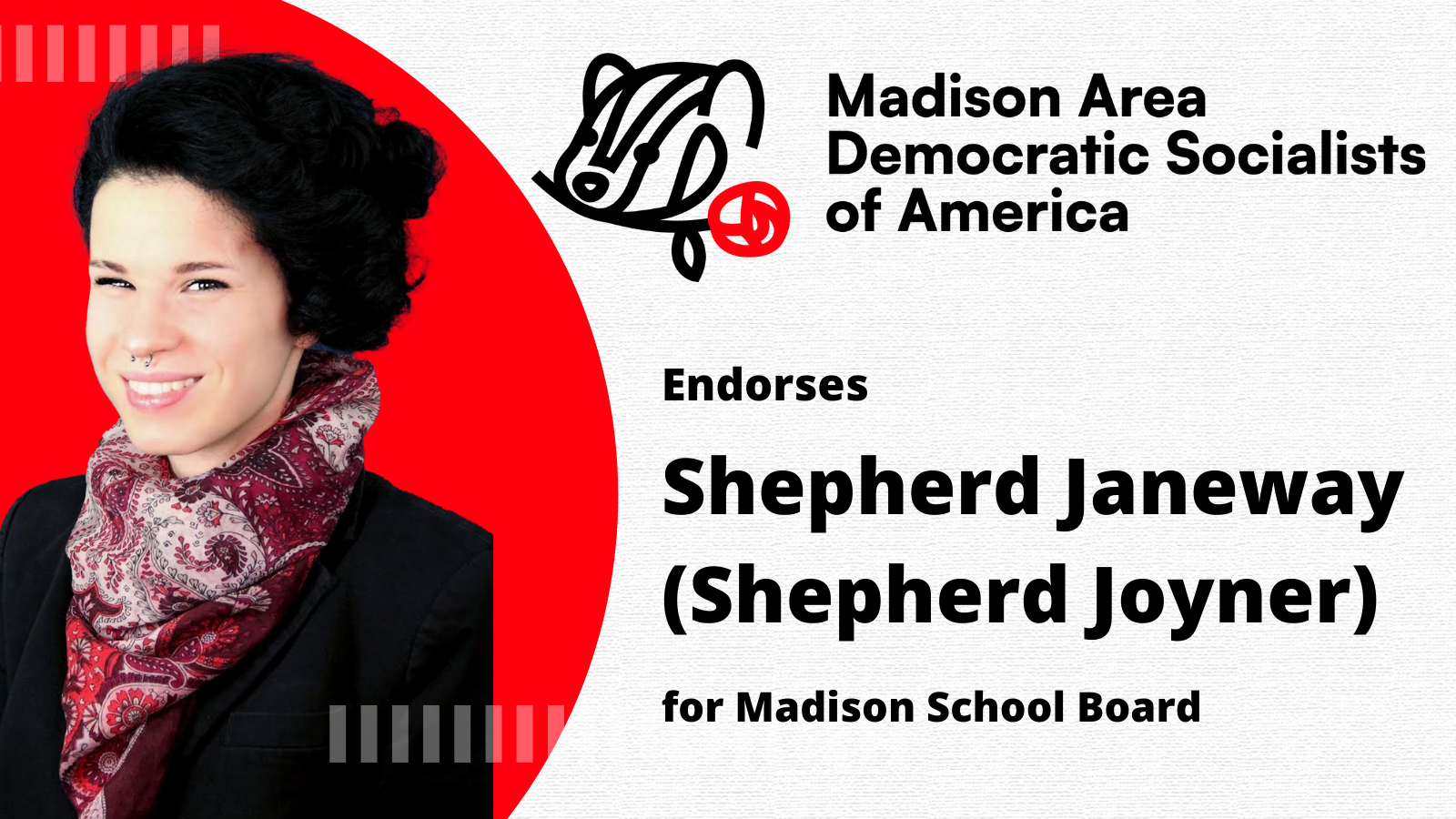
    Madison Area DSA is proud to endorse Shepherd Janeway (who will appear as Shepherd Joyner on the ballot) for seat 3 on the Madison School Board.

    Shepherd Janeway is a teaching artist with Whoopensocker, a UW-Madison program that uses creativity, expression, writing and collaboration to build self-empowered students. Through this work, Shepherd has gotten experience in Madison classrooms.

    Unlike their opponent Laura Simkin, Shepherd does not support returning School Resource Officers (SROs) to Madison’s schools. “I don’t believe in bringing school resource officers or armed law enforcement individuals into schools,” said Shepherd. “I believe that restorative justice practices and trauma-informed methods for behavior management are the way to address the root causes of the problems.” 

    “I don’t believe in bringing school resource officers or armed law enforcement individuals into schools,” said Shepherd. “I believe that restorative justice practices and trauma-informed methods for behavior management are the way to address the root causes of the problems.” 

    As someone who is Black and albino and attended public schools, Shepherd said they are familiar with the realities of racial inequality in the classroom. “We know that racial inequality contributes directly to an inequality of opportunities and resources in regards to education,” said Shepherd. As a result, students of color’s education suffers. Shepherd supports creating explicitly anti-racist policy and a clear protocol of response to racism.

    Shepherd’s other priorities are transparency, communication, staff retention, and COVID safety measures. They call for a more thoughtful and thorough approach to management of pandemic risks and better communication with parents.

    The election is on April 5. To vote early in-person from March 22-April 2, see these early voting locations. If you need to register to vote, bring proof of residence with you (although there is no voter registration on April 2, per state law).

    To vote early by mail, request an absentee ballot online by 5 pm Thursday, March 31, and return it via mail to the Clerk’s office before election day or in-person at your polling place on the day of the election.

    Here are some links to make sure you’re registered to vote (or update your address), answer questions you might have about voter ID, preview your ballot, find your polling place or request an absentee ballot.

    Follow Shepherd for School Board on Facebook

    More info: 

    Shepherd Janeway: Teacher, activist, educator

    Madison School Board candidates split on police in schools

    In Madison School Board forum, four candidates debate most pressing issues

  • The Serious Politics of the ‘People’s Candidate’ for State Senate

    The Serious Politics of the ‘People’s Candidate’ for State Senate

    by Madison Area DSA’s Electoral Politics Working Group

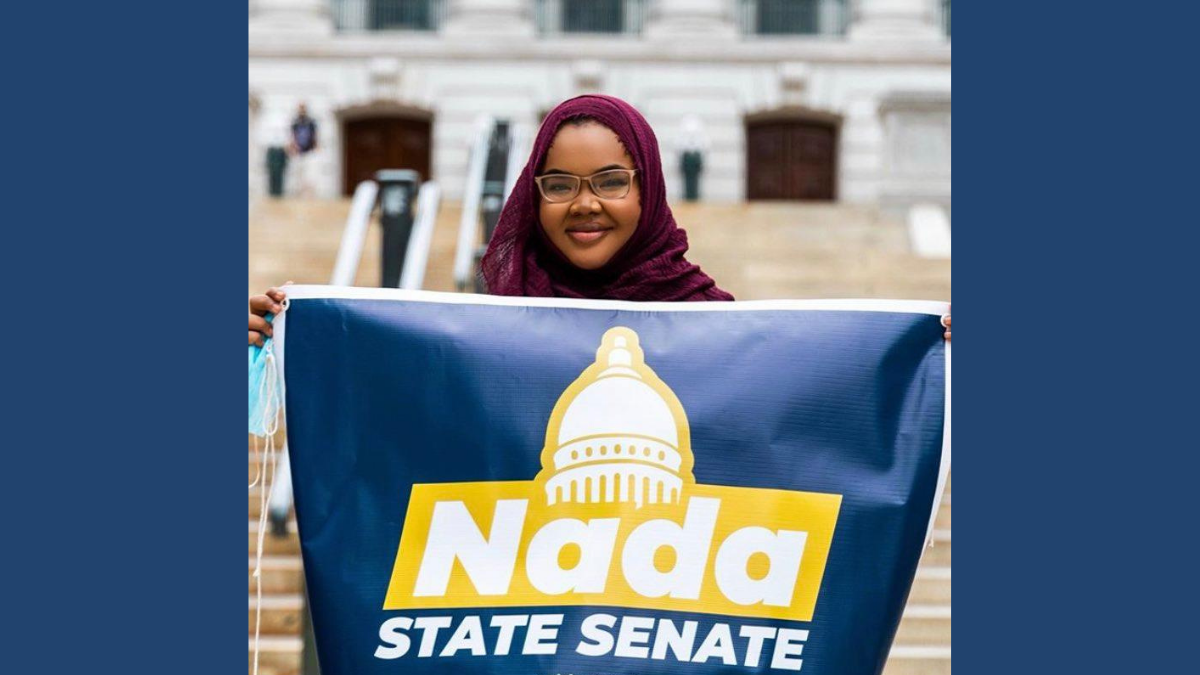
    In just her first candidacy for public office, Nada Elmikashfi exposed all the ways in which politics as usual in Madison was never good enough. In her run for State Senate, she shook up a status quo that has held for far too long. Even if you put Fred Risser’s unbearably long tenure aside, it’s rare for any incumbent in Madison to face a challenge. That such a challenge came from a young Muslim immigrant working class woman of color with extremely good politics brought much needed new perspective, and a glimmer of hope into a city whose politics are often very myopic. She did this in lots of ways that are worth exploring, one of which is how she stood outside the business as usual of Madison progressive politics.

    Most Madison campaigns fit inside extremely narrow ideological and temperamental bounds. Vague, polite, non-confrontational progressivism is the name of the game. Candidates do their best to exude the energy of that box-checking, post-2016 yard sign: “In this campaign we believe science is real, love is love, black lives matter, etc. etc.” The Madison Candidate wants you to know they’re on the right side of the issues, but they would prefer not to quarrel over them. No doubt some Madisonians would like to think that this is because there is broad political agreement within the city. Or perhaps, if there is disagreement it’s better for everyone to “take the high road,” because we’re all in this together aren’t we? But there are winners and losers in all politics. If no one is fighting it’s because someone has already won.

    But there are winners and losers in all politics. If no one is fighting it’s because someone has already won.

    When we can only conceive of politics as a polite affair where candidates not only can, but must elide their differences due to some notion that everyone wants what’s best, we lose sight of the fact that lives and livelihoods hang in the balance. In politics, there are real, material conflicts of interest that are going to be sorted out one way or another. Housing cannot become more affordable without hurting landlords’ bottom line. Lake levels can’t be lowered to stave off flooding without affecting the value of lakefront property. Racial justice cannot be achieved without hurting the profits of the prison industrial complex. If a candidate is a meaningful threat to those interests, powerful forces are going to fight back with everything they’ve got. If that fight does not manifest in the campaign, if everyone campaigning is on the same side, then it is pretty clear whose side that is.

    Nada brought these conflicts to light by speaking honestly about what is happening politically in Wisconsin. She called out Kelda Roys for owning a real estate company and (through a combination of personal loans to her campaign and big dollar donations) essentially buying her way into the State Senate. She swiftly denounced a bill co-authored by a Democratic State Senator that would have been used to criminalize Black people. There are some who might dismiss this as unnecessarily antagonistic, but the antagonisms are present whether they are acknowledged or not. The ways in which established politicians reacted to Nada make this clear. Roys, despite declaring her candidacy months after Nada and others, claimed to be the only person running for Risser’s seat. Former Mayor Dave Cieslewicz wrote an entire blog post dedicated to calling Nada unserious. Tim Carpenter responded to Nada’s criticism by harassing her online to the point that he was reprimanded by the State Senate Minority leader. These antagonisms came out not just because of the policies that Nada stood for, but because of who she is.

    Much of these reactions were based on racism, sexism, age-ism, anti-immigrant and anti-Muslim sentiment. A Madison born white male candidate with the exact same policies, levying the exact same criticisms would not have faced the same blowback. In this way, Nada’s identity cannot be extricated from her politics. There are meaningful political differences between a white man calling for racial justice and a Black woman doing the same and the differing reaction speaks to that. 

    Through being serious about the issues, honest about how our system works and just plain being herself, Nada put the Madison political establishment extremely off balance.

    In addition to how politicians and pundits react to each other, identity shapes the ,way candidates react to events outside of their control as well. Kelda Roys, during the height of the George Floyd protests, was put in the absurd position of trying to make the case that she (as opposed to any of the numerous candidates of color running for the seat) would be the one to deliver on racial justice. Politics is above all about trust and credibility. Particularly in the absence of an established, cohesive political movement, identity plays a huge role in who has it and who doesn’t.

    Through being serious about the issues, honest about how our system works and just plain being herself, Nada put the Madison political establishment extremely off balance. Even though she didn’t win her campaign, she’s already left an indelible mark on the city. Nada brought the politics back into Madison politics. Hopefully it is here to stay.

    Members of Madison Area DSA formed the Electoral Politics Working Group to advance democratic socialism through local political bodies, including elected offices. To learn more about the efforts of the working group and to find out when they meet and how to get involved, visit our chapter website.