Tag: news

  • Monthly Round-Up – March 2026

    Monthly Round-Up – March 2026

    This article is written by a DSA member and does not formally represent the views of MADSA as a whole or its subgroups. 

    Welcome to Vol. 8 of the monthly round-up! The content in this publication overlaps significantly with our DSA newsletter and monthly General Membership Meetings. To sign up for the newsletter or check out an upcoming General Membership Meeting, visit: https://madison-dsa.org/events/

    This photo depicts approximately 40 Madison DSA convention attendees with their fists raised. They are in a room with wood paneled walls.

    MADSA Annual Convention a Success

    The chapter held our annual convention on the evening of Friday March 20th and the full day of Saturday, March 21st. MADSA members elected new leadership for the coming year, voted to continue many working groups, and debated and passed resolutions that will shape how the chapter does its work this year and beyond. Below are 3 key themes from this year’s convention.

    1. Organizing Everyday People, Especially Labor

    This convention passed several exciting proposals around mobilizing everyday worker power. One was a major resolution setting clear goals around a “rank and file” worker organizing strategy. In short, key goals include: increasing organizing discussions in people’s unionized and non-unionized workplaces; taking specific actions to help existing unions become more active and socialist; taking steps towards a mass labor action on May 1, and building further potential for mass labor actions; and leveraging MADSA’s worker power for building new unions, pulling existing union members towards socialism, and building coalitions within and between unions. The resolution emphasizes a move away from convincing formal labor leadership, and towards supporting rank-and-file workers in taking concrete steps for socialist organizing in their specific context.

    The convention also ratified a Community Defense Working Group, which will be taking the main role in guiding MADSA’s STRIKE ICE OUT actions. The group will emphasize community education, non-violent neighborhood mobilizing, mutual aid, and strike preparation. Specific goals for the working group include providing materials and trainings, doing administrative tasks for maintaining neighborhood group chats across the city, encouraging in-person meetings between neighbors, disseminating information from other reliable sources (Voces, MTI, and Comite Sin Fronteras), supporting tenant organizing, and helping build towards a May 1st major labor action / general strike.

    2. Electoral Work

    Members voted to continue the Program Working Group, which is developing a formal platform with the key viewpoints and priorities of MADSA as a chapter. This work will be helpful in guiding MADSA’s collaboration with political candidates, and when deciding how to prioritize projects in the face of unprecedented growth in membership. 

    Members also passed a resolution to build DSA’s capacity as an independent political party. The resolution included a continuation of this past year’s electoral work, while also adding features like additional political education in the “off-season,” and collaboration with the Labor Working Group around research and explicit support of policy that improves labor rights.

    Lastly, members passed a resolution reaffirming the chapter’s commitment to Palestinian liberation and anti-Zionism. This resolution mandates that any program, platform, and/or candidates endorsed by MADSA “must support the Boycott, Divestment, and Sanctions (BDS) movement, refrain from any and all affiliation with the Israeli government or Zionist lobby groups, pledge to oppose legislation that harms Palestinians and support legislation that supports Palestinian liberation.”

    3. Improving Chapter Functions

    Lastly, several convention items focused on improving the running of our chapter. A spirited discussion took place around the accessibility of meetings. One particular area of concern has been disability access, including – but not limited to – variable masking requirements at different meetings. Another topic was improving support for working parents within the chapter, who face additional barriers to participating in regular meetings. On Saturday, members discussed a proposal and an amendment around accessibility issues, and they ultimately decided to table the final vote until the April general membership meeting.

    Several resolutions did pass related to the running of the chapter, including: 

    • Changes to certain chapter rules and processes, including standing meeting rules;
    • Creating a cohort model for welcoming and onboarding new members to the chapter;
    • Creating some editorial practices and increased structure for Red Madison, to improve responsiveness and to foster more participation in the publication. 

    A resolution around creating a process for formal coalition-building with external groups did not pass, after significant discussion and debate. 

    MADSA Attends “No Kings”

    This image depicts Madison DSA members at the recent No Kings protest. Some prominent signs say, "No ICE, No Wars, No Billionaires," and "Money for People's Needs, not endless wars and ice!"

    Members of the chapter recently attended the No Kings protest on March 28th, with the goal of being a visible socialist presence, handing out materials, and talking to interested crowd members about action steps for being politically engaged and effective. In preparation for the march, MADSA had organizing meetings, an art build on 3/27, and a crowd canvassing training emphasizing “NO ICE, NO WAR, NO BILLIONAIRES!” 

    Several MADSA members gave speeches at the protest! You can see them here, and shorter clips will be posted on Instagram in the coming week.

    ICE Out Efforts Continue

    MADSA continues to coordinate information about trainings and events, and neighborhood group chats, via the Strike Out ICE hub. Check it out here, and keep your eyes out for the newsletter in your inbox! 

    A major next step in the process is the Madison Worker’s Assembly on April 4th. This is an opportunity for the community to come together and reflect on goals and strategies for mass labor action.

    Additional Organizing

    This image is a promotional poster for the affordable housing panel from March 27th. It shows Ryan Clancy, Juliana Bennett, Bobby Gronert, Heidi Wegleitner, and Tex from Dane County Homeless Justice Initiative.

    Other important efforts this month included the following:

    • Labor Working Group hosted a Strike Studies event on 3/2; the next one is on April 6th.
    • MADSA hosted a panel discussion titled Against Empire: A Socialist Conversation on Imperialism on 3/26 – a topic that is especially relevant given current events.
    • MADSA held an Affordable Housing Panel, featuring local organizers and elected officials on 3/27 – video here!
    • The Program Working Group had an event on one of the planks in MADSA’s developing platform – public transit! This took place on 3/31.
    • There was a one-off reading group on 3/23 focusing on two short texts by Alexandra Kollontai, focusing on the intersection of Marxism and feminism. 

    And coming soon:

    • MADSA is starting to prepare for another Queer Liberation March, with a meeting planned for 4/4.
    • DSA made plans to attend the upcoming May Day Strong Solidarity School, preparing for a May 1st day of mass labor action / general strike – this is scheduled for April 11th.

    Social Events

    We continue hosting recurring social events – DSA 101, Coffee with Comrades, and the Rosebuddies program. MADSA Run Club is making a return on Sundays as the weather warms up!

    Protest Song of the Month

    For this month’s song, have a 1913 tune by Joe Hill, We Will Sing One Song.

    And that concludes our monthly round-up!

  • Member of PSOL in Brazil Visits Madison DSA

    Member of PSOL in Brazil Visits Madison DSA

    In December 2025, MADSA was visited by Peter B., a Brazilian socialist member of PSOL (Partido Socialismo e Liberdade/Socialism and Liberty Party). Peter has been living in New York for the past year and paid a visit to Madison, Wisconsin, as part of his effort to promote the First International Antifascism Conference, being held in Porto Alegre, Brazil, from March 26-29, 2026. This conference is being organized by his party, PSOL, as well as PT (Worker’s Party; party of current president Lula da Silva) and PC do B (Communist Party of Brazil)

    Peter has been an active socialist organizer in Brazil for many years and officially joined PSOL in 2009. Before joining PSOL, Peter was active in the student movement, as well as the broader youth movement in Brazil. He also worked as the chief of staff for a Brazilian congresswoman. Comrades in MADSA sat down with Peter for an intimate talk about what it has been like for Peter living in the United States and observing the actions of DSA. We also engaged in conversation about electoral politics, the rise of the far-right, the importance of internationalism, the various ways PSOL differs from DSA, and the differences between our respective countries. 

    PSOL is the second largest left party in Brazil and is positioned to the left of PT, the Workers Party. PT is the current largest left party, but is not an openly socialist party. PSOL currently has 12 congress members in Brazil out of a congress of over 500 members. 

    Brazil and the United States

    In the spirit of internationalism, Peter expressed that he and his comrades in Brazil are concerned about the rise of right-wing politics in the United States. They are especially concerned about the politics of Trump and the far-right. The realities of Brazil and the United States are intertwined, with far-right sentiment becoming a growing problem in both countries, as well as around the world. With these concerns in mind, socialists are frequently asking themselves: What are the best actions socialists can be taking to combat fascism in their country? For American socialists, do we feel DSA is prepared nationally to combat these issues? What about the issues in our local communities and how they are connected to international politics?

    If Americans think their recent political issues are unique to their own country – everything from political assassinations to coup attempts – Brazil is more alike than most might know. Jair Bolsonaro, previously mentioned as the former right-wing president, is currently in jail for orchestrating his own version of a January 6th-style attack, which occurred on January 8th, 2023. After left-wing president Lula da Silva was inaugurated, Bolsonaro supporters attacked federal government buildings in retaliation, hoping to begin a military intervention. Bolsonaro and his supporters were unsuccessful, but unlike the United States, the Brazilian courts sentenced Bolsonaro to a 27-year prison sentence for plotting a coup. 

    Political assassinations have been on the minds of Americans for the past year, from the attempt on Donald Trump to the United Healthcare CEO to Charlie Kirk. On the other side of the aisle, many have overlooked the assassinations of Minnesota House of Representatives Speaker Melissa Hortman and her husband, as well as the attempt on the lives of Minnesota State Senator John Hoffman and his family. 

    Peter remembers a particularly difficult time in PSOL: the assassination of Marielle Franco, a Black socialist city councilor, who was a member of PSOL. Franco, who was outspoken against police brutality, was killed by two former police officers. Peter mentioned a foundation created in her name that acts as a place for members of PSOL to organize, promote political education, carry out seminars, panels, studies, research, publications, and more. 

    Some other similarities between the United States and Brazil are obvious: both countries are bourgeois democracies where money in politics plays a big role in influencing elections and forcing organizers to find different spaces to put forward alternatives to the status quo. One major difference is Brazil does not have a bipartisan system and allows for many different parties to represent the people within congress. Peter believes it is good for socialists to have their own party. 

    Another difference is that Brazil has public funding for elections, which had been a major demand from left parties in Brazil in past years. This demand was won, but Peter acknowledges that there are still contradictory problems with money in politics. For example, Peter notes that politicians in Brazil are quick to spend massive amounts of money on running elections and building parties, but then turn around and claim there is not enough money to fund public education and other important needs for the working class. At this point in the talk, a MADSA member mentioned that Zohran Mamdani’s winning campaign was helped along using New York City’s public elections fund matching campaign, where individual dollar donations were bolstered by a public matching fund, allowing Zohran to stay competitive in the race.

    A major concern with politics in the United States is lack of voter participation. Many citizens regularly sit out elections and most people do not feel well represented by the major parties. In Brazil, voting is mandatory. Despite this obligation, around 20-30% of all voters in Brazil do not actually participate in elections. For comparison, in the 2024 general election, 36% of Americans did not vote. Mandatory voting, Peter argues, creates an environment of vigorous political debate prior to elections. It could also be potentially difficult for an individual in Brazil to apply for a public sector job if they did not have a record of participating in elections, which acts as another incentive to get people to vote and become politically aware and engaged.

    The work of DSA and socialists in office

    Comparisons between DSA as a political organization and PSOL as a legal party were brought up throughout the talk. Peter noted that DSA engages in candidate development and endorsement procedures, with a focus on questionnaires and candidate forums to try and ensure that DSA-endorsed candidates abide by the socialist strategy of the DSA. However, as members of DSA, we know that the process of engaging in electoral politics differs greatly from chapter to chapter, with large chapters like NYC-DSA seen as a powerhouse of electoral strategy whereas smaller chapters engage in electoral work with perhaps a more critical eye, considering the small numbers. The current endorsement processes MADSA is engaged in have been heavily debated and discussed among members, with most members seemingly eager to make the best possible decision in how to engage in campaigns and whether or not these campaigns will promote socialism at large.

    In Brazilian politics and elections, Peter relays how PSOL will run dozens of candidates at the same time at the state level. He finds that it is sometimes more difficult to individually interview every possible candidate and analyze their political beliefs, but this is perhaps in reality a far more simple process considering PSOL is an established legal party with strong leadership and a clear program. While there is no way to directly prevent opportunists from running as members of PSOL, the party structure having a coherent program for addressing issues in Brazil helps to create strong candidates in general, with less of a need to individually vet every candidate.

    While living in the United States during the past has been undoubtedly difficult for socialists, we experienced a glimmer of hope with the campaign and successful election of Zohran Mamdani, a cadre member of NYC-DSA who beat back incumbent mayor Eric Adams (who has a history of collaborating with Donald Trump and other conservative groups) and former governor Andrew Cuomo (who has a history of assaulting women). According to Peter, who had an up-close view of NYC-DSA’s historic campaign to elect Zohran, there was nothing quite like the Mamdani campaign. It was a very politicized, high-spirited campaign, focused on a working class affordability agenda while also connecting the issues of New Yorkers to issues to the world, such as Palestinian liberation and fighting the far-right.

    The Mamdani win showed that not only can socialists effectively message about bread-and-butter issues such as affordability, they can also highlight internationalism as a positive aspect of the campaign, as well as shining a light on the problems with conservatism in the United States. The unique circumstances of Zohran battling against two unpopular politicians too eager to uplift right-wing causes (most notably Zionism) made a strong case for socialism as the true alternative to “business as usual” politics in New York City. Can this be replicated around the country?

    A MADSA member brought up recent electoral political disagreements in NYC-DSA regarding New York City Councilmember Chi Osse’s attempt to potentially challenge Hakeem Jeffries, current Minority Leader of the House of Representatives, in his district. Peter, as an observer, felt that DSA’s political culture surrounding this particular moment was impressive. Around 300 members of DSA attended an in-person discussion about Osse’s potential campaign challenge and over 800 members attended online on Zoom. Peter noted positively that mayor-elect Zohran Mamdani attended in-person as a regular member of NYC-DSA and spoke against Osse’s candidacy. Afterwards, despite the mayor-elect making his preference known, Osse still received 45% support from NYC-DSA members. To Peter, this showed that despite NYC-DSA having just rallied for over a year to support Mamdani’s campaign, members were not afraid to disagree with Mamdani and argue against his point of view. This event also showed that despite his position in the executive office, Mamdani behaved as just another member of DSA, as a cadre member would be expected to act. 

    DSA has had electoral victories in the past, and Zohran is not the first win we’ve had to celebrate in the last few years. Despite the growing number of DSA electeds, the eternal question remains: What does it mean to be a socialist in office? How can we use elections to advance a socialist strategy? Peter B. shared his beliefs that a representative in government should be a member of a socialist organization, and not just a paper member. This representative should ideally be going to meetings and participating in the organization. Any representative should use their office to help grassroots movements, organize new movements, and help unions organize. Further, a socialist representative should always “talk the truth to society, to the working class.” Members of MADSA have recently expressed similar feelings about socialist electeds, including strong beliefs that an elected candidate should be using their time in office to advance the labor movement, evangelize about socialism, and be a participating member of DSA. 

    An example of how PSOL has used representatives in office to mobilize the working class was through their 2019 fight against a very conservative pension reform bill, put forward by former right-wing president Jair Bolsonaro. In reaction to this bill, the PSOL congresswoman that Peter worked for launched a campaign to register households as committees to organize against the bill. Although the bill passed, they managed to register and organize over 2,000 households nationally, getting these groups politically engaged at a grassroots level. 

    The importance of internationalism

    At the heart of Peter’s visit to Madison and his travels in the United States was the concept of internationalism. Peter expressed his strong belief in internationalism. To him, it is important because capitalism is an international system, and so defeating capitalism requires international organizing. The crisis of capitalism is a global problem impacting the lives of most of the world’s people, and we should think about our fight against capitalism on a global scale. International issues tend to touch on every country in some way, whether that be the climate crisis, the development and adoption of AI in the workplace, or warfare. 

    Palestine is another international issue that has seemingly galvanized a large part of the world’s population, uniting everyone in their belief in Palestinian liberation and the end to forever wars. Peter brought up the Global Sumud Flotilla, consisting of over 40 vessels carrying 500 people from around the world, sailing to try and deliver aid to Palestinians, as well as continue the struggle for Palestinian liberation. According to Peter, three members of PSOL were part of the flotilla, and this risky initiative was important for putting the attention back on the genocide and the falsities of the “ceasefire” negotiations.

    More specific to DSA, Peter noted that a member of PSOL attended the 2025 DSA National Convention in Chicago, and after this member spoke against Trump, their visa was revoked. Engaging in internationalism is a risky endeavor, but the working people of the world owe it to each other to extend solidarity with one another in the fight against global capitalism.

    The First International Antifascism Conference…

    …which is being held in March 2026 in Brazil, is a broad initiative organized by the left parties in Brazil, alongside many unions and the MST (Movimento dos Trabalhadores Ruais Sem Terra/Landless Workers Movement). MST is a historic mass movement of rural workers fighting for land reform and against injustice in rural areas. The event is anticipated to attract people from over 40 countries, with individuals ranging from elected officials, rank and file union members, social movement activists, and more. 

    The conference is open to anyone who wishes to attend. Registration for the event can be found here: https://antifas2026.org/en/

    MADSA was very happy to host Peter B. for a few days and talk with him personally about his political beliefs, the realities of being a socialist in Brazil, and the current socialist movement in the United States. MADSA as a chapter recognizes the importance of internationalism, fighting fascism, and being in solidarity with the workers of the world!

  • Monthly Round-Up – December 2025

    Monthly Round-Up – December 2025

    This article is written by a DSA member and does not formally represent the views of MADSA as a whole or its subgroups. 

    Welcome to Vol. 5 of the monthly round-up! The content in this publication overlaps significantly with our DSA newsletter and monthly General Membership Meetings. To sign up for the newsletter or check out an upcoming General Membership Meeting, visit: https://madison-dsa.org/events/

    MADSA Adds a New Branch

    The chapter reported at our December General Membership Meeting that MADSA has nearly doubled in size since October 2024 – from 368 members then, to 643 members now! In last month’s round-up, I shared a bit about how this growth is impacting the internal policies and structure of our organization. This month, I’m pleased to share another example of structural changes, as our chapter voted to add a new branch – the Southern Dane County Branch! 

    This branch will still be a part of MADSA, but will have the power to host their own meetings and to coordinate local efforts to support the chapter’s goals. They will host regular meetings around Fitchburg/Verona to increase accessibility for current MADSA members and potential new joiners. They plan to work with MADSA’s existing committees and working groups, while also acting as an organizing hub for people who live in more suburban and rural parts of Southern Dane County, with a strong emphasis on electoral, organizing, and educational initiatives. 

    Our Electoral Work is Expanding

    The nation has witnessed an increase in candidates running openly as socialists – often very successfully! With this development, we’ve seen more and more candidates on the local level. To meet the evolving political landscape, MADSA’s Electoral Working Group has updated our candidate endorsement process and published corresponding materials. The WG has added an endorsement deadline for 2026 elections, clarified the number of signatures required on endorsement petitions, and clarified interview questions for candidates. They also developed a sample questionnaire to demonstrate what types of answers candidates will need to provide during the process.

    MADSA Endorses Candidate Bobby Gronert

    The first candidate endorsed with this updated process is Bobby Gronert running for Common Council District 8! Bobby is a UW-Madison student and a member of the university’s YDSA chapter. His student-led campaign aims to work on affordable housing issues, tenants’ rights, and challenging fascism via local policies. Bobby was successfully endorsed by MADSA on December 13th, and the endorsement resolution included a pledge of 20-80 hours per month of volunteer support from the December date through election day, April 7, 2026. Bobby’s campaign is exciting news for the city of Madison, and it means new ties developing between UW’s YDSA and our MADSA chapter.

    The chapter expects to work on endorsement considerations for the following candidates this season:

    • Heidi Wegleitner, re-running for County Board District 2, and re-applying for MADSA endorsement;
    • Juliana Bennett and Zoe Sullivan running for State Assembly District 76;
    • Francesca Hong running for Wisconsin governor. 

    New Working Group Chartered: Platform/Program Development

    Lastly in this area, members at the December GMM approved a new working group dedicated to developing a clear platform for our chapter. The goal of the working group, slated to last 4 months, is to create a “comprehensive chapter program and/or platform” based on research and discussions with chapter members and with the broader Madison community. This will provide a more solid basis for organizing work, deciding on political endorsements, developing and supporting leadership in the chapter, and more. 

    Additional Organizing

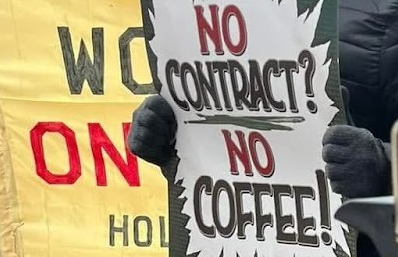
    Some chapter members have been supporting the Starbucks union strike in November and December. Members signed up for picketing shifts and showed out with signs and warm coffee in the cold winter weather. 

    Starbucks Workers United began striking on November 13th nationwide, and continue to do so in many locations, including State Street in Madison. If you’d like to support striking workers, here are some actions you can take:

    • Boycott all Starbucks locations and products while the workers are striking; talk to people around you about joining the boycott – check out and sign the “No Contract, No Coffee” pledge;
    • Turn people away from non-striking / non-union Starbucks locations in the area;
    • Show up to the picket line and participate;
    • Bring treats (especially hot drinks) to the picket line for morale!

    MADSA also hosted some talks and discussions this month, including:

    • A members-only debate on electoralism – what is the extent to which socialists should be engaging in electoral politics within our current capitalist system? What are the costs and benefits around the increase in electoral work this year?
    • Hosting a guest speaker from Brazil’s PSOL, who gave a talk on internationalism and resisting fascism;
    • Strategy discussion on supporting immigrants’ safety in Madison;
    • Check-in discussion on MADSA’s coalition work around housing issues and the Homeless Justice Initiative
    • Planning around the 2026 Chapter Convention;
    • Internal debate on several bylaws as the chapter continues to grow.

    We also shared our Madison DSA Wrapped with highlights from this year!

    Social Events

    We continue hosting recurring social events, including New Member Orientations, DSA 101, Coffee with Comrades, and the Rosebuddies program. Comrades also rang in the new year with a members-only New Year’s Eve party.

    Protest Song of the Month

    For a December protest song, I share The Homeless Wassail. Wassailing is an old English tradition of Pagan/non-Christian origin that now takes place during the countdown to Christmas. It originally involved the blessing of fruit-producing trees – especially in apple orchards – by singing, drinking, and making merriment. It changed over time to include house-visiting, and eventually the Christmas caroling we know today. The linked song highlights the deep pain, inequity, and injustice that continue in our communities.

    And that concludes our monthly round-up!

  • Can MADSA Make Better Possible? Francesca Hong and Madison Area DSA’s Electoral Strategy

    The past decade of the Democratic Socialists of America has been defined by shockingly successful moonshot campaigns that catapulted socialism into national conversation, leaving organizers scrambling to meet the moment without sacrificing their principles. First, we had Bernie’s 2016 presidential campaign and its 2020 encore, and then just a few months ago, Zohran Mamdani shattered expectations with his election as  mayor of New York City. Now, it might be Wisconsin’s turn: MADSA member and State Rep. Francesca Hong announced her bid for Governor at our September General Meeting. Since then, there has been widespread debate in the chapter, but one thing we all seem to agree on: this race could be a huge opportunity for socialists in Wisconsin. The question is – are we ready?

    MADSA members have been thinking about this race in the context of our preference for “cadre campaigns,” where we slowly and deliberately build our organization from the ground up by sending candidates into office who are drafted to represent DSA’s politics in office. I believe this is the best strategy for building our independent electoral apparatus, and laying the groundwork for a party – but it’s not the only strategy. In some ways, our relationship to Fran’s campaign might look more similar to the Bernie campaigns, where DSA reverse-engineered a socialist organization out of an electoral campaign. The comet’s going to pass whether we like it or not, and we know people are already watching it. We also know that the only thing that can win socialism is a mass working class organization, so we need to make sure that when people look around with new eyes, they find us and the movement we’re building. That means the question of whether this race will advance the class struggle can only be answered by our ability and willingness to rise to the occasion and build that movement.

    In my mind, the decision to get involved in any electoral campaign (or other organizing project) should come back to three simple questions (distilled by comrade Marianela D’Aprile):

    1. Does it make more socialists?
    2. Does it build the power and organization of the working class? 
    3. Does it build the power of DSA? 

    I believe that Fran and her campaign team want the answers to be yes, but I don’t think it’s entirely up to them– it’s up to us. There’s a very real chance that we get to live in a world where Fran runs as an extremely open socialist everywhere, endorses all of our downballot candidates, uses her platform to uplift DSA’s priorities, and encourages people to join DSA at campaign events. In that world, we are firing on all cylinders for most of 2026. We’re running her canvasses in Madison and across the state, including in districts where we don’t have enough of a footprint to run downballot candidates, and using them to recruit like crazy – since we’ll be the field leads, and hosting the after-canvass cookouts. We’ll be expanding our membership, expanding and deepening our coalition relationships, and building internal infrastructure – and potentially building toward a statewide DSA legislative campaign. Win or lose, a race like this can change the landscape of WI politics for the better, and build DSA’s capacity to take on state-level policy fights – and other struggles – in the future. Some of it will be on Fran, but a lot of it will come down to whether or not MADSA and our comrades around Wisconsin have the capacity to use this campaign to make more socialists, empower our class, and build our organization.  For the record, I want to be convinced, because I fear the gravitational pull of a statewide race will be too much to resist for the majority of the chapter. We might as well try to get the best endorsement situation we can.

    Below I’ve laid out my understanding of the state of the race, our relationship with Fran and her campaign, and the chapter’s strengths and weaknesses. Finally, I propose what an ideal campaign would look like, and what commitments it will take from Fran AND from MADSA to get us there. If we don’t feel like those commitments are possible, then we shouldn’t endorse. If they are, we may very well be foolish not to.

    Some context: as the co-chair of the chapter and active member of the Electoral Working Group, I have been privy to many conversations about and with Fran. I have also been involved in several DSA campaigns, including as a DSA rep to a campaign coalition team. There are definitely aspects to this campaign and our political terrain that I don’t have insight into, and I encourage other comrades to elaborate upon or argue with what I’ve laid out here. I do think this reflects the gist of the conversations about Fran’s campaign in EWG, and I hope this will be a useful framework for chapter members thinking about this huge decision in the coming weeks. Thank you to comrades Wesley, Justin, Adithya, Athnie, and others for your contributions!

    The Fran We’re Dealt

    In assessing this race, it’s helpful to understand MADSA’s current relationship with Fran. It is true that Fran is not a homegrown cadre, drafted by our organization to represent us in the Assembly as part of our political strategy. Despite this, we maintain a positive, but limited, relationship with her, and she behaves in office as we’d hope any socialist would – introducing legislation like the Economic Justice Bill of Rights, elevating the demands of organized labor and social movements, and taking the fight to the Democratic Party when necessary. To be frank, I think the reason we’re so distant is that for most of Fran’s time in office, MADSA hasn’t had the electoral or legislative capacity to build the relationship to the point where it would have been mutually beneficial.

    Some background: Fran was elected in 2020 at the top of a crowded field that included at least one other DSA member, Marsha Rummell. (MADSA did not endorse in that race, but did endorse Fran’s current chief of staff, Nada Elmikashfi, for State Senate District 26). After the election, Fran joined DSA. Fran was re-elected in 2022 and again in 2024, which is when MADSA endorsed her for the first time and about when she joined the WI Legislative Socialists Caucus. We didn’t get involved in the field for her 2024 State Assembly race, as she was a popular incumbent with no primary challenger. Instead, we endorsed on paper and threw our weight behind another race that needed more capacity, Maia Pearson’s unsuccessful challenge to incumbent Rep. Shelia Stubbs. I believe it was a mistake not to get more involved in Fran’s campaign, or at least bring her into greater communication with the chapter, as doing so would have given us more opportunities to deepen our working relationship. 

    Despite this, she was involved in MADSA’s 2024 priority campaign: Free School Meals for MMSD, and played a crucial role in connecting that local coalition to a state-level one. Occasionally, Fran has attended chapter and working group meetings and participated in DSA events, most notably the YDSA Organizing Fair shortly after the 2024 election, and the Hands Off Medicaid Town Hall earlier this year. We have reason to believe that she’d be willing to have a stronger relationship with us, if our chapter 1) had more capacity – and a strategy – for state-level legislative work and 2) had a formal communication channel with Fran and her office that could keep her in the loop on chapter priorities and facilitate her giving regular reports to MADSA membership. As a popular and highly-motivated activist Assemblywoman, Fran has a lot of political capital – much more than MADSA. She also has a lot of voices in her ear, and unfortunately, we haven’t been strong enough to earn a place amongst the loudest ones. 

    Unfortunately, the fact that she has political capital above and beyond MADSA’s means that her decision to run for governor is not an expression of DSA’s democratically-decided strategic priorities. I won’t lie – it’s not ideal that we’re getting involved so late and have so few cadre in the commanding heights of the campaign. As we know from her work in the legislature, Fran is a great fighter, but I think it’s safe to say that this is not a fight MADSA would have picked. If we’d been a factor in Fran’s decision to run for governor, we probably would have come out against it, both because of scale and because of the contradictions inherent to governing as a socialist executive under capitalism. There is a non-zero chance that Fran could win! That does feel like a bridge we’ll have to cross when we come to it, but we do owe it to ourselves to be serious about what that will entail, before the rubber hits the road. If we’re lucky, we can get some progressive stuff done with her as Governor, but there is a real tension implicit in having to govern, as we’re seeing with Zohran in NYC. We need to make sure having a socialist executive won’t backfire or fracture our movement, and see our role as creating the conditions in which a socialist executive can succeed.

    My belief is that the strength of any socialist elected depends on the strength of the movement that supports them, their ability to elevate movement demands, and how well they communicate back to the movement about the compromises they are forced to make – because there will be compromises. Even if Fran was the ideal cadre candidate in every conceivable way, there would be decisions she’s forced to make where there’s no good option. If we get involved in this race, we should get realistic about what we hope to achieve on the inside, and where she’ll need movement pressure from the outside – both to advance a popular mandate for socialist transitional demands, and to defend that mandate from the backlash of capitalists and their allies in the state and federal government. 

    Can MADSA Meet the Moment?

    While the weakness of the relationship with Fran is partially due to the weakness of our chapter in the past, our chapter is in a vastly different place than it was even a year ago. Our membership has nearly doubled since November 2024, and our active membership, though harder to quantify, feels like it’s quadrupled. Dozens of new members are pouring in every month, bringing new ideas, skills, energy, and enthusiasm. New members are taking on new responsibilities, building an increasingly comradely and democratic culture. 

    We have a chapter that is committed to the ultimate vision of building an independent socialist party, and an Electoral Working Group eager to expand our electoral machine. And in Madison, we can prioritize non-partisan campaigns on a local level, and focus on a vision of building up cadre candidates — leaders developed through our ranks. Our working group is committed to only recommending endorsements for campaigns where DSA will have a significant impact. That vision has driven some skepticism about Fran’s campaign, since it is 1) a Democratic Party primary in a high-stakes general election 2) not a cadre campaign and 3) would require a massive commitment from the chapter, potentially taking away from other cadre candidates. This skepticism has allowed us to take seriously the opportunities and challenges offered by this race, and given us time to build the relationships we need to make it work.

    It has also forced us to take stock of what we have to offer, which at this point in MADSA’s development, could be quite a lot. Thanks in part to our recent local program canvassing, we have at least a dozen people who could be field leads tomorrow, and another dozen who could be running shifts by the end of the month. We have countless more people who could canvass and take on other field volunteer roles, and many who can bottomline town halls, socials, and fundraiser events. This will take a tremendous amount of training and development work, but luckily, we have a strong and constantly improving Membership Engagement Team which is building an onboarding pipeline in conjunction with the Political Education Working Group. We have a good track record of comradely coalition work and connections throughout Madison, and have members with connections to smaller towns and cities across the state, who could help host events, train field teams, and even seed DSA chapters in parts of Wisconsin where we’re still punching below our weight.

    While we bring a lot to the table, some things are still in the oven. Our Electoral Working Group was chartered just a few months ago, and although it is doing great work and holding 20+ member meetings on a biweekly basis, the group has quickly borne the stress of increased attention on DSA. We went from having no endorsement procedure to handling endorsements at four different levels of government in mere weeks, and will need to keep learning and adapting to changing circumstances. As of this week, we’re now officially in the process of drafting a 2026 Political Platform to replace the outdated version from 2021, which will hopefully guide our organizing work for the next year and give some direction to our small but growing stable of policy people. We also have a desire to develop a coordinating structure to build on our Endorsed Candidate Expectations and support communication between our endorsed electeds and the chapter, but no concrete plans just yet.

    All of that information and organizing infrastructure is still getting built, but the foundation is there, and could grow much stronger if we get involved in Fran’s campaign at a high level and bring all of that experience back into the chapter. Both our program/policy work and nascent SIOC team can also help us build a stronger relationship with Milwaukee DSA and other WI DSA chapters, to the point where we could lead the adoption of a Wisconsin DSA Platform and build campaigns around shared statewide priorities. A statewide race is the perfect foundation for that kind of Wisconsin-wide coordination, and would help us build the organizing relationships we’ll need if and when Fran wins the election (and if she loses, too).

    The State of Play

    It’s been a long few months since Fran first announced her candidacy for Governor, and some of the chapter’s initial apprehension seems to have shifted. Fran has a new campaign manager who is a DSA member, and seems to be drawing a lot of her high-level team from Milwaukee DSA. Several MADSA members are also involved in their capacity as individuals. As a result, we’re seeing improvements in her messaging around “democratic socialism,” which now has pride of place on the front page of her website. There definitely could be a greater emphasis on DSA and recruitment to DSA in her campaign comms, but signs are promising that she’d be willing to work with us to shape her messaging. She has expressed to both Milwaukee and Madison DSA that she’s interested in getting us involved in field organizing in a big way, and sees us a key potential partner in her campaign.

    There are also some external forces that may be affecting some of the positive developments, and could continue to push this campaign more into “socialist tribune” territory. The race is almost comedically stacked with good-enough, labor-friendly, progressive-ish Wisconsin Democrats, and the entrance of Mandela Barnes – a classic “progressive except for Palestine” who’s running like he’ll run away with the primary despite his reputation as a loser – makes it even easier for Fran to distinguish herself as not just another progressive, but the true fighter for Palestine and the only unapologetic socialist. To really take advantage of that opening, Fran needs to run like she’s not afraid to lose – because the way the winds are blowing, that’s the only way to win. If she positions herself hard against the establishment and ready to take the battle to both the Republicans who want to flood our state with masked ICE agents and the Democratic Party establishment that doesn’t have any solution for that or just about anything else, she can win over broad swaths of working class Wisconsinites who are sick of business as usual.

    With these positive developments, it is looking more likely that the campaign will be ripe with opportunities for socialists in Madison and Wisconsin to build our capacities. Specifically, it opens up avenues to 

    1) coordinate and collaborate with other DSA chapters around Wisconsin

    2) recruit and develop leaders in communities where we don’t have a strong presence yet, through field work and through building coalition relationships with other organizations involved in the campaign 

    3) shore up our policy knowledge, deepen our working relationship with the WI Legislative Socialists, and help us develop our state-level electoral/legislative strategy

    4) build up our campaigning capacity for future electoral and other work

    5) and above all, to articulate a socialist politics and a vision for our state that speaks to the needs of working-class Wisconsinites.

    Playing Our Hand 

    Now that we know what cards we’re holding, we need a gameplan. It’s up to the chapter to iron out what our involvement in the campaign could look like, but I think it’s shaping up like this:

    • MADSA grinds to deliver Madison for Fran and builds a city-wide base for her key campaign demands, on the strength of issue-forward slate canvasses for Fran and our downballot candidates 
    • DSA chapters cohere a statewide DSA network to coordinate around the Fran campaign, and work toward an in-person WI DSA conference. That network will:
      • Go absolutely beast mode on field in towns and cities around the state
      • Train up DSA field leads where we have chapters, and send experienced organized to seed and mentor chapters where we don’t
      • ID campaign volunteers to recruit to DSA
      • Host & run town halls on the key issues, and use them to identity volunteers and local leaders & help sharpen our messaging 
    • WI DSA can think about what kinds of campaigns we can lead around issues where Fran’s platform overlaps with ours. If we have that vision in place well before the election, we can bring leaders we meet and develop through the campaign into that work long-term, whether as DSA members or coalition partners.

    I’ve said that the ball is mostly in MADSA’s court, but there are definitely some things we need from Fran and her team to make this possible. At a basic level, that looks like her promoting DSA somewhat regularly, and getting some MADSA people getting involved at a high level in the campaign (especially in field but also in comms, fundraising, etc.). We also need her to commit to endorsements for our down-ballot races, so we can campaign for them as a slate and do joint canvasses in Madison and Milwaukee. Finally, it would be great if we could get Fran to do a little political education work with us while on the trail and in office. Hopefully we can come to a shared understanding of what DSA needs and wants from this campaign, and get everyone, including Fran, bought into the idea that DSA can and will throw down if we think we’re building socialism, but will also work very hard to keep the class struggle on track.

    Can we Make Better Possible?

    I’ve laid out what I think MADSA’s involvement in this race should look like in an ideal world, and what we need from Fran to make it possible. Now I want to lay out concretely what I think we need to put into this race in order to get out what we need from it. 

    First, we need to make sure our heads are in the game. We need the whole chapter locked in on being serious, curious, adaptable, and comradely, and thoroughly committed to constructive communication and organizational democracy. Getting involved in a high-profile race like this means a lot of people are going to be circling us, joining, and wanting a piece of what we have to offer. We need to keep our eyes on the prize (socialism!) and make sure that we’re not falling for any opportunistic pitfalls. This will take rigorous planning and creative problem-solving. Internally, we’ll need to set up a democratic structure that can hold the relationship with Fran and the campaign, but not too close to the chest. There should be opportunities for rank and file MADSA members to get involved in the campaign coordinating structure we develop. This will make this project successful, and can help us lay the groundwork for more democratic, accountable relationships with our member-electeds in the future.

    Secondly, we need to be ready to grind. This campaign only works if we are all in, and have a large proportion of the chapter ready to do the work – not just canvassing, but learning how to lead canvasses and phonebanks, cut turf, run events, fundraise, and do campaign comms. Having people learn those skills will build up our chapter’s capacity for future fights, but will also take countless hours of chapter member time away from other things we could be doing. If our members, and especially our electorally-inclined members and leaders, are not excited to do that work, they should say so, so we don’t overpromise and underdeliver. We’ll also need to be everywhere all the time, and be representing DSA in a positive way in coalition spaces, at canvass kickoffs, at campaign socials, and at the doors – and then, we’ll need to be identifying potential recruits like crazy and making sure our follow-up game is on point. This campaign gives us a great opportunity to talk to people in Madison and around the state who haven’t heard of DSA, and may be outside of our usual recruitment circles, and we should make sure we’re bringing them into a healthy and welcoming chapter with lots of ways to get plugged in. On top of the campaign work, we’ll need a summer of socials, trainings, and political education. 

    We also need to invest in our relationship with Milwaukee DSA and other WI chapters, and make sure we’re building member-to-member social ties and space for political discussion and creative collaboration, not just top-down coordinating bodies. A centralizing priority with such high stakes will be a great opportunity to do any repair work that needs to be done, and to start to articulate what a statewide DSA Program could look like. 

    Finally, we need to get aligned internally – or at least start the conversation – about what we want to see from Fran’s administration, and who we’d like to see in it. We need a sense of what we think we can accomplish with a woman on the inside, and what issues we expect to have to push her on from the outside.

    That’s a lot to think about, but luckily, we have some time. As of today, Fran is still in the petitioning process, and will have a questionnaire, an interview, and another candidate forum for her to tell us what she thinks. At the same time, we need to be talking amongst ourselves about what we think we can realistically deliver, how much we’re willing to sacrifice to do it, and whether we think it’s worth it in order to make more socialists, grow DSA, and build the power of the working class to defeat capitalism and win social, economic, and political democracy for all. I believe in our chapter’s democracy and our ability to make a strong, empowered, democratic decision about this endorsement, and I look forward to continued discussions about this over the weeks and months to come.

  • Monthly Round-Up – November 2025

    By a Comrade

    This article is written by a DSA member and does not formally represent the views of MADSA as a whole or its subgroups. 

    Welcome to Vol. 4 of the monthly round-up! The content in this publication overlaps significantly with our DSA newsletter and monthly General Membership Meetings. To sign up for the newsletter or check out an upcoming General Membership Meeting, visit: https://madison-dsa.org/events/

    Behind-the-Scenes in a Growing Org

    Over the past year, the DSA has had a huge boom in membership nationally, a surge in membership here in Madison, and an increase in name recognition after Zohran Mamdani’s recent high-profile win in NYC (as well as other wins across the nation!). MADSA saw several new work groups form throughout 2025, as well as new projects, book clubs, potential candidate endorsements, and events for members and the community at large. These efforts all remain underway!

    As MADSA has scaled up, we’ve also contended with more mundane operational questions– How do we handle marketing and social media posts, now that there are so many more events? How are we feeling about our electoral endorsement process when it’s for re-elections? How can we keep developing comradeship among members? What is a good venue for our monthly meeting?!

    Here is a small behind-the-scenes look at some changes as we expand:

    • The Communication Committee (Comms) is working on appointing “liaisons” within each working group and project, so that Comms can stay better oriented to the chapter’s marketing/posting needs;
    • Comms and Executive Committee are also working on increasing direct posting access for various Working Groups so that they are not solely reliant on Comms for posting information about events and actions;
    • The Electoral Working Group has been exploring endorsement for several candidates running in state and local races, as well as discussing and reviewing the endorsement processes themselves;
    • Various members continue their efforts to revitalize Red Madison for internal and public readership – this has included identifying people who are open to contributing, as well as making calls for submissions at our general meetings;
    • The chapter will be publishing a resource to prepare for the 2026 Chapter Convention, where members will continue shaping the direction of MADSA;
    • The chapter has been experimenting with a few different venue options for GMMs to accommodate our new numbers and the geographical distribution of our membership.

    It is our hope that these changes will support the continued growth of the chapter, both in scope and in activity levels. 

    Social Events

    Our chapter had two reading groups wrap up in November:

    • Skyscraper Jails, discussed in the Abolitionist Working Group meetings;
    • Wretched of the Earth, discussed on Sundays, in a hybrid virtual/in-person format.

    We continue hosting recurring social events – New Member Orientations, Coffee with Comrades, Crafting with Comrades, MADSA Run Club, and the Rosebuddies program. 

    As the year comes to an end, we’ll be reaching out to members and asking about their experiences in MADSA this year, and their socialist resolutions for 2026. We’re also planning a New Year’s party on New Year’s Eve, details forthcoming!

    Protest Song of the Month

    For a November protest song, I’d like to highlight an artist from an indigenous background and ties to the Midwest – John Trudell. John was a Santee poet, musician, actor, speaker, veteran, and activist, at one point chairing the American Indian Movement (AIM). Here is the Listening / Honor Song, a spoken word piece over traditional music. The lyrics can be found here

    And that concludes our monthly round-up!

  • The Peculiar and Continuing Importance of Anti-Black Racism in the U.S.

    By Blair Goodman — Political Education Working Group, Madison DSA

    Madison, right now

    Across Dane County, our campaigns against jail expansion, corporate developers, and layoffs at TruStage all run into the same brick wall: a system that divides and disciplines labor along racial lines. Anti-Black racism isn’t an add-on to class struggle—it’s a core method by which exploitation keeps reproducing itself. This piece offers a framework for connecting those dots in our local work.

    1) Capitalism’s birth in racial slavery

    Modern capitalism was built through dispossession and enslavement—the twin thefts of land and labor. Plantations were early financial instruments linking human bondage to credit, insurance, and global trade.

    W. E. B. Du Bois’s Black Reconstruction showed that enslaved labor was integral to world capitalism, and that the Civil War’s “general strike of the slaves” was the first mass withdrawal of labor in U.S. history. He also named the wages of whiteness: the social privileges that kept white workers tied to their own exploitation.

    2) The logic of racial capitalism

    Cedric Robinson and Oliver Cromwell Cox argued that capitalism didn’t create racism—it modernized it. Racial hierarchy became a tool for managing labor, marking some workers disposable and others “deserving.” Whiteness functioned as property and as discipline: a counterfeit privilege that fragments the class.

    Each transition—from slavery to sharecropping, from industry to mass incarceration—reshaped rather than removed racial rule.

    3) Ruling-class strategies of division

    From Bacon’s Rebellion to Reaganomics, elites have used racial politics to stabilize profit.
    After Reconstruction, terror and “Black Codes” rebuilt cheap, coerced labor.
    In the industrial North, corporate leaders hired across color lines to break strikes and then incited mob violence to keep unions weak.

    The New Deal’s exclusions of agricultural and domestic workers preserved segregation inside the welfare state. Later, Nixon’s “Southern Strategy” and Reagan’s “welfare-queen” myth converted white resentment into a new austerity consensus.

    4) Anti-Black racism in the contemporary economy

    • Labor: Black and brown workers dominate low-wage logistics and care work; white workers are overrepresented in management and tech.
    • Policing and prisons: Incarceration functions as labor discipline under the 13th Amendment exception.
    • Finance: Redlined credit and predatory loans siphon wealth from Black communities; the 2008 crash transferred billions to banks.
    • Environment & health: Toxic exposure, food deserts, and hospital closures show how profit literally costs lives.

    Corporate “diversity” rhetoric and right-wing culture wars both mask this structure.

    Resistance—from teachers’ strikes to warehouse walkouts—shows multiracial solidarity can still rupture it.

    “Anti-racism isn’t a distraction from class politics—it’s how we build working-class power that can actually govern.”

    5) What this means for organizers

    • Integrate racial analysis into every campaign. Whether the issue is housing, healthcare, or wages, trace how racial inequality shapes the field of struggle.
    • Center Black working-class leadership. Leadership development and cadre training should deliberately cultivate Black and marginalized organizers—not tokenism, but strategy.
    • Reject false binaries. Universal demands (like Medicare for All) only transform society if implemented through racial justice.
    • Challenge whiteness as a relation. Build reflection and accountability—not guilt—into your organizing culture.
    • Connect local fights to systemic critique. Show how each campaign teaches lessons about racial capitalism and how collective action can dismantle it.

    The goal is not moral reconciliation but power: a unified multiracial working class capable of governing society in its own interest.

    6) Political education & collective memory

    • Pair readings of Black Reconstruction, Black Marxism, and Hammer and Hoe with local labor history.
    • Map your shop or neighborhood: who gets which jobs, services, protections—and why?
    • Debrief campaigns not only on tactics but on leadership and racial dynamics. Document lessons so they become chapter memory.

    Political education isn’t a classroom—it’s the loop between struggle and understanding.

    Use this next week

    • Bring this piece to your WG or union meeting; connect one paragraph to a current Madison fight.
    • Host a 60-minute discussion using the five organizer implications above.
    • Send local examples (housing, policing, labor) to #redmadison for follow-up coverage.

    Sources & further reading

    • W. E. B. Du Bois, Black Reconstruction in America (1935)
    • Oliver Cromwell Cox, Caste, Class and Race (1948)
    • Cedric J. Robinson, Black Marxism (1983)
    • Angela Y. Davis, Are Prisons Obsolete? (2003)
    • Keeanga-Yamahtta Taylor, From #BlackLivesMatter to Black Liberation (2016)

    About the author: Blair Goodman helps political education at Madison DSA. This piece is part of our ongoing effort to tie local campaigns to a rigorous understanding of racial capitalism.

    🗒 One-Page Printable Discussion Guide

    For WG meetings, study circles, or union caucuses (60 min)
    Goal: connect theoretical insight on racial capitalism to immediate campaigns in Madison.

    Agenda (60 minutes)

    • Opening check-in (10 min): one moment you’ve seen race and class intersect at work or in organizing.
    • Read-aloud (10 min): paragraph 5, “What this means for organizers.”
    • Small-group discussion (25 min):
      • How does anti-Black racism operate in our current campaign or workplace?
      • Which of the five organizer implications feels most urgent here?
      • What concrete change in practice could reflect that insight?
    • Report-backs (10 min): one takeaway per group.
    • Closing commitment (5 min): each participant writes one action step to test before the next meeting.

    Materials

    • Printed or digital copy of the essay
    • Whiteboard/poster paper for mapping examples
    • Optional: QR link to MADSA events page
  • Monthly Round-Up – October 2025

    By a Comrade

    This article is written by a DSA member and does not formally represent the views of MADSA as a whole or its subgroups. 

    Welcome to Vol. 3 of the monthly round-up! The content in this publication overlaps significantly with our DSA newsletter and monthly General Membership Meetings. To sign up for the newsletter or check out an upcoming General Membership Meeting, visit: https://madison-dsa.org/events/

    Union Efforts Continue in Madison

    In August we celebrated the successful union elections at Festival Foods, and Hilton Monona Terrace. Another union battle continues in Madison, however, led by healthcare workers at GHC, and supported by patients and community members.

    The GHC union effort was able to initiate a Special Member Meeting on October 13, where patients with GHC could express opinions on unionization, and conduct an “advisory” vote directing GHC to support the union. Members unanimously supported the union, and asked GHC’s board for transparency around how much money they’re spending on union busting.  Read more here! 

    Beating Back the Political Doom

    MADSA members have been creating more opportunities to learn and be in community, for members AND non-members. These are crucial antidotes to the doom, overwhelm, and helplessness that many people are feeling about the current state of the world. 

    This month, these events included:

    • A discussion with Copaganda author Alec Karakatsanis about policing, media, and narratives around safety;
    • A presentation, for people of all knowledge levels, on understanding the mechanisms of capitalist exploitation, titled Marx’s Capital and Global Capitalism Today;
    • An Organizing 101 workshop for people to learn about workers’ rights and the union process.

    The Electoral Working Group is also busy at work in this realm. Members of this WG have been canvassing local residents to learn more about the issues that matter most to them, and what solutions they hope to see. The working group also organized a public Madison Community Town Hall, with the goal of creating a space for community members to express grievances and connect around possible next steps.

    There was also fruitful internal discussion this month about a potential change to a MADSA voting policy, and how this interacts with the role of meetings in our organization. Some members made compelling points about meetings as a space for developing important leadership skills, refining our ideas and worldviews, changing each others’ minds, and strengthening community bonds; on the other hand, other members discussed concerns around accessibility and inclusivity, and encouraged the chapter to ensure that people can participate meaningfully in major decisions if they have limitations around meeting attendance. Debates like this reflect the chapter’s process of growth, and ongoing work around participatory and inclusive democracy. 

    Further Organizing Highlights This Month

    Our work continues in many ways thanks to our dedicated membership. Here are other key organizing efforts taking place this month in MADSA. This summary is not exhaustive! 

    • No Kings, No Bosses – The “No Kings” protests had a massive presence across the country this month, and this included Madison, WI! MADSA members showed up with a strong presence at the rally.
    • The petition process begins for potentially endorsing candidates in statewide elections. When MADSA endorses a candidate, it is not just a symbolic seal of approval; the chapter is also pledging to provide consistent labor and organization to help that candidate win and to collaborate with them throughout their term. Candidates who wish to gain backing from MADSA must go through a process that includes collecting petition signatures, meeting several times with various chapter bodies, and ultimately winning a chapter-wide endorsement vote. The candidate must demonstrate their commitment to following the expectations outlined in the chapter’s endorsed candidate policy, found here.
    • MADSA’s No Appetite for Apartheid contingent is supporting members in making a pledge to boycott Israeli products. Click here to take the pledge, and to get updates about stores who commit to being an Apartheid Free Store.

    Social Opportunities

    Our chapter has several ongoing reading groups, including:

    • Skyscraper Jails, discussed in the Abolitionist Working Group meetings;
    • Wretched of the Earth, discussed on Sundays, in a hybrid virtual/in-person format.

    We continue hosting recurring social events – New Member Orientations, Coffee with Comrades, Crafting with Comrades,  MADSA Run Club, and the Rosebuddies program.

    Protest Song of the Month

    The song I choose for this month is “Freedom Now” by Tracy Chapman! This song was dedicated to Nelson Mandela and his work in the anti-apartheid movement. I think that the sentiments in this song still resonate to this day.

    And that concludes our monthly round-up!

  • The Bitter Fruits of Democratic Austerity: Reflections on Trump’s Victory

    by Blair Goodman, MADSA member, co-chair of Equador Working Group on the DSA International Committee and chair of the Training Subcommittee of the DSA Growth and Development Committee


    As we urgently grapple with Trump’s return to the White House, it’s crucial to swiftly understand the economic and political factors that led to this outcome. The Democrats’ failure to promptly address the real economic concerns of working-class Americans has paved the way for Trump’s populist rhetoric to once again resonate with voters.

    The Disconnect Between Wall Street and Main Street

    Despite the rosy picture painted by macroeconomic indicators – a booming stock market, low unemployment, and steady GDP growth – the reality for average Americans has been starkly different. Under the Biden-Harris administration, we witnessed a shocking 20% increase in consumer prices, the biggest slump in living standards since the 1930s[1]. While the rich got richer, most Americans struggled to keep up with inflation.

    The disconnect between official economic data and workers’ lived experiences is staggering. According to a recent poll, 62% of respondents rated the economy as “not so good” or “poor”[2]. This “vibecession” – where public sentiment doesn’t match official economic data – has been a critical factor in the Democrats’ downfall.

    The Failure of Bidenomics and Harris’s Neoliberal Approach

    Perhaps most damning is the decline in real wages for union workers under Biden. Using the Bureau of Labor Statistics’ Employment Cost Index, we see that inflation-adjusted wages and salaries for union workers decreased during Biden’s term while increasing under Trump. No wonder 56% of Americans thought the country was in a recession, with 72% believing inflation was still rising.

    Going back to Bill Clinton the Democrats’ embrace of austerity policies has deeply betrayed their working-class base. They’ve continued catering to Wall Street and big business instead of pushing for transformative economic policies that benefit the majority. Harris’s refusal to support a single-payer healthcare system, her backtracking on fracking, and the maintenance of Trump-era tax cuts for the wealthy all demonstrate the party’s shift away from progressive economic policies.

    The Shift of Traditional Democratic Voters

    One voter’s quote summarizes why sufficient numbers switched from Democrat to Republican: “I’ve been a Democrat my whole life, and I haven’t seen any benefits. Democrats have been sending funds to wars and resources to migrants rather than to Americans who are struggling. I trust Trump to put us first.”[2] This sentiment reflects a broader trend of disillusionment among traditionally Democratic voters, particularly regarding economic issues and the perception that the party wasn’t prioritizing struggling Americans.

    The Immigration Paradox

    Ironically, much of the US outperformance in economic growth results from a sharp increase in net immigration, twice as fast as in the Eurozone and three times as fast as in Japan. Yet, the Harris campaign failed to capitalize on this economic benefit, instead caving to anti-immigrant sentiment and supporting the continuation of border wall construction, which contradicted the economic benefits of immigration and alienated potential supporters.

    The Looming Debt Crisis

    Both candidates have ignored the elephant in the room: the ballooning public debt. Currently estimated at $35 trillion, or around 100% of GDP, the debt load is set to soar higher – potentially reaching $50 trillion within the next 10 years. This rising debt will inevitably lead to higher taxes and cuts in government spending, regardless of who is in power, posing a significant economic challenge for the future.

    The Need for Socialist Policies is Urgent

    Join a socialist organization. I prefer a mass multi-tendency organization like the Democratic Socialists of America, but if you need something more focused, go for it. Learn to be active in your organization and promote outward-facing, mass work.

    To rebuild and move forward, we must embrace truly socialist policies that unite the working class:

    • Implement a wealth tax on the ultra-rich to fund social programs and infrastructure investments.
    • Establish a single-payer healthcare system to eliminate medical debt and ensure universal coverage.
    • Enact a Green New Deal that creates millions of good-paying union jobs while addressing climate change.
    • Raise the minimum wage to a living wage and strengthen workers’ rights to organize.
    • Invest in affordable housing and public transportation to improve the quality of life for all.

    The Road Ahead

    While the Democratic Party has failed us, we must strategically consider whether it can still be a vehicle for progressive change. Our immediate focus should be building grassroots solid movements and labor organizations that can exert pressure on political institutions from the outside. Of course, we should use the Democratic line where it is strategically convenient and pursue reform that transfers power from the owning classes to the working classes. 

    We must also concentrate our defenses against the coming onslaught of right-wing policies. Concentrating our defenses means making choices about where we can protect voting rights, defend reproductive freedom, and safeguard the rights of marginalized communities. We must recognize that unions will likely face a much more hostile environment under a Trump administration, forcing labor into a defensive position. We will need to find a strategy to resume the offensive. 

    As we move forward, we must remember that the underlying forces of capitalist production, investment, and profit are much more powerful than any particular policy adopted and implemented by a government. However, this doesn’t mean we should give up on political action. Instead, we must work tirelessly to build a movement that can challenge the foundations of a system that continues to fail most Americans.

    The road ahead is challenging, but we must channel our anger and sadness into organizing and action. Only by uniting the working class around a truly progressive economic agenda can we hope to reverse the tide of right-wing populism and build a more just and equitable society for all.


    Sources: 

    Kamala Harris Is Not Doing Well With Union Voters

    How Bad Would a Trump Presidency Be for Labor? 

    The US presidential election: part one – the economy – Michael Roberts Blog

    The US election part two: Trump v Harris: