
Blair Goodman and Colin Gillis are members of DSA’s Socialist Majority Caucus.
There is a meeting today in a DSA chapter somewhere in this country. Someone new showed up. They sat through an hour of business they did not understand, watched three veterans talk past each other about something that happened two years ago, and left without anyone getting their contact information. They will not come back.
There is another meeting happening somewhere else. It started on time. Someone explained the agenda. New members were introduced and offered a specific thing to do before the next gathering. At the end, a person who had never been to a socialist meeting in their life walked out feeling like they had joined something real.
The difference between those two rooms is not ideological. It is organizational. Over the last two years, DSA has grown enormously, climbing from roughly 50,000 members to over 100,000 nationally. There are many reasons for the surge: the unpopularity of Donald Trump and his policies, and the historic victory of Zohran Mamdani’s mayoral campaign, chief among them. We want to name another cause whose importance has been badly underappreciated: DSA is able to seize this moment in part because it has spent years promoting and standardizing good practice in how meetings are run and how chapters are built.
Some may perceive this focus on infrastructure as a retreat from politics. They may say Robert’s Rules is a distraction from class struggle, that worrying about meeting culture means you have run out of things to say about capitalism. Building a socialist organization that can sustain itself, develop new leaders, and prosecute a political project over the years requires the same seriousness about institutional conditions that any fighting organization brings to its work. Infrastructure points outward. A chapter that runs perfect meetings but never knocks on a door has missed the point just as badly as one that canvasses every weekend but cannot keep the people it recruits. The two approaches depend on each other. The capacity to do mass work depends on building an institution capable of holding and developing the people who show up to do it.
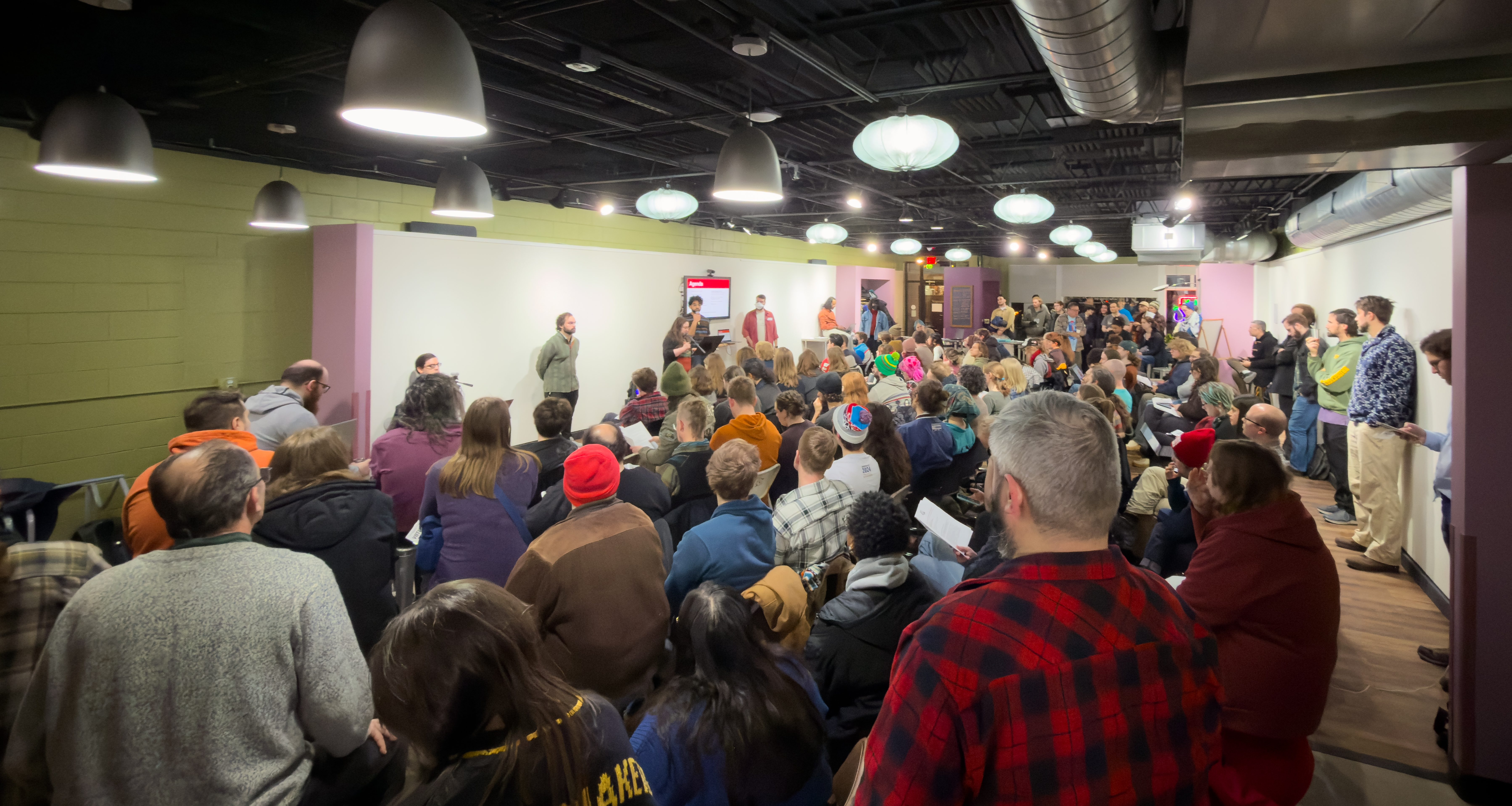
That institution is built at the chapter level. A friend who rarely participates but is an influential member of our local political community attended a General Membership Meeting earlier this year, in March. Afterward, he confessed he was taken aback by some of the positions members took in a debate about electoralism, but he spent more time talking about how impressed he was with the facilitation. A hybrid meeting of more than a hundred people was expertly run, allowing members to disagree forcefully and in a comradely way. There is a material dimension to organizational hygiene, too. This year, the branch secured office space in the Labor Temple. That is not solely a procedural decision. It is a declaration that the chapter believes in its own future, and members respond to it because serious institutions attract serious people. It is also a clear upgrade: our previous space was plagued by flies and clutter. The new one is bright and well-appointed, in the heart of Madison’s labor community. Physical space, financial stability, trained facilitators, documented roles, and meeting cultures that do not drive working people away are all part of the same project. Ninety percent of movement building is infrastructure.
The left has two recurring ways of falling apart. The first is structurelessness. This occurs when a movement refuses formal leadership and decision rules. Without clearly defined processes and roles for meetings, informal power does not simply vanish. Instead, it becomes unaccountable. Occupy Wall Street had enormous energy and no machinery to hold it, and the encampments scattered without leaving a durable organization behind. The second is the cadre model, which imposes discipline and public unity and treats standing disagreement as a threat to be managed. It can act decisively, but it cannot absorb dissent. The International Socialist Organization, the most significant American group in that tradition, dissolved in 2019. Many of its most dedicated organizers found their way into DSA, where disagreement need not mean departure. DSA’s wager is that democratic process is the alternative to both: an organization that can hold real ideological disagreement and still function, as long as members share a process that makes disagreement productive rather than fatal.
What does this mean concretely? It means a new member should leave their first meeting knowing three things: what the chapter is working on, what they can do, and who to call. It means meetings should start and end on time, not because punctuality is a bourgeois virtue, but because respecting people’s time is how you keep working-class members who have two jobs and a commute. It means decisions should be made transparently so that members who disagree with the outcome can nonetheless trust the process that produced it. And it means leadership development is not a program you launch when things are going well. It is the continuous work of an organization that intends to survive its own successes.
The difference shows up in the work itself. A chapter with real infrastructure can organize tenant unions, building by building, showing up consistently enough that residents trust it with something real. It can run a rigorous endorsement process, reliably put canvassers on doors, and hold the candidates it elects to something after elections are over. A chapter without it cannot do any of those things consistently, regardless of how correct its politics are. Infrastructure is not what you build after you figure out what you stand for, it is what lets you stand for anything at all.
Process gets weaponized. Rules of order can be used to slow decisions, bury inconvenient resolutions, or exhaust opponents. This happens across the political spectrum within DSA, and anyone who has attended a contentious convention knows it. But the answer to procedural manipulation is not less procedure. It is better shared norms, practiced consistently, at every level of the organization. The chapter meeting is where those norms are built or broken, not the convention floor.
DSA is a big tent. Whether this big tent stands or falls depends above all on whether the chapters inside it are real institutions: communities that retain members, train successors, and show up with capacity when the political moment demands it — that is built meeting by meeting, office by office, follow-up call by follow-up call.
To the comrade reading this who just joined: the arguments you will encounter inside DSA are real arguments, worth having, among people who mostly want the same things. You have every right to form your own view of them, but know that a chapter that works is not a chapter that has resolved its political disagreements. It is a chapter that has built the capacity to have them, keep its members, and still show up next month. That capacity is not separate from socialism. It is what socialism looks like in practice, right now, in the rooms where we organize.
Leave a Reply