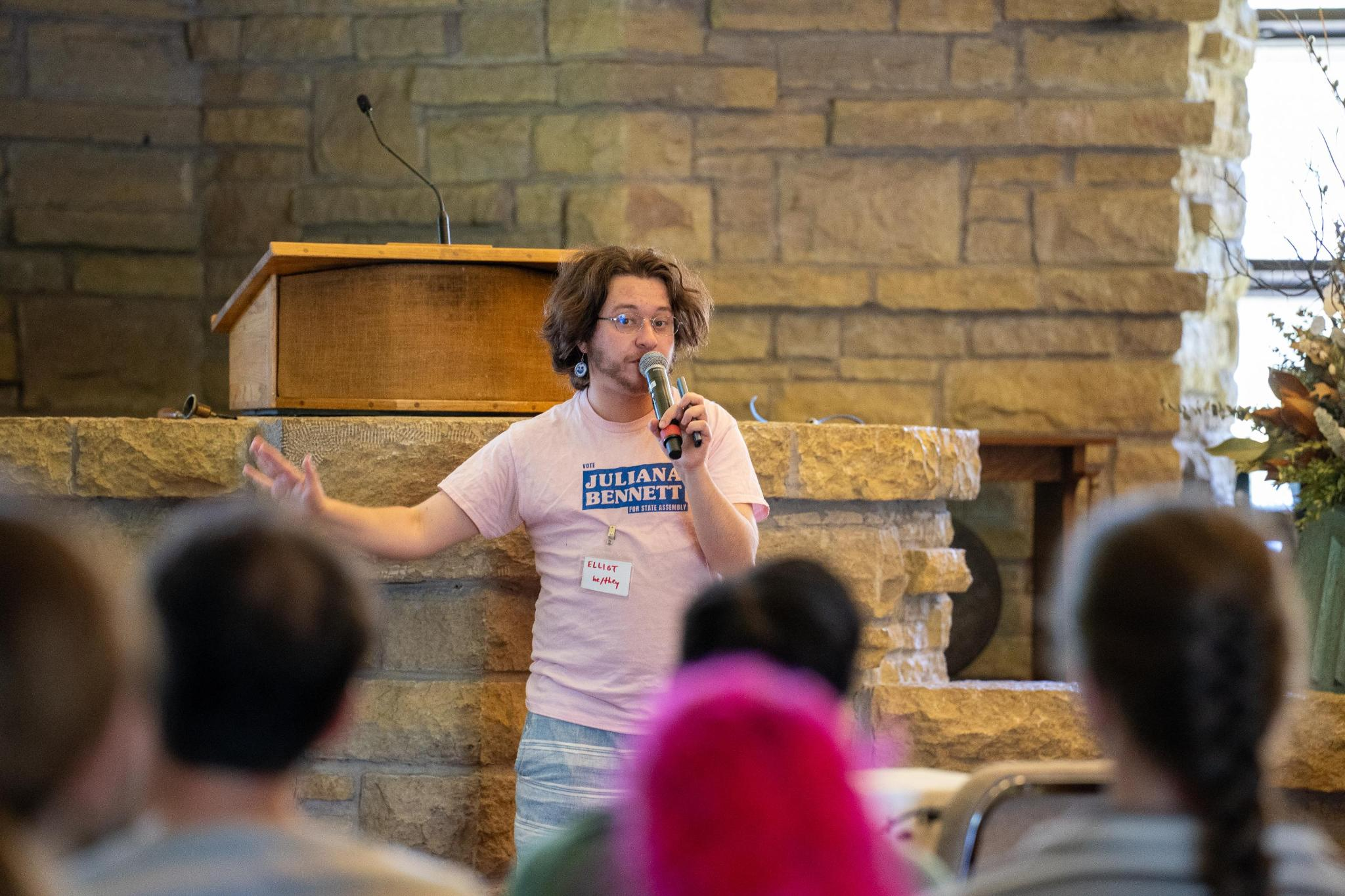
I recently went back to DSA 101 for the first time since I joined the Madison Area DSA chapter in 2025. There was a crop of at least 10 prospective and new members excited for what opportunities MADSA could provide them. I facilitated a small group of 3 during the discussion section of the meeting. When I asked what work people were interested in, one said electoral and working to push the state legislature left. The others in my group weren’t sure. Multiple options were already discussed in the presentation at the beginning of the DSA 101. In the closing of the meeting, the presenters rattled off several more options: upcoming events, a petition against data centers in Madison, new potential mutual aid projects, and a new member cohort chat for the attendees. The folks I was talking to came away still unsure of what they wanted to do next given the wide array of choices.
We are living through an “everything crisis,” a term you may have heard from opinion editorialists periodically since 2020. The working class in America is under attack from all angles: beat down by cops and ICE, mistreated by our bosses, living in an unstable, warming climate, and grieving a genocide co-signed by Democrats and Republicans alike in our government. And of course much more you can probably think of. That’s a big part of why in MADSA, there’s a group for almost anything. At a glance, this past year we have had:
| Current bodies | Electoral, Admin, Abolition, Communications, Community Defense, Finance and Fundraising, Labor, Political Education, Program, No Appetite for Apartheid |
| Proposed new bodies | International Solidarity, Anti-Data Center |
| Recent previous bodies | ICE Out (May Day), Hong Campaign, Free Schools Meals for All, Medicaid, Mutual Aid |
While our membership is much larger than it was a year ago and 1000 members sounds (and is) an impressive number, maybe a quarter of that total (if I’m being generous) is actively engaged in some work in the chapter. There is an even smaller group of formal chapter leaders: just 32 at the time of writing. When leaders need to step down, their successors are usually running uncontested and sometimes significant effort must be expended to recruit even that one candidate.
If we want to be a healthy, positive model for what organizing should be in Madison, this is unsustainable.
I love the experimentation and broad appeal having so many different projects ongoing brings to our chapter. I do not want us to sunset important work and lose the members or knowledge in those bodies. If you’re working on things that are less popular in the chapter, know that what you are doing is still very valuable.
But the reality is that our resources are constrained, and the duty we have to make change for our communities (and the world) is heavy. I therefore propose an effort to cohere existing efforts and knowledge behind short-term and medium-term projects that we can all contribute to in our interest groups AND get something out of for our interests.
We can’t afford to lose focus. We can’t afford to spread ourselves thin. The stakes for the working class are too high. The idea that we need all these separate bodies in order to maximize the appeal of organizing in MADSA falls apart when leaders of these bodies begin to run on empty if they can’t keep enough members engaged on a regular basis with their specific work to actually make meaningful advancements in the class struggle. Lacking proper support, projects may die off without proper documentation and transmission of lessons on to future organizers. While not a perfect priority campaign, the ICE Out/May Day project from early 2026 attempted to coordinate across chapter bodies and had multiple successes: raising over $1000 for legal aid to immigrants, inspiring worker-members to take serious first steps in organizing their workplaces, and excellent coordination of a big community breakfast event and a mighty bloc in the May Day march put on by Voces, etc. I’m imagining we could do so much more with a priority campaign like this with more time to prepare it.
That’s why I propose the creation of a Priority Plan for next year’s chapter convention: selecting 2 to 3 whole chapter centers of focus that build power stretching beyond the current moment, while still meeting the current moment. This plan should include consideration of how folks across the chapter with different levels of skill and interest will be drawn into the work and kept engaged, even when things get tough or slow. We must make use of standing chapter committees such as Comms, Membership, Admin, Tech, and Finance and Fundraising as spaces to contribute our skills across projects.
In the subtitle of this piece, I name two concepts that I think contribute to us being spread thin in our work: Reactivity and Atomization.
Reactivity, in my political definition, means centering your activism around what’s immediately catching the attention of the most politically aware people at a given time. That is, reactivity is following the headlines. There is certainly a lot of benefit in terms of growing the membership and increasing short term engagement through reactive activism. As socialists, many of us think in terms of historical materialism and using the historical circumstances around us to our advantage.
However, there are considerable drawbacks to reactivity as a primary approach. When the headlines shift, engagement in a reactive project drops and members want to focus on the next big issue. The core leaders struggle and burn out.
Reactivity also is an inevitable part of Electoral work that I spend most of my time on. When seats open up without warning, or a member-elected announces a run for Governor, the tendency of many of us (even myself sometimes) is to work on inserting MADSA into the situation as fast as possible. We might pursue such a campaign without consideration of the balance of chapter work and how a seat might fit into our larger goal of “building the apparatus needed for an independent socialist party” agreed upon in the past two chapter Conventions.
American Socialism is not something we expect in years. Some of us expect it to be possible in decades, some maybe not even in our lifetimes. We must think carefully about balancing short-term opportunities with the larger goal of building durable power for the working class that can end capitalism, because we know this is a fight we will be in for the rest of our lives most likely. We cannot afford the self-inflicted burnout that comes from cycling through reactive campaigns, and/or creating so many areas of work in reaction to our everything crisis that none show tangible progress.
MADSA’s current struggle across many priorities is also a result of atomization. Atomization is the default social trajectory of American capitalism. Atomization means social groups and individuals becoming more and more disconnected from broader social systems. MADSA fights against this trend, actively cultivating social opportunities around a core of political action. However, we still exist within American capitalism and are not immune to atomization within MADSA. A big value in DSA is maintaining the “big tent” of the organization. The benefits of the big tent are:
- Inclusion of socialists who might not have refined opinions as to their specific political tendency within socialism yet,
- Ability to work together across tendencies to do work on a mass scale, and
- Opportunity to refine our strategy, tactics, and theoretical understanding in comradely debate between socialists of different tendencies.
However, in such a large organization, different working groups and political tendency blocs still become atomized from each other via social self-selection, which leads to sharper conflicts over time in the chapter. These may simmer for a long time before erupting due to the disconnection between social groups within MADSA. For example, criticisms that some members had of the No Appetite for Apartheid campaign didn’t reach the organizing leaders until shortly before their charter was up for another vote in November’s General Membership Meeting.
I believe we need to use General Meetings and especially chapter Convention to break down those barriers and actively foster the continuation of our “big tent.” We can also work to make better use of our standing committees rather than doing everything in our own groups like Electoral, which will foster more connection across fragmented parts of the chapter.
The competition between groups for activist energy is real, the competition between political ideas is real. We need to confront these differences out in the open as much as possible to move our chapter forward. I believe that starting with the 2027 Chapter Convention as a forum for working out these conflicts more intentionally through a Priority Plan deliberation is the first step towards making this chapter a sustainable place to organize.
If you are interested in making this a reality, please note your interest in being on the 2027 Convention Committee to our Executive Committee so they can contact you when planning begins.
Leave a Reply