If we have to vote for people to represent us, could we at least do better than the garbage we are doing now?Our plurality, first-past-the-post systems of electing people for office are bad. We know no voting system is perfect, thanks to Arrow. So, should we consider systems like sortition or liquid democracy, which attempt to fix the problem by doing away with elections in various ways? Maybe, but what are our options if we must vote?
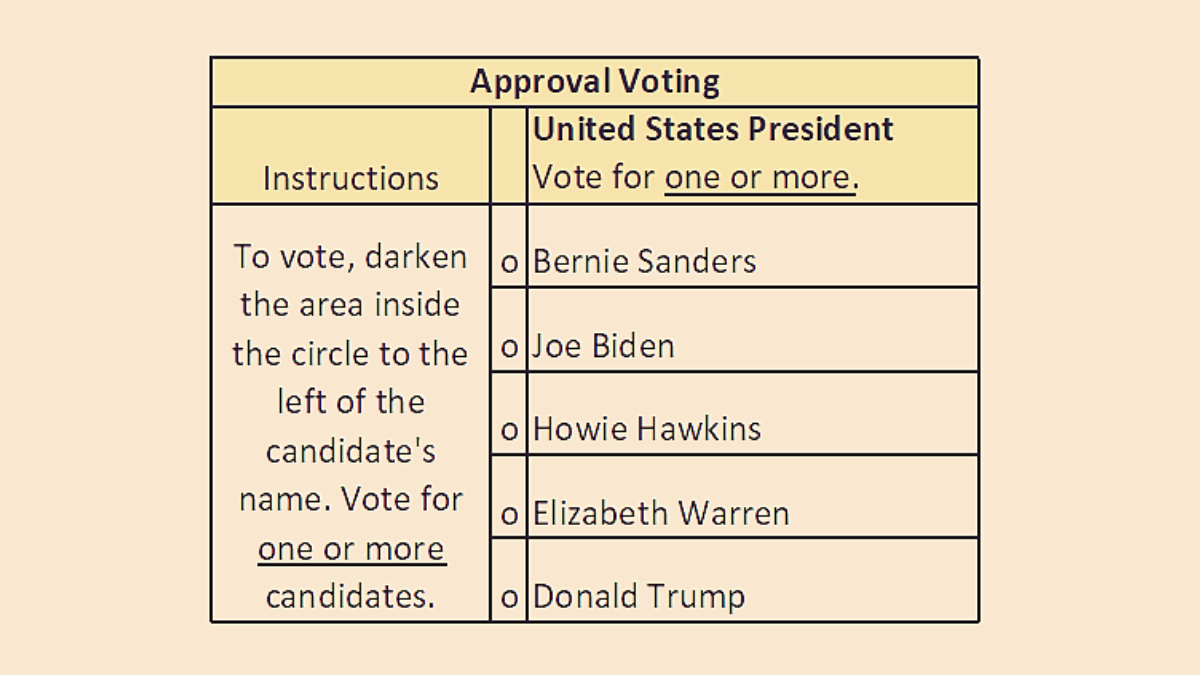
After Red Madison recently discussed ranked choice voting (RCV), it’s time to look at a simpler alternative voting system: Approval voting. It works just as it sounds: you vote for everyone you “approve” of. Your ballot looks exactly the same as it does in familiar first-past-the-post. A bunch of circles with names by them — but now, you can fill in more than one circle. That’s the only difference. We get rid of the rule of only voting for one. (If you learn better with visuals, try this video that compares plurality, ranked choice, and approval voting.)
Advantages of Approval Voting
This is very easy to describe to voters: vote for everyone you approve of. Got it? Done. Far fewer ruined ballots, because now it’s near-impossible to screw up. (You can make your ballot useless by being pro-everyone. But maybe you’re… pro-everyone? Well, you’re weird.) It’s an old idea, used for selecting popes in the Middle Ages, and in Greece’s legislative elections, from 1864 to 1923, but it didn’t get the name “approval voting” until 1971.
Each party can have a candidate on the ballot, just like they can now, but “third party” candidates can get a better sense of voters’ honest support. There are no longer “spoiler” candidates, and it’s easy to see why: you can vote for them and the other one. It’s even possible to eliminate primary votes (and cut costs!) if there are small numbers of candidates for office, and just put everyone from all parties on an approval ballot.
How to count the votes and find a winner of an approval election? It’s almost too simple: just count them. All of them, on every ballot. Tally them all up, and boom. Done. The candidate with the most votes is the winner. Want to do multi-member districts? The top N candidates get seats.
Another majoradvantage is that approval is cheaper than other voting system changes. It requires no new voting machine hardware, and no new infrastructure. It stays easy to subdivide, so precincts can report their summary votes in a legible, easily-combinable way — unlike ranked choice. Finally, it’s easy to audit and recount, where counting and audits can be difficult with ranked choice.
If we believe people’s true preferences lean toward democratic fairness and socialist policies, approval voting is the simplest system that gives third parties a fair chance to compete without being labelled as spoilers.
The best way to sum it up is that approval voting is simpler in almost every way than ranked choice, range voting, and other systems. Simple should make everyone happy. (Well, everyone except the people who benefit from our current two-party domination. Looking at you, defense firms and health insurance companies!) So why should socialists be in support of approval voting, other than the benefits of increased democracy?
If we believe people’s true preferences lean toward democratic fairness and socialist policies, approval voting is the simplest system that gives third parties a fair chance to compete without being labelled as spoilers. For example, Nader voters in 2000 or Green Party voters everywhere are blamed for “spoiling” elections. Approval would eliminate that blame game. It also provides a better way for voters to express themselves in primaries: a place where it’s important that socialist policies get a fair shake.
Comparing Approval with Ranked Choice
If approval voting is better in almost every way than our first-past-the-post, how does it stack up to ranked choice? Ranked choice has more mindshare, is actively being used by cities like Minneapolis and states like Maine, and is being pushed by some advocacy groups like FairVote as better than approval voting. If big money is currently pushing ranked choice, that should perhaps give socialists and other outsider parties pause.
Let’s look at FairVote’s two main complaints about approval voting in detail.
First, they talk about the issue of majority rule: “If voters truly are free with their approvals in an approval voting election, it’s quite possible two or more candidates could earn more than half the vote. Indeed, it’s possible that a candidate whom well over half of voters see as a top choice could lose to someone who nobody sees as their top choice.” That sounds like it might not be a downside at all, and instead the most voters would have “approved” of that candidate for office. Sounds downright… democratic?
The second issue FairVote raises (which incidentally contradicts the “majority rule” claim) is that “[in] approval voting elections, you can’t indicate support for more than one candidate without support for a lesser choice potentially causing the defeat of your first choice.” They claim this kind of “bullet voting”, where you use your approval ballot to only vote for one candidate, simply reduces approval to a plurality system. While it’s true that ranked choice and range voting get around this issue to some extent, ranked choice also has tactical voting problems where ranking your true first choice first is not always best for that candidate, and it may not even solve the problem of spoiler candidates. Honestly, ranked choice’s failure modes are extremely confusing. For the nerds out there, you can dig into the Gibbard-Satterthwaite theorem which proves tactical voting problems will pop up in any voting system that’s not a dictatorship or lottery (hey, sortition again!)
So why not keep it simple? Approval voting is still far more expressive than plurality voting, which is possibly the worst of all worlds; and approval is at its strongest to help voters make decisions in highly contested elections with multiple candidates who don’t reach a majority at all. Simpler is better for another pro-democracy reason: more-complex ballots may decrease voter turnout.
In practice, under approval voting, in elections like the 2020 presidential election, voters who want to strongly “disapprove” of one or more candidates could do so by voting for everyone else. After approval voting is used for a while, DSA members who wanted to approve a DSA candidate and not approve the Democratic party candidate would be free to do so. But this does not mean that approval reduces to a plurality system as FairVote claims: voters would continue to have the free choice of voting for more than one candidate, and there are cases (like 2020) where it may express voter’s desires better to simply vote for more than one candidate.
In addition, there is some evidence that ranked choice still leads to two-party lock-in. See, for example, Australia… where ranked choice has been in use in their lower house for a century, and they still have a two-party lock. However, switching from plurality voting may have encouraged their center-left Labor Party to rely on left-wing voters for Green and other parties choosing Labor as a “second best”, and this has pushed them to incorporate environmental policies. Approval would likely result in a similar “party pull” mechanic, to pull to where the actual public center is.
Conclusion
Third parties should be in favor of approval voting, where they may start to gain additional support from normally Democratic-party-line voters, and a snowball could start rolling downhill. The mainstream parties should be in favor as well, because it will push a competition to have positive policies that more voters actually support instead of just anti-policy like “orange man bad.” Of course, that’s likely not what the Democratic Party powers are interested in, and that is why approval voting is going to need major grassroots support.
If approval voting is better and still very simple, why is nobody voting this way? Well, The Center for Election Science helped Fargo vote to switch to approval voting for city positions in 2018, and they had their first election in June. This week in St. Louis, voters were asked to consider adopting approval voting for future city elections. The proposition passed with a healthy 68% margin, so their primaries will be conducted with approval voting with the top two candidates going into a runoff.
We should strongly consider approval voting for internal group elections. We should then push for it at the local level, for city and county elections. Then we could try to push for state primaries, and if it works there, eventually all state elections. Finally, if it proves an improvement in those cases, it sure seems like we could someday stop trying to bake a cake out of rotting garbage with our federal presidential elections and the Electoral College, and get simpler. Approval voting: it’s simple.
This article was originally published by The Red Nation at therednation.org.The Red Nation is an organization dedicated to the liberation of Native peoples from capitalism and colonialism, centering Native political agendas and struggles through direct action, advocacy, mobilization, and education.
Since the murder of George Floyd in Minneapolis earier this year, we have witnessed the largest mass uprising in the United States’ recent history with millions taking to the streets day in and day out. This has included massive rallies, street battles, and tearing down statues of racists. The police have met these protests with brutal force. The uprisings continued following the attempted murder of Jacob Blake in Kenosha, Wisconsin and the subsequent murder of two protesters in Kenosha by 17-year-old white nationalist Kyle Rittenhouse.
The Black Lives Matter (BLM) movement originated from the 2013 acquittal of George Zimmerman for the murder of 17-year-old Trayvon Martin in Florida. The movement has continued because of the countless killings of Black people at the hands of law enforcement. Following the murder of Michael Brown in Ferguson, Missouri, BLM grew more and more militant. Just like today, protesters called for justice, defunding, and even abolishing the police. BLM may have begun in 2013 but is part of the long history of Black resistance since the first slave ships arrived onto Turtle Island.
These events are nothing new for a country founded on white supremacy, genocide, and slavery. Even so, some might be surprised that the current uprising started in the North, specifically the Great Lakes region. In order to understand the uprisings, one must grapple with the commonly held myth that institutional racism is exclusive to the South. Indeed, US cultural memory seems to embrace the defeat of the South in the US Civil War as an exoneration of the North. It goes without saying that the North has racism baked into its core. The contemporary and historical experiences of Black Americans in the North – especially in the Great Lakes region – show how true this is.
Everyday Life in the Racist North
A recent study found that Wisconsin was the worst place for Black Americans, and Minnesota lagged not far behind at number five. A 2019 Brookings Institute study found that Milwaukee (just north of Kenosha) was the most racially segregated metro area in the United States. In fact, the five most racially-segregated cities were in the North, with four (Milwaukee, Detroit, Chicago, and Cleveland) in the Great Lakes region.
The data underscores how systemic racism goes well beyond the land of Dixie. According to the Prison Policy Initiative, Black people constitute 38% of Wisconsin’s prison population, even though they represent only 6% of the state’s population. In Minnesota, 31% of the prison and jail population is Black, while making up only 5% of the state’s population. Though not as staggering, Latinx and Indigenous people are disproportionately represented in prisons and jails in both Minnesota and Wisconsin as well.
Historical injustices are further reflected in the racial wealth gap. Considered property for centuries, Black Americans were not allowed to own property. The Institute of Policy Studies found that the median wealth for White households in 2016 was $146,984 and for Black Americans it was an astonishingly low $3,557. These researchers found that White wealth has skyrocketed in the last two decades while Black American wealth has decreased. Wisconsinites and Minnesotans will brag how great their states are to raise a family, but this data begs the question: whose families?
History of Systemic Anti-Black Racism in the North
The Great Migration at the outset of the Twentieth Century brought millions of Black Americans from the South to the industrial North, settling in large numbers in places like Milwaukee, Minneapolis, Chicago, New York, Philadelphia, and other cities. Black Americans came for jobs and to flee racial violence including lynchings. Although many of these migrants’ lives were improved in the short term, the threat of racial violence still loomed.
As Black Americans migrated northwards in greater numbers, the practice of redlining— refusing to lend mortgages to Black Americans in specific neighborhoods–barred them from huge swathes of cities, segregating them into concentrated and inherently impoverished areas instead. This legal practice ended with the Fair Housing Act of 1968, which came about as a result of pressure from the Black Freedom Movement. The growing racial wealth gap proves, however, this was far from the end of financial discrimination. Black Americans and other people of color have continued to face hurdles when applying for loans, and were disproportionately targeted by predatory lending practices in the lead up to the 2008-2009 economic crisis.
Though the North may not have had the segregated entrances or bathrooms of the Jim Crow South, life was nonetheless governed by a violent enforcement of racial separation. One clear example were the Chicago race riots of 1919, sparked after a White man murdered a Black American boy for crossing an invisible segregated line while swimming in Lake Michigan. Not surprisingly, the police did not arrest the man. After the dust settled, 38 people were dead.
Even the most racist institutions of the South like the Ku Klux Klan (KKK) have found a home in the North. In the 1920s, the KKK made its first appearance in Wisconsin, organizing rallies to win fellow white supremacists to their cause. In 1997, a large Klan rally was organized in Beloit, Wisconsin, an industrial town on the Illinois border. The terror of the KKK still exists today throughout the Great Lakes region.
It is no surprise that the KKK’s numbers rose alongside the growth in sundown towns. These were all-white towns that would not allow Black Americans after sunset. In Wisconsin, most towns (with the exception of urban centers like Milwaukee and Madison) were sundown towns. Violence was necessary for the enforcement of sundown towns. Minnesota was no different. In 1920, three Black circus workers were dragged from jail in Duluth and hanged from a telephone poll as police watched. Though oftentimes Black Americans were the targets, plenty of sundown towns throughout the US would have the same practice toward Indigenous people, Mexicans, Chinese, Japanese, or any non-White person.
This racial antagonism was reflected in the relationship with Indigenous people, who have long faced unique battles with racism in the Great Lakes region. It was common in Northern Wisconsin in the 1980s to see signs that said, “Save a Walleye, Spear an Indian” as conflicts rose between White settlers and Anishinaabeg people for exercising their treaty rights.
With violence there is always resistance. The American Indian Movement was founded in Minneapolis in 1968 to combat police violence against the Indigenous community and actively worked with the Black Panther Party. In Chicago the Black Panther Party built the Rainbow Coalition with the Young Lords, a militant Puerto Rican organization, and the Young Patriots Organization, composed of displaced White Appalachians, to combat police violence and poverty. These powerful examples are a reminder that resistance to racial violence has also always existed in the North.
Moving Forward
As today’s uprisings continue and the call to defund and even abolish the police gains more steam, one must grapple with the North’s racist history. The North, and the Democratic elite who govern most of the region’s cities, would prefer to maintain the myth that racism is exclusive to the South. If this were the case, these murders would merely be brutal acts against humans rather than a direct product of systemic racism.
Instead, Democratic lawmakers in places like Chicago, Minneapolis, Madison, and Milwaukee double down on these systems, displaying an unquestioned loyalty to police unions while cutting social services. Now, these lawmakers would like you to forget their racist policy decisions as they attempt to convert street protest to votes. The Democrats in office did not spark the anti-racist movement, it was the people in the streets demanding change. In order to fight racism in the US, we must have no illusions about where power lies. Racism must be confronted in both the North and the South.
As Malcolm X said in his The Ballot or the Bullet speech in Detroit, Michigan on April 12, 1964: “As long as you south of the Canadian border, you south.”
This interview has been edited for clarity and length.
DL: Tell me about your educational and professional background.
BB: My first degree is in psychology. Then I worked in the senior living world for about a decade before going back to school for my nursing degree. I graduated last year and have, up until pretty recently, worked in public health.
DL: Oh, senior living. So you have a lot of experience in one of the settings that have become known for COVID-19 outbreaks.
BB: I still talk to some of my friends that I worked with, and it’s not been very pretty there. Even thinking back to when I worked there, there’s just not a lot of familiarity with various types of PPE. People know what it is but you’re just not used to working with it on all the time, though I’m sure they’re used to it now. And then just the insidious nature of COVID – just the way it can transmit makes it very dangerous in that kind of setting. A fairly large portion of the deaths – I want to say almost half of them – have been in long-term care settings. And the hard part is you can’t control where workers go after hours, so if you have even one employee that doesn’t take it seriously, your entire population is at risk. That makes it really hard for them.
DL: During this pandemic, you were working in public health outside of Dane County. What can you share about how the pandemic has been playing out outside of Madison?
BB: I was in a more rural county. What the challenge usually is in rural counties is that their hospitals tend to be smaller, with fewer ICU beds and a lot less speciality care in general. I worked in the communicable disease program before the pandemic, and I would call anyone who had a new hepatitis diagnosis. We didn’t have one hepatologist in the entire county, so [patients] would always have to go to Madison or Milwaukee.
When you have a new illness like [COVID-19] that needs very specialized care, a lot of times [patients] end up being transferred to Madison or Milwaukee anyway. So when more rural areas write it off as a Madison problem or a big city problem, they do that lacking the knowledge that their own local areas can get overwhelmed very quickly. And then if the “big cities” are overwhelmed, their communities will have nowhere to send people.
The other thing that was really hard is the pandemic has become a political issue. We would call each person who tested positive and try to do contact tracing and give them guidance. And when the existence of the pandemic or encouraging people to wear masks is a political thing, those calls are very difficult. At least one person I called literally did not believe [the positive test result] because they did not believe the tests were accurate. I had to try to ask all of the questions I was supposed to ask, but it was like, “Well why did you go get tested if you won’t even believe the results when they come back? What’s the purpose of going and getting your nose swabbed if you weren’t going to listen?”
We ended up running into that a lot. People would refuse to give us any contacts or they would say, ‘Well I don’t feel sick, I don’t have any symptoms,” so they would refuse to quarantine. Or they would give contacts but then those contacts would be like, “Well, I’m not doing that,” or they’d say, “Yeah, okay,” but you could tell they weren’t going to follow the instructions.
It’s also kind of hard because – like with [tuberculosis] patients, in my time there, I didn’t have anybody who actively had TB, but the other nurse I worked with had had a number and if there was anybody who refused to isolate while they had this very contagious condition, they could rely on local law enforcement to enforce quarantine orders. A lot of times once you had a quarantine officially imposed, people would follow it. You had mechanisms to ensure people were not putting others at risk. I feel like, because it’s become politicized, we’ve lost any ability to enforce for the public protection. I think that’s really caused it to spread a lot further than it would have otherwise.
DL: What about testing? In Dane County we’ve got this drive-up test site at the Alliant Energy Center where anyone can get tested for free throughout the week. Was there a site like that in the county you were working in?
BB: No. The local hospital we worked with – their testing was free. But they would not test anyone who did not have symptoms unless they had the specific instructions from public health, for instance like if a group home worker had an exposure or this is somebody with immunocompromised family members who had an exposure. So we could usually authorize initial testing. But the way the Alliant Energy Center [test site] works, where you can just show up with no questions asked about why you think you need testing, that didn’t exist. There were multiple times when, even though for some people in our county it was an hour drive, we still presented Alliant as the only option where they would be able to get tested in their situation.
We do tell people even if they get a negative test, because you can just not have a high enough viral load, you’re supposed to quarantine for fourteen days. So sometimes in medicine we ask, “What will be different if you’re tested?” For a lot of people who don’t have symptoms who have been instructed to quarantine, being tested wouldn’t necessarily change anything. But there are situations where, you know, if you have two parents and they have a child they’re caring for and they were both exposed but asymptomatic, knowing if one tested positive or not would be helpful in knowing who can care for the child. So it is useful. But I know that a lot of places don’t have the access Dane has to testing.
DL: Most of us are aware of the rising case counts, hospitalizations, and deaths in Wisconsin. I think we’re less aware of how public health professionals and health care workers are holding up in this crisis. What can you share about that?
BB: It’s something I’m very concerned about. I think the public – and even other health professionals – don’t really know what public health does. I applied [to be a public health nurse] having done like a rural immersion where we went up to a Northern county and worked in their public health area for three weeks. And even having that experience I didn’t know all the things that our health department would be doing when I was hired. Like making care plans for kids in the low-income pre-k program called Head Start. We’re involved in training teachers if an EpiPen is needed for a student. I did the jail vaccine program where we’d go in and offer different vaccines to people who were incarcerated in the local jail. Honestly I think I miss that more than anything else because, having a positive interaction with people who were maybe having the worst month of their life, and giving them a positive interaction with somebody in health care when most of their interactions had probably been negative preceding it was really validating of what I was doing or of what public health could do. Even doing things like fluoride varnish to help prevent cavities in kids who maybe didn’t have access to dentists.
So I think what’s most upsetting to me is, I’d say in most health departments across the country, these things are not being done now because it’s all COVID, all the time. Public health is always a hard sell for why it should be funded. People see why you should fund treatment but they don’t always understand funding prevention. So public health is chronically underfunded at a national and a state and a county level. They were very staff-strapped and cash-strapped before the pandemic. I know our county didn’t staff up. There was like a skepticism at the administrative level that such things could be afforded even though it’s like a pandemic, and there’s statutory requirements to respond to a communicable disease. It felt kind of exploitative. When you’re also in a community where half the community doesn’t think the pandemic is real, you can see where that’s coming from.
I think we’re going to see a mass burnout of public health workers. You’re working all the time for a really extended period of time. As a more direct-level worker, I didn’t really see it, but I know that on the management and the Health Officer level, the public facing people, they’re getting death threats. I know our health officer got death threats. The Madison-Dane County officer got death threats. She’s had protests at her house. There’s public meetings where the county boards vote on expanding actions to prevent further spread during the pandemic and people show up, won’t wear masks, cram in to speak about something, and then get very threatening and make threats at the Health Officer or other people who are just trying to take steps to protect lives basically.
We’ve already seen people leave over that. I know a number of states have lost their top health officer for the state and a lot of counties, I think, have or will lose their health officers. I know Sauk County’s health officer just quit. I don’t know if I’ve specifically seen names in other counties but I know it’s got to be a rough time for everybody involved.
DL: When people think of overwhelmed hospitals, I think most of us imagine hospitals running out of actual physical space, but you’ve pointed out that the number of caregivers is also a factor.
BB: When I was in nursing school I did a brief research project on the healthcare worker shortage. It’s better in Madison and Milwaukee and surrounding areas, but pre-pandemic there was a shortage of nurses, providers, and Certified Nursing Assistants (CNAs) in most rural areas, like particularly up North. It’s particularly bad for psychiatrists or people who can prescribe psychiatric medications.
The CNA shortage is actually pretty bad. A few years ago the Democrats in the state tried to increase the pay rate for CNAs at state-run facilities, in the hopes that it would also rise in private industry, and that was shot down by the Republicans in the state legislature in favor of trying to reduce the number of hours of training required to get a CNA. So they thought that was the barrier for people wanting to go into the field.
You can start surging spaces, you can put two patients in a room if you have to, but you can’t just conjure up more nurses or doctors.
Having been a direct caregiver before, when I worked in senior living, it’s a very difficult job, especially if you’re working in a place where people have memory loss or cognitive issues or a psychiatric diagnosis. I would work in our memory neighborhood and you get people who are physically aggressive because they’re not aware of what’s going on. You’re dealing with bodily fluids. You could probably make more money at Target down the street. It’s not like a living wage where you can sustain a family off of it. It’s very difficult for people to stay in the field long-term. Even in Madison there’s a CNA shortage but it’s particularly bad in rural areas. King VA actually started closing beds in the Veteran’s nursing home just because they couldn’t find enough staff to actually care for people.
You can start surging spaces, you can put two patients in a room if you have to, but you can’t just conjure up more nurses or doctors. I think that’s kind of going to be one of the barriers if we keep seeing hospitalizations.
DL: You’ve talked about this a little bit already but how has the politicization of COVID-19 changed the public health response to the pandemic in Wisconsin? How are things supposed to work compared to what’s actually happening here?
BB: It became a very big concern for me when things were presented as a choice between either economics or saving lives. There’s definitely a middle ground where you can help people who are struggling economically from the impact of the pandemic but also protect people. But you had people on one side saying “Every measure possible to save lives,” which I think makes a lot of sense, and the other which was like, “No, we shouldn’t do anything because that will hurt the economy.” But if people are dying because of a pandemic running rampant, you’re still going to have economic impacts. People aren’t going to want to go shopping or to a movie or out to eat when they know they can catch a deadly virus. By keeping the virus under control, you’re also providing some of that economic protection.
I would have liked to see the government step in more to help people who are in tough economic situations as well. One of the places we would see a lot of cases before things got pretty bad recently would be in workplace settings, because people wouldn’t want to call in sick. Or we would basically have employers telling the workers like, “No you have to come in to work anyway. We need you here.” And then when we would call and say “Hey, you have an outbreak in your workplace, you have to take these measures,” They would say, “Oh yeah, yeah, we do all that, we have people stay home, we mask, we distance,” I think because people feel like forced to go into work, we’ve seen it spread a lot more, and when people don’t have some of the economic support as a business, they’re more likely to pressure people to work in situations when they shouldn’t. So it’s all kind of a self-fulfilling prophecy almost.
Making that political, like “We need to prioritize business. We’re not going to support those businesses with policy but we need all businesses open as much as possible,” furthered the spread and made things much more difficult in our country than they had been in other countries.
It’s not just the way we’ve politicized the virus, but the way our political system is set up. We never were going to handle the virus well here.
In Europe, for all the businesses that paid people to stay home, that kept people on the payroll, still paying some portion of their income, the government subsidized those businesses instead of having businesses lay off a bunch of people and then the government paying unemployment. I feel like that would have been a much better way to handle everything and it’s a reason we have seen fewer cases in Europe, one of many reasons. We also don’t have any universal healthcare, so we’re also at a disadvantage because if people lose their jobs, they lose their healthcare and then they delay going in for care if they do get COVID.
It’s not just the way we’ve politicized the virus, but the way our political system is set up. We never were going to handle the virus well here. Back in February when you could kind of see how this was spreading and becoming a pandemic, I think one of the things I was most afraid of is that our country would be uniquely unable to handle this because of the poor policies we have at a ground level.
There are a set of powers that a health officer has for protecting their county in case of a communicable disease. A lot of them have been in place for a really long time, since before the advent of a lot of vaccines and antibiotics that have helped protect us from pandemics being a regular thing. For a lot of public health professionals, you can point to the moment when the state Supreme Court struck down the Safer At Home order as the moment everything turned for our state. After that happened, I know a lot of counties wanted to issue their own Safer At Home orders and you had the legal bodies of counties saying, “Well no, now it’s been deemed against the state constitution, our state laws,” And so health officers don’t have that power even though it’s right there in the state statutes.
I think a lot of health departments also know that even if they’re in the right, they weren’t going to be able to [issue new orders] for lack of political will in their community. And it made people err too far in the other direction. They didn’t want to issue any kind of orders for fear that the whole chapter [of the state statutes] itemizing health officer powers would be deemed invalid and that they’d get sued and taken to the Supreme Court.
DL: We know that there are big COVID-19 outbreaks in some Wisconsin prisons. What can you share about the risks incarcerated people are facing right now? What should the state be doing differently? Why do you think the DOC isn’t being transparent about COVID-19 deaths in prisons?
BB: I have a particular interest in correctional health. It was an area I considered working in as a nurse before I realized you have a lot of peer pressure to follow institutional rules that maybe aren’t in the best interest of the patient – I’ll put it that way. I had one of my clinicals in the state infirmary which is at Dodge Correctional. So I have some experience providing nursing care in a prison setting.
It’s actually very hard to find nurses, doctors, psychiatrists, who want to work in prisons. So they’re actually pretty short-staffed, too, even pre-COVID. I was able to use that fact to shadow nurses in quite a few settings, so I’ve been to the one federal prison in Wisconsin, a couple of state prisons, and at least three county jails. I know a little bit about how they provide care in a pre-pandemic setting and I can only imagine that it’s really hard to provide adequate care in this kind of situation. Even quarantine and isolation. Really the only way you could [have someone quarantine] is to have them stay in an individual cell for basically the entire time. So anytime you see that they’re quarantining or isolating somebody in a correctional setting, I don’t see how they could do it aside from solitary confinement. They would call it something different, but they’re basically having that person stay in a cell that entire time so that they’re not around other prisoners or guards or staff.
I have tried to read as much as you can from the outside and I’ve heard a lot of reports that people aren’t being allowed masks in prisons. I was actually reading through the mask mandate today for work and individuals who are incarcerated are actually exempt from the mask mandate. So I found that exception very interesting. I know it’s very difficult to have things like hand sanitizer in the prison setting because there’s always the fear that people will drink it to try to have some kind of intoxicating effect from it, whether that’s a likely outcome or not. It can even be hard to have adequate access to other hygiene products. So I just imagine it kind of spreads very quickly in those settings.
Our prisons in Wisconsin are overcrowded under normal circumstances. I think basically every prison we have is over capacity, so that doesn’t allow for very much social distancing. I’ve been in some of the general population areas where there’s basically bunk beds packed in a room. I don’t think you could get six feet apart in most places like that. Some places have tried to be better at releasing people who are incarcerated. Dane County was more successful than others. At the state level, they only released like a thousand people but we have somewhere around 25,000 people incarcerated normally. So I don’t know that they made that big of a dent.
The industry is very reluctant [to release people] because then the question gets asked, “Well, why were those people incarcerated if there were other options?” and so there’s a counter incentive to being aggressive about finding people that could safely be outside of prison and jails.
A lot of the prison population is at a higher risk for adverse outcomes anyway because people that are incarcerated for a life or a long-term sentence – basically they appear ten to fifteen years older than their chronological age because you just see an earlier onset of old age diseases. You’ll see heart disease much earlier, diabetes much earlier, heart attacks, stroke much earlier, just like general worse health partially because of not very nutritious diets, a lack of exercise, a lack of space, and I would think despair probably factors in there. A lot of people have a history of smoking before they’re incarcerated so there’s a lot of chronic lung disease. You would expect worse outcomes compared to other people who aren’t incarcerated at the same age.
It’s pretty well-documented that there’s kind of a graying of the prison system. So there’s a lot of people who are in their fifties or sixties because they were given a life sentence. You know, if you were arrested in your thirties because of the three strikes rule during the nineties, you’re approaching your sixties at this time. That was a lot of what we saw during my clinical there, a lot of people who just had chronic conditions related to being in prison for so long.
DL: Imagine for a second that as a country we had the political will to make any changes we wanted to make people safe starting tomorrow. What things would make the biggest difference right now to keep people healthy and safe? What do public health and healthcare professionals need?
BB: Our lack of a universal healthcare system is a big thing. There’s nothing more heartbreaking as a nurse than calling and counseling a patient about what to do and who then says, “Would I have to go to the hospital if I’m having trouble breathing? I don’t have any health insurance and I can’t afford it.” You know? Trying to figure out what to tell them and trying to explain, “Well, if you’re having these symptoms, maybe you can wait a little longer but definitely if your fingers are turning blue, go to the hospital. So if we had a system of healthcare that covers everybody so that affordability is not a worry, you would see people seeking care sooner, you’d see people getting treatment sooner, being diagnosed sooner. I think that would’ve really helped.
Similarly we have no universal sick leave for workers. And if you think not having universal health care and sick leave policies doesn’t affect you, go to any fast food restaurant where people work part time at minimum wage and can’t afford to take off work, you’re going to be exposed to whatever they have. It really does affect everybody if you’re looking at it from a purely selfish point of view.
There’s nothing more heartbreaking as a nurse than calling and counseling a patient about what to do and who then says, “Would I have to go to the hospital if I’m having trouble breathing? I don’t have any health insurance and I can’t afford it.”
The whole way the US is set up, really, made us so susceptible for this to spread. The fact that our minimum wage is not liveable – I would have people begging me not to have them quarantine because they couldn’t afford to miss the paycheck or they’d say “I don’t know how I can get food for the rest of the two weeks,” or, “I have to pay my rent. What do I do?” When such a huge portion of our country is living paycheck to paycheck we’re just not going to weather this as well.
I don’t know if there’s a way we could policy our way out of the politicization of a crisis like this. Having better leadership would help. We did have a pandemic playbook. It’s funny – as we saw how this could be playing out back in February, I’d go home from work and on my own time I would print out “How to Mass Distribute a Vaccine,” what are non-pharmacological interventions, so like social distancing, and masks, and closing schools if needed and stuff like that. We have had a lot of those [plans] for a long time and they just were not utilized. Instead they were mocked and made fun of and I don’t think that helped anything. We threw out the whole playbook so funding for public health and funding for public education around public health are both really essential.
As of 2016, Wisconsin was the third worst funded state for public health. So public health funding so that we could have a robust workforce would also really help. If you don’t have enough staffing to even keep up with the cases coming in. Public health does so much stuff to prevent childhood illness, maternal mortality, preventable illnesses and spread of communicable disease normally that funding it properly would also be pretty high on my policy request list.
For healthcare workers in general, I’ve thought a lot about how we get more people into healthcare. I have to say for nurses one of the biggest issues is that there’s actually a shortage of nursing instructors. To be a nursing instructor at UW and at most nursing schools, you need to have a doctoral degree in nursing, a DNP. It’s the same degree you need to be a nurse practitioner. So you would have to go back to school, get that degree, and you could become a nurse practitioner and make $90,000-$100,000 a year or be a nursing instructor and make $60,000 a year, which is not that dissimilar to what you were making before going back to school for that degree and going into debt. So paying nursing instructors more, incentivizing becoming an instructor. Student loans in general are a huge problem, but health care workers self-sacrifice a lot on a normal day. So having mechanisms of student loan forgiveness, especially during a pandemic, would help keep people in the field but also maybe bring more people in.
I think there are a lot of policies that would improve the country that would also have a positive effect on preventing the spread of a pandemic.
by Madison Area DSA’s Electoral Politics Working Group
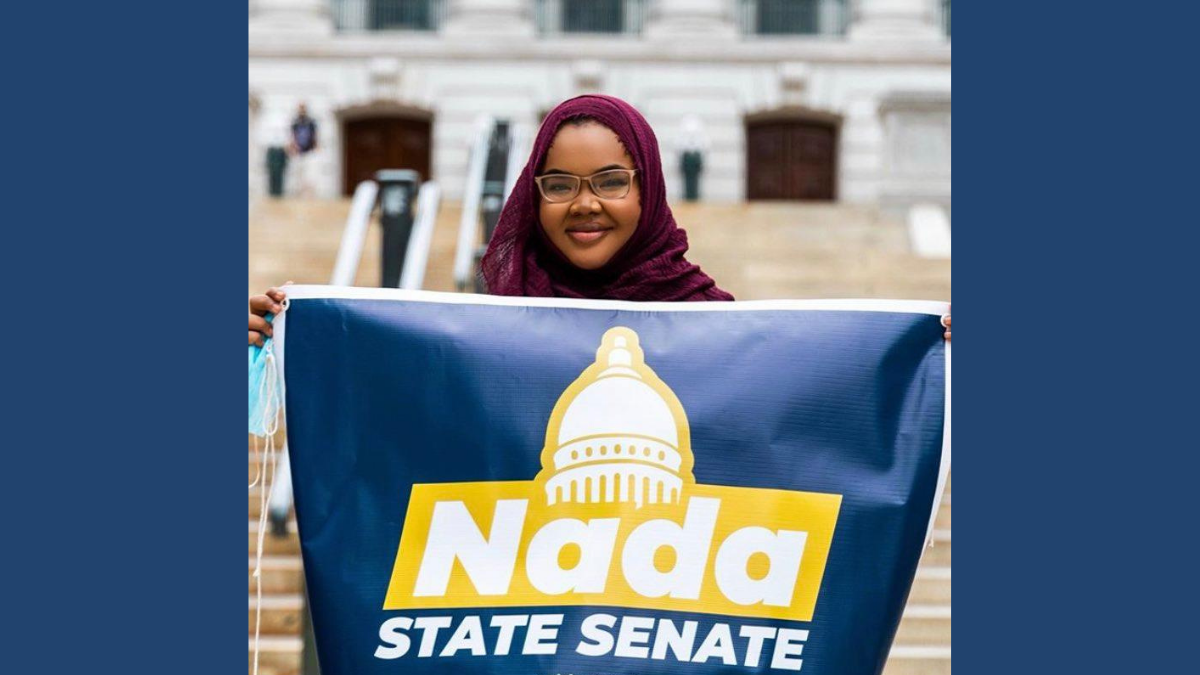
In just her first candidacy for public office, Nada Elmikashfi exposed all the ways in which politics as usual in Madison was never good enough. In her run for State Senate, she shook up a status quo that has held for far too long. Even if you put Fred Risser’s unbearably long tenure aside, it’s rare for any incumbent in Madison to face a challenge. That such a challenge came from a young Muslim immigrant working class woman of color with extremely good politics brought much needed new perspective, and a glimmer of hope into a city whose politics are often very myopic. She did this in lots of ways that are worth exploring, one of which is how she stood outside the business as usual of Madison progressive politics.
Most Madison campaigns fit inside extremely narrow ideological and temperamental bounds. Vague, polite, non-confrontational progressivism is the name of the game. Candidates do their best to exude the energy of that box-checking, post-2016 yard sign: “In this campaign we believe science is real, love is love, black lives matter, etc. etc.” The Madison Candidate wants you to know they’re on the right side of the issues, but they would prefer not to quarrel over them. No doubt some Madisonians would like to think that this is because there is broad political agreement within the city. Or perhaps, if there is disagreement it’s better for everyone to “take the high road,” because we’re all in this together aren’t we? But there are winners and losers in all politics. If no one is fighting it’s because someone has already won.
But there are winners and losers in all politics. If no one is fighting it’s because someone has already won.
When we can only conceive of politics as a polite affair where candidates not only can, but must elide their differences due to some notion that everyone wants what’s best, we lose sight of the fact that lives and livelihoods hang in the balance. In politics, there are real, material conflicts of interest that are going to be sorted out one way or another. Housing cannot become more affordable without hurting landlords’ bottom line. Lake levels can’t be lowered to stave off flooding without affecting the value of lakefront property. Racial justice cannot be achieved without hurting the profits of the prison industrial complex. If a candidate is a meaningful threat to those interests, powerful forces are going to fight back with everything they’ve got. If that fight does not manifest in the campaign, if everyone campaigning is on the same side, then it is pretty clear whose side that is.
Nada brought these conflicts to light by speaking honestly about what is happening politically in Wisconsin. She called out Kelda Roys for owning a real estate company and (through a combination of personal loans to her campaign and big dollar donations) essentially buying her way into the State Senate. She swiftly denounced a bill co-authored by a Democratic State Senator that would have been used to criminalize Black people. There are some who might dismiss this as unnecessarily antagonistic, but the antagonisms are present whether they are acknowledged or not. The ways in which established politicians reacted to Nada make this clear. Roys, despite declaring her candidacy months after Nada and others, claimed to be the only person running for Risser’s seat. Former Mayor Dave Cieslewicz wrote an entire blog post dedicated to calling Nada unserious. Tim Carpenter responded to Nada’s criticism by harassing her online to the point that he was reprimanded by the State Senate Minority leader. These antagonisms came out not just because of the policies that Nada stood for, but because of who she is.
Much of these reactions were based on racism, sexism, age-ism, anti-immigrant and anti-Muslim sentiment. A Madison born white male candidate with the exact same policies, levying the exact same criticisms would not have faced the same blowback. In this way, Nada’s identity cannot be extricated from her politics. There are meaningful political differences between a white man calling for racial justice and a Black woman doing the same and the differing reaction speaks to that.
Through being serious about the issues, honest about how our system works and just plain being herself, Nada put the Madison political establishment extremely off balance.
In addition to how politicians and pundits react to each other, identity shapes the ,way candidates react to events outside of their control as well. Kelda Roys, during the height of the George Floyd protests, was put in the absurd position of trying to make the case that she (as opposed to any of the numerous candidates of color running for the seat) would be the one to deliver on racial justice. Politics is above all about trust and credibility. Particularly in the absence of an established, cohesive political movement, identity plays a huge role in who has it and who doesn’t.
Through being serious about the issues, honest about how our system works and just plain being herself, Nada put the Madison political establishment extremely off balance. Even though she didn’t win her campaign, she’s already left an indelible mark on the city. Nada brought the politics back into Madison politics. Hopefully it is here to stay.
Members of Madison Area DSA formed the Electoral Politics Working Group to advance democratic socialism through local political bodies, including elected offices.To learn more about the efforts of the working group and to find out when they meet and how to get involved, visit our chapter website.
This article was originally produced for the September 18 episode of Labor Radio. Labor Radio airs every Friday at 5:30 pm on WORT FM 89.9. You can also stream it online or listen to past episodes of Labor Radio at wortfm.org.
In July Madison Teachers Inc. the union representing Madison public school teachers and staff put forth their ideas as to how to open the Madison Metropolitan School system in ways that would protect the health and safety of all concerned- teachers, students, and staff. After a few weeks of back and forth discussions MTI and the School Board were able to develop a mutually satisfactory plan of action. As a result Madison schools will open, with some students in school, and others on line. In addition MTI and the School Board, and the Madison community are developing the resources to provide child care for those students whose parents must return to work.
The difference is clear: the Madison School Board has a relationship of respect with the union, Madison Teachers Inc. and those it represents. The University of Wisconsin disdains those who work at the University and disrespects their organizations.
Meanwhile, the smart restart of the University of Wisconsin looks dumber by the day. It appears to have accomplished increasing the COVID-19 levels in Dane County and the city of Madison. Well over 3500 students are quarantined to their dorms. Face to face classes are banned. All classes are virtual. The UW is considering drastic action whatever that might be. Faculty, academic staff, teaching assistants and support staff have all spoken out against the so called plan. UFAS and the TAA have tried to approach the UW with their ideas specifically arguing that it is premature to start in person classes until at least the end of October. In contrast to the School Board, the University has refused to meet and confer with the unions who collectively have over a thousand members. The UW continues to stonewall the public, staff and students. The difference is clear: the Madison School Board has a relationship of respect with the union, Madison Teachers Inc. and those it represents. The University of Wisconsin disdains those who work at the University and disrespects their organizations.
While all collective bargaining in the public sector is constrained in many ways, the Madison Metropolitan School district and the union have found ways to talk with each other . The UW has done the opposite, refusing to meet and confer with the unions on campus and thus endangering the city, the county the students and the staff.
The anti-union bias of the University places all of us in jeopardy.
The University of Wisconsin-Madison’s “Smart Restart” is already a disaster, perhaps even sooner than faculty, staff, and some local elected officials predicted. Over the past few weeks, students returned to campus in order to begin their fall semester with a “hybrid” mix of remote and in-person instruction on September 2. Starting on September 4, Dane County posted a record-breaking 160+ cases of COVID-19 a day for three days in a row – a dramatic jump from the seven-day average of about 40 cases a day. A significant portion of these new cases have been traced to students at UW Madison.
As people beyond the campus bubble recognize the growing danger, a low buzz of hostility and resentment towards UW Madison students has begun to pick up. Hand-wringing about college partying, stories of disobedient frats and sororities, and pictures of packed lines outside of college bars abound on social media. Make no mistake – this reckless activity is actually taking place and it is distressing, not only for the greater community but for the students themselves. While younger people are less likely to die or be hospitalized as a result of COVID-19, the long-term effects of the disease are unknown, and even some of the immediate effects of COVID-19 for survivors are disturbing. But few people actually seem concerned about the students’ health and welfare. It is incorrectly taken for granted that college students can survive COVID-19 and be just fine even as they make the rest of us unsafe. More often than not, the complaints are taking on an air of blame, with the encouragement of university administrators who, after deciding to bring students back, have already publicly admonished students for the outbreak that has followed their return. Just one week into the fall semester, students are the new scapegoats.
But students aren’t really the ones to blame here. Like so many of the deeply flawed reopening plans that have been rolled out in cities, states, and workplaces, the success of UW Madison’s strategy for bringing students back to campus hinges on people defying their most human impulses and adopting a life of solitude in which their only risky human interactions are those that generate profit. In the case of the University, this means attending in-person classes that necessitate their paying full tuition and living in the dorms. Public Health Madison & Dane County’s entire Forward Dane plan relies on the same general premise. Yes, it is fine to go shopping or go out to eat, and it is fine for shops and restaurants to bring employees back to the workplace. These things are vital to the economy. No, you should not have in-person visits with friends and family at someone else’s home.
Sadly, given the amount of community spread and the low levels of COVID-19 testing in the United States, most in-person interactions are probably ill advised right now, whether they stimulate the economy or just our hearts and minds. But the folks in charge are willing to take the risk! Or rather, they’re willing to subject workers and students to risks to the extent that it will make them money.
This is just another example of how the response to COVID-19 is shaped to fit the logic of capitalism. Activities that generate profits – labor, purchasing goods and services – are approved, but people must limit the non commodified social interactions that would actually enrich their lives and sustain their mental health in order to keep conditions favorable for the profitable activities to continue. Unsurprisingly, humans are not good at living within these confines and restricting their activities to what’s best for business or a University’s bottom line. The inherent contradictions of these guidelines are too obvious. If it’s safe to return to work or to attend class in person, why isn’t it safe to visit with friends and family? Why shouldn’t we also be allowed to take the risk involved in spending time with people we actually want to see?
It is especially cruel to ask college students to conform to this contradictory logic – and then to punish them for failing. College students are in the prime of their lives when it comes to socializing, not just because they’re at a social age but because they have tobe social in order to construct a network in a city where the majority of them did not grow up. Without that network – trapped in their dorm rooms and apartments – students are alone. Their families live elsewhere. Their roommates might be their good friends but they also might be mere acquaintances or even total strangers. Their closest friendships and most valued relationships might have nothing to do with who they live with and who they are now being told to hunker down with for the next two weeks in response to the “Smart Restart’s” predictable failure.
I have the most sympathy for college freshmen in particular. This fall’s freshmen are the high school seniors whose proms, graduations, and end-of-school festivities were blighted by this pandemic months ago. There was plenty of time for leaders within the federal and state governments to act and plenty of time for local government to get it together when it became clear that both the state and federal government response to COVID-19 was an abject failure. Public health officials could have made the honest evaluation that without resources from the state or the feds for a massive expansion of testing and contact tracing in our community, bringing students back to campus for in-person classes was too dangerous to be advisable. University administrators could have listened to the concerns of faculty, staff, and students and come up with a plan for an all-remote semester with no on-campus housing. They could have been honest with these incoming freshmen about what was actually on offer at UW this year.
Instead, the very students who have already paid a high personal price due to COVID-19 have been lured to campus by greedy University administrators under the false pretenses of a normal fall semester that was never going to happen. Now, instead of learning remotely from the comfort of their bedrooms at home, taking a gap year, or spending far less money to take online classes at a local community college, freshmen are being charged tens of thousands of dollars to shelter in place in dorm rooms, far from their family and friends, during one of the most tumultuous and unsettling times in recent memory. They are being asked to endure extreme isolation during a period of their lives that many young adults find isolating and anxiety inducing under normal circumstances. It is despicable and shameful that UW Madison has elected to treat them this way.
It is also unsurprising that many students are choosing to buck these incredibly unfair circumstances and engage in dangerous behavior now that they’re back on campus. All around them, people in positions of authority have failed to deal in honest, logical information. Given the absolute absence of leadership from the federal government on down, students recognize there is no reason to believe this will change for the better any time soon. They are in the middle of a city that has already insisted on getting back to a pretense of normal regardless of safety, where middle-aged couples can be seen meeting up with their friends at restaurants all over town any night of the week. Students are being charged full-price for tuition, the cost of living in the dorms, and for their rent, the benefits of which normally include proximity to other young people for a rich social life. But now the onus is on them to live like hermits in order to protect the community? Sure.
The individuals who are responsible for this situation – for this outcome, which will have a negative impact on our entire community – are primarily those in charge at the University of Wisconsin-Madison. They are the ones who proceeded with this foolish plan in spite of being told repeatedly that it was a terrible idea. They are also the ones who still have the power to do things differently – to adopt the all-virtual “Moral Restart” workers have been asking for. But Public Health Madison & Dane County, which remained silent about the advisability of a “Smart Restart” instead of denouncing it as a major public health risk, is on the hook, too, as are Madison Mayor Satya Rhodes-Conway and County Executive Joe Parisi, who were also awfully quiet about a plan that was guaranteed to harm the community over which they both preside. Simultaneously, this entire shitshow has been informed by the system we live in, where the relentless pursuit of profit takes the place of any other priority or plan.
We all deserve better than this sickening restart. Yes, even the bozos risking their lives for mediocre mixed drinks at Wandos.
Why won’t the Democratic Party get on board with Medicare for All, which is wildly popular among all Americans and would arguably give them a big shot in the arm as they face off against Trump in the middle of a nightmare pandemic? What does it mean that they’ve abandoned any mention of it in their party platform or in Biden’s campaign? Will they go to hell for this?
Sincerely,
Baffled
Dear Baffled,
The short answer is money. There are a lot of good people in the Democratic party, but because of the political system in this country, most elected officials feel the need to make friends with big donors. The health insurance industry is a ready supply of donors and a nice place to land as a lobbyist or executive after congress. Democrats with more wealthy friends become more influential within the party. All this assumes the politician is not corrupt or conflicted in more overt ways.
But let’s say most of the party actually listened to the people. The massive popularity of Medicare for All is blunted further because the senate is an undemocratic institution. Even if the Democrats win the senate and remove the filibuster (their only way to enact any sort of policy,) they feel they must cater to the right wing of their senate delegation. The Democrats may end up in a situation where they are effectively no farther left than Joe Manchin of West Virginia, who is hard to tell from a Republican. Joe Manchin’s daughter was, until recently, CEO of a company that infamously jacked up the prices of EpiPens, a drug delivery system that can literally mean the difference between life and death for people with severe allergic reactions.
People like Manchin would be less of an issue if party leadership were interested in exercising power or enacting policies that help people cover the basics of life. Even when they had enough votes to beat the filibuster in 2009, with an energetic and charismatic leader in Obama, the Democratic party talked itself into a far worse negotiating position on healthcare before actually negotiating with the opposition. Now they have the uninspiring, elderly trio of Joe Biden, Nancy Pelosi, and Chuck Schumer. These three are risk-averse and conservative in terms of party strategy, and they have made no secret that they consider people to their left to be more threats than allies.
To summarize, the Democrats as a whole are too friendly with the industry they would have to eliminate. They are unable and unwilling to exercise power. Even though Medicare for All has the potential to benefit them electorally in a public health crisis and massive recession—as well as making a tangible difference in the lives of the most marginalized populations in America, whom Democrats pretend to represent—the mass movement tactics needed to enact this basic social right are unpalatable to these people. Those same tactics threaten the system that helped install them into such influential positions. Because of this ideology, the leadership is chasing suburban centrist unicorns instead of giving the working class something to fight for.
Whether they’re going to hell? Their friends at the fracking companies are certainly trying to find it down there.
By Michael Martínez, originally published at Conter
Some weeks ago, the liberal literary magazine Harper’s Weekly, of New York City, published a story about a dreary town in ‘Flyover Country’ (a derogatory term for parts of the US between the cosmopolitan coastal cities) called Kenosha, Wisconsin that no one who is anyone had ever heard of (at least, the author by his own admission had not, until being assigned to cover it). The story could just as well have been told by a clever algorithm: Wisconsin matters because it matters for the Electoral College maths, which decides the fate of America and the world.
Trump won it narrowly in 2016, and it is competitive again. Kenosha is in Wisconsin. It once boasted a bustling industrial economy that provided good, stable, blue-collar jobs. Now it does not. It used to be reliably “blue.” Now it is not. It is “postindustrial”, in the far western end of the “Rust Belt”, tucked inconspicuously in the general metropolitan area stretching between Chicago and Milwaukee. There under grey skies lives the elusive and euphemistic White Working Class, driven mad by misery and poised to deliver Wisconsin and the White House to Trump once again.
In fact, as a city of 100,000, Kenosha was never particularly obscure to Midwesterners, nor for that matter to anyone with a serious interest in the problem of de-industrialisation or the history of the class struggle in the United States. It was once known to many as the site of a major sit-down strike that helped win the war to establish the United Auto Workers; now Kenosha is known again to everyone as a theatre in the war for Black freedom. On 23rd August, Kenosha Police Department officer Rusten Shesky fired seven shots at point-blank range into Jacob Blake’s back, with four connecting. A neighbour caught the attempted murder on video, which went viral. By the evening of the 23rd, people in Kenosha had risen in rebellion.
With the police department apparently caught off guard, the demonstrators seemed to more or less have the run of the place. Police defended the courthouse and the police headquarters, but lacked the capacity to prevent the torching of garbage trucks they had placed as barricades, looting of shops, destruction of car dealerships, and so on. The second night of the uprising saw the Kenosha Department of Corrections office burned right to the ground. That same night, the uprising expressed itself in Madison as well, where a handful of demonstrators, under cover of a much larger sympathetic crowd, broke out windows at the courthouse, vandalized downtown banks, and especially targeted the headquarters of the Wisconsin Manufacturers and Commerce – the largest capitalist lobby in the state, and an organization who bears no small responsibility for Kenosha’s misery. The graffiti read, “You have stolen more than we could ever loot.”
The continuity with events earlier this year is clear enough. What began in Minneapolis carried on in Kenosha, without the light ever going out in places like Portland and Chicago. But the third night of Kenosha’s uprising marked a new and disturbing development. On 26th August, 17 year-old Kyle Rittenhouse traveled 30 miles north to Kenosha from the nearly all-white, relatively affluent village of Antioch, Illinois, armed with an AR-15-style rifle. He was one among many armed right-wing vigilantes who traveled to Kenosha from across the region with the stated aim of “protecting property,” and the actual aim of acting out a violent fantasy. Rittenhouse’s dream came true: while defending a car dealership, he shot a demonstrator in the head; as others attempted to disarm him, he shot another in the chest, and a third in the arm. Only the third man lived. When Rittenhouse approached the police line to turn himself in, they allowed him to leave. He was back home in Antioch before he was arrested and charged.
Elements of these events also bear clear parallels with dynamics that have played out in other cities throughout the year. The collaboration of the police and vigilantes is well-known in Portland, for instance. The same dynamic was clear in Kenosha, where although the sheriff formally declined to deputize citizens, the police were seen to be thanking the vigilantes, giving them water, and, of course, refusing to arrest Rittenhouse. Rittenhouse is also not the first vigilante in America to target left-wing demonstrations; James Alex Fields rammed his car into the anti-fascist rally in opposition to the “Unite the Right” gathering in Charlottesville, killing Heather Heyer almost exactly three years ago. What has changed is the popular elevation of a vigilante to the status of a hero or martyr, in what might be the darkest turn yet for the reaction since the start of the Black Lives Matter movement.
What distinguishes Rittenhouse from Fields? Fields was radicalized by the white supremacists of the alt-right online message boards, and was clearly associated with neo-Nazi tendencies. Trump was forced to condemn, however haltingly, the neo-Nazis in Charlottesville. Rittenhouse, on the other hand, comes from squarely within the mainstream of anti-BLM reaction.
To my knowledge he is the first right-wing terrorist to emerge from that reaction, shaped by it as early as his pre-teen years. The symbols displayed on his social media are the typical symbols of the culture of police-worship that emerged since 2014 – “Blue Lives Matter” slogans, “thin blue line” flags, and so on. Rittenhouse would have turned 11 that year. He is a former member of a youth police cadet program, and aspired to become a police officer – and I suppose he may yet, if he avoids conviction. To his admirers, he did not attack a ‘peaceful’ demonstration, but acted as a good American in the face of an unruly mob. He was not unprovoked, like Fields, but acted in self-defence against violent rioters.
The slogan “Free Kyle” is being raised on social media, and reportedly among BLM counter-demonstrators. It is conceivable that Rittenhouse’s example will be considered or adopted by others in light of his construction as a hapless patriot only eager to restore peace to Kenosha. This is especially plausible because defences for Rittenhouse are not fringe on the right. Fox prime-time host Tucker Carlson, with the highest-rated show in US cable-news history, told nearly 5 million viewers that: “Kenosha has devolved into anarchy because the authorities in charge of the city abandoned it. People in charge from the governor of Wisconsin on down refused to enforce the law. They stood back and they watched Kenosha burn… How shocked are we that 17 year-olds with rifles decided they had to maintain order when no one else would?”
Republican Party leaders themselves have offered similar apologetics. Wisconsin State Assembly Speaker Robin Vos argued that Democratic Governor Tony Evers pulled the trigger himself when he declined assistance from the White House, the agencies of the latter badly tainted by their lawless repression of the Portland demonstrations. Like Carlson, he raised the spectre of the threat to property on a Wisconsin radio program: “People are literally dead because folks have had to take to themselves to try to protect their own property.” Democrats, it should be said, have been less than forthright in their condemnation of the attack on the demonstrators, still hoping to ride the fence between supporting the movement and condemning the “violence.” Their reticence cedes space to the right to define the situation.
As it stands now, it appears that the BLM demonstrators are undeterred. The movement was gifted an immense moral victory from out of left field, as it were: NBA players organized a strike in the middle of the playoffs, with the Milwaukee Bucks – favored to win the championship – taking the lead, and the action spreading to other professional athletic leagues. The course of the 2020 uprising continues to confound expectations.
Our Harper’s reader may interject: That’s all very interesting, but what does this mean for the election? Liberals fear, and the right hopes, that the BLM uprisings can produce a reaction that will give Trump another term, legitimizing a ‘law and order’ program. Polling does not seem to suggest that the uprisings have had an impact on the relative levels of support for Trump and Biden. Biden, in fact, often articulates a law and order program himself, to the extent he manages to articulate anything at all. The uprisings are producing a generation of committed leaders of the left and opponents of the forces of the state. Perhaps little Kenosha holds the key to Wisconsin’s ten electoral votes, perhaps not; but in 2020 it has already made history.
Wisconsin’s own Milwaukee Bucks led NBA players in making history on Wednesday when they chose not to take the court for scheduled playoff games. The players’ decision comes as Americans continue to grapple with ongoing racial injustice as shown by the police shooting of Jacob Blake, a Black man, in Kenosha, WI.
Wednesday afternoon, media outlets across the country and around the world began to highlight what they called a “boycott” by NBA players in solidarity with people of color facing deadly police violence and systemic racism across the country.
Those headlines, however, were imprecise at best and outright propagandizing at worst. Their use of the term “boycott” broadly undercuts the power of worker solidarity in the United States.
NBA players did not “boycott” Wednesday’s playoff games. They went on strike.
The difference between these two actions is critical in understanding the potential for labor as a force. When one chooses to “boycott,” they are making a choice as a consumer, withholding purchasing capital as a form of protest. A “strike,” on the other hand, is a collective refusal to work as a form of protest. Definitionally, media outlets’ insistence on referring to the actions of NBA players as a “boycott” is outright incorrect, and one is forced to wonder why that poor word choice took hold among members of the bourgeois press.
The rhetorical shift from worker solidarity to consumer decision appears to follow recent trends in the American understanding of power. Canadian author Naomi Klein discussed the bloated role of consumption in a 2014 article in The Nation.
Indeed, Americans do tend to find identity through consumption choices, and even well-meaning leftists can fall into the trap of an identity that is merely forged in receipt paper, that comes from the boycott of major corporations and well-known exploiters.
“Late capitalism teaches us to create ourselves through our consumer choices: shopping is how we form our identities, find community and express ourselves,” Klein said.
Indeed, Americans do tend to find identity through consumption choices, and even well-meaning leftists can fall into the trap of an identity that is merely forged in receipt paper, that comes from the boycott of major corporations and well-known exploiters.
Therefore, it is little wonder that various media outlets chose to frame the action of NBA players as a consumer choice. For many, consumer choices are the extent of appropriate political power, reaching just past the ballot box. That is not to say that boycotts are not useful tools in political action, but the reduction of the collective force of workers to the terms of individual consumer decisions only reinforces the idea that political power, at least for the working class, is only shown through the ways that people spend their money, not the ways that they are able to organize and push for change through collective labor actions.
This current understanding of power through consumption is in no small part the result of decades of conservative action against workers and labor unions, which have historically been the greatest counterweight against capital. Currently, nearly 30 states, including Wisconsin, have “right to work” laws on the books, stripping union organizations of power by requiring them to provide benefits for workers who do not join the union or pay dues. These laws and anti-labor sentiments have driven union membership down significantly over the past 40 years to a mere 10.3% in 2019, according to the U.S. Bureau of Labor Statistics.
As a result, broad American culture does not hold collective labor action in the same regard as it did throughout much of the 20th Century, and capital has no problem with minimizing the effects of labor action, that is, action that could cause workers from around the country to realize their power and demand better conditions for themselves and their families.
The NBA, then, as an organization that is owned by capital, along with large media corporations, has nothing to lose by encouraging a consumerist framing, as many Americans, who have grown used to a public distaste for organized labor since President Ronald Reagan fired striking air-traffic controllers in 1981, will readily accept the rhetorical switch.
Additionally, athletes, including NBA players, have been roundly criticized by reactionary forces over their willingness to speak out against injustice. NFL quarterback Colin Kaepernick famously faced enormous backlash over his decision to quietly protest police brutality, drawing the attention of President Donald Trump, who demanded the Wisconsin-born player and others be fired.
Critics of athletes, actors and singers have often tried to separate them from other workers by trying to limit their political speech in ways that would be unthinkable to others. Similarly, the decision to call the NBA players’ strike a “boycott” reinforces this idea of separation. When other workers choose not to work, it is considered a collective labor action, a strike. However, when high-profile workers with elevated visibility choose not to work in order to fight injustice, the powers that be seek to “other” the workers and distance them from the public in order to weaken the bonds of solidarity and commodify the personhood of the strikers.
Some have pointed out that the NBA players are subject to a “no strike” clause, per the association’s collective bargaining agreement, which has led people online to speculate that the use of the term “boycott” in the national press could be an attempt at keeping players from losing their jobs. A closer look, however, shows that the bargaining agreement’s wording transcends the term “strike” and seeks to “prevent each player from refusing, or threatening to refuse, to participate in any scheduled . . . game,” regardless of what they call the action. Even if the media says the players are participating in a “boycott,” the “stoppage of work” puts the players at risk of termination.
In the end, there is no concrete answer for this blatant error. No matter the reason for the word choice, though, it did not take long for people to take notice of the linguistic misstep. Within hours of the initial reports, social media sites buzzed with posts about the wording and its implications.
“NBA players are courageously on strike (withholding labor), NOT boycotting (withholding their $ /purchase). The diff is important bc it shows their power as *workers,*” Representative Alexandria Ocasio-Cortez (D-NY) tweeted Wednesday night.
Some large bourgeois media organizations soon jumped on the opportunity to cash-in on the trending topic with columns and explainers, but the vast majority of outlets continued to insist that these workers did not strike, even as other athletes began to follow suit.
As more people, then, become aware of the NBA players’ actions, it is up to the left to guide the discourse forward in a way that reminds workers of their collective power and the ways that that power can be harnessed for social and economic change. While major media organizations continue to manufacture consent at the whims of capital, working class folks across the country and around the world will face the challenge of creating grassroots solidarity with the victims of racial injustice and the scores of workers willing to lose everything to fight that injustice.
By David Boffa, Ally Bates, Peter Jurich, and Ben Ratliffe
The COVID-19 pandemic is here for the long term. Thanks to disastrous leadership at nearly all levels of government, a widespread culture of science denialism, and a toxic for-profit healthcare system the United States has in large part failed to make any significant progress in stopping or even slowing the spread of COVID-19. Most of us who’d hoped for the summer to bring relief—back when we were young and innocent in the pandemic’s early days this past spring—have now accepted that not only was this not the case, but that quite the opposite has happened. While new cases have been falling for several weeks thanks to the restrictions adopted by several states the numbers are still staggering; as of this writing, Wisconsin has had over 70,000 confirmed cases, over 7,000 active cases, and is adding hundreds of new cases a day.
Despite the reality of this situation—which is significantly worse than the spring, when schools were closed statewide—we are weeks away from many schools in the state choosing to reopen. Currently, Wisconsin has a patchwork of reopening plans for schools during the 2020-21 academic year. The Education Forward plan developed by the Wisconsin Department of Public Education notes that under state law individual school districts “determine the operations of their buildings and the learning environment.”
Some districts, like the Madison Metropolitan School District, have opted for a fully online reopening (Madison schools will be entirely online at least until October 31). Others—like the School District of Baraboo—planned to have fully in-person instruction, five days a week, for all students (although families may choose whether to do in-person, hybrid, or all virtual learning). Some districts are still waiting to make decisions and many have plans to reevaluate as the school year begins. In all cases it seems that parents have the option of choosing a fully online learning experience.
Districts that have decided to reopen in full or in part—e.g., some districts will have students in school only part of the week—appear confident that they are taking the necessary steps to ensure a safe reopening (or as safe as possible). This includes, but is not limited to, steps like social distancing (6’ apart), mask usage, sanitization stations and equipment, protocols around bussing, and teaching and reinforcing good hygiene practices. Districts’ confidence in these measures—more accurately, their overconfidence—doesn’t seem to acknowledge two key points: 1) the difficulty of enforcing these policies on the ground; and 2) the need for robust testing, tracing, and quarantine protocols. Without the latter, any success on the preventative measures will be wasted.
Back to School in Sauk Prairie schools
In the Sauk Prairie school district, plans seem to change with each new weekly Sauk Prairie School Board meeting. The board’s original plan was to halve the number of classes each day but double the time in each class, which would cut down on passing time in the halls but still bring the entire population of students back to school every day. According to one teacher (who spoke on condition of anonymity) the schools already have had kids returning for summer sports and testing positive for COVID. As of this writing, Sauk Prairie School District appears to have settled on a hybrid model in which students will be split into two groups that will alternate in-person school attendance.
One teacher from the district spoke to Red Madison and asked not to be named for fear of retaliation. She says a “teacher task force” was set up to give teachers some input in planning, but the board gave it no actual power. The National Education Association, which represents educators at the district, has up until recently only made some tepid requests to “please think about the teachers.” Their union finally initiated a letter-writing campaign after teachers demanded elected leaders take a firmer approach.
When asked what she and her colleagues need going into the fall, she talked about how nearly impossible it is to plan the semester. Equitable internet access is a major problem; furthermore, because the school doesn’t have open internet access students must use the school’s Chromebooks, which have limited capabilities. As to the other options, she said, “these hybrid plans are preposterous and masks and plexiglass in classrooms is just theater when you’re talking about spending every day with 120 students in a room with poor ventilation.”
“Be angry at being forced to go back to work without ensured safety and good compensation. Be angry that 23% of the districts’ students qualify for free and reduced lunch. Be angry the government isn’t providing any child care relief. This has nothing to do with ‘lazy teachers who won’t make sacrifices for their kids’ and everything to do with inequality and the government not stepping up.”
Beyond the practical needs of teaching, she says a major part of the problem lies in who is being blamed for the chaos—namely, teachers. Many parents, influential locals, and even other teachers are pointing fingers at the teachers who are most outspoken against reopening in-person classes in the fall. She says teachers are very much aware of the struggles of parents as many teachers are parents themselves.
Instead of being angry at teachers, this educator says, “Be angry at being forced to go back to work without ensured safety and good compensation. Be angry that 23% of the districts’ students qualify for free and reduced lunch. Be angry the government isn’t providing any child care relief. This has nothing to do with ‘lazy teachers who won’t make sacrifices for their kids’ and everything to do with inequality and the government not stepping up.”
No Easy Options
Regardless of what plans school districts go with, each includes a variety of socioeconomic hurdles. As with many things in this pandemic, the burden of these hurdles is primarily shouldered by individuals and families, not larger entities with the systemic capacity to handle them.
School districts that do choose to prioritize the health and safety of their students and staff by starting the school year with remote learning must also be prepared to do more to support students and their families as they adopt new routines and a dramatically different learning model. The class divide in our education system is only getting wider in the pandemic. The move to remote learning creates a number of challenges specific to lower-income families.
For one thing, students in lower-income families are less likely to have access to all the technology to successfully participate in online learning. Some school districts are able to provide laptops or other devices to students for online learning, but that is still very contingent on their household having internet access. A 2015 Pew Research Center analysis of census data found that 35% of lower-income households with school-age children did not have a broadband internet connection at home. Sometimes internet access is also limited by where the student lives—rural populations are significantly less likely to have the infrastructure for internet access, even if they could afford it, and those that do have significantly slower internet speeds.
Beyond the technological limitations of online learning for lower-income families, there is also the issue of childcare and adult support for students. Lower-income and minority parents are more likely to be unable to work from home. Young children require supervision—who is able to do that in families where the adults are unable to work from home? Sure, some families have community support systems in place and relatives that are able to look after their children, but this is an undue burden on families to solve on the micro-level, when a macro solution should be implemented.
Children also will need help with their remote learning, ranging from assistance in operating their online learning portals to understanding concepts. That is challenging for parents regardless of their economic situation. Parents working outside the home may not be able to provide that support during typical school hours, and parents working from home are also trying to juggle their own work and possibly caring for other children. Either way, this is a challenge for families; caring for and educating a child is a full-time job that many parents do not have the capacity to do without financial support.
Schools that are re-opening in-person will probably also face the same technological and childcare issues as schools with remote learning starts. A COVID-19 outbreak is almost inevitable for school districts planning on in-person learning, but a mid-term pivot to online learning will probably not be executed as well as those that planned to open online, possibly exacerbating the above-stated issues as families will have less time to prepare.
Ultimately, even finding solutions for all of these issues (and many more) on a school district level isn’t even as wide of a scope as it should be. Public education is notoriously underfunded, so school districts are probably doing the best they can with the resources they have. If anything, this highlights the overall need for our state and nation to invest more in education so schools are able to make the safest choice for their students and provide those students the necessary support in and out of the classroom.
Districts backing down
As this hodgepodge of reopening plans that feel more like experiments are announced throughout Wisconsin, there are some stories of teachers successfully protesting the plans put in place by district leaders. A suburb of Madison provides one such example. This district originally opted for a model in which students may learn virtually from home, but teachers must return physically to the building everyday—a decision seen by many to have placed unnecessary health risks on teachers.
Back when this decision was made, the district sent teachers a correspondence with the following rationale: “We believe that in order for our educators to provide the best possible learning experiences for students, they need access to their classrooms, their materials and supplies, and their colleagues.”
“To me, this implies that it is acceptable to risk our health for convenience,” says a Dane County middle school teacher who wishes to remain anonymous. “It just makes no logical sense in terms of health and safety to Zoom with my colleague one room over instead of the next neighborhood over.”
When teachers from multiple districts in Dane County voiced their concerns over this and similar decisions, those districts sent more memos to staff. One widely circulated statement read:
“We know some staff members may be hesitant or reluctant to physically return to school. We respect this sentiment. However, as an organization, we must staff our schools to meet the needs of our students. Unless a staff member qualifies under a specific law (or policy) for a leave or accommodation, staff must be prepared to physically return to work once our school buildings reopen. A general feeling of uneasiness or a concern that by physically returning to work might increase exposure to family members is generally not going to be a sufficient reason to remain away from work according to federal leave requirements.”
In reaction to this statement, the anonymous teacher said, “To reduce concerns about contracting a virus in a pandemic as ‘a general feeling of uneasiness’ was astounding—let alone the tone about concerns of putting families at risk.”
Almost immediately after this information was shared, teachers challenged this unnecessary risk and their district decided that it would no no longer be required, but “strongly recommended,” to teach virtually from the school building instead. “I am so grateful for teachers who spoke out,” the teacher says. “I believe that initial decision was based on public perception of a few outspoken, negative community members and the surveillance of teachers.”
Under the political microscope… again
Decisions that dictate teachers’ professional lives and general health are often made erroneously without union input—as is common in manys districts in Dane County and beyond. In fact, the teachers’ union heads in this district were surprised when the decision to teach from the school had been announced since they were still in the middle of researching safe options for learning.
“I feel pissed by how much I and others must advocate literally for our lives,” the teacher said. “Many of us entered the profession in part because we love the beautiful cacophony and chaos of students filling the rooms of our school—the vibrancy, the dynamism. But you know what else we love? Our lives—and being able to offer ourselves fully to this beautiful, difficult work we do. We value our lives! Our districts should, too!”
As the school year looms on the horizon, the decision within each school district of whether to physically open buildings has become a political argument. Teachers in Wisconsin are unfortunately used to their jobs being at the center of political scrutiny, but framing the debate through the lens of a global pandemic is new.
“Many of us entered the profession in part because we love the beautiful cacophony and chaos of students filling the rooms of our school—the vibrancy, the dynamism. But you know what else we love? Our lives—and being able to offer ourselves fully to this beautiful, difficult work we do. We value our lives! Our districts should, too!”
The debate surrounding the reopening of schools unfortunately falls in line with the debate of whether teachers should be willing to die for their students—a conversation that teachers are really tired of having. But with current focus on the pandemic, the teacher says: “We are trained to protect our students, with full knowledge of potentially sacrificing our own lives, in the extraordinary, unexpected circumstance of an active shooter. But now, we are expected to offer up our lives in a pandemic? Why is there not more outrage about that?
“I don’t know how teachers and schools became the center of the ‘return to normal’ narrative, but until there is a vaccine and widespread access to it, there will not be any part of this past sense of ‘normal’.”
She adds that this “return to normal” narrative is pushed harder through the idea that American students will “fall behind” in learning but notes that that is a “false, dangerous construct.”
“We have the possibility in education to reimagine, if we want to, what meaningful, equitable learning could look like. With that, I know in my district and in others, teachers were explicitly—and in my opinion, rightly—told last school year to privilege connection over content.
“Deep care for our students and teacher safety are not mutually exclusive. My hope is that this awakens and/or affirms a sense of political (in the broadest sense of the word) advocacy for all teachers.”