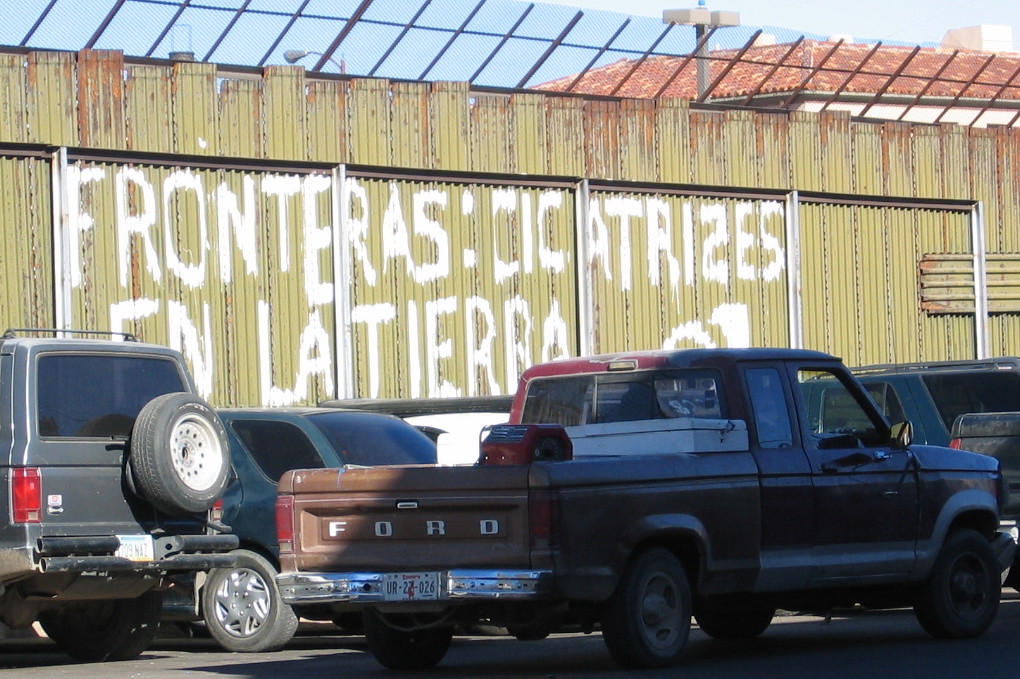
Tag: feat-June2020

  • Black and Indigenous Solidarity

    Black and Indigenous Solidarity

    By Charlie Aleck, originally published at Rampant

    Charlie Aleck is a non-binary Nuu-chah-nulth and Creole maker and shaker currently based in the Midwest.

    Introduction for republication in Red Madison:

    On Friday, July 17th thousands of people in Chicago rallied and marched in support of Black and Indigenous people. The rally was organized by Chi-Nations Youth Council, Black Lives Matter Chicago, BYP1000 and several other organizations. The march ended up at Grant Park and the plan was to take down the statue of Christopher Columbus. The Chicago police surrounded the statue and would not let the protesters through. They began swinging nightsticks and batons. Quickly the beautiful march of solidarity turned violent because of the police. The Mayor of Chicago has defended the actions of the police. 

    Alderman Carlos Ramirez-Rosa said on Twitter, “Black and Indigenous Chicagoans and people from all across the city came together to do what our so-called progressive mayor refused and failed to do. They were met with violence and abuse. It’s shameful and disgusting.”

    It’s important that the people of Madison learn and work with others fighting for liberation throughout the Great Lakes region. 

    This article below was previously published in Rampant on Friday, July 17th leading up to the march and giving context and understanding of the need for Black and Indigenous solidarity. Rampant is a Chicago-based magazine for revolutionary politics, Chicago-style.


    On Friday, July 17th, a coalition of Black and Indigenous organizations and activists has called for a solidarity rally in Chicago, with specific demands for defunding the police, investing in communities, and ending the history that honors the enslaver and colonizer Christopher Columbus.

    The rally is the first of its kind in Chicago in recent memory to explicitly call for solidarity between two groups that have already been collaborating and building struggle, but now have the opportunity to make real demands and push the movement for Black lives and Indigenous sovereignty forward. 

    —

    On June 1st, one week after the beginning of the uprising, Indigenous women gathered in ceremony at the site where George Floyd was murdered. Over asphalt painted with messages of solidarity, heartbreak, and unconditional love, jingle dress dancers in full regalia and ribbon skirts formed a circle around powwow singers on drums. The rhythmic clashing of jingle cones, the singers and drums, the eagle feathers and scarves each dancer lifted to the sky, carried the prayers and medicine for George Floyd and his family. But it was not just for Floyd, it was also the other victims of Derek Chauvin, like Wayne Reyes, the Leech Lake Ojibwe man who was shot and killed by Chauvin and 5 other cops in a flurry of bullets in 2006.

    The Jingle Dress dance, gifted from Creator to the Ojibwe people during the last major pandemic in the United States, the 1918 Spanish Flu, holds the Ojibwe teaching that sound carries medicine through the air. The sound of the rows of cones on the dress itself, the drummers and singers that accompany, the sight of Inidgenous people gathering and dancing for the sake of healing, is a small part of what it takes to resist. To lift people’s hearts, to help them to breathe, to keep on fighting and living.

    Then, like today, people needed a way to rest their bodies, uplift their spirits and be present amid the despair and constant fear of pandemic and the horrors brought forth by racism and capitalism. Music and dance continue to erupt out of protests, new anthems have been born, and give the movement energy to carry on.

    Minneapolis has seen waves of revolt against the police from Black and Indigenous people. The American Indian Movement was formed there in July 1968, growing out of resistance to police brutality. One of the first programs created was a people’s patrol against the police inspired by their collaborators and comrades in struggle, the Black Panther Party for Self Defense. 

    There are clear reasons why police violence has been an integral part of organizing. Black people are the disproportionate victims of police murder, making up 32 percent of victims killed by police while only making 13 percent of the population. Indigenous people make up the highest rate of police killing of all ethnic groups–despite the widespread underreporting of deaths by way of misidentification of Indigenous victims as Asian or Hispanic. Whether it’s on the street, in homes, in schools, or left exposed and neglected in jail cells, times when police are called upon to interact or control Black and Indigenous people, there is an undeniable risk of violence and death. As long as police exist, Black and Indigenous people will never be safe.

    Black and Indigenous struggle have taken on similar tactics, and have learned and grown from each other since the many decades from the Civil Rights movement to the first recorded rebellion of the enslaved of 1521 of  African Wolof and Indigneous Taíno peoples who rose up against Christopher Columbus’ son–Diego Colon.  Slavery and Indigenous genocide arose together and have been resisted since their origin.

    What does freedom look like? 

    In the long task of movement building there is always the lingering question of what the world after revolution would look like, and understandably many have been unsure what an equitable, just society could look like.

    The ongoing mutual aid systems that have popped up across the country in response to Covid-19 have shown us that we can build ongoing networks of support that redistribute wealth, labor and food regardless of whatever capitalist Democrat or Republican tries to horde resources away from us.

    We also see glimmers of it in the historic Supreme Court ruling of McGrit v Oklahoma where astonishingly the conservative Trump-appointed Justice Gorsuch ruled in favor of honoring the treaties and deemed that 47 percent of the state of Oklahoma is now under tribal sovereignty. 

    What does it mean to take back the land? What does it mean to re-occupy space as colonized and displaced people?

    When working-class  Black and Indigenous people take power, we often do so by building a thriving community and providing ourselves the resources the state never allowed. 

    We’ve seen spurts of re-occupation throughout the last century.

    From Philadelphia’s MOVE, to Chicago’s Freedom Square, most recently the Capital Hill Autonomous Zone in Seattle, to the highway takeovers of the early Black Lives Matter movement, Wounded Knee and Alacatraz, and of course Standing Rock. When working-class  Black and Indigenous people take power, we often do so by building a thriving community and providing ourselves the resources the state never allowed. 

    We can already imagine some of the things within our reach. The freedom to healthcare by reopening Chicago’s west and southside clinics, by turning over the Bureau of Indian Affairs’ flailing Indian Health Clinics and opening properly funded and robust medical centers. The freedom to education by reopening Chicago’s shuttered schools, and building an anti-colonial curriculum that teaches about the original inhabitants of the land, enslavement and Black history. The freedom to live safely without police by providing homes to all unsheltered people, creating community centers that can help conflict resolution and de-escalation skills training. All the things our society is fully capable of providing, but is kept from us day in and day out to produce a wealth that we will never see.

    Ultimately, those kinds of goals are what makes us so threatening to US capitalism, because if we can provide resources for ourselves, that means the resources can and should be made available to everyone. 

    To fully take back the land we must restore Indigeneous sovereignty and stewardship over the land, which is to say Indigenous people’s role and responsibility as human beings to protect and preserve life as we know it for generations to come. Indigenous teachings and history as people of this land for more than 10,000 years has provided rich insight and knowledge no settler society can fully replicate, and that this current society has no vested interest in without profit. 

    As Black people in the United States and elsewhere throughout the diaspora, taking back the land is a form of reparations. Intertwined in the act of sovereignty, it is a way to provide  communities that continue to be looted of people, resources and opportunity, with access to healthcare, food education and safety. No one without a home, no one without food, or anything they need.

    When we take back the land we fundamentally transform the relationship millions of people have to the land, and their responsibility to it and each other.

    Chicago specifically, looking at the demands that organizers are putting forth for Fridays actions, which continue to grow, you see a rapidly transformed city. 

    • Defund the police and redistribute funds to communities that need them. 
    • Rematriating the unceded land east of Michigan Ave to Niswi-mishkodewinan (The Council of Three Fires) people. 
    • Make the First Nations Garden a permanent space and open more intentional green spaces around the city.
    • Abolish Columbus Day and Denounce the Doctrine of Discovery. 
    • Purge cops from schools and public transit. 
    • Stop Cop Academy.
    • Close Chicago’s notorious Homan Square. 

    Naming our bonds

    Today as the Black Lives Matter movement resurges we’ve seen a flourishing of Indigenous languages. Thanks to Radmilla Cody, an Afro-Indigenous Diné woman, and her search for respectful language to describe her African ancestry we now have the word Naahiłii. 

    “Na(a)” – Those who have come across.

    “hił (slash in the l)” – dark, calm, have overcome, persevered and we have come to like

     “ii” – oneness.

    Those who have come across, those who have persevered.

    “Naahiłii beda’iina’ nihił danilį” Black Lives Matter in Diné.

    “Makade-bizaawizijig da-apiitenimidiwag” in Ojibwe.

    “Taaqsipait Iñuggutiŋit Nuimanaqtut” in Iñupiaq.

    And in dozens of other languages, Black Lives Matter.

    We share the experience of racialization being invented on our skin for the sake of forced labor and free land, from the one-drop rule to blood quantum (the fractionalization of “Indian Blood” that tied the amount of Native ancestry to how much land was allotted to you by ways of the Dawes Act)–both of which used laws to racialize and oppress us. We share the history of police being created out of slave catchers and Indian agents, as a way to monitor, intimidate and control our populations. We have had a specific relationship to the land that has gone on to inform what colonialism looks like in other parts of the world. Black and Indigenous people not only have parallels but share history on shared land. We have generations of Afro-Indigenous kin across Turtle Island who are innovating art, music, language, and Nation building efforts. Blackness and Indigeneity never existed as solely dichotomous unrelated experiences, but rather flowed alongside and together as the colonial project expanded across the Northern, Central and Southern continent.

    We cannot ignore that the Indigenous people here on Turtle Island and the Indigenous people of the African continent have everything to gain by coming together in solidarity. Black and Indigenous freedom necessitates the freedom of all people.

  • Time for a Better Madison: Nada for State Senate

    Time for a Better Madison: Nada for State Senate

    An interview with Nada Elmikashfi by David Boffa

    The following is a conversation with Nada Elmikashfi, who is running for Wisconsin State Senate in District 26. We spoke via phone and the following is a transcript of that conversation, edited for length and clarity.

    What can we do to make housing more affordable in Madison? What can be done at the state level to bring relief to tenants and homeowners?

    All of us in working class Madison can tell that people can’t afford to live. In the 26th district the median rent in Madison has increased 23% over the past five-year period while the minimum wage has stayed the same. So we have incredible amounts of people in Dane County that are extremely rent burdened. I think about 25% pay 50% or more of their monthly wages on rent. So they’re literally having to choose between, you know, buying food and keeping a roof over their heads.

    And so I think that we need a really strong progressive voice in the capital who’s going to push for increased development of affordable housing units in amenity-rich areas and to also make sure that we are championing tenant rights. So enacting laws that prohibit discrimination based on a prospective renter’s source of income; laws that limit evictions without just cause; laws that prohibit any sort of discrimination, especially discrimination against homeless people in rental housing; and then of course really, really important, laws that guarantee a right to counsel in housing cases so everyone has the ability to represent themselves strongly and to really fight back against these abusive landlords.

    You mentioned a right to counsel in housing cases; would you consider expanding this right to other counsel or other categories—e.g., sustenance, safety, health, or child custody, things like that?

    One hundred percent. I think that we purposely make government and programming inaccessible to very many. My mom is an immigrant like me and so English isn’t her first language and I’ve seen how applications sometimes when it comes to federal or state programming it’s very difficult to try to navigate through it. And especially through the legal system, too, like when my mom was applying for disability I helped her a lot through it, and so it was incredibly burdensome, some of the bureaucratic tactics that you have to go through or processes. And so I think that a right to counsel in many of these cases is going to really alleviate some of the additional burden that’s on people that are already struggling.

    This country is having radical conversations about defunding police on the way to abolition, reparations, and transformative justice. What are some of your more aspirational goals for correcting the harms of systemic racism in one of the most racist states in the country, and what could reparations in Wisconsin look like?

    When we look at defunding the police I think Alexandria Ocasio-Cortez had a really intelligent and just revealing answer—someone asked her what does an America with defunded police look like and she said go to your nearest white suburban neighborhood. And so it’s an aspiration for America to be truly equitable. 

    I think a Wisconsin that isn’t the most segregated [state] in the entire nation is one that I would aspire to. And I think that when we look at reparations it also doesn’t just manifest in what people think it is, which is cash payments to black people whose ancestors have been historically disenfranchised. It’s also in our education system—making sure that we have great schools and a lot of diversity and bridging those gaps in opportunity that really affect people of color. It manifests in housing—making sure that we are destroying whatever is left of redlining that decimates the equitability in the housing industry. Making sure that our kids feel safe to express who they are. That is reparations in themselves, and I think that our country is moving towards a place where we can have those conversations—where we can talk about racism and in a way that’s a little bit easier than in 2014, when there was a Black Lives Matter protest here on campus it was accepted far less and was met with a lot more aggression than this time, so I think that we’re moving in a really great direction. 

    I still would love to see local officials and state officials really put pressure on neighborhood associations to make sure that they aren’t blocking affordable housing developments because of racism. That we’re each untangling those racist and white supremacist ideas and philosophies in our own lives and in our own heads, so that in the next four years and the next ten we can move to a really racially just and equitable country.

    We have some progressive candidates and we have to support them, but the Democratic establishment seems so hell-bent on not actually making systemic changes. Do you have thoughts on that?

    I think that why I get called radical is because I’m willing to critique the Democratic party and not just the Republican one. I think the Democratic party is immersed in an elitism that inherently leaves out the working class and communities of color in particular. I think that there needs to be a reform of these democratic processes that lack a really working class agenda and I think you see that in who’s represented at the polls. I think the Democratic party has a lot to go in terms of really making sure that we’re rooted in the working class, making sure that we are fighting for progressive policies in our everyday life and not just when it’s fashionable on Twitter. 

    “The Democratic party is immersed in an elitism that inherently leaves out the working class and communities of color in particular.”

    That for me is where I really see myself being that Democratic Socialist voice in the capital to make sure that moderate Democrats are held accountable to Madison’s working class and Wisconsin’s working class. It’s hard to fight for the working class if you’re not part of it; my rural immigrant background means that I can connect around Wisconsin with marginalized groups, with rural communities, with immigrant communities that have been primarily just left out of the conversation. I think that’s what the Democratic party needs; they have a lot of problems to be fixed and I don’t believe in waiting around until they hand us a little bit of what we deserve.

    Can you talk a little bit about the roots of your own interest in Democratic Socialism? Where do you think these ideas for you really took hold?

    I remember walking into my first DSA event and I was really, just, apprehensive because I didn’t see a lot of diversity. But in Alexandria Ocasio-Cortez, in Bernie Sanders, I saw this party or this ideology that really was accepting of who I am in every single aspect of it and wasn’t very much tokenizing it. And I think that is kind of an idealistic view of DSA but it is what we aspire to, even if there are a few places where that doesn’t come into fruition. 

    But for me what I saw in DSA was this valuing of people, where the government works for you, you don’t work for them, And I think in its simplicity, in its fairness and equitability, that’s where I really was drawn in. I saw an incredible self-awareness of where we have been as a country, an incredible hope for the future of what we can get to. And so for me a party or a political ideology that recognizes the work society still has to do, recognizes how we are faulty, inherently, as a system, and one that is so racially just in its platforming, was definitely something that I found a home in that I was never really able to find completely within the Democratic party.

    And I think that’s not to say that DSA doesn’t have its own problems, institutionally and systemically, but I see that it has so much hope and so much character that others do not.

    Can you speak to some of the problems that you see within the DSA? If you want to offer some ideas you’re welcome to. 

    In the beginning it was really hard for me to find my place because there is very little diversity and so I think that it goes to show that we maybe need to start doing recruitment more. So maybe really feeling engaged with our community here in Madison, because this is the message that sells, this is a message that carries the entirety of Madison’s working class. And so we should be much bigger and much more representative. 

    So that was a problem that I think is also perpetuated by a gatekeeping that I have kind of experienced within membership, within people that want you to prove your ideals, prove that you’re not a neo-liberal. And it’s like well as a Black woman I’ve lived these issues too—like, this affects me every day. And so for me I think that we have to stay cognizant that not every person who joins DSA even knows who Marx is or Lenin. So I think that that is maybe a not so prevalent gatekeeping tactic but I’ve seen it and I know that it’s turned some people away and so the more that we can work on ourselves to make sure that we are accessible for everyone I think the stronger that we’re going to be as a collective.

    You’ve spoken out in defense of protesters even when the protest has taken some deeply unpopular forms. As a result you receive death threats and harassment from people on the right and even people who are supposedly liberals and progressives. Where do you find the strength to keep going in the face of these threats and harassment?

    I always pride myself in being a strong person, but when you’re getting hundreds and thousands of hate comments and death threats it gets to you and it scares you and terrifies you. And it dismays you more than anything that this is the state of our country and that no matter what values I bring to the table, no matter how articulate I am, or the policy that I work so hard to draft with constituents, some people are just going to see me as a Black Muslim woman and an immigrant who has no place here. And so the best way I deal with that is just looking at the larger picture, that there is definitely more goodness than there is evil in the world, and that my candidacy alone is historic, my voice isn’t supposed to be here, and that the best thing I can do is fight a little bit harder so that someone, when another DSA-er from a marginalized community decides to run they deal with a little bit less than what I did. So I draw strength and that hope that I have America can be better and nicer to people that are different, people that don’t fit the mold of an old rich white man. 

    “Every piece of hate that you see floating around there’s equal if not more love floating, as well. Maybe that’s naive but it’s definitely made this a little bit easier to bear.”

    I also have to get off social media for a little bit, even though it’s really hard to do so. But I remember when I got that horrible voicemail I posted on Twitter about 15 minutes later an older white man sent me the most lovely message that was like, “you’re the best of America and we are proud to have you among us.” Every piece of hate that you see floating around there’s equal if not more love floating, as well. Maybe that’s naive but it’s definitely made this a little bit easier to bear.

    Do you want to talk about Joe Biden at all?

    I do. I think it’s crazy to me that we have come to a place where we have two choices presented in front of us and both have accusations—credible accusations—of sexual assault. And so for me that is incredibly discouraging of where we are, where the democratic party is. And so it pushes me harder to run for office in order to be a voice for people that don’t feel strong enough to speak out against Biden. So I’m gonna tell everyone to vote but I’m not gonna tell a survivor that they need to cast their vote for someone with credible sexual assault allegations. So it keeps me in a very interesting place, and I think in a place a lot of Americans find themselves. But the only thing we can do is really hope that this is the last time this happens.

    What’s been one of the more difficult or challenging aspects of deciding to run?

    There was a gatekeeping that I experienced in the capital that gave me impostor syndrome for like two minutes. It’s hard, when you see a capital that does not look like you at all, to think “oh I can get here and make a change” or that my voice will be heard. And so really humbling myself, getting to know Madison, made me certain that those gatekeeping tactics, that imposter syndrome, was not something I could worry about. That there were bigger things that we had to solve that went beyond just me and the individual and whoever else runs in these races. It’s about progression as a whole, and how we each are responsible towards contributing to it.

    “I want to see more DSA-ers doing what I’m doing, because their voices are just as integral as mine, as anyone, in the capital. And the more that we have those socialist ideals saturating the political field the more we can get in places where we can really represent the working class and fight for them.”

    Are there moments that really made you glad to have run or that inspired you during the run?

    I think standing with my fellow Madisonians during the protests. When I get messages from public officials that are like, “hey this is for me politically inexpedient to talk about but it’s something important that you should fight for, can you please elevate this;” when I get messages from community members that are like, “I need your advice on this;” all the things that show me that people trust me with their values and their issues really give me that hope that I can be a a megaphone for their concerns in the capital. So I use those little examples to keep me going. 

    Madison has recently voted to terminate its contract with police in schools. Are you hopeful or are you worried it might be an empty gesture?

    I’m really hopeful that this bodes well for the future; that we continue to prioritize the safety of all students. And so I think that it’s turned the lens on diversity within the school system, it’s turned the lens on opportunity within our education system, as well, and so I think it’s a really great step in the right direction. And now we have to couple it with making sure that we bridge those educational achievement gaps between students of color and white students. So it’s a great first step.

    A lot of this was done because of the work of protesters, people like yourself, groups like Freedom Inc. Are you hopeful that there will be more changes made in response?

    I think the protests in a way have turned attention to people in local offices and our elected officials and what we can be asking of them. So I think it’s opened the floodgates and that people are now really involved in the political process—they’re listening to city council meetings, they’re really engaged with public officials, and in exactly what they should be fighting for. And I think the fact that people are realizing that these public officials need to do better, that we can hold them to a standard of service that we haven’t gotten, is the really great part of all these protests. Because now we have that power to demand change, and they can’t mute the TV, they can’t unfollow us on Twitter, when we’re right outside City Hall screaming it out.

    What can people do to support your campaign?

    We have a lot of volunteer options coming up. You know people power is what gets us to the capital. I’m not a wealthy real estate entrepreneur—just a working class Madisonian really trying to make sure the capital is ours. Whoever can lend their voice to phone bank, whoever can donate, can join us to strategize—those are all really great things. Please visit www.nadaforwisconsin.com to find our volunteer portal and sign up.
     

    What do you think is important for people to do outside of your campaign in terms of supporting some of the progressive policies that you yourself support?

    I think people need to run for office. I want to see more DSA-ers doing what I’m doing, because their voices are just as integral as mine, as anyone, in the capital. And the more that we have those socialist ideals saturating the political field the more we can get in places where we can really represent the working class and fight for them. So run for office.

  • Sheriff Issues Racist Press Release

    Sheriff Issues Racist Press Release

    FOR IMMEDIATE RELEASE

    Contact: Madison-Area Democratic Socialists of America

    Sheriff Issues Racist Press Release

    July 10, 2020 – Sheriff David J. Mahoney’s recent press release reveals his office’s profoundly anti-Black racial bias. In his rush to alert the public about people who are not currently in jail, he’s forgotten some truly dangerous individuals. We’d like to fill in the gaps. 

    BREAKING NEWS! These white individuals are also NOT in jail today. 

    • Matt Kenny, aged around 50 of Madison, murdered two people, including an unarmed Black teenager, Tony Robinson. Subject at large! Has never faced any criminal charges for these murders. Last seen: working for Madison Metropolitan Police Department!
    • Brendan O’Neil, age 26 of Sun Prairie, stands accused of a hit-and-run, injuring a Black woman with his truck. Bail set at $350; he reportedly left jail almost immediately after his arrest. Presumably still operating his truck, a potentially deadly weapon. Look out!
    • Four white “classic Wisconsin frat boys,” ages unknown, who sprayed lighter fluid at an 18-year old Black woman before throwing a lighter at her, causing the fluid to ignite, burning her face and neck. They have not been found. Top guys not on it!

    These men did not require the assistance of a bail fund to get free, relying instead on institutionalized white supremacy to shield them from accountability. Friends and Comrades of Madison Democratic Socialists are not calling for the imprisonment of the individuals that are referred to here. As abolitionists, we bring attention to these few white men to highlight the racist assumptions around guilt and innocence that sit at the core of the criminal punishment system in general and the Dane County Sheriff’s Office in particular. In a society valuing Black life, the press release and the naked racism it exposes in the Sheriff’s office would warrant Sheriff Mahoney’s resignation or dismissal. In the days to come, we will continue to see whether ours is such a society.

    Support Free the 350 Bail fund. Release all incarcerated people in Dane County Jail and Defund the Police.
    You can download a copy of this press release to spread the word.


    Madison-Area Democratic Socialists of America condemns Dane County Sheriff Dave Mahoney’s press release and stands in solidarity with Free the 350, Freedom Inc., and all organizations calling for the release of incarcerated people from Dane County Jail. You can read MADSA’s full statement here.

    We are also distressed to share that almost as soon as we started putting this satirical press release together, another racist attack took place in our community. A violent white racist attacked a Black woman and her children at Woodman’s. The attacker, David Lythjohan, punched and shoved multiple members of the family, including a four-year-old girl, while hurling disgusting racial slurs. He was arrested and taken to jail. A local activist called the jail and found out that Lythjohan was charged with two misdemeanors: battery and disorderly conduct, for which the standard bail amount is $650. Lythjohan is also not in jail today, further highlighting that the Dane County Jail has nothing to do with public safety.

    You can contribute to a fundraiser set up for the family that was subjected to Lythjohan’s violence here.

  • Kick Trump Off Stolen Land

    Kick Trump Off Stolen Land

    by Brian Ward

    Today Trump will have an Independence Day rally and fireworks show at Mt. Rushmore in He Sapa (the Black Hills). He Sapa is a sacred place to the Oceti Sakowin, the Seven Council Fires, or the Lakota, Nakota and Dakota people (Sioux). Lakota leaders have sent a message to Trump that he is not welcomed on their land during a pandemic that has disproportionately affected Indigenous people and that they view his visit as a continuation of the violation of treaties. 

    Millions of people visit Mt. Rushmore every year to celebrate the “Shrine to Democracy,” otherwise known as a “Shrine of Hypocrisy” by many Indigenous people. Cheyenne River Sioux Tribe Chairman Harold Fraizer said, “Lakota see the faces of the men who lied, cheated and murdered innocent people whose only crime was living on the land they wanted to steal.”

    Oglala Sioux president, Julian Bear Runner said “The lands on which that mountain is carved and the lands he’s about to visit belong to the Great Sioux nation under a treaty signed in 1851 and the Fort Laramie Treaty of 1868 and I have to tell him he doesn’t have permission from its original sovereign owners to enter the territory at this time.”

    Mt. Rushmore was set to feature the most famous and influential leaders of the US settler state, Washington, Jefferson, Lincoln and Teddy Roosevelt. All four Presidents have Indigenous blood on their hands.

    After the discovery of gold and years of war and resistance the U.S. officially stole He Sapa from the Oceti Sakowin in 1877. This came on the tails of 1871, when Congress unilaterally discontinued the treaty process with Indigenous Nations. As settlers flooded the area and systematically stole Indigenous land via the Dawes Act of 1887, the US settler state decided He Sapa would be a perfect place for building a “Shrine to Democracy.” 

    Mt. Rushmore was set to feature the most famous and influential leaders of the US settler state, Washington, Jefferson, Lincoln and Teddy Roosevelt. All four Presidents have Indigenous blood on their hands. Washington, who was a well known slave owner, was also called “town destroyer” by the Haudenosaunee Confederacy during conflicts prior to the revolutionary war. Jefferson, another well known slave owner, wanted an “empire of liberty.” He expanded the US with the Louisiana Purchase without care for the Indigenous population, setting up the landscape for the removal of Indigenous nations in the southeast. Lincoln oversaw the largest mass execution in US history with the hanging of 38 Dakota men following their uprising in 1862 and he expanded settler-friendly policy and removal during the Civil War. Teddy Roosevelt expanded National Parks, which was viewed as a “nicer” way of displacing Indigenous people and stealing land in order to “conserve” the land and create space for white enjoyment.  

    This might be a brief history of the actions of presidents on Mt. Rushmore’s but what about the guy who designed it? The idea and construction began in 1927 and was completed in 1941. Mt. Rushmore was designed by Gutzon Borglum who was a well known racist and sympathizer, if not a member of the KKK. In one letter he expressed his racism toward Indigenous people writing, “I would not trust an Indian, off-hand, 9 out of 10, where I would not trust a white man 1 out of 10.” Putting more salt in the wound, the monument was named after wealthy investor and gold prospector from the Black Hills gold rush, Charles E. Rushmore. 

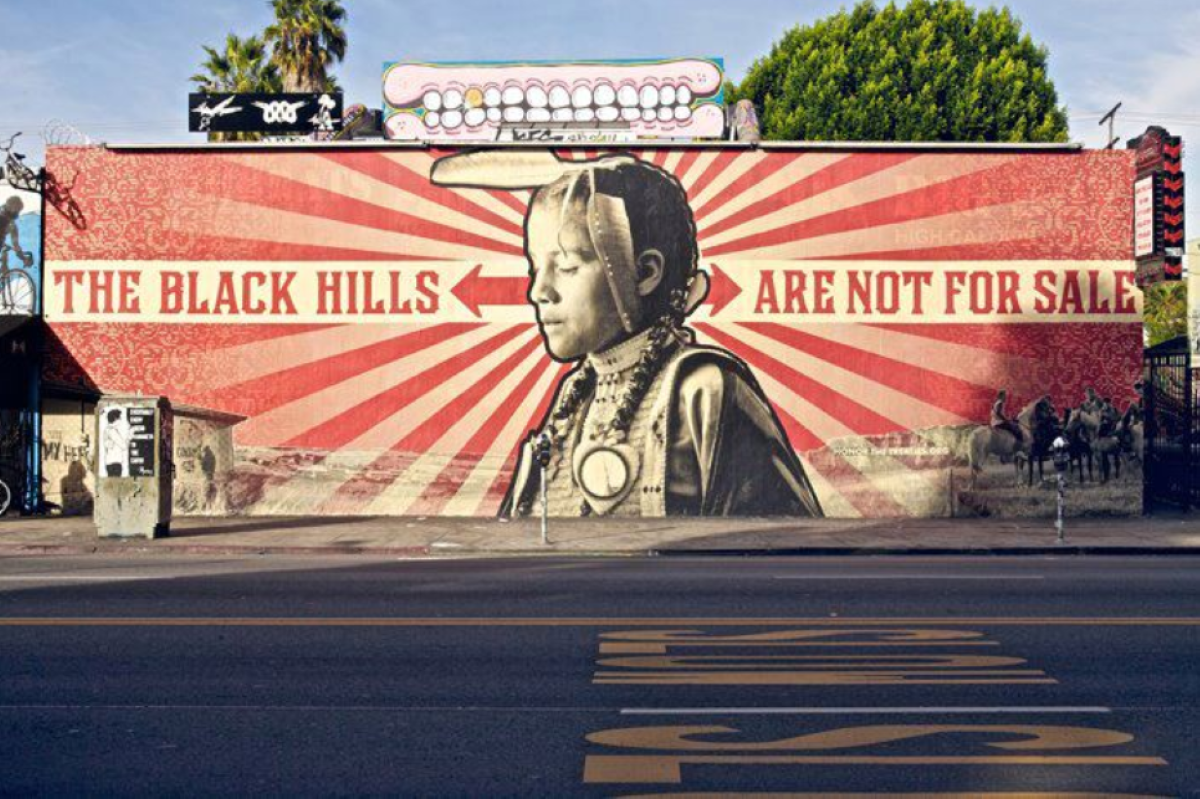
    The Oceti Sakowin always fought to get He Sapa back with the slogan, “The Black Hills are Not for Sale.” In 1971 twenty-three American Indian Movement protesters climbed to the top of Mt. Rushmore demanding that the U.S. government honor its treaty obligations. Following years of protest against uranium mining in the Black Hills and the growing Red Power movement, in 1980 the Supreme Court  affirmed the fact that the US stole the Black Hills and they needed to pay Lakota for the land. The Lakota have continued to refuse the money because they want the land back. Since then bills in Congress that would transfer the Black Hills National Forest over to the Lakota have continued to fail. 

    On a clear day at the edge of the Pine Ridge reservation near Red Shirt Table you can see the faces looking right at you as a reminder that this land was stolen. All the time I spent on Pine Ridge Reservation I could never bring myself to go to Mt. Rushmore, I could only drive by and flip it off. 

    In anticipation of Trump’s visit, members of the West River Democratic Socialists plastered the word “Fat Taker” on all the presidential monuments in Rapid City. The Lakota word for “Fat Taker” is “wašíču,” as their Facebook post said, “used to describe settlers whom since the beginning of settler colonial violence, take the fat from an animal without sharing or giving back in return. This greed is also applied in settler exploitation of land, people, and resources through violence.” Trump is only the most recent of a series of Fat Takers. 

    As we talk about bringing down monuments that represent the racist history of the United States, Mt. Rushmore needs to be included in the conversation. Trump said, “We’re here to protect our national monuments,” and celebrate our heritage: this is the heritage of settler colonialism and the constant erasure of Indigenous people from history. 

    It’s time to give He Sapa back to the Oceti Sakowin.

  • Supreme Court Victory Brings Relief, But DACA Recipients Still Need Certainty

    Supreme Court Victory Brings Relief, But DACA Recipients Still Need Certainty

    An Interview with Janelle Pérez by Dayna Long

    Janelle Pérez is an advocate and volunteer with the Community Immigration Law Center and a member of DSA. She has been involved in the fight for immigrant rights for the last decade. This interview was edited for clarity and length.

    DL: On June 18, the Supreme Court ruled that the Trump administration does not have sufficient justification to end DACA (Deferred Action for Childhood Arrivals). Can you tell me why this was such a big moment for you and your family?

    JP: My husband is undocumented and he’s a DACA recipient. It’s been a long year of us trying to navigate what would happen if the Supreme Court decision didn’t fall in our favor. His DACA was going to be expiring next year. We’ve also applied for him to be a Green Card resident, since we are married. So it was like, what is going to happen when your DACA expires but we haven’t heard back from your application? Does this mean that you’re going to have to leave the country? And what does that look like emotionally, financially? Those are things that caused a lot of stress and a lot of panic. To see myself in a situation where I would have to separate from my husband, I think that’s a very high emotional toll. 

    So once the decision was made we both were very happy because what this means for us – this will eliminate any type of separation from myself and from his family. This also means that he will be able to renew his DACA. As of now, it’s been clear that anyone who has had DACA can renew it. The uncertainty still stands on whether or not new applicants or someone who has never applied for DACA before will be able to under this ruling, and the advanced parole. 

    Advanced parole for DACA is basically allowing the DACA recipient to leave the country for emergency circumstances, like if a family member passes away. I know there’s been some circumstances where [recipients] have used that advanced parole to study abroad if they were students in the University. But then when you would re-enter the United States it would be legal. 

    For us, it’s being able to renew his DACA and being able to live without the fear of him being deported or of him having to self-deport if his DACA would have expired early next year.  

    DL: Obviously this SCOTUS decision is a product of many, many years of work that started before Obama announced the DACA program in 2012. What sort of efforts have you been involved in? Whose work have you admired? 

    JP: This is work that I was doing way before I met my husband, when I was still in Chicago. One of the initial calls for action for undocumented students was the Dream Act. That started in 2009. I became more involved in the Dream Act in 2010 all the way up to 2017 because there’s been a consistent effort of trying to pass this bill in Congress which would technically be a pathway to citizenship for undocumented students, undocumented individuals.

    It’s something that I’ve always been passionate about because I’ve grown up in a privileged home in a privileged place where both my parents are citizens and I’m also a citizen. I wanted to use my voice and my privilege to be able to fight and be an ally to those who weren’t citizens and who were in a situation where they may not have a pathway to be here. A lot of them are people who I grew up with. I never thought, “Oh he’s undocumented and she’s not undocumented.”  We were all raised in the same community. 

    So I did a lot of work locally in Chicago through an organization called the Illinois Coalition for Immigrant and Refugee Rights. Locally, here in Madison, me and my husband – my husband doesn’t like to be very prominent about [the work he does] because of his situation right now. He tries to keep it really minimized so he has a better chance of not raising any flags during any of this application process. But he is an advocate. He does work with a lot of youth in Madison, especially in the Latinx community. 

    I do more of the front line work, too. So like two years ago when ICE came and did raids in Madison, I was helping with the response team making sure that if I spotted ICE I let this group of people know. We were part of a task force that was letting people know where ICE was or where they planned on being. 

    I also volunteer for the Community Immigration Law Center on the East Side of Madison. I do a lot of advocacy work there for the immigrant community. I also do Spanish interpreting for the lawyers who do not speak Spanish. 

    DL: People are already pointing out that the Supreme Court decision is a reprieve, but not a solution. It doesn’t block the Trump administration from trying to end DACA again, though it seems unlikely that he’ll try it before the November election and of course the hope is that Trump will be defeated in November. But what would it take to end this ongoing uncertainty for DACA recipients? What needs to happen? 

    JP: We need a more solidified permanent solution. DACA is not that. What DACA does is, under certain circumstances, people can apply for DACA. You have to be a certain age, you have to have gone to school here, have good moral standing. And for me, the whole “good moral standing” piece is just – it’s problematic. There’s certain criteria that you have to fit to be able to apply for DACA. Other undocumented individuals are ineligible for it, so they still are undocumented without any support, in a sense, without being able to go and work because DACA grants you a two-year work permit. It gives you a temporary driver’s license. [People who are ineligible for DACA] are still at risk of deportation. 

    DACA recipients are as well, even though the government says that it will halt deportations for DACA recipients, but we’ve seen in the news that it doesn’t. We’ve seen from personal narratives that it doesn’t. So it’s a not a very structured or supportive program for undocumented individuals. 

    Going back to a more solidified, more permanent solution, that’s exactly what the Dream Act was about – that pathway to citizenship. If you’ve been in the United States for over a certain period of time, if you’ve been here since you were one or two years old and this is what you consider your home and you’ve done everything here, we need to make sure that you feel that you are not only home, but to protect you. Because if you were to go back to your “country of origin,” where your family comes from – that’s not something that is realistic for people either. 

    The reasons why – like I said, undocumented individuals, DACA recipients, are tax payers. They go to school. They work. They’re paying more out of pocket for things than we typically would. They don’t have access to a lot of federal programs. My husband had to pay out of pocket his first year at UW Madison. Not only did he have to pay out pocket for that because he’s not eligible for any type of government loans or grants, he was also considered a non-resident student so that’s another, larger chunk of money that he has to pay. At UW Madison you’re considered a non-resident student if you’re undocumented. You’re looking at $50-60 thousand a year. He saved up to be able to go for one year. That’s not realistic for a lot of people. 

    And immigrants contribute a lot to the US economy. From the perspective of a capitalist country, it would be in their favor to grant these individuals a pathway to citizenship for the economic flow of the country. 

    DL: There’s a narrative that I see a lot around Dreamers as being sort of model, high-achieving individuals, like when you read articles where DACA recipients are quoted, they’re doctors and lawyers and scientists and their academic and professional accomplishments are always listed. I understand that this cuts against xenophobic and white supremacist narratives about immigrants being undesirable, but it also makes me feel funny since we don’t have conversations about what people who were born in the US have accomplished to deserve to stay.  What are your thoughts about this narrative? 

    JP: It’s always great to acknowledge the accomplishments of any individual. We live in a country where we strive for a better life, or a fair shot at what would be considered the American Dream. We have to consider that not all DACA recipients have this kind of pathway or this opportunity to be doctors, be lawyers, go to college. Realistically, with all these factors, some universities you have to pay out of state or international student tuition. You’re not eligible for any kind of grants or loans unless that’s privatized. You have to recognize that there’s multiple types of DACA recipients. 

    The reason why these certain [recipients] are on a pedestal is because we live in a meritocracy society. There’s this need of a hierachy and competition, to raise and set a standard, like these are the good individuals, these are the good undocumented individuals, these are the great DACA recipients because they’re doing something good in their life. You also have DACA recipients and undocumented individuals who are skilled workers and we don’t talk about that and how that’s also very necessary. Yeah, we need doctors, we need lawyers, we need these people with degrees. We also need plumbers, we need mechanics, we need people who are in construction. People who can continue to help us in other ways.

    When any immigrant applies for any type of legal status in the US you always have to be approved or show that you’re of good moral standing. What does that look like in American society? If you’re worthy to be here, can you financially support yourself, kind of like what can you give us? 

    DL: You really answered this question earlier when you talked about the capitalist reasons for supporting a pathway to citizenship. It’s a mentality of thinking about people in terms of what’s good for capital instead of what’s good for people.

    JP: Right. Exactly. And that was one of the factors that the Dream Act – why it wasn’t agreed on by Congress. It wasn’t as capitalistic. It was more about what would benefit Dreamers versus what would benefit the country. Whereas DACA was saying, “Only certain types of skills and characteristics will make you eligible to apply.” If it really did benefit DACA recipients, there would be a pathway to citizenship or a pathway to a legal residency. That’s not happening. Every two years, your status is in limbo again because you don’t know whether or not one, the program is going to stay and two, your renewal for DACA will stay

    There just needs to be an overhaul of the immigration system in the US because the way it’s structured is based on how it benefits the country. And not necessarily how we can help individuals that we fucked over. If you go back in history and how we have colonized Latin America, and not only that but other different parts of the world, we were the reason why individuals could not stay in their countries any longer. 

    My father is from El Salvador. So, during the time he left as a child, during the civil war in the 80s, it was very imperialist. The US came in and trained soldiers in these countries. It wasn’t just El Salvador. We’re looking at Honduras. Guatemala. We’re looking at all of these other Latin American countries and the US literally flipped that country over and a lot of people didn’t feel safe and they left. And where do they go? They go to the United States. So it’s a vicious cycle of our colonialism, our invasions. There’s a reason why all these immigrants are coming to this country. It’s not fair that we’re doing all this damage and all these atrocities and then people come here and we say they have to be worthy of our values, or our economy. 

    We’re going to be seeing this type of immigration and these types of issues for who knows how long if it doesn’t change. There definitely needs to be more efforts – and not only completely changing the immigration system but also our relationships and what we’ve done with other countries. Because this is going to continue to happen. 

    DL: We’re living through a moment of really heightened struggle for Black liberation and some extremely radical demands – Defund Police, Abolish the Police, Abolish Prisons – are suddenly up for consideration in the mainstream. It has reminded me of the importance of having the far-reaching, revolutionary kinds of demands in mind in all of our movements. What are those types of demands in the fight for immigrant justice?

    JP: The ultimate aim is all these individuals, all these students and people who grew up in the US, who’ve only known this place as their home, they deserve a chance at becoming a US citizen. A chance to be able to practice their voting rights, to contribute in this country at a deeper level than just economically. 

    The detention centers – that’s not necessary. We’re separating children, we’re separating families. The only reason detention centers are really in place – I mean, in part to treat immigrants as unlawful in the eyes of this country but also for profit. A lot of these detention centers are privately owned and they purposefully fill these places up as much as they can for profit. They don’t need to be here. The conditions of detention centers are god awful. Detainees are not being treated like humans, they’re being treated as less than animals. That’s not necessary, that’s not needed. That’s not helping our country and it’s not helping any immigrant. They just need to be eliminated. 

    The other thing that I was thinking about is abolishing ICE completely. The purpose of ICE and why ICE was created was to profile and unlawfully detain and deport people. We’ve seen that time and time again. I don’t think that having a force like ICE is going to be very helpful in this country, it just invokes a lot of fear for the immigrant community. Instead of trying to make this community more fearful, we need to strategize to find a way to make them feel more welcome, and find more ways and resources to help their situation, and not to try to get them out of here because of something that was out of their control. Like a three year old who came here, who is undocumented, that’s not their fault. 

    One other thing – right now, anyone who is trying to apply for asylum – there’s this “return to Mexico” policy. you can’t even qualify to be seen for an asylum case unless you have asked for asylum from every single country you have crossed. 

    So for example, if you are from El Salvador and you’re going to the US to find asylum because you cannot live in El Salvador anymore – you’re afraid because of the violence, the gangs, the cartels – you have to go to Guatemala first and seek asylum. And you have to have proof that you’ve gone there first. And if they say, no, we can’t give you asylum, then you can go to the next country and ask. So let’s say someone from El Salvador goes straight to Mexico, they’re going to ask if you went to your neighboring countries first to ask for asylum and if you have no proof, then you’re not allowed at all. You have no shot of getting asylum in the US. 

    So that’s really problematic because if you try to find asylum in a neighboring country, the security of your life is not really improved because all of your neighboring countries are in that same turmoil. It’s terrible. Terrible policy that is leaving a lot of people dying and dead at the border. Or a lot of people, from what I’m hearing, are paying “coyotes” to take them back to their country because they can’t wait any longer. Or they’re just stuck because Mexico can only support so much as well.

    When we were looking at the caravans crossing through Latin America, at some point there was some resistance within Mexico but parts of Mexico supported having these refugees come into their country. But Mexico can only support so much because they’re also going through a lot of issues. Something needs to change when people arrive at the US border because we do have the resources to be able to help and support these individuals. We have a system that can allow immigrants to come into the country. And help them build a better life for their families and for themselves. 

    DL: I think we first connected because both of us have politics that really fall to the left of the mainstream. I’m interested in your thoughts on the political scene right now and how the Democratic Party has failed on some of these questions and what has to change. 

    JP: I do not support the Democratic Party. The deeper I go with my advocacy and work, especially with immigration, but it’s also shifted to the Black Lives Matter movement right now and Black liberation, it’s evident that the Democratic Party does not give a shit about Black and brown people. They do not. There’s been no effort from that party to really develop any kind of laws or any type of protection for these minorities. It’s very frustrating when we see the Democratic Party give up when they try to fight for even basic human rights for us. 

    I’m at a point where, you know, when Bernie dropped out of the race, a lot of people were like, “Well, we’re going to have to vote for a lesser of two evils,” but if we continue with that pattern nothing is going to change for us. We’re still going to be treated the way that we’re treated, we’re still not going to be put as a priority for a lot of issues that really affect us that haven’t been addressed. When we talk about education, when we talk about healthcare, when we talk about job security, food security, poverty, it’s not something that is in [the Democratic Party’s] agenda. 

    If we could get rid of the Democratic Party that would be beautiful. I would love to knock them down and reform and restructure a new party that is for the people. But that’s not realistic in this society and in this government. What we can do and what we’ve seen is at the more local level is putting in people with our beliefs and our views and our justice in their hands. 

    But [we need to be] more mobile and more grassroots about it because I feel like, although we use places like Facebook and Twitter as a platform to talk about how shitty this is, how shitty this election will be and how shitty the Democratic Party is, we’re only attracting a certain demographic or a certain chunk of the community. We do really need to practice advocacy at the local level, at the physical level, where we’re actually trying to organize within communities and educate them. Not only educate them but also let them speak about what their issues are, and what they want to see within their own communities and their own neighborhoods, so I think that that is a start. 

    I hope that with all of these awful events happening that there is a positive light to this. Hopefully with all of this that’s happening, people will start reflecting and thinking about what needs to change in this country to better all of our situations. At some point, at every level, everyone was impacted by COVID. Everyone is going to be impacted by this election and these current decisions by the Supreme Court so I think people really need to take the time to reflect on what really needs to change. This impacted everybody. 

    DL: Is there anything that I didn’t ask you about that you wish that I had? 

    JP: As someone whose parents were immigrants who came here and I was born here so I have citizenship, I’m not any different than my friends and family who are undocumented. We need to start unpacking what that looks like as a society because if you see beyond labeling – we love to label in this country – these are just people who want to work hard and want an equal shot at school, at life, at being able to build something meaningful for themselves, whatever that is, in this country. 

    If people are looking for opportunities to help, there are tremendous amounts of pro-bono lawyers and non-profit organizations that have advocates who are doing so much work, so many cases. These people need a lot of support, they need volunteers. It could be as simple as making copies, being a receptionist, being a translator. Those are things that I’ve seen from my own experience volunteering at the law clinic and also working with other lawyers. 

    These are things that are needed. It’s not a solution but for the time being, if people want to get involved those are the ways to get involved because that’s where a lot of the work is being done. A lot of people are getting granted access to the US through these non-profits and lawyers that are working around the clock to get people out of the border and out of the detention centers and here to get an asylum case.

  • Monuments for “Good Guys”: Rethinking History

    Monuments for “Good Guys”: Rethinking History

    By Brian Ward

    Across the United States, toppled monuments are forcing people to grapple with the country’s history, a bloody history that the nation as a whole has never properly addressed. A new consideration of this history would force us to rethink American wealth and power. Stolen Indigenous land and stolen African labor created the country’s wealth, but Indigenous people and African-Americans have never been allowed to share in that wealth. 

    The Black Lives Matter movement has pushed people to confront some of this history and the white power structure behind it. It has been inspiring to see the removal of statues of Confederate generals and other slave owners, and the act of removing Confederate statues is easy to defend to mainstream liberals. These figures are clearly racist, and the depicted traitors are the conventional “bad guys.”

    However, the recent toppling of the “Forward” statue and Colonel Hans Christian Heg in Madison and the President Ulysses S. Grant statue in San Francisco is now pushing us to also rethink the “good ones,” past figures that mainstream liberals view as Civil War heroes, including Abraham Lincoln, whose Bascom Hill monument is also a rumored target.

    Where are the statues of Harriet Tubman, Sojourner Truth or Frederick Douglass?

    When people frame these figures as the heroes, they remove the agency of the abolitionist movement and the formerly enslaved people that liberated themselves and forced people like Lincoln and Grant to turn the Civil War into a movement for Black Liberation. Where are the statues of Harriet Tubman, Sojourner Truth or Frederick Douglass? Also, the Civil War binary of “our heros and their heroes” continues the erasure of Indigenous people from history and lets people like Grant and Lincoln off the hook for their racism and role in the expansion of settler-colonialism and the invasion of Indigenous Nations. 

    With this in mind, we can begin to truly examine the historical significance of Madison’s “Forward” statue that was torn down by protestors on June 23. “Forward” became Wisconsin’s state motto in the midst of the United States’ expansion and settler-colonialism in 1851. At that time, Wisconsin had been the frontier for colonizers in the decades that followed the American Revolutionary War and the 1787 Northwest Ordinance that set up the qualifications for statehood. In short, settlers needed to outnumber the Indigenous population in an area to gain statehood, which led to an influx of settlers and forced removal of Indigenous people. The original seal of the Wisconsin Territory in 1836 contains a Latin slogan that translates into “Civilization Succeeds Barbarism” along with images of Indigenous people moving west and American moving in behind them with machinery. 

    By the time that “Forward” became the state motto, the Taylor Administration was attempting to forcibly remove the Ojibwe from northern Wisconsin into Minnesota Territory, following the forced removal of other Indigenous Nations from Wisconsin like the Ho-Chunk. The removal led to the Sandy Lake Tragedy, in which the U.S. government left 400 Ojibwe for dead without promised food and supplies. After the tragedy, increased resistance to removal pressured the government to create reservations in northern Wisconsin. Despite the U.S. government’s best effort, 12 Indigenous Nations remain in the state.

    The original “Forward” statue itself was later created for the Colombian Exposition in Chicago in 1893 to celebrate the 400th anniversary of the arrival of Christopher Columbus, a known slaver and a symbol of brutal colonialism for many across the country. 

    As a result, the term “Forward,” which has been adopted by many Wisconsin progressives, falls in line with the idea that this settler-colonialism was progress and that the White man brought civilization. African-Americans, Indigenous people and other people of color were never included in the “Forward” idea. 

    Madison’s Hans Christian Heg statue was also brought down by protestors on June 23, which caused some to become upset on account of Heg’s anti-slavery activism. The statue, which was unveiled in 1926 after Norwegian-Americans raised money to have it commissioned, bore no mention of Heg’s anti-slavery views or his work in the Free Soil Movement or Republican Party. Instead, it focused on his Norwegian heritage and time fighting in the Civil War. 

    Additionally, Heg was a settler who participated (though was not instrumental) in the 1849-1851 California gold rush that displaced Indigenous people and started a genocidal policy against Indigenous people in California. The statue, in turn, does not appear to celebrate Heg’s anti-slavery views, but rather Norwegian pride. I think that if Heg were around today, he would care more about the way African-Americans are treated than a statue.

    Similarly, protesters in San Francisco also removed a statue of President Ulysses S. Grant, who was the leading general credited with winning the Civil War. Grant actually owned one slave prior to the Civil War, and his wife reportedly owned slaves through her family. To be fair, Grant did fight the Klan in the American South and was the last President to oversee reconstruction before it ended in 1877.

    However, Grant’s administration also oversaw an illegal war against the Lakota, Northern Cheyenne and Arapaho, breaking the 1868 Fort Laramie Treaty, and his administration stole the Black Hills, a sacred Lakota site, from the Indigenous people there, because it was filled with gold. The expedition against the Lakota, Northern Cheyenne and Arapaho was led by General George Armstrong Custer, another Civil War hero, and soldiers attempted to round Indigenous people up for refusing to go to reservations designated to their Nation. The campaign culminated in the U.S.’s defeat at the Battle of the Little Big Horn by the Lakota, Northern Cheyenne and Arapaho in 1876. Afterward, however, Indigenous people on the plains were nevertheless rounded up and forced onto reservations.

    Even Lincoln, who is perched up on Madison’s Bascom Hill, who is well known as “the man who freed the slaves,” faces scrutiny for his role in American colonialism and the enslavement of Africans. In August 1862 Lincoln did, after all, state that his purpose was to save the union, even if that meant not ending slavery. This quote is often used to point out Lincoln’s shortcomings, and we must recognize that he was forced to change his tone because of the abolitionist movement and the courageous fighting of formerly enslaved people on the frontlines of the war. 

    Lincoln was foundational in the new Republican Party, a third party at the time of its creation, and the Free Soil Movement, which was a movement of settlers who wanted land out west at the expense of Indigenous people and Nations. Lincoln made sure to follow up on the movement and help pass policies that dramatically attacked Indigenous Nations and expanded the U.S. settler-colonial state. 

    For example, the Homestead Act  enabled any man to claim 160 acres of surveyed government land (Indigenous land) and buy it for a small fee after five years, which facilitated the expansion of states. Additionally, the Pacific Railway Act started the construction of the Transcontinental Railroad, which became the epicenter for conflicts between U.S. government-backed settlers and Indigenous people for the next 30 years. 

    Lincoln’s Morrill Act gave Indigenous lands to land-grant Universities for cheap. In Madison, that meant that Ho-Chunk land was given to the University of Wisconsin-Madison, which still benefits from that stolen land today. This act is the reason why Lincoln has sat on top of Bascom Hill since 1909.

    A greater understanding of American figures . . . forces us to rethink the contradictions of this country and what we are taught from day one. As the rapper Immortal Technique says, “How could this be/the land of the free/home of the brave?/Indigenous holocaust/and the home of the slaves.”

    To top that all off, Lincoln oversaw the largest mass execution in U.S. history after the Dakota people fought against the expansion of settlements in what is today Mankato, Minnesota. He approved the public hanging of 38 Dakota people on December 26, 1862. 

    Holding a greater understanding of American figures is important not because it allows us to bad mouth these leaders, but because it forces us to rethink the contradictions of this country and what we are taught from day one. As the rapper Immortal Technique says, “How could this be/the land of the free/home of the brave?/Indigenous holocaust/and the home of the slaves.”

    Statues have always carried political agendas. Confederate monuments, for example, were erected in the late 1800s and early 1900s to create a resurgence of Confederate revisionism. Yes, it would be nice to have statues of abolitionists and other freedom fighters, but people across this country need more than statues. We need to challenge a system that has built its wealth on bloody history. 

    Some people may still feel uncomfortable with the recent move to tear down statues of figures like Heg and Grant, the long-held idols of this country, but they are just that – statues, and we can still discuss these figures and learn about this country’s past. We are in a challenging moment, and popular ideas are quickly changing. Let’s take time, then, to amplify the voices of the oppressed and to know that Black and Indigenous lives are more important than these mere images of past figures.

  • “Enough Was Enough”:  The Science Behind the Movement

    “Enough Was Enough”: The Science Behind the Movement

    An interview with M. Adams by Dayna Long

    Photo by Emily Mills

    M. Adams is Co-Executive Director of Freedom Inc. and a national leader in The Movement for Black Lives. You can follow and find ways to support Freedom Inc.’s work on Facebook.

    DL: It’s pretty clear that we’re living through a historic and unprecedented moment. There’s urban rebellions in every city. You have often referred to yourself as a movement scientist, and so I’m wondering about your assessment of the conditions that led to this upsurge of struggle that we’re seeing around the country. How do you think that we got here? 

    MA: A few significant threads that are woven into the cloth of this time are, one, in the last 10 or 15 years there’s been massive Black resistance to particular anti-Black violence that we can point to. Hurricane Katrina, which for many people my age – I’m 34 – was a lifting of the veil. We were able to identify state violence and point to it and say, “This is it, this is where it’s happening.” I think also the murder of Trayvon Martin, criminalization of Marissa Alexander, the Jena Six, the New Jersey Five, Ferguson – there’s several moments in the last 10 or 15 years that have sown in the seeds of resistance, or the seed of protest and rebellion in particular, as responses to state violence. 

    At this point, we can say it’s in people’s memories. That’s really important, because if we look at Cuba – I’m not saying we’re in the same stage that Cuba was in terms of our pre-revolutionary conditions – but if we look at Cuba, within a single lifetime, there were wars and rebellions. There’s something about people having participated in protest and rebellion in recent memory, I think, that is making rebellion feel more accessible to people. Part of why this is so big is because Ferguson was a predecessor. That’s one aspect of it, is that Black people – in particular, young Black people, not just the civil rights generation, but Black people thirty and below – have in our lived experience, have a history with rebellion.

    Many Black people know that there is no existing institutional recourse for what they’re experiencing or what we’re experiencing as a community and for our families. And so I think the very human, innate response is to fight for what you need, to rebel. That’s exactly what’s happening.

    Two, I think the conditions of the pandemic are an important one. The pandemic really highlighted and helped to speed up people’s awareness of how fucked up things are for Black people. People’s frustration and disappointment in the government’s response was really a blow. When people saw that Black people were dying, when people saw that we weren’t getting ventilators, I think it heightened things. We, as Black people, were not good enough to be saved, but our labor was deemed essential. Many could see how the military and police forces were well-funded, and health resources grossly underfunded. The contradictions were heightened! And because we were socially isolating, social distancing – many movement people were not thinking that there could be a move to in-person action. Many thought that all in-person work was far off. I did not think that. I knew that things were steeping and brewing and that things were ripening. So that was a miscalculation, a misunderstanding of the science, by some people who are on our side. 

    I think the other factor is the brute nature of gendered racial capitalism and police terrorism. To watch anyone scream for their mother as the life is choked out of them, for minutes, which feel eternal, evokes, forces all of us into action. In the last years, we have been inundated with stories, videos, memories of painful Black death, both slow and gratuitous. Enough was enough. So when we saw George Floyd’s slaying – it was reminiscent of lynching, and that is effectively what it is – in the middle of broad daylight, it ignited all of those things.

    Those are some of the important social, economic and political factors, factors that were put in the crucible, that were put in the bake for this moment. I will also say, to go back to the science part, I remember being in classes in high school, chemistry classes, and learning about the concept of saturation, which is when something has absorbed all it can take. I think we are at another point of saturation. Internally, inside, many Black people know, whether or not they can articulate it, that there is no existing institutional recourse for what they’re experiencing or what we’re experiencing as a community and for our families. And so I think the very human, innate response is to fight for what you need, to rebel. That’s exactly what’s happening.

    Those things, also with a fourth of Donald Trump. He is a fucking terror, and I think the rise of his white nationalism – but also, all the other forms of white supremacist, cisheteropatriachial capitalist violence that he sanctions – has forced many to reckon with their value systems and morality. He and national systems, as well as local systems, demonstrate the stark differences between how white people live here and how Black people live. Black people have effectively been backed into a corner knowing that nothing’s going to come here to save you. I think sometimes liberal governments confuse people on that, thinking, “Oh, there’s a way out,” or maybe there’s some harm reduction that will happen to make it more bearable. But I think with Trump it’s pretty clear. It’s pretty fucking clear. 

    DL: I almost fell out of my chair the night of the first rebellion on State Street when the mayor was praising your daytime protest and standing with Freedom Inc. and Urban Triage and the Party for Socialism and Liberation without saying those names. I’m interested in what you make of this sudden change of heart where you have people like the mayor, county board supervisors, and folks who have traditionally opposed the stuff that you’re fighting for suddenly sidling up to your organization. 

    MA: I don’t confuse them making a statement as being supporters of our mission. Our demands now were our demands then. I think there are two things that are happening right now.

    One, tactically, the state is always figuring out how to divide and conquer, which is why we continue to have a message of “The movement will not be divided.” So we continuously say, however people resist, they resist. We will not at all feed into the narrative or support the narrative of a good protest versus a bad protest in terms of tactics being used and, really, in terms of whether or not there’s property destruction. We don’t at all measure protest or the effectiveness of our work by how many businesses still have glass. So one, we need to understand and be mindful about the ways that, right now, the opposition will try to pit us against one another. And we must reject that every time. 

    The other dynamic that I do think is interesting, that we have to have a level of sophistication to (which doesn’t completely change our position or orientation, but rather should be a factor in our strategy), I do think, based on the work that has been done for four or five years in local cities, that there have been organizations that have been able to advance in some local policy and opportunities. I do think that, for example, some of the things that we have seen in Minneapolis – with the university and the schools ending their contracts with the police – that didn’t just happen because of now. Now was absolutely a hell of a catalyst in the fire, but it was also because, prior to that, there have been organizations who were working to ultimately end police terrorism and, as a result, were able to help advance particular things that they could exploit within the system. So perhaps they were able to advance by getting someone who was less harmful to their political goals in office, which meant maybe they had a little more leeway in advancing current initiatives. 

    I say that to say, I think there’s an opportunity for us to follow that and to get police out of schools right now. I think if that is to happen, it’s going to happen not just because of the current resistance but also because some of our bigger opposition that was on the school board four years ago is no longer there. That’s a result of us being in the street rebellion, big picture and formative demand work, but also impacting institutions around us to create more leeway for some of these changes to happen through policy. Not that that’s our only method, but for some of that to happen, I think both of those things are happening. There may be people right now inside of the local government who are less adversarial to what we’re trying to achieve, and there may be some supporters. 

    However, again, we’re very clear that even if there may be some inkling of that, we are still very much against that total system and institution. 

    DL: A lot of socialists and anti-capitalists are under the mistaken impression that we can limit the fight against capitalism to economic issues and set aside questions of oppression, like racism. I’m interested in your understanding of the centrality of the fight for Black liberation in ending capitalism. 

    MA: It’s on both sides. We cannot end white supremacy and racial terrorism without anti-capitalism. We cannot end capitalism without ending anti-Blackness, white supremacy and racial terrorism. It’s because of how the systems were developed. You can’t end one without ending the other on both sides. 

    “We cannot end white supremacy and racial terrorism without anti-capitalism. We cannot end capitalism without ending anti-Blackness, white supremacy and racial terrorism.”

    When people don’t have an understanding of how closely linked they are, it shows, because when there is anti-Black violence or white supremacist terrorism that happens to us, when our folks take to the street against the police, for example, they also are dealing with the economic situation they’re in. We have a true understanding of capitalism’s invention of race. To be clear, this is racial capitalism. There isn’t another form of it. There is no such thing as color blind capitalism. There’s only one capitalism that’s really ruling right now and has been ruling for 400 years, and that’s a white supremacist, patriarchal capitalism. So when that police terror happens to us and we’re resisting, we’re resisting the whole of it. 

    So for a person who doesn’t understand how those systems were developed together or globalized together to produce this condition and context, to them it seems disjointed that a Black person would be murdered by the police and that a Black person resisting would then go and burn a business. But if you understand that the role of the police is to act as an occupying force within this capitalist system to protect the material and policies and laws of capitalism, to advance those objectives, which are the expansion of capitalism – which is the exploitation of Black people, Black bodies, Black labor, the earth, women, disabled, queer, intersex and trans people, etc. – if we understand that, then a resistance against the police is a resistance against the business. 

    I think many leftists tend not to have a true understanding of the full picture of capitalism, because they neglect to understand how race was an essential feature in advancing capitalism and how Black people were effectively the first real capital, the first real place for profit. The creation of race – anti-Black chattel enslavement, the pillaging of Africa and the genocide of folx Indigenous to the Americas – was one of the first real ways of deriving profit and wealth under the capitalist system. I would like to see those on the left have a better understanding of that. We cannot end capitalism while also upholding white supremacy. 

    I would like to see many people who focus on race only to have a material analysis. Race has a material connection. There is value derived from race. Race is a creation of a capitalist system. They developed around the same time. My point is that we have to understand that this is a racial capitalist system and not simply a racial system or a capitalist system. 

    “We have to understand that profit is derived from race, profit and value is derived from gender and those things are exploited as part of the capitalist system and also exacerbated and recreated as part of the capitalist system. And so in order to defeat capitalism we have to defeat its essential features, which are race and gender oppression and all of their derivatives, ableism, xenophobia, etc.” 

    And really, it’s actually a gendered racial capitalist system, because without reproductive violence and the controlling of women’s bodies, the forcing of heteronormativity, the imposition of the nuclear family to produce workers, social reproduction theory and a host of other things, there couldn’t have been the same level of wealth accumulation. There couldn’t have been a precapitalist condition with reproductive violence and extractive patriarchal practices toward the Earth. The development of the state follows the same way. We have to understand that profit is derived from race, profit and value is derived from gender and those things are exploited as part of the capitalist system and also exacerbated and recreated as part of the capitalist system. And so in order to defeat capitalism we have to defeat its essential features, which are race and gender oppression and all of their derivatives, ableism, xenophobia etc. 

    DL: Finally, you’re not just a leader here in Madison, you’re a national leader in the Movement for Black Lives. We’re in the middle of the Movement for Black Lives week of action. Can you tell me about the significance of this week and speak to the movement’s demands? 

    MA: The Movement for Black Lives is a collection of over sixty Black-led organizations in the country. We do have a week of action that is inspired by the incredible resistance and rebellion happening all across the country, led by Black people. And on the following weekend of Juneteenth, we have a weekend of action. In many of the places where the rebellions are, there are organizations in the Movement for Black Lives that are joined in the resistance work. 

    Locally, the demands that we are really uplifting that are also connected to the broader week are, one, defund the police. Based on what I just said about how the police function as an occupying force within the Black communities with the objective to advance the gendered racial capitalist agenda, we have an assessment that the police must absolutely be defunded and this current iteration of police as we understand it must be abolished. We’re fighting to completely defund it. Take the money. Take the money and the resources completely away from the police and instead invest those in Black life-affirming institutions, infrastructure, programs, grassroots-led initiatives. Some of those things may be healthcare. Some of those things may be seizing land and developing land cooperatives. Some of those things may be ensuring universal income for Black people. Some of those things may be creating more opportunities for Black people to control our own food systems from farm to table. So there’s a range of things that we’re saying are important, Black life-affirming institutions, and they are not this iteration of police. As part of this fight, we are also directly contesting for the power the state has to develop policing apparatuses. We are seeking to determine what safety looks like for our communities.

    The second thing we are continuing to fight for is freeing ’em all, getting our folks out of prisons. We understand the role of prisons inside of this system is in connection with what the function of the police are. So we’re demanding the release of our folks right now, today, immediately. 

    Also, we are advancing community control of the police, which is around seizing the political power, seizing the state’s ability to have an organized, armed branch of the state. We’re directly going after the power to govern ourselves around safety. We think, as Black people, that we should determine what those institutions and structures look like, and not the state.

    There are also some other things that people are doing work around, including some online and digital organizing work, to fight for Black people to have the right to actually protest, to stop the police repression. Get the fucking national guard out of here, get the military out of here, get these police out of here, don’t be arresting people, let people out and all this stuff against surveillance. So that’s also some of the stuff. And we’re also demanding that Trump resign. Get his ass out of here! 

  • Ripe for Rebellion: A Report from Minneapolis

    Ripe for Rebellion: A Report from Minneapolis

    An interview with Robin Wonsley by Tessa E.

    At the end of May, mass protest broke out in Minneapolis following the murder of George Floyd, who was killed by officers of the Minneapolis Police Department while bystanders filmed the incident. News of his murder and the video quickly sparked protests across the country and the world, including in Madison. On June 14, Tessa E. interviewed Robin Wonsley of Twin Cities DSA for Red Madison. The interview has been partially edited for length.

    TE: Can you tell us a little bit about yourself and what kind of work you have been involved in, prior to the protest starting [at the end of May]?

    RW: I’m a long time socialist and labor activist as well as a Black Lives organizer. I’ve been a long time labor advocate. I was one of the lead organizers for a campaign that successfully got a $15 minimum wage passed in Minneapolis in 2017, and in St. Paul in 2018. From there I joined Education Minnesota as an organizer, and have been working to bring our labor union along in linking up with various anti-racist campaigns that are community driven, BIPOC [Black, Indigenous, and People of Color] driven. I’ve been doing that since 2017. I’ve also been a part of our local socialist movement through Socialist Alternative, and have participated in a variety of actions and campaigns through that work. I joined DSA in February 2020, and have been doing work to support some of our housing organizing through our housing branch, worked on our COVID-19 response, and am now working on our response to the growing anti-police brutality movement, which has grown into a movement to defund and disband the Minneapolis Police Department.

    TE: We have seen different levels of protest over the last several years in response to similar brutal murders by the police of Black people and I am wondering, at what point did you see or realize that this time is different? And the holding power of this moment?

    The first time I realized that this was different was around May 28th. The first wave of protests really kicked off around Monday the 27th. The days honestly blur together. So I wanna say that the first day a mass protest was called was that Monday when George Floyd was murdered [May 25]. Then literally the following day after we had that massive protest that brought out about 20,000 folks, that several civil rights groups organized, was the occupation of the 3rd Precinct police station where the four officers involved in Floyd’s murder all worked.

    As the police constantly initiated attacks on peaceful protesters, that is when we saw the looting and fires start taking place. That signaled to a lot of folks that we were moving from our typical protest after a Black person has been killed by police, when we typically allow the civil rights groups or advocacy nonprofits to go in and try to negotiate the bare minimum reforms on behalf of Black and and brown folks. Black and brown youth basically carried out multiple mass actions in the following days that had these escalation contingencies, where, yes, folks were going out to loot, folks were going out to also set fire amongst private properties. (It’s come out since then that some of the fires were set by agent provocateurs, police officers who were there to try to incite violence to justify a need for mass policing.) By that Thursday there were five actions happening in that one day, and each action was pulling several thousand folks.

    We’re talking about people from not only Minneapolis, but people coming from all across Minnesota, all across the country, to attend these actions. This was something we did not see in the wake of Philando Castile, or Jamar Clark, or Marcus Golden, or several other victims of police brutality, we have never seen any actions that became like this so quick, that also had that much escalation. The mayor was not able to contain it, the governor was not able to contain it, the National Guard could not contain it. Any time they would use brutal force against peaceful protesters, protesters would get right back to the protest. These folks was not being deterred by the oppressive actions of the state to try to subdue and kill this movement, and they also wasn’t trying to be pacified by any civil rights groups.

    So what we saw was very independent, characterized by the participation and leadership of Black and brown youth who were spontaneously organizing actions.

    TE: How have you seen the rebellion model how communities can care for themselves and take shape when our institutions fail us?

    RW: Our communities built new infrastructures of care. There was a huge mandate from our political class to direct all of our police and military presence toward subduing and attacking the peaceful protesters. But the way that they tried to package it was by saying it was these white supremacist vigilantes and white instigators, or anarchists, or segments of the left – who are actually our allies on the ground in our anti racist, anti capitalist movement – co-opting  what was peaceful protest or a peaceful movement, and that without their co-optation we wouldn’t have property damage, that small or minority owned businesses wouldn’t be attacked.

    Our state leaders and our city leaders used that to justify bringing in the National Guard. So the public was put under this curfew and basically  told that if you’re a good person stay home, all the bad folks will be dealt with by our military and police forces.

    “In a lot of communities there were neighbors that had never talked to each other prior to this uprising, and the next thing you know, they are meeting up at Powderhorn Park in Minneapolis with hundreds of other folks, trying to create a nightly patrol system.”

    What folks found out in that moment, because fires were still being set in local communities, is we did have white supremacists and vigilantes go and shoot up and try to target our historically Black communities in North Minneapolis. So when folks were calling for the police or calling for the fire department to come and tend to these things they got no answer. This happened for several days, where people were looking to reach out to them and nothing, they got nothing.

    So communities were having to look to themselves and meet their basic needs. Communities ended up building mutual aid programs. Thousands of volunteers were doing grocery runs and buying hygienic products and baby products. Folks also started cleanup crews after all the damage police and vigilantes were bringing. And people were building their own community defense committees to address, more so in North Minneapolis, the presence of white supremacists.

    In a lot of communities there were neighbors that had never talked to each other prior to this uprising, and the next thing you know, they are meeting up at Powderhorn Park in Minneapolis with hundreds of other folks, trying to create a nightly patrol system. They were forced to have to tend to a responsibility typically given to our political leaders and the police. The police have been given this social service function. And to see them all completely absent in that role really forced communities to see that we can care for ourselves, that we already had existing networks and infrastructure providing that. We just need to figure out how to support that more and scale it up.

    TE: What type of organizational structures that already exist have been particularly helpful in providing a support system for the communities and the people who are protesting to defund the police?

    RW: On the actual campaign side, we had existing organizations like AIM [the American Indian Movement], which is a Native American organization that does alot of work around community defense, providing de-escalation training so that you, neighbors and residents don’t have to call police to deal with someone who is experiencing, like, a manic episode. In Minneapolis we have a crap ton of non-profit organizations, especially charitable organizations. So this was their moment to shine in a lot of ways. And then the next thing you know, in the following week, you saw more churches coming out and organizing food distribution sites and mobilizing their membership to do supply runs, and to donate supplies all across the city.

    We also had several organizations that were BIPOC-led that had been doing work for a number of years around police abolition, which include MPD 150, the Black Lives Vision Collective, and Reclaim the Block. We know in our city [that in] housing there is a huge crisis around affordable  and public housing. We know folks are still not given the wages that are needed in order to have quality of life in this city. Yet every budget hearing, we were seeing increases in police budgets, and mind you these increases typically follow a high-profile killing like Jamar Clark and Philando Castille. So these things just didn’t make sense. Our progressive city council–and we have one the most progressive and diverse city councils in the entire country–would still authorize, largely, increases in our police funding, while all of our social safety nets that we know do add to our community safety and wellness, like housing, healthcare and food access, those things were not being invested in.

    So those groups have been doing a lot of organizing in different pockets of communities to amplify that we need to start divesting from the police. And in this particular moment they were really able to sharpen that analysis more clearly. Black Lives Vision, which I should highlight is the new formation of our former BLM Minneapolis chapter, and Reclaim the Block held a very phenomenal action [on June 13], a defund MPD action that brought out about 10,000 folks. They marched through Northeast Minneapolis. We marched through the headquarters of the police union and then we ended our march in front of the mayor’s house, Mayor Jacob Frey. And surprisingly this man came out, mind you in a crowd of 10,000 folks. He knew that the organizers of this action were likely going to ask him this question, “Where do you stand around police abolition?” It’s been clear that at this point we have had multiple victories, we have our public schools divest from police, we’ve had our public universities sever their relationships, so at this point it’s looking at the city, like, “What are you all gonna do next?” It’s time to end this relationship and our mayor basically said, “No, I do not agree with defunding or abolishing the police.”

    Following that, there was another community action where the city council was given the opportunity to share their plans addressing the proposal around dismantling, disbanding or defunding the police. Prior to that our mayor, all the city council members, were like, “Yes.” If you looked on their Twitters they were all for this, they said the MPD is corrupt, it’s time for their end, we need to do something different. They amplified that message that Sunday as well in their community meeting. Not even twenty-four hours later, most of those city council members were backpedaling on all the agreements supporting the disbandment and defunding of the police.

    There hasn’t been deep organizing in working class and especially working class Black communities because right now what we’re seeing is actual counterattacks from working class Black folks who are saying, “No, we don’t buy what this demand to abolish the police is, like, all chaos is gonna break out. We stand with our mayor.” And we’re also preparing for that counterattack from police who are actually gonna say or try to create incidents or chaos to try to justify that, “No, you actually need us. We’re here to manage the public and create law and order.”

    So we have this huge opening right now because these groups have gotten us to a point of abolition.  The issue is that we did not as a collective, as a united left, we did not do the work that was necessary with working class people around there [being] a transitional program.

    That is our transitional program, it’s amplifying that. It’s not looking to state leaders who are more interested in preserving and protecting private capital or private property and big business interests. Those are not our allies in the fight. You have segments of working class Black folks that are still supporting our political leaders, they’re supporting the police chief because he is an African-American man, and they think that is where we need to take on this failed project of reforming the police department. 

    So right now we’re in this very extreme political moment where we have the left that is trying to galvanize around abolition, but create a transitional program that wins over working class people; but then we have working class people–because we haven’t done that work–hearing only “abolition,” and for that are going back and trying to galvanize around reforming the system that we know does not work, has not worked, and has not brought safety and wellness to our communities. So there is a lot of work that needs to be done with existing groups to really win over working class people to the idea of and the practice of abolition. 

    TW: I think this links back to how you were talking earlier about the community stepping up and taking care of itself. So what sort of demands are you hearing on the street? You’ve already started talking about how there’s thousands of people and hundreds of views between them all, about the spectrum between abolition and reform, but in these groups where do you see that energy leading? 

    RW: I think a weakness, again, of not having the united front with our movement for Black lives organizations that have been doing this work, the weakness of not having broader segments of the working class, is this demand to abolish the police is seen as very isolating, seen as very disconnected from a huge population of working class Black folks and their lived experiences. Our BIPOC folks gave space to our city elected officials to determine how they will adhere to that demand. The way in which [officials have] been able to make those determinations is again based in nothing concrete, there is no concrete action behind it outside of a resolution to pursue a yearlong study that might yield a recommendation, not a referendum that can voted on, not an ordinance or policy that can be passed or enacted, but a recommendation around maybe dismantling or restructuring the police department.

    So we’ve allowed our political class to get back power that under the uprising we reclaimed, a huge sense of power amongst working class folks where it caught our political and business leaders completely off guard. They were weak, and for that moment we were able to get many concessions from the political class, and we won them. These are things that we have been trying to organize and win for decades, we got literally in hours. So now with the threats of counterattacks from the police, the counter-movements that are sure to come from working class Black people who do not vibe with this abolition demand, we have a lot of work to do on the ground. Meeting people at their doors, and being intentional about how we do it under COVID times, to have conversations around demands. We need to draw out what that demand looks like. 

    “Minneapolis is the Jim Crow of the North. If you look at data about disparity on racial level and economic level of Minneapolis, and Minnesota as a state, we rank second as having the worst disparity. At every marker of our social infrastructure we fail Black and brown folk.”

    I think some of the demands that socialists and some of the working class can galvanize around is defunding the police. It means redirecting the money toward these people-directed initiatives, community-governed and controlled and owned efforts, as an alternative to policing. I think that’s where there’s some common ground, where we all agree that we can’t keep funding the police in this way and still have our basic needs met. It just can’t happen. Those are contradictory [goals] and, time and time again, city leaders have put the interest of police over the needs and frustrations of working class folks.

    TE: The rest of the world is looking at Minneapolis and thinking, “Why Minneapolis?” And I wonder if it was surprising to you. Were you thinking this was the place where it would start? And I know that you guys have a lot of great longtime campaigns that have been happening there. But was it shocking to you?

    RW: Yes.On the second or third night, several of my friends that follow me on social media from college, who all did organizing work together, called. And one particular friend from the East Coast was like, “If someone would have said that the 21st Century revolution was going to take place in Minneapolis, we would have laughed in their face. Minneapolis would not have been nowhere near our radar.”

    In retrospect, it’s been close to almost three weeks, the ground for it was ripe. Minneapolis is the Jim Crow of the North. If you look at data about disparity on racial level and economic level of Minneapolis, and Minnesota as a state, we rank second as having the worst disparity. At every marker of our social infrastructure we fail Black and brown folk, in public education, in healthcare, in income, in housing, we have never been able to create an equitable system that provides basic necessities and a sense of safety for our Black and brown folks. On top of that, we add insult to injury by allocating funding towards excessive policing of those communities, so those people can be routed into a prison system and be used for free labor for a multitude of corporations.

    You brutalize these folks by harassing them and murdering them, too. We’ve had over a dozen murders in the past decade, where several of them have been public murders. Millions of people around the world have seen Philando Castille or Jamar Clark or George Floyd, video footage of their murders, and nothing has happened with the police who are responsible for their murders. We’ve had numerous useless federal investigations and nothing comes about from it.  It’s the North Star of racism in Minneapolis in so many ways, and it makes sense that it’s Black and brown youth–and I want to make clear that it’s those who’re responsible for the uprising–got tired. You can’t deprive me of my basic needs and then authorize my death through police and then expect me to constantly be silent. If you poke a lion a couple times don’t be surprised when it bites you back. It makes sense why now Minneapolis would have its uprising.

    I don’t think anyone would have imagined that Minneapolis would have the national and international impact that it has had; from our uprising, we have had anti-police brutality actions to BLM actions in all fifty states of this country. We’ve had numerous mass solidarity actions take place in more than twenty countries around the world. No one would have imagined Minneapolis to have that ripple effect from our local uprising, but I think it amplifies that folks are tired of this racist system of global capitalism, and policing is one of the clearest ways where millions of us are faced with this system. Everyone has someone who has been incarcerated in this system. Everyone knows someone who has been abused or policed or harassed through these institutions. And I think it was a trigger point for a global community to say we’re tired of how things are, we’re tired of being treated as disposable and expendable in this system. It’s been unfortunate that it took the death of another Black man for that to happen, and it’s been inspiring to see, again, the world galvanize around eradicating such a crucial aspect of globalized capitalism and to try to figure out a pathway forward to make that possible.

    It’s going to have to take all of us. We can’t have policing fall in Minneapolis and do nothing about how it continues to manifest and impact folks in Atlanta, where there are uprisings happening right now, or in South Africa where they just had a racialized murder of a Black woman take place. It has to be interconnected, an international movement, for us all to be free from it.

  • Solidarity with Freedom Inc.

    Solidarity with Freedom Inc.

    by Katherine Scott for Madison Tenant Power

    Across the world, people are rising up in response to the police murders of George Floyd and Breonna Taylor (and Ahmaud Arbery and Rayshard Brooks and Toyin Salau and … ). Statues of slavers and tyrants are falling, and cities have begun dissolving or slashing funding to their corrupt and violent police departments.

    Milwaukee Journal Sentinel opinion columnist Daniel Bice seems to have missed the memo. He recently wrote an op-ed calling for the state of Wisconsin to defund Madison nonprofit Freedom Inc. Their crime? Leading the Black Lives Matter protests in Madison.

    The organization’s leaders aren’t just within their rights to speak out and advocate for government change: they’re fulfilling their obligation to speak up for the vulnerable populations they serve.

    Freedom Inc. provides domestic violence counseling, education, and leadership programs for Black and Southeast Asian women, children, and LGBTQ communities. Bice doesn’t argue that Freedom Inc. does valuable work, and does it well. He’s just angry that the nonprofit’s leaders are outspoken about racism. In fact, he’s furious that Freedom Inc.’s leaders consider Black lives more important than a little broken glass.

    But there’s nothing “radical” about Freedom Inc.’s support of prison abolition or defunding the police department if you believe that Black lives matter. The organization’s leaders aren’t just within their rights to speak out and advocate for government change: they’re fulfilling their obligation to speak up for the vulnerable populations they serve. They’re living out their mission.

    Spending money on Black and brown Wisconsinites will always annoy people like Bice, but in this op-ed, he can’t even get his facts straight. The “$3.6 million over 5 years” number he tosses around breaks down to $720,000 per year, a normal operating budget for a nonprofit of its size. 

    And Bice is wrong that it’s state money: though the state has a say in the way the grants are allocated, Freedom Inc. receives its funding from Violence Against Women (VAWA) and Victim of Crime grants, which are federal programs.

    But Bice isn’t really here to quibble over funding — he’s just looking for a way to criticize Black Lives Matter without saying the quiet part out loud. Just look at another recent op-ed attacking Milwaukee County Executive David Crowley for supporting the protests. Crowley, the first Black county executive, didn’t support Milwaukee curfews and refused to appear with Mayor Tom Barrett. 

    “You get the sense that Crowley, had he not been elected county exec, would be helping to lead the protests,” writes Bice, as though Crowley’s support for the safety of his friends, family, and constituents would be something to be ashamed of. 

    Bice is bringing out the old dog whistle: he’s not willing to say that he doesn’t believe Black lives matter, so he’s attacking its leaders for being unruly, insubordinate, not respectable enough. He doesn’t care that eliminating Freedom Inc. would undermine Black and brown communities in the most segregated state in America. Bice can frame it however he likes, but his attack is racist, plain and simple.

    Freedom Inc. courageously lives out its mission by leading the fight against racism and injustice. Our entire community benefits from its efforts. It deserves more public funding, not less. Madison Tenant Power stands in solidarity with Freedom Inc.

  • Layers of Burden, the Struggle of Immigrant Workers

    Layers of Burden, the Struggle of Immigrant Workers

    By Mary Croy

    While human rights abuses rage on the border, immigrants in Dane County and Wisconsin face a set of their own challenges.

    “Financial stress, worries about getting relatives sick, childcare, and how they are going to teach their children, there are layers and layers of stress and worry,” said Bianca Tomasini, organizer for the Madison chapter of Voces de la Frontera, a grassroots immigration rights organization based in Milwaukee.

    Immigrants here in Dane County are often low-wage workers and essential workers, and particularly for those in the undocumented community, COVID-19 has increased fear and financial distress. For example, in struggling households, having hours cut from 60 per week to 40 is a cause of crisis, as there is not enough income to pay the bills.

    Tomasini described the fears of workers that Voces serves. “Workers are afraid to speak up. They are in workplaces that are not safe.” Voces is helping workers in 11 companies where employees are still being made to work without Personal Protective Equipment (PPE), in addition to a host of other abuses, such as absence of sick leave, an inability to practice social distancing, and lack of transparency as to whether co-workers have come down with the virus. In one case, a person who complained about conditions was fired. Voces started a lawsuit, and the worker got their job back.

    Voces has contacted OSHA, but the federal agency is not doing inspections at this time. They also have contacted the state department of health and other agencies to try to enforce protections for vulnerable workers.

    Voces has been able to win concessions in some of the companies, but there “are at least two companies that barely give minimum PPE, and there is no social distancing and no sick leave.”

    Lack of transparency and information from employers is another cause of fear for immigrant workers.

    “Many live in multigenerational families and would like to know when someone has COVID,” Tomasini said.

    They live in homes where there may be elderly parents or grandparents who are especially vulnerable to the virus. Yet many companies do not share information about workplace COVID-19 cases with their employees, adding to the stress on workers and their families.

    While undocumented workers pay into the system, they are not eligible for the benefits of other workers.

    “Even though they pay taxes, and they make sure they pay taxes, they cannot collect unemployment,” Tomasini said, describing additional financial distress of the undocumented community. They received no stimulus check. They are very concerned about paying bills and it is not always clear if testing is available.

    Voces has been informing immigrants that testing for COVID-19 is available at the Alliant Energy Center for no cost, as well as through other clinics.

    Adding to the burdens of this vulnerable community are concerns about childcare and education now that kids are home from school, especially since many in the immigrant community are essential workers and are away from home for long periods of time. “It is an awful time for everybody,” said Tomasini, “but particularly for a community that cannot access everything.”

    When people are sick, immigrant families reach a different level of stress, she added, and the expensive nature of healthcare is making their situation more troubling, on top of the concern that in attempting to access healthcare they will be asked about their status.

    Immigrants in the process of getting Green Cards have another fear looming. “People have lots of questions, although COVID services are not supposed to be counted against them,” Tomasini said, describing the “public charge” provisions put forward by the Trump administration. People still fear going to the doctor.

    No ICE raids have been carried out in Madison since the stay at home order was announced, according to Tomasini, and there have been few deportations in Dane County. “Milwaukee has had some dubious deportations,” she noted.

    Yet ICE has not stopped all activity. Some people who were in detention centers have been moved far away, so it is difficult to find them or for the detainees to get legal help. Although detention centers in Wisconsin are not as bad as those in states on the U.S.-Mexico border, individuals who remain in detention in Wisconsin are very depressed. Here in Dane County, Centro Hispano has been a good resource for assisting immigrants by directing them to clinics and helping them find financial resources. In other parts of Wisconsin, Tomasini describes assistance as “piecemeal.” The services available in Dane County are not available in other parts of the state, and Voces organizers are scrambling to get people needed help. The Sheriffs in Sheboygan and Waukesha counties have pledged to work with ICE, adding to more fear for workers in those areas of Wisconsin. “It is remarkable what Voces has done to stand up to companies and improve conditions,” Tomasini said. “But the battle is not won yet, for sure.”


    Meanwhile, to the south, there are nightmarish conditions for people fleeing from violence and life-threatening poverty and oppression in Latin America. Immigrants in Northern Mexico have been turned away from seeking asylum in the United States amid the COVID-19 pandemic. Asylum hearings have been subject to long delays. Around 60,000 immigrants are waiting in Mexico, 6,500 of whom hae already been forced to wait over six months.

    For example, refugees in Ciudad Juarez are living in a warehouse. There is no social distancing. And these may be the “lucky” ones. Many other people awaiting asylum hearings are forced to stay in squalid tent campus near the border. There, they are not only very vulnerable to COVID-19, but are victims of rape, assault and other crimes. In a camp in Matamoros, Mexico, 2,500 people are sharing a few dozen toilets in a packed tent city.

    This is the place where Oscar Alberto Martinez Ramirez and his daughter, Angie Valeria, drowned trying to get into the U.S. There are not enough hospital beds in Matamoros if there is an outbreak in the camp, and the U.S. automatically denies admission to refugees who are sick.

    In addition, 37,000 people are held in immigration jails throughout the country. Many spend their days in large rooms filled with long concrete benches or bunk beds. Others are in poorly ventilated two-person cells. The detainees often do not even have soap. Sinks or showers are often inaccessible. As of 2019, there were over 4,500 complaints of sexual abuse at the border dating back to 2014. Because ICE and Border Patrol are under the jurisdiction of the Department of Homeland Security, the agencies can shield information about personnel from the public, making for a lack of accountability.

    Rage against immigrants is nothing new. Xenophobia and nationalism have been exploited to divide the working class since the 19th century. The Trump Administration has manipulated this issue, demonizing immigrants, who are the victims of the very crimes that the President accuses them of committing.

    American imperialism also has caused desperate people to flee Central American countries in fear for their lives. The U.S.-backed coup in Honduras in 2009 led to intolerable conditions for the working class in that country.

    Socialists must support refugees and speak out against the racism and imperialism of the U.S. government. ICE is an unnecessary agency, which only came into existence after 9/11 and serves as a tool of terror on immigrant communities throughout the U.S.

    But we can make a difference here in Wisconsin. Voces de la Frontera is an immigrant rights group that has been on the frontlines of political action. They have a branch here in Madison, which meets monthly and coordinates activities, grassroots organizing, and protests to support immigrants and refugees. There are many campaigns, such as restoring driver’s licenses to all, without regard to immigration status. This is an overlooked issue that is vital to our undocumented worker community. Now more than ever is a time for solidarity!


    How you can help

    Voces de la Frontera is a dynamic, grassroots organization that helps immigrants and their families, including those who are undocumented. They are on the frontlines of fighting for our most vulnerable workers. There are several ways you can help.

    You can become a member

    The most pressing need is financial aid. Immigrants are facing pressures paying bills, rent, food, healthcare, childcare, and other expenses. Voces has started a direct aid fund which helps undocumented families throughout Wisconsin. More information about providing financial aid is available here.

    In Dane County, Centro Hispano is a hub of assistance for Latinx families, including immigrants and undocumented workers.