The public execution of George Floyd, a black American, by police officers has sparked anger and outrage, not only across the United States but throughout the entire world. After the now-infamous video showing an officer kneeling on Floyd’s neck, mass protesting has erupted with major cities in every US state taking part.
Rightfully so, people are angry, upset, and heartbroken. And while much of media discourse is surrounding the validity of different forms of protesting, focusing on “riots,” “looting” and the presence of “outside agitators,” there is no one correct way to protest. I don’t endorse violence. But I also do not condemn the destruction of property. Especially if said property was built upon, and exists solely because of the exploitation of others, which is true for most institutions in the US. The majority of protests happening around the world are peaceful. Only one group consistently refuses to keep the peace, refuses to abide by the law, and chooses to escalate violence at seemingly every opportunity.
The police.
If we want to reduce the amount of gun-related incidents involving police officers and civilians, we must take away the police officers’ ability to escalate the situation into one of life or death.
This militant group justifies the use of force by claiming that its role in society is to protect its citizens. The police have been the primary on-the-ground opposition to Black Lives Matter protests. Over the past few weeks, many examples of police using “riot” gear against protesters have surfaced. This military-grade weaponry has shown to be incredibly powerful and dangerous. While baton use can cause severe bruising and broken bones, deep wounds have also been afflicted by launching tear gas canisters and shooting rubber bullets. A few noteworthy cases have resulted in victims of rubber bullet shootings sustaining life-altering injuries and in one documented case, completely losing sight in one eye.
These “less-lethal” forms of weaponry that have been disgustingly displayed and used against peaceful protesters should not be overlooked. Individuals engaging in these protests must be made aware of the dangers of these oppressive tools. But if these “less-lethal” weapons are so incredibly dangerous, that begs the question: Why have lethal weapons at all?
Why should police officers carry lethal firearms on their person in the first place? Why guarantee the ability to kill at a moment’s notice? Why sign off on issuing weapons that have the ability to end life faster than you can pull your headphones out of your ears to hear what’s going on? There is no good reason.
People may argue that as long as the Second Amendment stands and people have guns, officers should too. And yes, kinda, sorta, that makes sense. We want police officers to use force when there are crises that pose imminent threats to public safety. Crises in which the lives of American citizens are at risk. Crises that may actually justify the use of lethal force. However, every day is not a crisis. Traffic stops are not a crisis. Foot patrol in public areas is not a crisis. If we want to reduce the amount of gun-related incidents involving police officers and civilians, we must take away the police officers’ ability to escalate the situation into one of life or death.
Think about the murder of George Floyd, only this time, imagine that none of the police officers have guns. Would a bystander have intervened? Would the people be more evenly matched in confronting officers as they murdered a civilian? Maybe the police officers wouldn’t have exerted such blatantly excessive force in the first place if they couldn’t hide behind their guns. Without guns, David McAtee and Sean Monterrosa who were both killed by police during protests these past few weeks would still be alive. Police do not need guns to effectively enforce laws and protect citizens. Just look at our European neighbors. Fewer officers possess guns and fewer deaths are carried out by the hands of the police.
And yes, The United States is a bigger country with more crime. And you could argue that our crime rate necessitates police carrying lethal weaponry. But to me, this seems like a vicious cycle. Police executions and gun violence lead to fear. Fear leads to buying guns. More guns in combination with fear then mean more death. While the crime rate in the US is higher than in other countries, the difference between the rate at which police in the US kill civilians and the rate at which police in other countries murder civilians is substantially greater. The United States has a rate of 4.96 intentional homicide victims per 100,000 citizens [1] (A metric used for measuring violent crime). Compare this to the 1.20 rate in the United Kingdom and you may think that the United States has a justification for their differing policing policies[1]. But if we look at the rate of killings by police officers we see a much more alarming discrepancy. In the United Kingdom, there are .5 police killings for every 10 million citizens [2]. In the United States, there are 30.4 [3]. So although the United States has a violent crime rate five times greater than the UK, we have 60 times the amount of killings at the hand of law enforcement.
It’s also important to note that compared to other countries we then have many more guns. We rank #1 in the world with citizen gun possession clocking in at a whopping 120 guns per 100 citizens [4]. The Falkland Islands, who rank second, have half that. European countries like Germany and Sweden have around 20 guns per 100 people (Germany at 19.6 and Sweden at 23.1 [4]). It’s no surprise that with more killing machines comes more killings.
The end goal should be a complete abolition of the current police state. Completely disarming police officers of lethal and “less-lethal” weapons. If we must have an intermediary step, “less-lethal” weapons should be used only in situations in which there is an immediate threat. I expect police officers to be well-trained both in physical skills and in communications. An adept police officer should have no problem effectively subduing dangerous perpetrators with “less-lethal” force. Perhaps without their killing devices police will be forced to rely less on guns and more on communication and de-escalation techniques. Disarming the police state will be no easy task, but the power and the will of the people is strong.
This reading list originated in response to the brutal murder in February 2020 of Ahmaud Arbery, a Black man, by three white men in Glynn County, Georgia. Our goal was to provide Red Madison readers with a means of contextualizing this crime within America’s long history of anti-black violence. These books are not adjacent or supplemental to standard narratives of American history—they are American history, and any narrative that ignores these events is a false one.
As a sad reminder of this fact, in the few weeks between the time we decided to pull together this list and our publishing of it yet another Black man was murdered—George Floyd in Minneapolis at the hands of police officers.
The systemic changes that are required to make this country safe for Black Americans will take more than a reading list. But understanding the historical roots of this violence can play an important role: educating ourselves can make us better listeners, can help us spread these truths to people who need to hear them, and can provide a basis for thinking about what a society would look like that actively encourages not just the survival but the flourishing of Black Americans.
Books
Najia Aarim-Heriot, Chinese Immigrants, African Americans, and Racial Anxiety in the United States, 1848-82 (2006)
James Baldwin, The Fire Next Time (1963)
Edward E. Baptist, The Half Has Never Been Told: Slavery and the Making of American Capitalism (2016)
Daina Ramey Berry and Kali Nicole Goss, A Black Women’s History of the United States (2020)
W. Fitzhugh Brundage, ed., Under Sentence of Death: Lynching in the South (1997)
Stephanie Camp, Closer to Freedom: Enslaved Women & Everyday Resistance in the Plantation South (2004)
Karen L. Cox, Dixie’s Daughters, with a new preface: The United Daughters of the Confederacy and the Preservation of Confederate Culture (2019 edition)
Crystal Feimster, Southern Horrors: Women and the Politics of Rape and Lynching (2011)
Taylor Branch, Parting the Waters: America in the King Years 1954-63 (1988)
Taylor Branch, Pillar of Fire: America in the King Years 1963-65 (1988)
Taylor Branch, At Canaan’s Edge: America in the King Years 1965-68 (1988)
Terence Finnegan, A Deed So Accursed: Lynching in Mississippi and South Carolina, 1881–1940 (2013)
Sally E. Hadden, Slave Patrols: Law and Violence in Virginia and the Carolinas (2003)
Dorothy Roberts, Killing the Black Body: Race, Reproduction, and the Meaning of Liberty (1997)
Keeanga-Yamahtta Taylor, From Black Lives Matter to Black Liberation (2016)
Stephanie E. Jones-Rogers, They Were Her Property: White Women as Slave Owners in the American South (2019)
Blair L. Kelly, Right to Ride: Streetcar Boycotts and African American Citizenship in the Era of Plessy v. Ferguson (2010)
Ibram X. Kendi, How To Be An Antiracist (2019) [NB: not strictly history, but important]
Ibram X. Kendi, Stamped from the Beginning: The Definitive History of Racist Ideas in America (2017)
Danielle L. McGuire, At the Dark End of the Street: Black Women, Rape, and Resistance—A New History of Civil Rights from Rosa Parks to Black Power (2011)
Elizabeth Gillespie McRae, Mothers of Massive Resistance: White Women and the Politics of White Supremacy (2018)
Robin D. G. Kelley, Hammer and Hoe: Alabama Communists During the Great Depression (1990; 25th anniversary edition 2015)
Edmund S. Morgan, American Slavery, American Freedom (1975)
Sowande’ M. Mustakeem, Slavery at Sea: Terror, Sex, and Sickness in the Middle Passage (2016)
Safiya Umoja Noble, Algorithms of Oppression: How Search Engines Reinforce Racism (2018) [NB: not strictly history, but important book on technology and race]
Charles M. Payne, I’ve Got the Light of Freedom: The Organizing Tradition and the Mississippi Freedom Struggle (second edition, 2007)
Cornel West, Race Matters (1993; new edition 2017)
Kidada E. Williams, They Left Great Marks on Me: African American Testimonies of Racial Violence from Emancipation to World War I (2012)
Dan Georgakas and Marvin Surkin, Detroit: I Do Mind Dying (1998; third edition 2012)
List compiled and introduced by David Boffa
So you need to order some books but you’d rather walk across the hot coals of this burnt-down Amazon warehouse than order books from Amazon. No problem! Here are some alternatives.
Place an order with Moon Palace Books, which reportedly refused to allow Minneapolis police to use their parking lot as a staging area during protests, offered food and supplies to protesters, and is backing calls to defund the Minneapolis Police Department.
The Black Lives Matter and Justice for George Floyd movement has started to spread to small towns in Wisconsin demanding justice. McFarland, Wisconsin, is a town of a little over 9,000 people located outside of Madison. Only two percent of the population identifies as African-American. Despite this, on Wednesday, June 3rd, about 500 people came out to Arnold Larson Park to attend a speak-out organized by members of the Black Student Union (BSU) at McFarland High School (MHS).
Inspired by the spreading protests around the country, Laëtitia Hollard from the BSU planned a speak-out within 48 hours. Normally, an event organized for Black Lives in an overwhelmingly white small town might only hope to draw double-digit numbers, but in this political moment the results were quite different.
The event quickly spread among students via social media on short notice. The event featured African-American students and community members discussing their experience in school, the communities and how they are reflected in the curriculum.
The event organizer, Laëtitia Hollard, spoke about how she was one of only a few students of color in her school. She said, “I thought black was a bad word up to the fourth grade. It was a word that no one liked, that no one would use, because we thought it was offensive.”
Emmanuel Aweay, an MHS alum who was one of the founders of the MHS BSU, spoke about the importance of learning black history. He highlighted how he has learned more about black history on social media than he ever did in school.
He went on to say, “A chain is only as strong as its weakest link. And in the metaphorical chain of the United States, the black community has been weakened by the hands of our oppressors for far too long.” Playing on Trump’s MAGA slogan he went on to say, “If we truly want to make America great, we need to strengthen our weakest link. Once that is accomplished, we can accomplish anything. There is strength in numbers.”
Community member Robert Robinson tried to explain to the mostly white audience what it is like to talk to his son about racism.
“I had to explain to my son that one day you will be judged by the color of your skin – not because you’re smart, not because you can bring things to this world – and that you may be killed by the hands of someone wearing a badge that serves to protect you.”
These experiences are reflected in recent studies about the African-American population in Wisconsin and the midwest. In Dane County, nearly 50 percent of African-Americans live below the poverty line and Wisconsin was deemed the worst state for African-Americans to live in. This list also countered the common narrative that racism is exclusive to the south.he top five worst states for African-Americans were in the north;Minnesota, where Geogre Floyd was murdered, was number two.
During the speak-out white community members were clearly listening to the messages and trying to understand how to stand in solidarity with African-Americans and call out racism when encountering it.
Later in the speak-out Jewel Sherchok, an MHS student who has been attending the protests downtown, led the crowd in a “say their names” chant—reciting the backgrounds of those killed by the police before chanting their names—that mentioned George Floyd, Breonna Taylor, Ahmaud Arbery and Madison’s own Tony Robinson, who was killed by the Officer Matt Kenny in 2015. Jewel is of Asian descent and stressed the importance of other people of color standing in solidarity with African-Americans and against racism.
Following this there was a 9-minute kneel, which was the amount of time that it took for Derek Chavin to murder George Floyd. The speakers made it clear that this was a time to reflect on the injustices and what they can do about them.
The fire may have started in Minneapolis but it’s spreading quickly and every day people are taking action and questioning the common narratives they have been fed.
Wrapping up the event, Laëtitia Hollard promoted a resolution that she worked on with a member of the Village Board on how McFarland can combat racism in the community, schools and throughout the country. Hundreds lined up to read the resolution and sign a petition in support to convince the board to vote in favor of these actions. The Board is set to discuss and vote on the resolution Monday, June 8th, at 7pm.
In addition to the Board resolution, MHS and Dane County Equity Consortium, which represents school districts across Dane County, sent out a strong message in support of the Black Lives Matter Movement, African-American students and the recent protest.
The events in a small village in Wisconsin show the widespread influence that this movement is having around the country. The fire may have started in Minneapolis but it’s spreading quickly and every day people are taking action and questioning the common narratives they have been fed. People’s ideas have changed more this past week than we have seen in recent memory. This is the power of movements.
This resolution was created by members of Madison Area DSA to helpyou take up the call for #Justice4George with your union. Please feel free to use and share.
Dear Union Siblings,
The recent murder of George Floyd at the hands of police has led to a new national uprising against police brutality across the country.
As stewards, activists, labor leaders, socialists, and organizers in our respective unions, we have a duty to show our solidarity in the struggle against racism in the United States. For this reason, I have put together a “template” resolution which can be shared and distributed across all of our local unions and central labor councils to showcase that unions stand firmly on the side of the oppressed in their struggle for freedom.
The template contains a total of 11 resolutions, 9 of which can be used “a la carte” — added, removed, or edited, to craft a resolution which makes sense for your local or labor council. Please take a moment to read the resolutions and decide which ones make the most sense for your circumstances. Additionally, make sure to share the template with other union activists who can use it to convince their own locals to vote and stand in solidarity with the #BlackLivesMatter movement and George Floyd.
Union Resolution to Demand Justice for George Floyd!
[INSERT UNION LOCAL or CLC HERE] stands in solidarity with the family, friends, and loved ones of George Floyd, with the Black community, and with everyone demanding police accountability and justice.
WHEREAS on May 25, 2020, a white Minneapolis police officer murdered 46-year-old George Floyd, kneeling on his neck for eight minutes while he pleaded to be allowed to breathe, and
WHEREAS three other police officers aided and abetted the death of George Floyd, and
WHEREAS the Black community repeatedly faces the deaths of loved ones at the hands of the police, and
WHEREAS the core principle of the labor movement – “An Injury to One is An Injury to All” – requires all working people of conscience to take a stand for justice, and
WHEREAS the labor movement must explicitly fight against all forms of discrimination which are used by institutions, including our own workplaces, as a means to divide and conquer the working class majority and our fellow union siblings, and
WHEREAS the same police departments responsible for violence against Black, Brown, and Indigenous people are also used by employers to destroy picket lines set up by striking worker’s fighting for decent living conditions, and
WHEREAS in Madison, Wisconsin in particular, has one of the highest rates of racial inequality in our jail population in the entire country, and
WHEREAS the state of Wisconsin is consistently ranked in the top 5 worst states in regards to key metrics on racial equity for Black people in the United states;
THEREFORE BE IT RESOLVED that [INSERT UNION LOCAL or CLC HERE] stands in solidarity with the family of George Floyd and all people demanding justice for his murder.
[INSERT RESOLUTIONS (FROM BELOW) HERE]
BE IN FINALLY RESOLVED that [INSERT UNION LOCAL or CLC HERE] will issue a statement to our membership to the effect of the resolution above.
——————————————————————————————————————————-
Resolutions to include in your draft language:
BE IT FURTHER RESOLVED that [INSERT UNION LOCAL or CLC HERE] calls for the immediate prosecution of Derek Chauvin for the murder of George Floyd.
Be IT FURTHER RESOLVED that [INSERT UNION LOCAL OR CLC HERE] also calls for the immediate arrest and prosecution of officers Thomas Lane, Tou Thao, and J. Alexander Keung for aiding and abetting the murder of George Floyd.
BE IT FURTHER RESOLVED that [INSERT UNION LOCAL or CLC HERE] calls for an immediate de-escalation by police and National Guard forces and an end to violence against the protesters in [INSERT LOCAL REGION] and across the country.
BE IT FURTHER RESOLVED that [INSERT UNION LOCAL or CLC HERE] will not assist, cooperate or provide our services to police attempting to arrest or physically assault protestors demanding justice against police brutality.
BE IT FURTHER RESOLVED that [INSERT UNION LOCAL OR CLC HERE] calls for all charges to be dropped against those protesting for justice for George Floyd.
BE IT FURTHER RESOLVED that [INSERT UNION LOCAL or CLC HERE] calls for a thoroughgoing review of law enforcement policies and practices by federal, state, and local authorities, followed by concrete and systemic reforms to ensure that all people in our society are granted equal treatment by law enforcement and criminal justice systems, regardless of the color of their skin.
BE IT FURTHER RESOLVED that [INSERT UNION LOCAL or CLC HERE] calls on the AFL-CIO to expel police unions from our organization.
BE IT FURTHER RESOLVED that [INSERT UNION LOCAL or CLCHERE] will donate [$XXX] to [INSERT LOCAL BLACK-LED COMMUNITY ORGANIZATION HERE]
BE IT FURTHER RESOLVED that we call on our membership to safely participate in or otherwise support actions called by those seeking justice for George Floyd.
The Mental Health Crisis and the Necessity of Medicare for All
by Karl Locher
Our mental health has been falling to pieces for an awfully long time.
It takes a lot of numbers to summarize the obvious truth, which is that humans of the 21st century are increasingly isolated and distracted, living in deteriorating communities and struggling to keep touch with something akin to reality. The foundations of our mental health are being stripped away from us and the novel coronavirus pandemic is laying this problem bare. Indeed, the anxiety and isolation of the pandemic are exacerbating social dynamics that pre-date the novel coronavirus by decades. Before the pandemic, in 2018 48,344 people in America died by suicide, 67,367 died by drug overdose and about 88,000 die annually of alcohol related illnesses. In Dane County alone, we are already experiencing an increasing number of overdoses and suicide attempts as the pandemic escalates. The aptly named “deaths of despair” make this crisis of mental health an exceptionally lethal one.
This may feel like a new crisis, certainly the statistics indicate that the collective mental health of people in the United States is deteriorating in unprecedented ways. However, it is a mistake to understand the current crisis of mental health as a singular and novel event. Both rhetorically and statistically, the phenomenon of this crisis that has drawn the most attention is white male suffering – and, inadvertently, the violence caused by white men. Indeed, the leading indicator of “deaths of despair” is the declining life expectancy of white men in the United States since the turn of the century. This indicator is often quoted unironically, and without the important context that white male life expectancy is still longer than that of black men. Even a brief examination of the social conditions of this latest iteration of the American crisis of mental health reveals a pattern as old as our country itself.
A unique feature of a capitalist crisis of mental health is the way in which original psychological suffering can be turned into abstract pathology which can then be repurposed to subjugate and commodify the individual.
Going back through the history of the United States, and therefore the leading edge of capitalist development, there have been a series of mental health crises. The most striking difference between those of the past, and the crisis of today, is that prior crises were put upon oppressed people by way of race, gender, and sexuality and therefore were not crises of despair, suffering, or mental health, but of deviancy, psychopathology, and subhuman misery. Indigenous peoples were among the first to suffer from the trauma of colonialism and to witness the cruel transformations of community and body that occur through the intergenerational transmission of that trauma. Over time, three crucial elements of mental health were stolen and stolen again from indigenous peoples: a sense of safety, identity, and self-efficacy. As capitalism developed in the United States, and indigenous struggle was repeatedly purged from collective memory and history, we arrive at a present in which indigenous mental health is only recognized as a genetic pathology of alcohol use disorder, not one of intergenerational trauma.
Similar crises have played out in the bodies of black people, white women, and many people whose spirits have been under the heel of American capital. A unique feature of a capitalist crisis of mental health is the way in which original psychological suffering can be turned into abstract pathology which can then be repurposed to subjugate and commodify the individual. In the mid-19th century, Black slaves who yearned for and took steps towards their own freedom were diagnosed with “drapetomania,” an invented illness that shares eerily similar diagnostic features to the psychotic illnesses of which black men are diagnosed – but do not actually experience – at disproportionately high rates in the United States. Women who fought in their homes and in the streets for their liberation were diagnosed with hysterical personalities and banished to mental health hospitals just as black people were “treated” in facilities that were nothing more than re-branded plantations.
Each iteration of this crisis of mental health can find its genesis in collective and intergenerational trauma[1], bound together by the death of identities and communities, the despair of self-efficacy, and the theft of bodily autonomy. In a basic sense, each crisis has an origin in the dispossession of a reasonable sense of safety within society. In a more elaborate way, these traumas occurred in context of the more gradual process of depriving people of the foundations of mental health. Humans need to be heard by one another, to experience compassion and separation, to be challenged to grow and nurtured as they do, to be able to play and encounter risk while also having a safe home to which they can return. People need to be experienced as humans by other humans, humans who have unique and meaningful experiences and imaginations. It takes little imagination to realize how the social changes of the last century deprived great numbers of people of such foundational conditions. Trends of suburbanization of communities, evisceration of public education, and decimation of unionized work, have made it such that even our opportunities to play and converse with one another are isolating and alienating. Living in a society that is actively hostile to one’s livelihood, well-being, or even fundamental existence is devastating to mental, as well as physical, health the effects of which ripple through time in insidious ways. In this framework, it should then be little surprise that the specific trauma of neoliberalism and the intergenerational trauma of toxic masculinity has finally caught up to white men.
The coronavirus pandemic has revealed a great deal of cruelty in our society and many people are now realizing that it isn’t worth returning to the “old normal.” People already oriented to socialist politics, or having already experienced the most cruel forms of oppression themselves, are unsurprised by this revelation. This dynamic is pertinent to the exacerbation of the mental health crisis throughout the coronavirus pandemic. Clearly, the foundations of our mental health have been deteriorating for a long time, but now that the bottom has dropped out from underneath us, a sense of safety and belonging in society is even more difficult to attain than it was before the pandemic. Of course, the pandemic didn’t have to turn out this way, and only feels so inhumane on account of a society that has been structured around capitalist accumulation, rather than human flourishing.
If capitalism got us into this mess, it is clearly trying to convince us that it can get us out of it. With each new version of this crisis, the symptom is turned into a commodity that can once again fuel the cycle of exploitation. Nearly every moment I’ve spent online in the last month has been flooded with advertisements for novel mental health products. I stopped counting all of the new services and apps being marketed on Instagram a while ago when I realized the insipidly relaxing promotional videos had all blended together into a nauseatingly similar message. Just relax, everything will be fine if you just tune it all out. Whether it’s a meditation app that promises to wipe away my obviously irrational worries about our collective welfare[2] or integrated online psychiatric services offering evidence-based solutions to my pathological isolation from other people[3], the markets clearly agree that something is amiss with our mental health.
Don’t mistake my sarcasm for an attempt to erase the distinction between healthy, adaptive concern and pathological, life-ruining anxiety – or any other form of psychological suffering. My target isn’t those who suffer, but those exploit the suffering. To treat psychological suffering, of clinical significance or not, as somehow discrete from our social conditions is repulsive. The underlying message is that the problem is you not the world you live in and it’s a message that allows human suffering to be commodified.
There is a strong evidence to suggest that social inequality is a unique cause of serious psychopathology, such as borderline personality disorder, psychotic disorders, and substance use disorders. The gross inequalities of our society are the product of brutal oppression and exploitation, but also the subtler abrasion of market ideology. These qualities of our society are evident in our mental health care as well. America’s largest mental health facilities are prisons and the centuries-old practice of locking up the mentally unwell is still America’s favored treatment. In our broader healthcare system, the enthusiasm for evidenced-based treatments that produce no discernibly beneficial outcomes is creating a system in which neither the patient nor the therapist actually matter. Treatment systems today virtually erase the individual and are hell-bent on finding the “right” treatment for the right pathology, a philosophy that has shown virtually no clinical benefits, yet has unquestionably improved the bottom line for corporate health systems.
Commodified healthcare doesn’t work. It really doesn’t work for mental healthcare. Individual mental health is better when our collective mental health improves.
Still worse, an appalling number of people simply don’t have access to mental health care at all. 27 million Americans went without health insurance in 2018, a number that is steadily rising. Even those with insurance often go without any or adequate mental health care. The reasons for this are numerous, ranging from insurers violating the federal mandate for parity of mental health and medical benefits, to fragmented provider and payer networks that prevent people from seeking care where it is available, to a dearth of mental health providers in rural areas (and even many urban areas). In context of the failure of commercial health insurance to provide mental health care, it is entirely unsurprising that a market has emerged for apps and private services to exploit the void.
Commodified healthcare doesn’t work. It really doesn’t work for mental healthcare. Individual mental health is better when our collective mental health improves. In order for us all to do better, we need Medicare For All. To provide lasting healing, our practices of care must acknowledge and respond to the collective social conditions of a suffering individual.
If our current crisis of mental health illustrates the need for universal healthcare, it may also be able to illuminate how to organize a system of socialized healthcare. In particular, the pandemic has revealed the urgent need for democracy in healthcare. The opacity of distribution of protective equipment amongst healthcare workers, staff furloughs and shortages occurring within the same community, and persistently worse health outcomes for people of color, trans and queer people, and women point to the need for a healthcare system that is responsive to both its workers and its patients. This is to say that healthcare must be deeply democratic as much as it must be socialist. Our current system of commodified health care necessarily obstructs this kind of democracy. In a very real sense, our healthcare is in the hands of our employers, not our own. Just the same, hospitals and clinics have traded the medical patriarchy of the 20th century for the data-driven tyranny of insurance companies.
To heal people from the trauma and dispossession of capitalism, we need to reorganize power within medicine. It will take a tremendous feat of organizing and democratic power in order to realize Medicare For All. In building a single-payer, national healthcare system, socialists and healthcare providers alike can change the very conditions in which healthcare is provided. By shifting the organizing principle of health systems to the wellbeing of patients, our hospitals and clinics would demand greater input from the care workers who are present with patients. Such a system would grant all people the same economic power within the healthcare system. Shifting power within healthcare would result in a major transformation of a foundational system of social reproduction. Doing so would allow for people to build greater power for challenging other capitalist systems of exploitation and oppression. In organizing together, and by providing better healthcare for one another, we would create more empathetic capacity to care for one another, to be able to listen and respond to conflict, to alleviate isolation and exist in a shared community. These things, as much as any clinical treatment, are crucial to our shared mental health and should guide our health politics in this time of crisis and beyond.
[1] For an outstanding illustration of the workings of intergenerational trauma, see D.A. Luepnitz’s The Family Interpreted: Psychoanalysis, Feminism, and Family Therapy, specifically chapter 15.
Soren Warland is a recent graduate of UW Madison, an environmental activist, and member of the Sierra Club.
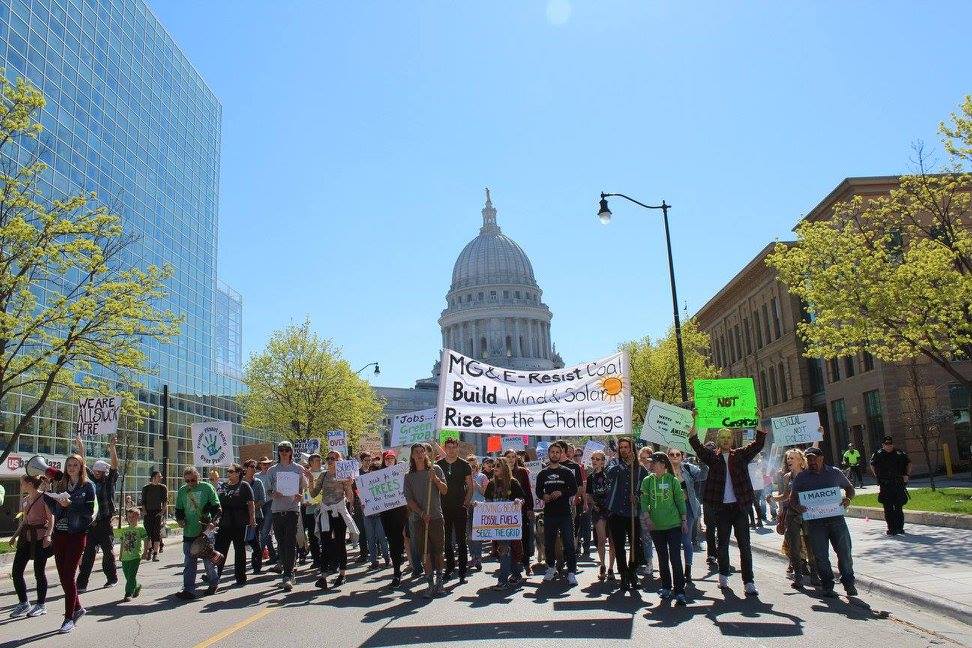
Alliant Energy has made plans to close its Edgewater coal plant, and this is a victory for both public health and our fight to prevent catastrophic climate change. Yet the closure of the Edgewater plant also points towards the dire need for Alliant, MGE, and WPS to close the Columbia power plant as well. As long as this coal-fired plant continues to operate, Madison residents and other Wisconsinites bear the costs to their health and finances. In addition, they are also forced to rely on an energy source that contributes to climatic destabilization worldwide.
The current pandemic has highlighted the dire need to shift away from the usage of coal, the dirtiest fuel source. A recent Harvard study discovered that the air pollution stemming from coal plants can increase the rate of death from Covid-19 by almost 10%. The people who suffer the most from both toxic air and Covid-19 transmission are those that can least afford to contend with the medical complications from contact both of these sources of illness. It is unacceptable that the most vulnerable of our society are saddled with the dire health effects of coal usage. Continued operation of the Columbia power plant prolongs the disease burden inflected on these individuals.
If the Columbia power plant is allowed to operate until 2030, then ratepayers will collectively lose an estimated $257 million. Working-class folks who are barely getting by as it is can’t afford that kind of sum, stolen from them in the form of high energy rates.
The Columbia power plant is the top emitter of pollution in Wisconsin, releasing poisonous coal ash into the waters surrounding its place of operation. It is not the wealthy utility company executives who bear the health costs from this toxin, but regular people already at an economic disadvantage. Groundwater pollution from Columbia’s coal ash was discovered in 2010, and yet this plant is still allowed to spew its carcinogenic material into our precious waterways. By only closing down the Edgewater coal plant, we allow Columbia to continue releasing its toxins into Wisconsin communities.
The use of coal plants doesn’t just burden people with respiratory issues and other health problems. The operation of coal plants such as Edgewater and Columbia also takes desperately-needed money out of Wisconsinites’ pocketbooks as well. Contrary to what fossil fuel executives would like you to believe, it is not wind and solar that are expensive and uneconomical fuel sources, but coal. In 2019, the Columbia and Edgewater power plants lost a collective $16 million. This loss was, naturally, foisted upon the plants’ customers in the form of high fuel costs. If the Columbia power plant is allowed to operate until 2030, then ratepayers will collectively lose an estimated $257 million. Working-class folks who are barely getting by as it is can’t afford that kind of sum, stolen from them in the form of high energy rates.
In addition to health complications and excessive energy costs, usage of the Columbia power plant also contributes to the greenhouse gas emissions that are setting humanity on the course for catastrophe. A warming climate means a destabilized agricultural system, increased transmission of parasitic diseases, and deadly heat waves. All of these consequences will only serve to increase the inequality that is already rampant in our political-economic system. The Columbia coal plant must be shut down, so that we can take one small step towards achieving a renewable, just future.
The fact that toxic power sources such as the Columbia and Edgewater power plants still operate underscores the need to make out utilities publicly owned. Madison residents don’t want to be reliant on dirty, outdated modes of energy. Yet when our utilities fall under the ownership of a privately-held company, we have little choice but to use the energy sources that our utility providers give to us. Instead of making decisions to benefit the fortunes of a few wealthy members on a board of directors, communities with publicly-owned utilities can use the revenue from energy sales to invest in their own communities. Instead of profits going into the pocketbooks of rich shareholders in a different city, publicly-owned utilities allow communities to get energy at lower prices, or pay for projects such as low-income housing. Converting Alliant, MGE, and WPS into public utilities would allow Madison residents to transition to renewable energy on a faster scale, and make decisions about their energy portfolio democratically. We should not allow a few individuals to stand in the way of Madison’s green energy future.