This is a talk given to Madison Area Democratic Socialists by Haley Pessin (Queens DSA, Afrosocialists & Socialists of Color Caucus), “Racism, Capitalism and Rebellion” about the political moment around the George Floyd protests and uprising.
In a show of blatant disregard for the health and safety of Wisconsin residents, dozens of business and trade associations in the state signed onto an open letter calling on Governor Evers to set a firm date to begin reopening Wisconsin Businesses on April 24th. Their calls were supported by the far-right wing in Madison organizing for an in-person protest on April 24th to re-open the state.
This “firm date” set by business interests in the state of Wisconsin flies in the face of scientific recommendations. Scientists at the University of Washington Institute for Health Metrics and Evaluation have created a model which suggests that the peak of the impacts of the virus in Wisconsin could come as quickly as April 12th, but that is only when scientists adjust the model to assume that we will continue full social distancing measures through the entire month of May.
Luckily for everyone in Wisconsin, Governor Evers ignored these calls and the Wisconsin Department of Health Services extended the Safer-At-Home order through May 26th. But the decision only further inflamed the opposition. At the time of this writing, over 3,000 people have indicated through Facebook that they will attend the protest, with another 12,000 marked as interested.
It’s no surprise for socialists and progressives who have time and again witnessed businesses ignore the vital messages from scientists across the world in favor of their profit margins. Capitalists and their politicians have long been ignoring the recommendations of scientists to reduce and eventually forgo completely the use of fossil fuels by 2030 in order to prevent a climate catastrophe. Unfortunately, the economic system as it is currently set up prioritizes the extraction of oil and gas in pursuit of profit over and above the wellbeing of people and our environment.
For those who continue to work through the crisis, many employers have not done everything in their power to ensure the safety of their workers. This is where organizing within our workplaces and communities becomes essential to our ability to come out of this crisis with as little damage as possible.
But we also know we can’t go on as we are. As things currently stand, the burden of this health crisis has fallen squarely on Wisconsin workers who have applied for unemployment at unprecedented rates. At the end of this crisis, it is virtually guaranteed that thousands of Wisconsin workers will have permanently lost their jobs, and as a result also lost their access to other necessities like health care. For those who continue to work through the crisis, many employers have not done everything in their power to ensure the safety of their workers. This is where organizing within our workplaces and communities becomes essential to our ability to come out of this crisis with as little damage as possible.
As workers, we know what we need in order to ensure a safe workplace as essential employees. Besides practicing social distancing measures and adequate access to PPE, we must be collectively advocating for paid sick leave in the event anyone is our family gets sick, hazard pay for employees working with direct contact to the public, and additional flexibility and time off for families with children who are required to stay home as a result of the closure of schools and daycares.
We also know what we need in order to make sure this crisis does not result in thousands of additional homeless families on the street. A one-time $1,200 stimulus will not last more than a month after considering rent/mortgage, food, and other expenses. Therefore, we must be demanding a moratorium on all rent and mortgage payments until the end of the health crisis so that people can stretch the funds to cover food and other related expenses, rather than have the funds act as a subsidy for landlords and banks.
Additionally, while an expansion of unemployment benefits through July is currently helping to keep many workers who have been furloughed afloat, legislation needs to be passed at both the state and federal level which ensures employees remain on their payroll at work to maintain health insurance benefits during the pandemic. As many other socialists have pointed out already, pushing millions of people into unemployment during a global pandemic will result in more death, as those without insurance will wait longer to seek treatment from medical professionals. These are just a few of the basic demands that working-class people need in order to survive through this health crisis.
Winning these basic demands, in addition to extending the Safer-at-Home order through the month of May, will be no easy task. We face a state legislature whose thorough contempt for workers is well-documented over the last ten years. Governor Evers can be described at best as a moderate who is all too willing to give into the interests of business if we cannot build an equally formidable opponent to those interests. Evidence for this was put on display nationally as Evers waited until the day before the Wisconsin election to attempt to postpone it, leaving no time for progressives and socialists across the state to organize as response to the Wisconsin Supreme Court when they easily over-ruled his order.
At the city level, Mayor Satya Rhodes-Conway has abdicated responsibility for the crisis, saying that the city’s hands are tied by laws which preclude them from doing anything of significance. They have opted instead to encourage the plethora of Madison’s NGOs and the business community to commit donations providing need-based aid to our poor and homeless population who are deemed as deserving of funds. Thus, if the Wisconsin Republican Party’s response to this crisis has been to actively make things worse, the leaders of the Democratic Party have accomplished much of the same through their spineless inactivity.
We will need to build a movement of unions, immigrant rights groups, NGOs, socialists, and other progressive organizations who can collectively exert the kind of power necessary to pressure the state into action.
Despite the reluctance of our elected officials to respond to the health crisis, we’ve witnessed a number of incredible workplace struggles within the city of Madison over the last several weeks which have secured numerous important victories. Petitions by city workers, such as those by Madison Metro Transit employees, secured additional paid sick leave, safety provisions, including free fares and back-door entry, bathrooms at transfer points, and other key demands. Rather than waiting on the union leadership at Teamsters Local 695 to act on their behalf, workers circulated petitions and demanded meetings with management to discuss how they would implement new policies to keep them safe.
Additionally, healthcare workers at both UW and Meriter Hospital have organized petitions to demand additional paid sick leave and proper PPE to combat COVID-19 in the workplace. Willy Street Co-Op workers also secured additional paid leave from their employer through their newly formed union, UE Local 1186. If this health crisis has taught us anything, it is that a credible organizing approach in the workplace is the most important factor as to whether workers will bear the brunt of the repercussions from the global pandemic.
As things currently stand, victories by workers and unions in the city have been detached from one another. And while the Wisconsin Department of Health Services has extended Governor Evers’ Safer-At-Home order through May 26th, we know that the families will still experience hardship without more relief. If we hope to stand a chance in pressuring the state legislature and Governor Evers to implement a truly safe Safer-At-Home and implement the policy demands described above, we will need to build a movement of unions, immigrant rights groups, NGOs, socialists, and other progressive organizations who can collectively exert the kind of power necessary to pressure the state into action.
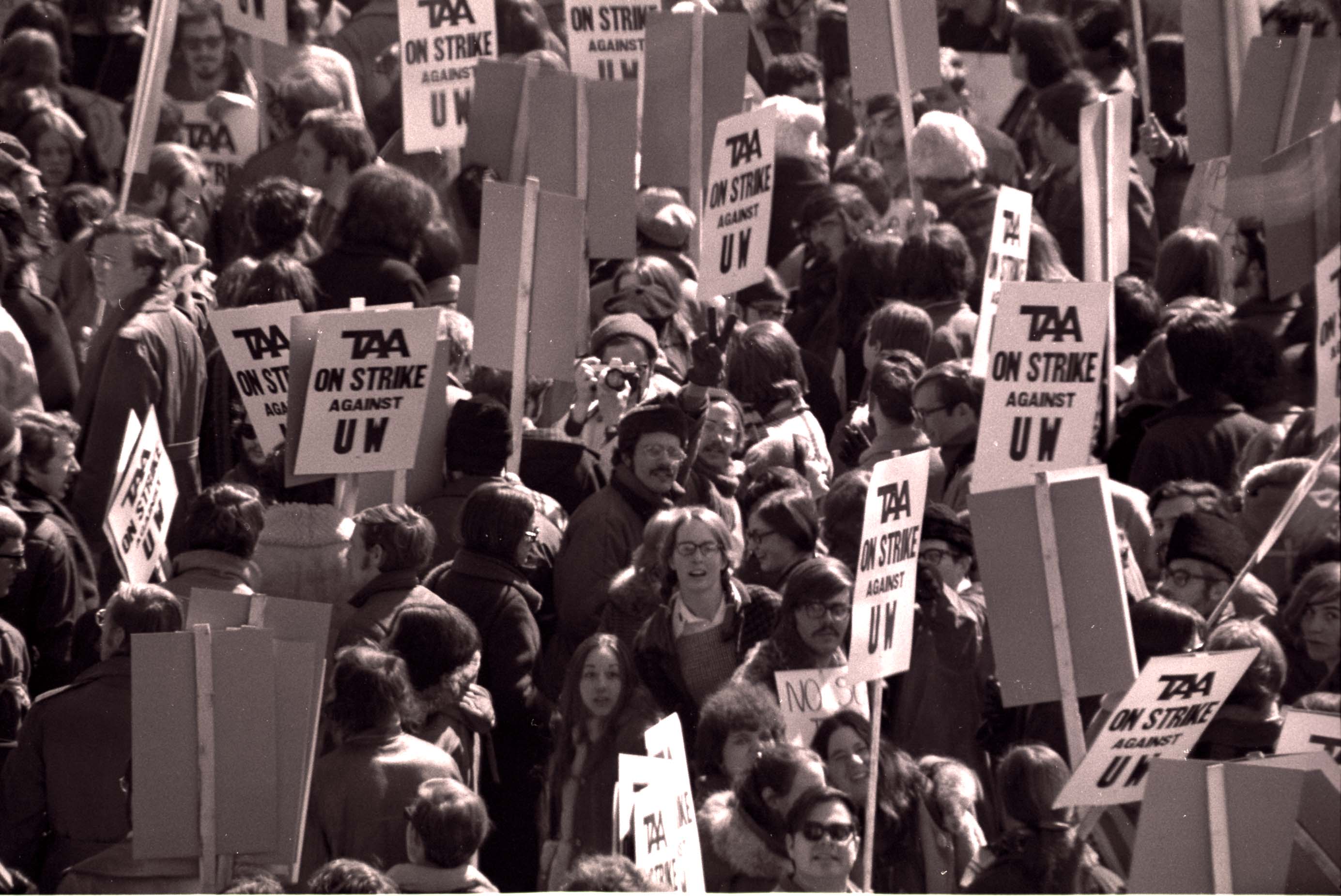
March 16, 1970: Teaching assistants and other graduate workers at the University of Wisconsin–Madison stood outside campus buildings chanting and holding signs, where just a week earlier they had been teaching classes. Some brought their dogs, others their children. Spirits were high. It was a graduate worker strike, the first of its kind anywhere.
Grad workers and their allies held the picket line over the course of the next four weeks. When the dust settled, grad workers at UW won historic rights: extended funding guarantees, a grievance procedure, workload and class-size limits, fair discipline and discharge provisions, a democratic evaluation process, and health insurance for Teaching Assistants (TAs), Project Assistants (PAs), and Research Assistants (RAs). But it took years of struggle amidst an ever-changing political terrain to strike and win.
With the backdrop of the Vietnam War and campus-based movements committed to ending imperialism abroad, graduate student workers took their first steps into the uncharted waters of organizing a labor union and demanding a contract.
The Teaching Assistants’ Association (presently chartered with AFT, though originally an independent labor union) is the oldest graduate workers’ union in the world, having hastily organized as a united front at the anti-Vietnam War draft sit-ins in May 1966 to demand that the university refuse cooperation with the Selective Service System. At the time, TAs were frustrated over their lack of control over curriculum and assessment, especially in a historical moment—the Vietnam War era—where a male student’s failing grade could mean the loss of student deferment status and result in forced draft into the army. With the backdrop of the Vietnam War and campus-based movements committed to ending imperialism abroad, graduate student workers took their first steps into the uncharted waters of organizing a labor union and demanding a contract.
Three years later, in April 1969, the TAA and the UW administration entered into a Structure Agreement, a binding document between the TAA and UW administration that gave the TAA the right to be the exclusive bargaining agent of TAs at the University of Wisconsin–Madison (at the time, Research Assistants were considered their own bargaining “unit” and did not fall under the purview of the TAA). Although the terms of the Agreement were concessionary on the part of the TAA, with bargaining limited to working conditions and excluding bargaining over wages and “fringe benefits” like healthcare, the TAA thus became the first independent labor organization of TAs in the US.
Being a graduate student can elicit emotions ranging from extreme self-doubt to profound gratitude (getting paid to read!). It can be alienating and isolating. It is where the myth of meritocracy is propelled onward, as tenured faculty (predominantly white and male) assert that they made it to the top of the academic pyramid by virtue of academic achievement, intellect, and merit alone.
And graduate school is where graduate students are told to go along to get along: Don’t speak up too much, lest you be unemployable on the academic job market; Don’t speak out against your abusive supervisor, lest you lose your funding; Don’t share your work or collaborate, lest someone else “steals” these ideas and publishes them.
When framed in this way, we might see graduate school as a training ground for capitalist culture: above all, what is prized is civility, obedience, and the individual. Marc Bousquet, in his book How the University Works, reminds us that “The uses to which the university has been put do benefit corporate shareholders. These include shouldering the cost of job training, generation of patentable intellectual property, provision of sports spectacle, vending goods and services to captive student markets, and conversion of student aid into a cheap or even free labor pool.”
A whole host of forces—mobilized resources, capital, ideas, struggles, and emotions, what Gramsci might term “hegemony”—collude to obscure the political implications of graduate school. From early on in our academic training, graduate students are ideologically trained, obscuring the political and economic realities of higher education. University administrators, in lockstep with mainstream media representations and inherited wisdom, ingrain into graduate workers that they are “apprentices,” or “primarily students,” or “academics-in-training.” Graduate employees are also routinely disciplined by the notion that graduate labor is privileged or only “temporarily exploited,” which locates the problem in individuals rather than institutions. Administrators never affirm graduate student employees’ claims to being “workers,” which might dispel the illusion about the relations of employment.
As such, to form a labor union under the collective label of graduate student workers—to assert that, as employees of the university, they are entitled to labor rights like collective bargaining and democratic control over their workplaces—is nothing less than a foundational challenge to the hegemonic ideas circulating about the true nature of graduate education.
Bargaining for the first graduate employee contract at UW began in May 1969. Graduate workers demanded a grievance procedure overseen by a Workers Grievance Council, employment appointments that lasted the duration of a student’s graduate program plus two years to account for the difficult academic job market process, a fair evaluations procedure, and a health care plan. More radically, the TAA also sought real decision-making power in what they called “educational planning”—course offerings and content, the selection of texts and teaching materials, and pedagogical techniques.
Negotiations proved to be tense and unproductive. After bargaining in the summer and fall of 1969 produced no headway, one Wisconsin American Federation of Teachers (AFT) observer came to the following conclusion: “Fellows, you guys are going to have to strike” (Van Ells). The TAA set a bargaining deadline of January 8, 1970 for UW administrators to reach an agreement. The deadline came and went, and the university remained unwilling to entertain the TAA’s demands. A war of words followed, and the union broke off negotiations.
Talks wouldn’t resume for two months, and the TAA continued to prepare for a strike, training its members in picketing and organizing picket captains. Union organizers circulated pamphlets, hung posters across campus, and utilized the student newspaper The Daily Cardinal to amplify their message. They held teach-ins and leaned on their department steward network to organize within buildings and departments.
When talks between the TAA and UW administrators finally resumed, the university made a number of concessions, including class sizes, student evaluations, length of appointments, and a health plan comparable to the one offered to faculty. One issue remained: control over educational planning. The TAA still insisted on redistributing the decision-making power over pedagogy and curriculum, while the University, with support of many faculty members, refused to concede any control. In the early hours of March 16, with no movement from the University on graduate worker control over curriculum, TAA members voted to strike.
The TAA still insisted on redistributing the decision-making power over pedagogy and curriculum, while the University, with support of many faculty members, refused to concede any control.
TAA President Bob Muehlenkamp vowed to “shut the place down.” On the morning of March 16 from 3 AM on, grad workers formed picket lines at loading docks, construction sites, and classroom buildings. Teamsters in Madison honored picket lines by stopping campus bus services and deliveries. Undergraduate students established an Undergraduate Strike Center and joined the TAA on the picket lines. These infrastructural disruptions were instrumental in assisting the TAA’s work stoppages.
It would be incomplete to suggest that the TAA won over everyone to its militant tactics. AFSCME Local 171, the union representing campus maintenance and food service workers at UW, sided with the University, as did many undergraduate students, who cited the disruption of their classwork. Though the picket lines were strong, many TAs scabbed the strike.
“Many people,”writes Alyssa Battistoni of the difficulties in her graduate employee organizing campaign at Yale in 2016,
liked unions in the abstract, for other people, but had reservations about whether one made sense for us. We worked independently for the most part (getting paid to read!); we exercised control over our own work — or at least hoped to one day. Nearly all of us had grown up hearing about how bad teachers’ unions were for our own precious educations. Few of us came from union families; almost no one had belonged to a union before, and those who had sometimes cited bad experiences. Even among those who were nominally sympathetic, ‘I think unions are good, but . . .’ was a common refrain.
How could someone being “paid to read” claim injury as a worker at an institution of higher education? These ideas that academics lead a “life of the mind” and that labor organizing is antithetical to its mission serve the ends of university administration who use this as cover to shift instruction to low-wage contingent instructors and online instruction with few, if any, job benefits. John Coatesworth, a former TAA radical who has since become the establishment Provost at Columbia University, said in undermining Columbia’s graduate employee unionization efforts, “the relationship of graduate students to the faculty that instruct them must not be reduced to ordinary terms of employment.” These claims are pernicious and bankrupt, and they spell the continued decay of higher education as a place for actual intellect and learning, but they are also ubiquitous in campus organizing and must be combatted at every opportunity.
Support for the strike began to wane in the beginning of April of 1970. UW reduced TAs’ paychecks and undergraduates began to return to class. On April 9th, sensing the growing intolerance of the strike, TAA members voted 534 to 348 to end the strike and accept the latest university proposals.
The final proposal guaranteed three to four years of financial support, a health plan that covered dependents, a grievance procedure with binding arbitration, class size limits, and more. But they lost on educational planning; TAs had the opportunity to participate in planning courses, but faculty retained final control over curricular content. It was a victory, though a touch anti-climactic.
It was through the hard work of organizing on the ground, of raising expectations, of believing in democratic rule that the TAA was able to change consciousness 50 years ago…
The origins of the TAA 50 years ago offers hope to academic workers in the age of the corporate university. It was through the hard work of organizing on the ground, of raising expectations, of believing in democratic rule that the TAA was able to change consciousness 50 years ago, and these issues remain true today. The number of administrators in the UW System increased between 2014 and 2017 while at the same time the number of faculty declined; shared governance has been hollowed out; and state funding has been catastrophically cut. These trends are going to continue, and we have to remember that no one will save us but ourselves.
Graduate labor organizing today faces an uphill battle, but it’s clear that the world around us is changing. Graduate labor unions have the opportunity to tap into the tide of support for striking public educators and other public and private sector workers as we advocate for our rights as workers in the academic labor system. Collective workplace actions have the potential to transform institutions much more than purely rhetorical actions. If the TAA is to stem the corporatization of the university, then we must do the hard work of organizing and compelling allies and supporters to act through publicity campaigns, one-on-one conversations, public demonstrations, and more. We must pair this work with a clear-eyed understanding of the tactics that universities will use against graduate workers, and see them as tactics that emerge from the neoliberal assault on public education.
In every federal election, the Federal Election Commission (FEC) tracks donations to candidates – when an individual gives money to a candidate, it’ll ask their name, where they live, their occupation and employer. Normally this is rather mundane information, but for the 2020 Election it gives us a window into the politics of class in the Madison-area. Looking at what kinds of occupations support the Presidential candidates draws class lines and helps us to stake out what interests are being represented: normally working peoples’ interests are subsumed in the Democratic Party coalition, but with Bernie Sanders in particular there are clear poles of attraction in the 2020 Primary. We can also start to look at who Madison’s politicians are and who they support and start to ask how well they reflect those they represent.
Voting in the United States is largely a class phenomenon: the less money you make, the less likely you are to vote. Many working-class people either expect that elections won’t change much about our lives, or we see what’s on offer and don’t vote as a protest. While there are more workers than managers, technicians or owners of capital, the low turnout among bottom earners means that a third of votes cast were by those making $100,000 or more. Income alone is only one way to look at class; most Americans have a negative net worth (we have debt) and the Top 1% sit on a hoard of wealth.
The more formal education a person has, the more likely they are to have an investment in elections and policy. Non-voters tend to be more “liberal” than voters, though the word liberal here actually refers to working class issues (union organizing rights, public education, universal healthcare, etc.) and not attachment to the Democratic Party. In 1986, the economist John Kenneth Galbraith declared, “If everybody in this country voted, the Democrats would be in for the next 100 years,” – except that Democrats don’t offer the things most workers want either.
Politics is always complicated, but in the crowded 2020 Democratic Primary you have the establishment candidates (Joe Biden, Pete Buttigieg, Amy Klobuchar, Kamala Harris), the “reform” candidates (Elizabeth Warren, Andrew Yang) and then Bernie Sanders, the self-proclaimed democratic socialist calling for a more dramatic change through a “political revolution” to remake politics, the economy, and the energy system.
In the establishment camp, Biden is the classic “back to normalcy” figure (“Nothing will fundamentally change”), representing the political establishment pre-Trump and rests heavily on his association to Barack Obama; Buttigieg and Klobuchar acknowledge some of the problems of neoliberalism but ultimately just offer a slightly updated version, with a new sheen on market solutions – both oppose universal public healthcare, for example, but kinda like the idea; Harris attempted to take up Obama’s mantle with multi-racial elites and women.
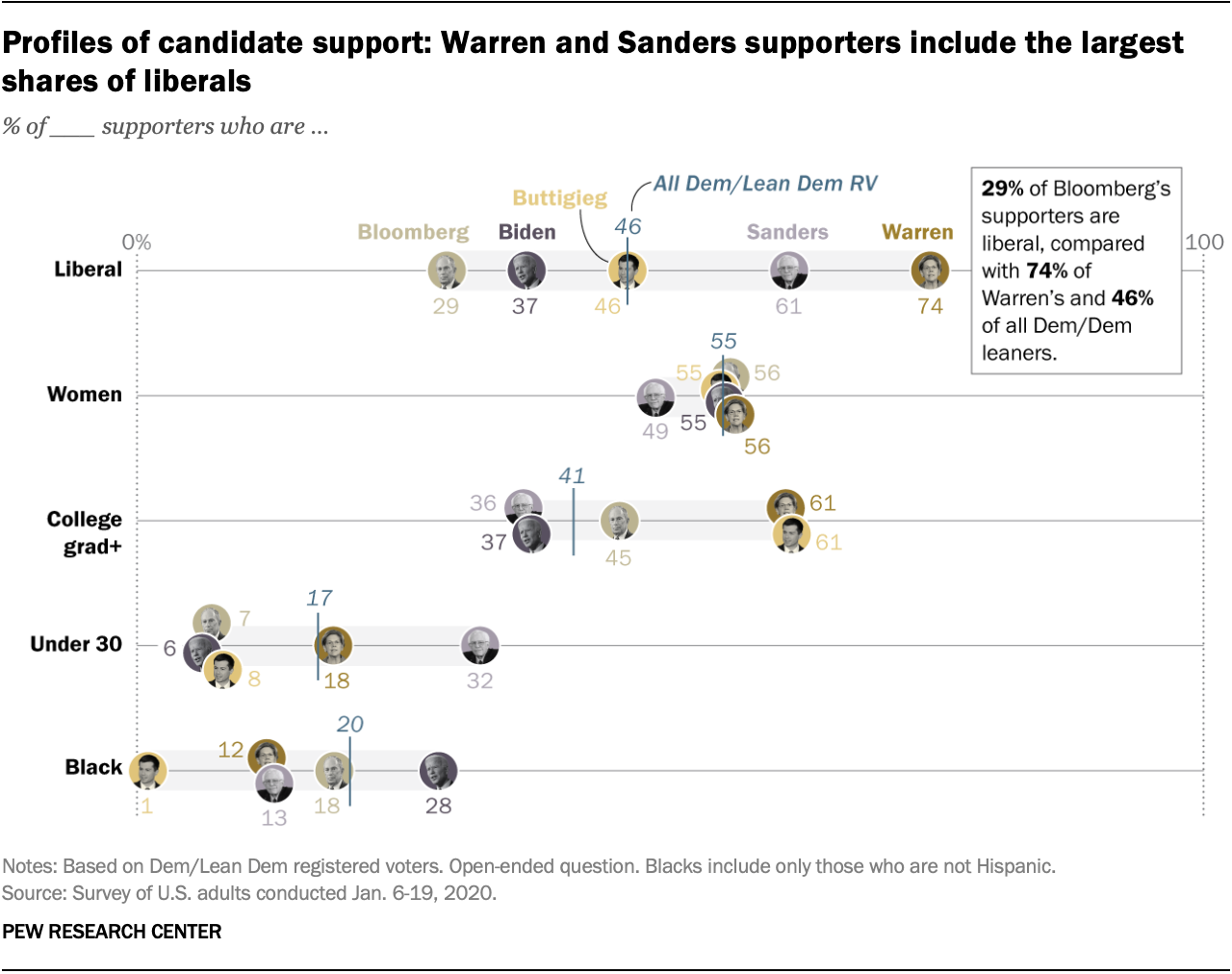
Warren and Yang are more assertive on reforms and paint their solutions as rational policy changes; a technical fix. Deepa Kumar and Patrick Barrett write, “Warren’s strategy of change is built on the assumption that the political system is fundamentally sound and simply requires a very competent and morally decent executive with an excellent set of policy proposals and a team of smart policy makers.” Warren and Buttigieg share a base of support from highly educated voters, though they’re split with the conservative wing going for Buttigieg and liberal one for Warren. Sanders appeals most to working people, drawing heavy support from youth, Latinxs, workers making less than $55,000 a year, and workers without college degrees.
There are also important identity representation issues: in our sexist society, many (particularly professional) women are interested in a female president and want that expressed through candidates like Kamala Harris, Elizabeth Warren, Tulsi Gabbard and Amy Klobuchar. Likewise, Andrew Yang is the first Asian American candidate for President, Sanders the first Jewish candidate, and Pete Buttigieg the first openly LGBTQ candidate. Clearly identity matters in the United States. At the same time, most candidates are maintaining the neoliberal consensus and not proposing anything altogether new – there’s no perfect alignment of identity and class, so take it with a grain of salt. At the time of this writing, nearly all of the other Democratic Presidential hopefuls who have dropped out have endorsed Joe Biden (Amy Klobuchar, Pete Buttigieg, Kamala Harris, Beto O’Rourke, Michael Bloomberg, John Delaney, Tim Ryan, and Deval Patrick). The only former candidate to have endorsed Bernie Sanders is Marianne Williamson, Oprah Winfrey’s spiritual guru. Elizabeth Warren ended her candidacy in early March but has not endorsed either Biden or Sanders.
Trends in Madison Area
Though voting may be anonymous (in theory), political donations are not. Pulling the data from the Federal Elections Commission (FEC), we can look at who’s donating to which candidates and political action committees (PACs) in Madison by location, employer, and occupation and start to draw conclusions from there. This gives us more precise information than looking at vote counts; no one has to donate, so if you do its affirmative and suggests you really want that candidate to move forward. I pulled the data for Madison and the surrounding towns, and for the large area employers. I’ll review the data and then offer some explanations for what it might mean.
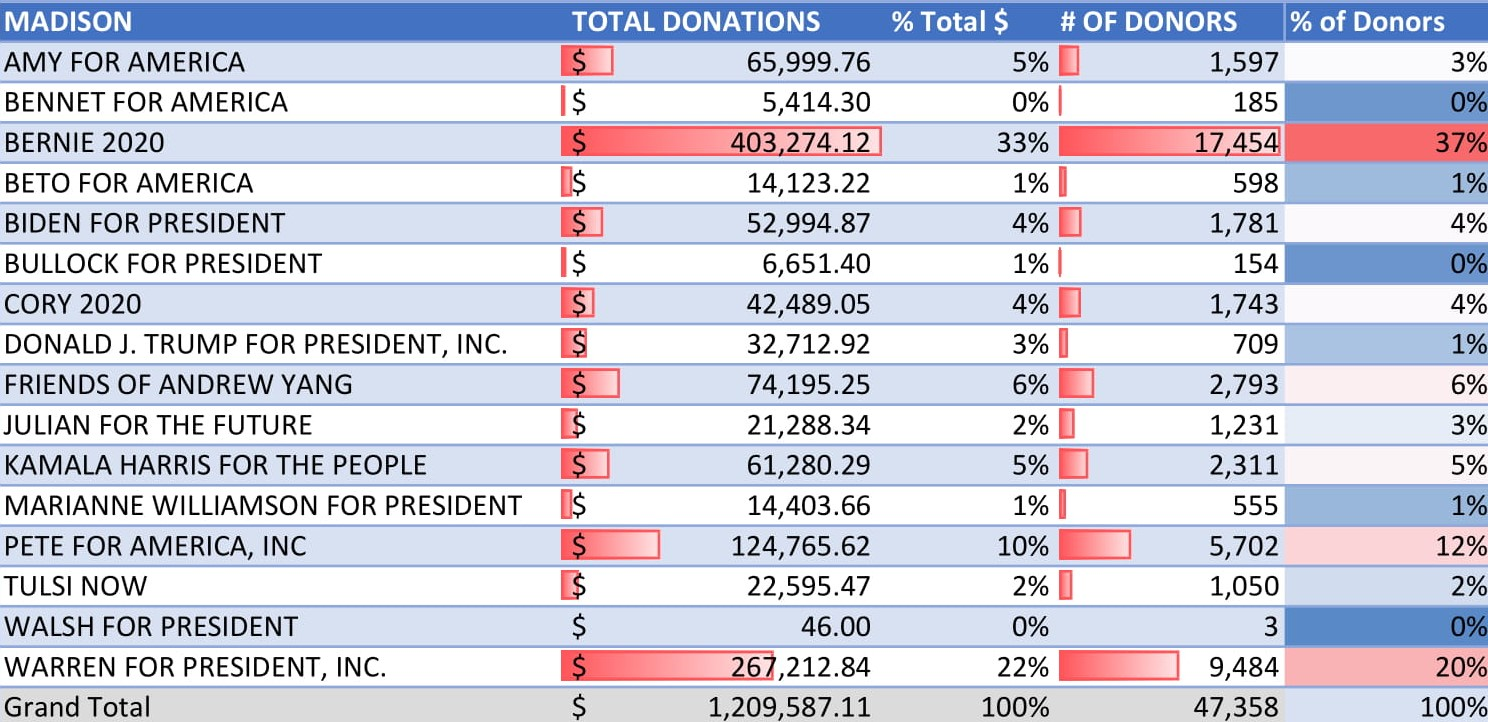
Data for Madison, WI
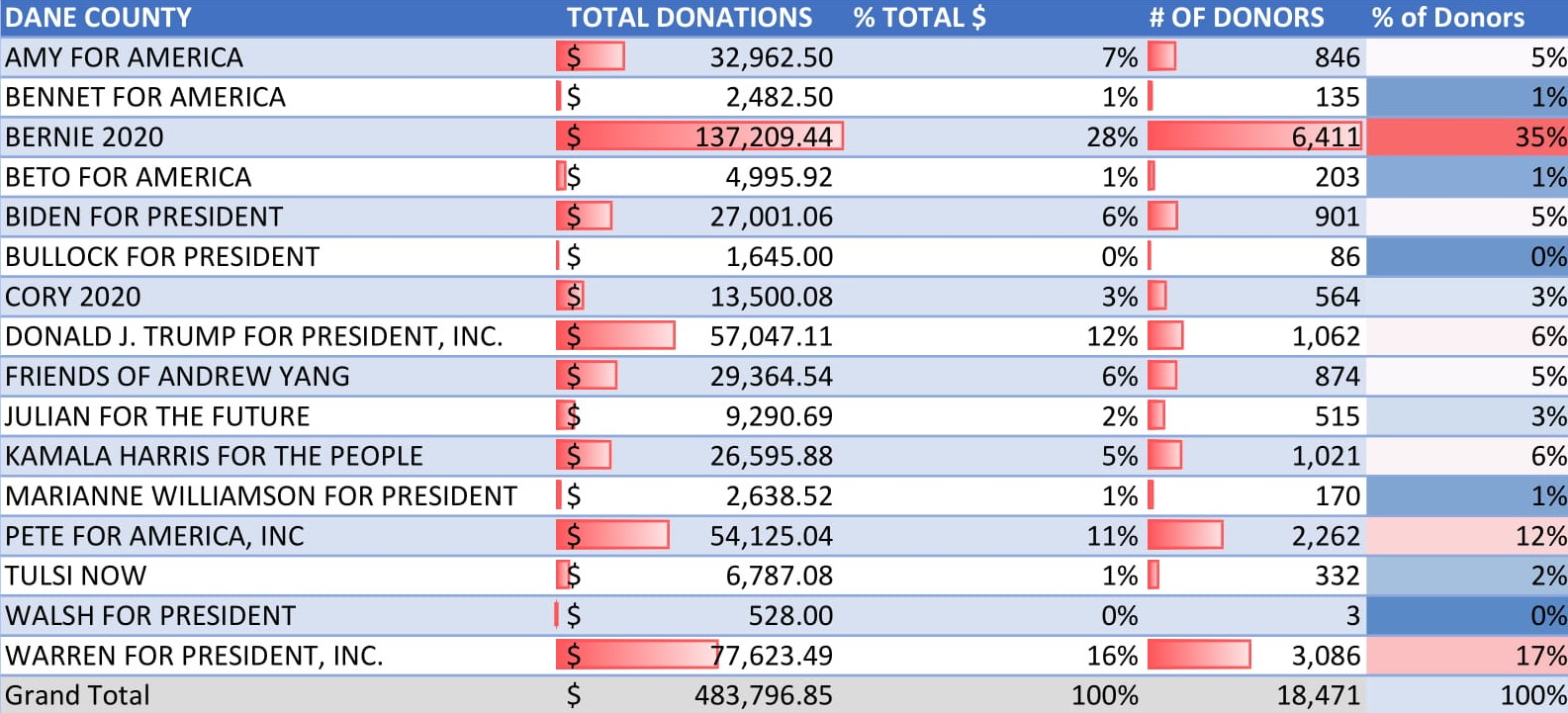
Data for Dane County cities Middleton, Monona, Verona, Stoughton, Waunakee, Cottage Grove, Fitchburg, Mount Horeb.
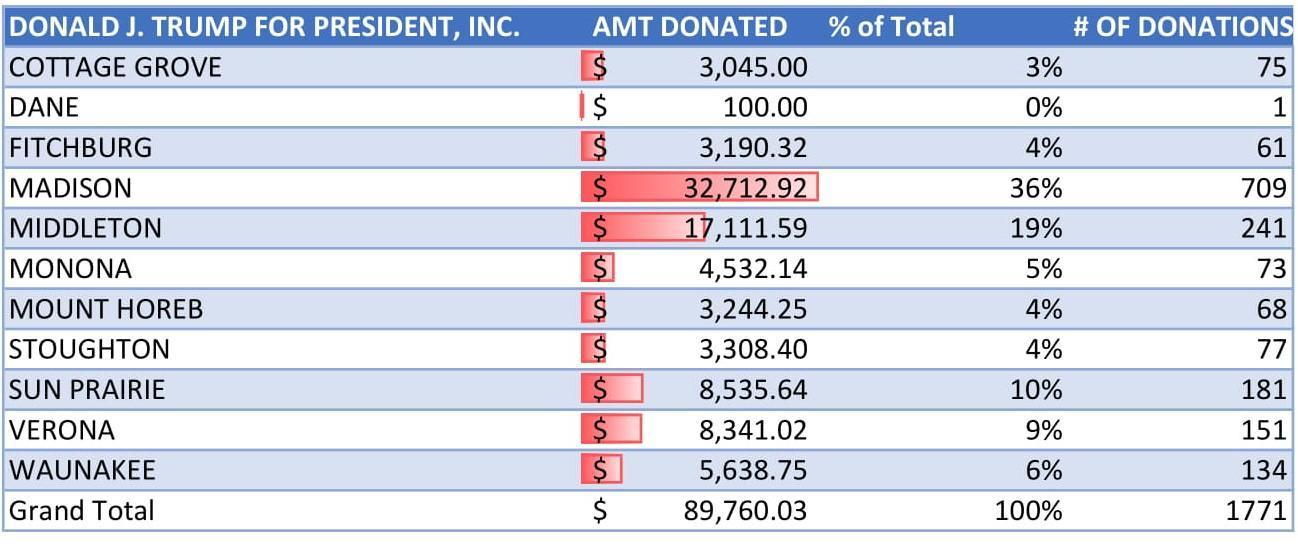
True to its reputation, residents of Madison-proper donated twice as much money to presidential candidates as other towns in Dane County combined. Even still, Dane County and Madison have similar trends: 98% of individual donations to candidates went to Democrats in Madison versus 88% in the rest of Dane County. Sanders had the largest number of donations (37% and 35% in Madison and Dane County respectively), Warren second (20% and 17%), and Buttigieg third (12% and 12%). The major difference is that Dane County has a higher proportion of Trump donors than Madison (6% vs 1.5%), but Madison gave more than a third of all the money that went to Trump from Dane County. Madison isn’t all that different from the rest of Dane County: both Madison and the surrounding areas show the same political preferences, but people in Madison donate a shitload more money to politicians.
Donations directly to presidential politicians through January 31st, 2020 were just shy of $1 million; money given to Political Action Committees (PACs) is more than double that at $2 million. PACs can take much more money than candidates themselves, which reveals something that we’d miss if we only look at direct contributions: rich people generally prefer to give a lot of money to action committees and political parties. In the US, the most an individual can give to any candidate is $2400, though the limits are much greater to parties and unlimited to Super PACs. Over $700,000 was given to the Democratic Party: The Democratic Party of Wisconsin and other various state Democratic Parties, the Democratic Congressional Campaign Committee (DCCC), Democratic Senatorial Campaign Committee (DSCC), Democratic National Committee (DNC). This is where big money goes: one CEO in Madison donated $10,000 to the Democratic Party of Wisconsin, an “Owner” $10,250, and a Programmer $10,000; a President of a venture capitalist firm donated $13,000 to the DNC.
Other titles that gave $1000 or more to Democratic PACs are Administrator, Consultant, Attorney, Physician, Business Owner, Executive, Statistician, Chief Marketing Officer, Marketing Executive, Politician, President, Professor, Programmer, Psychologist, Contractor, Surgeon, Manager, Retiree. These are who you might call the real base of the “Democratic Party establishment”. Democrats also have many “feeder” groups, PACs that support specific types of candidates in the Democratic Party: Emily’s List promotes female Democrats running for office; 314 Action promotes science; House Majority gives out money to “win back congress”, It Starts Today gives money out to Democrats running for Congress, MoveOn.org, etc. – these took in hundreds of thousands of dollars.
Donations to The Republican Party are also significant. Out of $176,000 given, $58,000 went to the Republican Party of Wisconsin, $54,000 to the Republican National Committee, $32,000 to the National Republican Senatorial Committee; and $28,000 to the National Republican Congressional Committee. Who donates? “Business Owner” $5000; President $10,000; Founder $3000; CEO $2500; Engineer $2000; Sales $1000; Retiree $2400. Other notables: Chief Financial Officer; Consultant; Debt Collector; Attorney; Sales; Insurance. (Notice any similarities to Democrats?)
Political Support by Occupation
The data shows us that each candidate has a base that is commonly defined by occupation. Bernie Sanders has by far the most donors with over a thousand job titles listed. The most frequent donors to Sanders are Teachers, Nurses & Medical Workers, Students, Hospitality Workers (Bartenders, Waitstaff, Cooks, Baristas), Warehouse workers, Drivers, and Office Clerks. This contrasts with more traditional top supporters for Joe Biden (Attorney, Retiree, Sales, Physician), Warren (Project Manager, Professor, Retiree, Software Engineer) and Buttigieg (Manager, Attorney, Teacher, Professor, Engineer). Every candidate shows some support across class lines (Biden has some Clerks and Blue-collar Workers, for example, but they’re a minority).
If workers aren’t monoliths, how do some common job titles align politically?
More than half of CEO’s donated to Trump, followed by Buttigieg (14%)
Lawyers donate to everyone, with Warren first (19%) and Sanders (15%), followed by Biden (13%) and Trump (12%)
Two-thirds of Clerical/White collar workers gave to Sanders and then Warren (14%)
Police give exclusively to neoliberal candidates (Buttigieg and Biden); State Troopers to Trump
Accountants: Trump and Sanders are the top recipients – Accountants seem to understand, “Tax law is class war”
Graduate Workers donated overwhelmingly to Sanders (75%) followed by Warren (14%).
Nurse donations were primarily to Sanders (37%), Warren (25%) and then Buttigieg (18%)
Teachers went for Sanders (42%), Warren (19%) and Buttigieg (10%).
Marianne Williamson’s top supporters were Artist, Feng Shui Master, Marketing Coordinator, Sales and Therapist. (The orbs have spoken.)
Blue collar workers (Mechanics, Tradespeople, Factory workers, Drivers, Cleaners, Agricultural workers, etc.) are typically considered to be the “conservative white working class.” In Dane County, Bernie Sanders collected half of all donations from blue collar workers followed by Trump (13%), Yang (12%) and Warren (10%). For the rest of the centrist candidates, only Pete Buttigieg and Kamala Harris received over $100 in total donations from blue collar workers. That’s completely different from the standard narrative of the enlightened, educated liberals and conservative manual laborers – at least as far as donations go. Of all donations to Trump, blue collar workers contributed less than 3% (nearly all from the skilled trades), retirees gave close to half, and real estate, business owners and capital managers most of the rest.
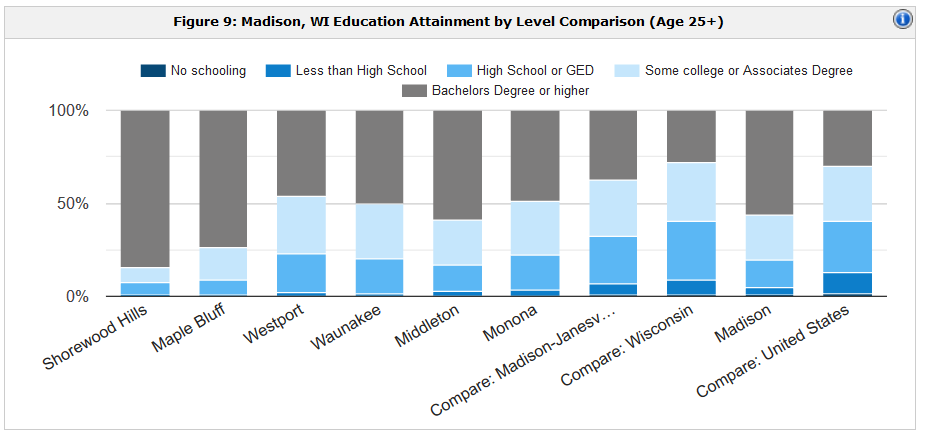
What this shows is that there is a very real class dimension to the voters and their perceptions of the candidates. The broad and lower section of the working class goes overwhelmingly for Sanders in small amounts (median donation is only $15), while the more educated technicians go for Warren and Buttigieg; Biden’s most frequent donors are from the more historic political class of doctors, lawyers, system administrators, top business management and salespeople.Madison has a larger share of Warren supporters than the rest of the US as a whole, which makes sense since she appeals to highly educated liberals and offers a softer “structural change” than Sanders. More than 50% of Madison residents hold bachelor’s degrees, and 24% have masters degrees or higher. Those with postsecondary degrees are more likely to regard institutions in society as legitimate (because they’re trained that way) and to look for adjustments and technical solutions rather than social ones.
This election is a unique opportunity to see how different classes express their interests (workers overwhelmingly for Sanders; technicians for Warren and Buttigieg, elites for Biden; Buttigieg and Trump), it shows the divisions among sections of the working class (white collar vs blue collar, skilled vs unskilled, etc.), and between workers: half of teachers and nurses are for Sanders, the other half are for technocratic candidates like Warren and Buttigieg.
There are some important limits to these numbers. First, most people don’t donate to electoral campaigns. That means we have to be careful about saying this data represents the electorate (people who vote), and more importantly the general population (including the 50% of people, mostly workers, who don’t vote or are ineligible). But the proportions match up fairly well with the Democratic Primaries thus far: Sanders won between 20-50% in the primaries through Super Tuesday (median 26.5%), and in Madison he’s raised 32% of all political dollars.
Second, many people who donate don’t want to give out information, so they report as “not employed”, “none of your business”, “n/a” and other creative middle-finger responses (I didn’t attribute these to any type of occupation). Third, this can’t tell us much about race or gender without some serious extrapolation. So, we should take this data as one useful element but understand that it’s a sample of voters who are skewed along class lines — overrepresented in the educated, administrators, technicians and elites, and underrepresented among most workers.
Local Politicians & Bureaucrats
If candidates express class interests, where do our local politicians align? Its no secret that real estate and tech companies drive much of the city’s policy, but who do our politicians support?
County Supervisor donations
Mayor Satya Rhodes-Conway donated to every neoliberal identity candidate (Klobuchar, Booker, Castro, Harris, and Warren), but gave most to Pete Buttigieg, the only LGBTQ candidate in the race and a personal contact of hers through the Mayors Innovation Project; Rhodes-Conway likewise campaigned for mayor as an LGBTQ candidate who wanted to address race disparity in Madison. Most city alders didn’t donate to a political candidate, save for Arvina Martin, who gave small amounts to Gillibrand, Harris and Warren, and Sally Rohrer, graduate student in public policy, who donated to Warren. Half of the twenty (20) city alders gave to the Wisconsin Democratic Party; the other half gave no political donations at all.
Greg Leifer, City of Madison Human Resources Labor Specialist, who sits opposite the City’s unions and is also negotiating for Willy Street Co-op against its workers’ union, donated solely to Joe Biden. That follows the pattern of union busters who support Biden.
Trends at the County are similar: most County Supervisors gave to multiple candidates, primarily neoliberals. The only local politician to have given any money to Bernie Sanders was Heidi Wegleitner.
This confirms most of what we knew about local politicians: the priorities are primarily identitarian neoliberalism, with some minor support for reform. The political preferences of seated politicians hardly represent what we see from the data above where there’s a plurality for Sanders, and large support for other reformers like Warren and Yang. In 2016 when Sanders won Wisconsin, most local politicians were astonished. Why? Because they’re a distinct political class managing local government on behalf of capital and they hardly represent the desires of people they govern.
A party in waiting?
Bernie Sanders did a lot of things for American politics since 2016, but one of the most significant is financing a Presidential campaign without any corporate dollars and maintaining his political platform without compromise. Those two things together have rallied millions of people who, as we can see from the above data , are not the traditional political actors of professionals, managers and elites.
For Madison, Dane County and the State of Wisconsin, we can see that class politics are expressed much more clearly than during a regular election and that these interests are far and away not represented by politicians – not just at the State level with Republicans, but among Democrats locally who are tied to establishment politics and neoliberal capitalism.
This also suggests another possibility: the potential for a party in waiting. Rather than accepting that local politics be dominated by the regular class of politicians we’ve had for decades, we can see that there’s an audience eager for an alternative if/when we can present them credibly: service workers, teachers, nurses, office clerks, university workers, drivers, warehouse pickers and receivers, and so forth. If we center the working class and oppressed as agents of change with a program to fight to better the lives of working people, fight racism, fight for a just ecological transition, we can already create a list of supporters from this election. The state is of course set up to keep the political structure as is, and we can’t expect that we’ll vote our way to socialism, but there is room to contest and organize for a different set of politics.
Family Farm Defenders, a Madison-based organization, has brought to North America the concept of Food Sovereignty, an idea pioneered in Latin America by Via Campesina, an international peasant farmer movement. They have been organizing for decades as an alternative to neoliberal agricultural policy. While neoliberals emphasize “food security,” their policies do not promote food security, but rather, international trade and exploitation of people, animals and the natural world. Via Campesina developed seven principles that center food sovereignty in local communities and emphasize the rights of our most vulnerable citizens.
Food, a Human Right
We all need it to survive. With the idea of Food as a Human Right, Via Campesina acknowledges this fact. Yet even in the richest country in the world, we find neighbors who struggle to put nutritious food on the table. It’s important to support efforts such as food pantries, The Beacon, and other social service networks, which serve thousands of people in Dane County every month.
Other programs, such as FoodShare Wisconsin, which provides food assistance, are in constant danger of being curtailed. As of this January, FoodShare Wisconsin served over 20,000 low income people in Dane County. And even in the midst of the COVID-19 crisis, the Trump Administration is working to cut SNAP (AKA food stamp) benefits for our poorest citizens.
When we regard food as a human right, we must re-examine our system of agriculture and delivery. Why are there food deserts and how can we eliminate this problem? Are there ways to promote consumption of healthy food? How can we show solidarity with the poor?
Agrarian Reform
Farm workers are a vital part of the food system. Yet they are among the most vulnerable laborers in our country, often working in harsh, dangerous conditions for low wages.
Farm workers are often exposed to pesticides. They lack information to adequately protect themselves from these toxins. They can be exposed up to three times as much as ordinary workers. In addition, in other countries, peasant farmers are being killed and their land stolen. The most vulnerable include members of indigenous communities and women.
How can we help in the organization of farm workers? What is our role in advocating for immigrant labor who are held hostage by fear of deportation?
Protecting Natural Resources
A key part of building Food Sovereignty is protecting the land. Too often, industrial scale farming involves the use of chemicals which can cause long term harm to the health of workers, consumers and the natural world. By putting the land back in the hands of family farmers, enacting robust regulation, and putting a renewed emphasis on sustainable methods, we can eat healthy and help heal the earth.
Already, there are sustainable options in agriculture. For example, CSAs (Community Supported Agriculture) grow food organically without the use of industrial pesticides. CSAs bring consumers and farmers together in partnership. Most are small farms, and it’s a great way of going local to support your neighbors while at the same time adopting a healthier diet. For our own gardens, we can learn about how to grow native plants, not use harsh pesticides and fertilize the soil through composting. Community gardens are being piloted in inner cities to allow these neighborhoods to enjoy more healthy food and build local resources and sustainability. By helping neighbors and healing the earth, we can put ourselves on a path to a better future.
Yet even as we make choices as individuals, the role of community needs to be strengthened. How can we advocate for sane farm policies, which protect the rights of small farmers while protecting the land? How do we pressure our lawmakers into implementing policies which end CAFOs (concentrated animal feeding operations) and other industrial farm practices which destroy the land and accelerate climate change? Can we institute community gardens where we live and make these accessible to everyone?
Reorganizing Food Trade
In large-scale industrial farming, food is seen as a commodity. Vital staples are traded on high risk markets with wealthy investors gambling on “futures.” Food Sovereignty seeks to put the priority back on the purpose of food—feeding people.
When developing agricultural policy, the emphasis needs to be on self-sufficient farming and local solutions. When so much of our food production is in the hands of a few corporations, producers and consumers suffer. For example, 80% of the beef industry is controlled by four multinationals. Small ranchers, those interested in healthy diets, and advocates for a clean environment and the humane treatment of animals are held hostage by these huge firms. In fact, in some states, it is illegal to film or publicize the ongoing abuse of animals in agriculture.
We must reorganize our food trade by finding ways to re-establish local networks to make food delivery local and sustainable.
Ending the Globalization of Hunger
People are becoming more aware of and concerned about high tech fixes to enhance the food supply. Many countries and states require that genetically modified foods be labeled, for example. But, our agricultural system is geared toward approaches that allow food to be produced on an industrial scale. Family farms, local knowledge and even seeds used to plant have been replaced by products created in a faraway laboratory, factory or company boardroom.
Food sovereignty stresses the local. While continuing to promote research and better ways to grow healthy food, it recognizes that not every community has the same methods of agriculture. It values knowledge passed down from generation to generation. Governments need to listen to farmers and consumers when planning the fight against hunger and for a healthier world.
Social Peace
In Wisconsin, small farmers have been forced to sell their family lands and give up farms at a devastating rate. This is part of a trend happening worldwide. In India, farmer suicides are a growing problem as more people go into debt. This problem has been exacerbated by the celebrated “micro loans,” which turned out to be another capitalist scam. In the Amazon, native people are forced off their land by mining companies or big agribusinesses– the pattern continues in every part of the globe. Rural areas, which hold the bounty of nature, are becoming more impoverished while residents flee to cities, which are becoming more polluted and less able to provide affordable housing.
How can we stop this downward spiral? This is especially important for vulnerable ethnic minorities and for those who have farmed for generations but are financially distressed due to industrial agriculture. Now is the time to come together to support family farmers. How do we best advocate for peasant farmers worldwide and family farmers here in Wisconsin?
Food Sovereignty and Democracy
Food Sovereignty, means, above all, returning control of agriculture to local farmers and consumers. In our current system of industrial scale farming, decisions are made in corporate headquarters with an eye toward the “bottom line” rather than feeding people. Food Sovereignty empowers small farmers and their communities to take control of production and distribution. It is important to listen to farmers and the people they serve. This must include overlooked contributors such as farm laborers.
We can support local agriculture and buy locally as much as our budget allows. But it is also important to advocate on this issue and form alliances with farm laborers, environmentalists and small farmers as we look to change our agricultural systems.
The current crisis with COVID-19 shows that it is absolutely essential to build up sustainability and resilience on a local level. We as socialists need to work in our communities to create networks which rely on community and support for the vulnerable. The principles of Food Sovereignty are vital to creating a new future which provides for all, rather than enriching a select few.
Charity wasn’t enough before the crisis. It won’t save the working class from COVID-19.
by Dayna Long
In one week following Governor Evers’ declaration of a Public Health Emergency in the state of Wisconsin, a group of businesses and wealthy donors amassed nearly a million dollars for a Dane County COVID-19 Community Emergency Fund. The fundraising was spearheaded by Michael Johnson, executive director of the Dane County Boys & Girls Club, which is acting as fiscal agent for the fund. On Friday, March 20th, Johnson appeared in a video press conference alongside Renee Moe, executive director of United Way. He explained that the fund will be used to award grants to individuals and organizations providing aid during the COVID-19 emergency. The process will be fast-tracked, with the intention of awarding grants and cutting checks by March 31st. Anyone familiar with grantmaking processes will recognize that this is lightning speed, which is laudable. Funds raised to address an emergency should be distributed as fast as possible.
Additionally, the need for aid and assistance right now is huge. Nearly 30,000 people filed for unemployment in Wisconsin last week. As whole industries shut down due to the recommended social isolation, layoffs have become commonplace. Our nation’s economic meltdown will make this worse. And at the same time that many workers have lost their income, some of the supports they might have relied on – like the free and reduced-cost meals their kids could eat at school – have been pulled out from under them. Workers who have kept their jobs, either working from home or commuting, are also struggling to find replacement childcare or to balance caring for their children with working full time, as daycares also close. Simultaneously, families are being advised to shell out for two weeks or even a month’s worth of groceries and toiletries to reduce their number of trips outside the home and prepare for eventual quarantine. For anyone living week to week or even day to day, this suggestion is an impossibility.
The fact is, people were struggling before any of us had even heard of COVID-19, when the economy was still booming. For some, the COVID-19 emergency is just the latest disaster in a series of events and systemic inequities that have left them homeless and hungry. For others, it will be the last straw that takes them over the edge from precarity to crisis.
Given the harsh reality so many people are facing, it makes sense that many are excited and relieved about the seemingly overnight creation of a Dane County COVID-19 Community Emergency Fund. And it is indisputably positive that people will be helped due to the creation of the fund. But that doesn’t mean that the entire situation is positive. In fact, there’s a lot for socialists to be critical and even wary of.
In the March 20th press conference, United Way Executive Director Renee Moe explained that United Way had been working closely with public health, the city, the county, the school districts, and its non-profit partner organizations to determine how best to fill community need during the COVID-19 emergency. That United Way sees public institutions like city and county government, public health, and the school district as partners is very telling. It shows that the Dane County COVID-19 Community Emergency Fund is another example of the transfer of responsibility for public welfare from the state to private philanthropy. In other words, instead of the city, county, and state government taking care of people in Dane County through robust social programs, we are now at the mercy of a class of businesses and donors and their favored non-profits for care, a neoliberal fantasy. This is wholly undesirable for a number of reasons.
In other words, instead of the city, county, and state government taking care of people in Dane County through robust social programs, we are now at the mercy of a class of businesses and donors and their favored non-profits for care, a neoliberal fantasy.
First, our public institutions are subject to public oversight and democracy, however limited and flawed. We choose alders, county board supervisors, and school board members. We elect our mayors, our county executive, and our state leaders, the people who have direct oversight of Public Health Madison & Dane County. When it comes to how the city and county provides services to the people who live here, there is at least the possibility that residents can have an influence.
On the other hand, residents of Dane County did not vote for Renee Moe or Michael Johnson, for the heads of local non-profits and service organizations, or for the members of the boards that often govern these organizations. We have no control over how the funds that were collected will be used and we do not get a say in the criteria that will be used to determine which individuals and organizations receive funding. This is fundamentally undemocratic, which is not just a problem of principles but actually undercuts the effectiveness of our response to this emergency. No one knows better what people need and how their needs can best be met than people themselves. There is no better authority on the circumstances and challenges facing individuals than an individual’s own lived experience. Even the best, most thoughtful food pantries are no substitute for giving people money and allowing them to decide how to use it. This is why socialists should be demanding a universal basic income as a part of the COVID-19 response.
But the fact is, many non-profits aren’t the best or most thoughtful. How could they be? While good non-profits often try to assemble a diverse board of directors that includes a range of experiences and perspectives, a criteria for many boards is the ability to give money and a social network that includes other people who can make substantial donations. This immediately excludes most working class people, the individuals with the most knowledge and experience about working class people’s needs. The result, at many organizations, is a board of directors that is older, whiter, and substantially wealthier than the rest of the society. These are the people who make decisions about the mission and priorities of non-profit organizations, including at least some of the organizations that will receive funding from the Dane County COVID-19 Community Emergency Fund.
In addition to the fact that farming out public welfare to private institutions is undemocratic and less effective than giving people the ability to care for themselves, there’s the funders themselves to consider. Among many big contributors to the Dane County COVID-19 Community Emergency Fund are Madison Gas & Electric and Alliant Energy Center, two organizations who actually harm our community by continuing to use dirty and expensive fossil fuels to supply our energy. One also has to wonder if a $100,000 donation from MG &E is getting off easy compared to measures that would lessen the financial burden on individuals and allow them to make different decisions about how to use their money during the COVID-19 crisis, such as waiving or steeply discounting families’ utility bills.
That really brings us to the fundamental problem with the non-profit industry as a whole. Non-profit organizations, which rely on private philanthropy, are fulfilling many needs that were previously met by the government and would be guaranteed in a socialist society. They have proliferated in the United States and around the world specifically because it is cheaper for businesses and wealthy individuals with family foundations and trusts to make a few major donations than it would be for them to pay the sorts of taxes that would fund a strong social safety net or better still, for them to pay all of their workers a living wage, with paid leave and full benefits. We are riddled with non-profits because they’re better for rich people, not because they’re good for the rest of us. They lend exorbitantly wealthy people, big corporations, and problematic industries a charitable veneer and help conceal a fundamental fact: that some families have so much money that they can give away $50,000 at the drop of a hat – more money than most Americans make in a year – is the reason that some families have no money and fell behind on their rent just one week into an international crisis.
Charity does not challenge the social order that has left so many families – families served by charities – in ruin. What we need instead of charity is solidarity.
Solidarity can take the form of mutual aid projects, like the one being so well operated by members of the IWW’s General Defense Committee of Madison. They provide assistance with no strings attached, not help through the lens of ruling class morality, with determinations about which people are actually deserving of care. It is a community project and people’s willingness to volunteer or give money is not conditional based on what sort of recognition they’ll receive at the end. It will leave Madison’s working class stronger by creating networks and empowering working people to help each other through their own self-organization. These are the kinds of projects that socialists should involve themselves in and support at this moment of crisis, especially because – perhaps unsurprisingly – the GDC Mutual Aid Project’s request for funding from Dane County COVID-19 Community Emergency Fund was rejected on the grounds that the GDC is not a 501(c)3.
We must also demonstrate solidarity in the most classic sense, workers supporting the struggles of other workers. We have to have the backs of workers who refuse unsafe working conditions.
We also have to recognize that mutual aid by itself won’t be enough. If working class people had the wealth to lift one another out of crushing poverty and crisis, we would have done it by now.
We must also demonstrate solidarity in the most classic sense, workers supporting the struggles of other workers. We have to have the backs of workers who refuse unsafe working conditions. We should support the demand that grocery workers be designated Emergency Workers. They should receive free childcare, free healthcare, hazard pay, and unlimited paid sick leave to use if they do become infected. And we have to fight for doctors and nurses. Hospitals are woefully unprepared for the coming crisis and healthcare workers are not being provided with the kinds of safety equipment that they need to do their jobs without getting sick. Making sure that healthcare workers have what they need to stay safe on the job is a question of life or death for them and for the entire working class that relies on these workers for care. Healthcare worker shortages will impact the working class first and worst.
Finally, this moment requires that we fight to win major concessions from government in order to save lives, keep people in housing, and pull folks back from the brink of financial disaster. This should include organizing around demands like a universal income (not a paltry one-time payment of $1,200), nationwide halts on rent and mortgage collection, and debt forgiveness, at the expense of the rich. They will take this crisis and use it to extract more profit from working people, while making inadequate gestures at generosity through NGOs managed by their friends. It’s time to turn the table to save ourselves.
Angelica Engel works at Willy Street Co-op’s East location in the deli and the juice bar. She is a member of the UE 1186 bargaining committee, which just negotiated the union’s first contract with Willy Street Co-op Management, ratified earlier this month. Engel is also a member of Madison Area DSA.
DL: How does it feel to work in a grocery store right now? How is morale for you and your co-workers and what are the biggest stressors?
AE: I would say that work at the grocery store feels more meaningful than it has ever felt before. It is really nice that there’s recognition that our work is important and that distributors of food have important jobs.
Morale has been mixed. Generally, people I’ve interacted with have been in pretty fine spirits. There’s a sense of camaraderie right now. But the people who are at work seem to be pleased to be there helping out.
However, many are not at work because they have some kind of illness, but nobody can get tested so we’re not sure. So it would be great to have more certainty about that. Many have taken anxiety related time off of work.
There’s also a lot more sudden emotional overhwhelm than ever before. Where it’s just – you just suddenly are crying. And then there’s a fear of getting sick obviously and anxiety – lots of anxiety – about how this is impacting our friends and our family members who also work in food service but not at a grocery store and who are now unemployed.
DL: Is it stressful to be interacting with the public as regularly as you are right now?
AE: At the beginning when we were just starting new measures – changing out deli services and enforcing occupancy rules, keeping under 50 people in the store at a time – there was more stress with interacting with the public. But that has changed over time as people have grown more accustomed to the new way we’re doing things.
DL: In a lot of workplaces, we’re seeing that it’s the workers who first recognized how COVID-19 was going to impact what they do and understood what changes need to be made to make the workplace safe. It makes sense because workers have firsthand experience that bosses and owners often lack. How do you think this played out in terms of preparation for COVID-19 at your workplace? Are there steps you want the Co-op to take that member-owners and shoppers can advocate for?
AE: Thus far, we have not heard about a plan for if and probably when a worker tests positive. Do we all drop what we’re doing and leave? Who’s going to work? I mean, we have the temporary agreement between the union and management related to COVID-19 that there would be temp workers and what not, but it’s hard to understand what would happen if we heard that somebody who had been at work just recently tested positive. And of course tests aren’t very available so maybe we don’t have to worry about that. But that’s messed up.
Also the bargaining committee needs to be more included in the decision making regarding this crisis. We’re standing in as the interim officers [of the union]. Stewards need to be more included in the decision making. So putting pressure on management regarding these features would be helpful.
It also seems like it would be really beneficial if there was more clear and thorough communication about sanitation standards. There’s a lot of new processes that are getting put in about how to clean things down at the end of the night but not everyone is getting this information. Better communication would be great. And I recognize that there’s mixed communications at all levels of government here.
The capacity of the store being decreased from before was helpful but it seems like it could be beneficial to decrease it even more. Even though we have the lines on the floor for social distancing from workers, it’s still very difficult to move around the store and maintain six feet of distance between people. Some of these aisles are barely six feet wide. So having less people in the store seems like it would help. Also I know that our curbside pickup and delivery options have been ramped up a bit. It would be great to see even more of that just to reduce that capacity of the store.
DL: You and your co-workers are coming off of a successful campaign to unionize and you just negotiated your first contract with co-op management. How are those efforts impacting the workforce during the COVID-19 crisis?
AE: I think there’s a sense that we feel better protected since we have the contract. Also a great sense that it got [ratified] just in time. It was right down to the wire. We weren’t able to properly celebrate our victory because that ten person limit [on gatherings] came in the day that our ratification meetings were happening. So we really got it done just in time.
I find it pretty poignant that our unionization campaign started with the no-fault attendance policy, with people being disciplined for calling in sick. So now we have our sick time and we won’t get disciplined for using it but there’s a sense that we need to protect it more than ever. We don’t want to deplete our sick banks because of COVID-19. There is protection against that with the legislation that went through and with the agreement with management we made on the fly that very Monday of the [contract] ratification. But there’s still so much confusion and anxiety and we would like more of an assurance that we’ll have a job if we have long-term impacts from this crisis.
DL: In states like Vermont and Minnesota, grocery store workers have been designated emergency workers during the COVID-19 crisis, which both allows grocery workers to keep reporting to work as other non-essential workers are ordered to stay at home, and makes them eligible for certain benefits, like free childcare. Do you think this designation would be helpful for grocery store workers in Wisconsin? What other policy changes would help grocery workers continue to provide the services that we’re all recognizing are essential to our communities?
AE: I think that absolutely it would be helpful in Wisconsin for grocery store workers to be emergency workers. A lot of people have kids and kids aren’t in school. And that’s definitely caused some people to already use the extra two weeks they got as a part of our agreement with management. But this obviously isn’t going away as fast as we thought it might. So that would absolutely help.
Generally, policy changes that would be very helpful for grocery store workers are the same things that would be beneficial to all workers. These obviously aren’t things that can necessarily happen immediately since there’s so much going on. But the same things that we always hear about – cancelling student debt, having universal basic income, higher wages, Medicare for all, so that we can be more flexible about how many hours we work and don’t get burned out as fast, so we don’t have as much exposure to pathogens, and so that we’d be able to have more flexibility in general and less stress. So that we could know that we won’t be financially ruined if we fall ill and can’t work for a while.
DL: Is there anything else you want people to understand about the experiences grocery workers are having right now?
AE: There’s anxiety about what we’ll be doing day to day. You know, you go into work and you don’t know what department you’re gonna be in necessarily. Things change from minute to minute and that’s not necessarily under anyone’s control. But just know that like all workers are having less predictability, less certainty, more stress, that impacts us maybe even more since we still have to go to work and there’s so much fear around [COVID-19]. Have some sensitivity and understanding that we’re doing the best we can. If our moods are off, there’s a reason.
In 2018, the Madison Common council created the Task Force on Government Structure. With the 2020 census looming, the council wanted to re-examine how city government works and implement any changes to coincide with the decennial redistricting of the city. In February, the task force released its report. There are several ideas worth examining in the report, but the most significant ones are the recommendations that alders be paid a full-time wage and that the council be reduced to 10 members from 20.
As a stand-alone matter, moving to a full-time wage for alders is a good step. As members of the task force highlighted, being an alder is a full-time job and if it doesn’t pay a full-time wage then it is extremely difficult, if not outright impossible, for a working-class person to hold a seat on the council. To establish what the full-time wage would be, the task force recommends a salary of 80% of the median income for a single parent of two (currently $67,000). This number seems reasonable enough, though 100% would be preferable. The report doesn’t include any mention of why 80% was chosen, but based on the other task force recommendation to be discussed here, it seems safe to assume that the answer is cost.
The second recommendation made by the task force is that the council size be reduced from 20 to 10. Unlike the section on paying alders a full-time salary, which has a very clear paragraph listing the benefits of the change, the report seems to try very hard to avoid making a strong case for why the council should be smaller. In the paragraph outlining the argument made by smaller council proponents, the only benefit cited is that fewer, larger districts would mean residents would be less likely to cross district boundaries during a move. Since underprivileged people tend to be more transient, the report argues, larger districts would increase the ability of underprivileged people to maintain a relationship with their alder as well as serve on the council themselves. This seems like a small benefit at best and would be extremely dependent on how the district boundaries were drawn and how far the typical move is. A change as drastic as halving the size of the council warrants much stronger justification.
Reading the report closely, it’s clear that the task force sees reducing the council size as financially necessary in order to pay alders a full-time wage. It’s difficult to convey the bizarre way the report sees the two as tied together without ever trying to make the case directly. The second paragraph touting the benefits of a full-time council mentions in passing that, “[alders] would likely have larger districts.” No reason is given as to why that might be the case. The paragraph highlighting the benefits of a smaller council ends with,
“Ultimately, Task Force members reiterated that the City’s current system of representation is not fair to those residents whose alders cannot work full-time and that, if reducing the total number of alders is necessary to achieve the goal of full and fair representation, then achieving that goal outweighs any negative effects that may come with having a smaller Council”
Why would reducing the number of alders be necessary to “achieve the goal of full and fair representation”? From earlier in the report,
[T]he Task Force noted the interconnectedness of [having a smaller council] with that of whether to move to a full-time Council. For example, the Task Force noted that if the City decides to move to a full-time Council, then it may, for financial reasons, decide to reduce the size of the Council.
Emphasis added. Suffice to say that the task force clearly believes, and wants the reader to believe, that a full-time council of 20 alders will be cost prohibitive. This is so obviously incorrect it’s easy to understand why the task force was unwilling to make the argument directly. Paying 20 alders a salary of $67,000 costs $1.34 million a year. That amounts to two tenths of a percent of the city’s $634.6 million current operating budget. The police department alone saw its operating budget increase by $6 million from 2019 to 2020. $1.34 million yearly is a paltry amount of money for the city and if paying alders a full-time salary is as essential for representational fairness as the task force makes it out to be, it would be money well spent. The cost of council payroll is not a valid reason to decrease the size of the council.
Financial arguments aside, the task force’s claim that “achieving [a full-time salary for alders] outweighs any negative effects that may come with having a smaller Council” has it completely backwards. Decreasing the size of the council would more than erase any benefits of paying alders a full-time salary. The lack of full-time salary is only one of several barriers facing working people who want to run for office, many of which are exacerbated by larger districts. Running a campaign itself is a full-time job that requires a lot of know-how, connections, and money that most people do not have. Larger districts require more time knocking doors, more connections made in the community, and more money spent on ads and literature. Larger districts make it easier to dilute the working class vote via gerrymandering. The task force itself acknowledges in its report that larger districts will increase the influence of money and decrease the influence of “small groups of residents.” Tellingly, they cite the latter as a benefit of reducing the size of the council.
Alders should be paid a full-time salary because it is a full-time job and people should be paid for their labor. It is clear that the city can afford to pay all 20 alders a full-time salary. Reducing the size of the council is utterly unnecessary and must be rejected. Paying a full-time salary may make it marginally easier for working people to be represented on the council, but influence over the council is more important than representation on it. It is clear that a smaller council will greatly reduce the influence that people can have over their alder. Fortunately, changing the size of the council can only be done via binding referendum. If the council decides to put such a referendum on the ballot, it must be vigorously opposed.
This report was originally published by The Red Nation at therednation.org.
Madison, Wisconsin. In the midst of the COVID-19 pandemic, the work to build support for the Red Deal is critical. We need to transform our society at a moment that further exposes the flaws of capitalism and imperialism.
We are currently seeing Indigenous resistance against climate change happening all around the world, including the courageous resistance by the Wet’suwet’en Nation against the Coastal GasLink pipeline and the Canadian government in northern British Columbia. Solidarity actions around Canada brought the economy to a halt. The climate crisis requires this type of bold change that must center Indigenous liberation.
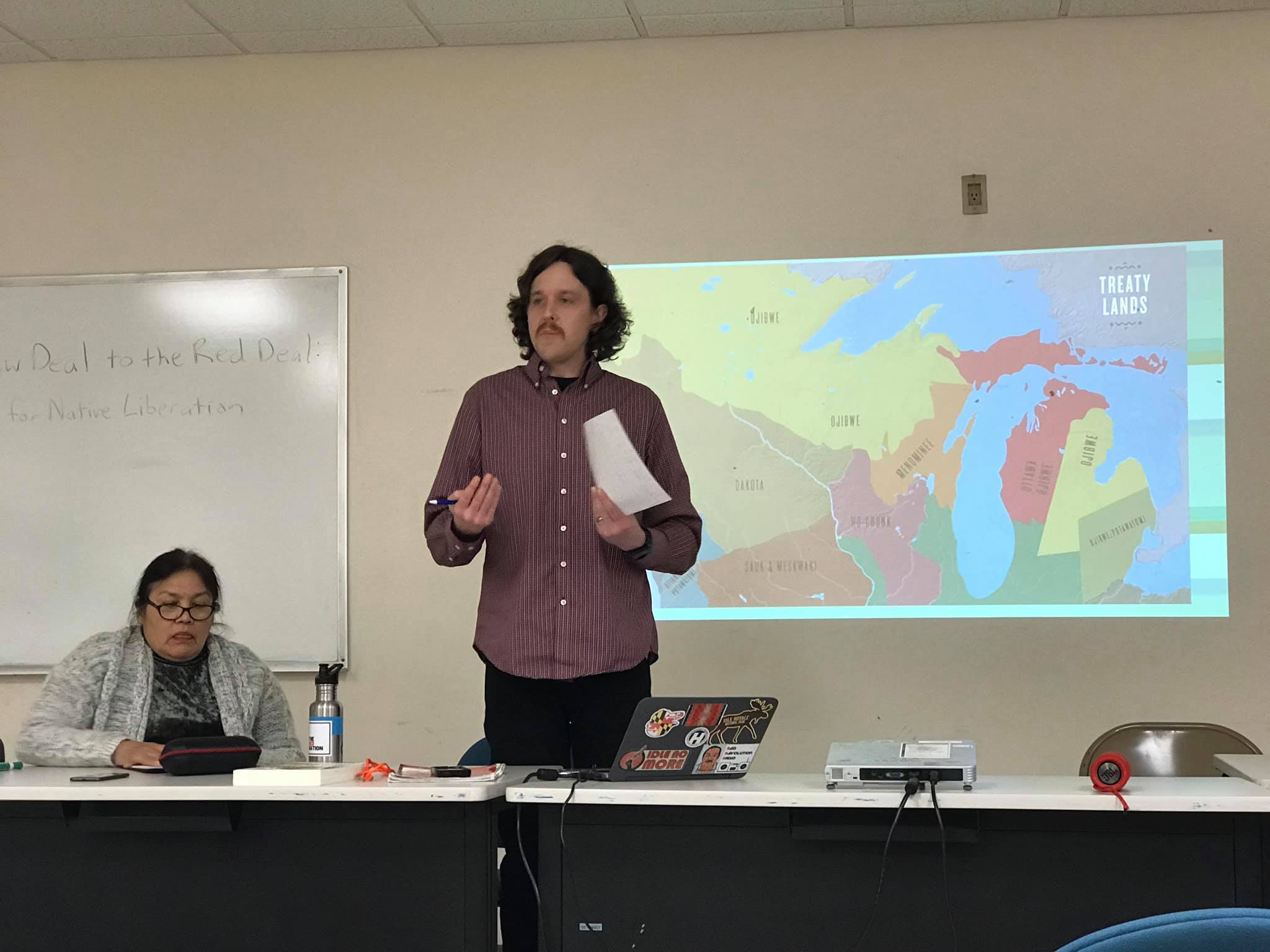
In Madison, Wisconsin on March 11th the grassroots group People’s Green New Deal Madison (PGND) hosted a meeting called, “Green New Deal to the Red Deal: The Fight for Native Liberation.” The purpose of this meeting was to introduce Madisonians to the Red Deal and how Native liberation should be central to the fight for climate justice and how we can transform our world away from profit and toward human need.
PGND is a grassroots group of ecosocialists fighting for the radical promise at the heart of the Green New Deal proposal. They are the radical pull of the Madison climate movement, pushing to build bus routes, not jails, put people before profits, end war, and engage in international solidarity and cooperation to stop climate change.
The meeting featured two amazing speakers. Nick Estes (Lower Brule Sioux), co-founder of The Red Nation and author of Our History is The Future: Standing Rock Versus the Dakota Access Pipeline, and the Long Tradition of Indigenous Resistance, spoke alongside Tara Tindall (Ho-Chunk), a Madison-based educator. They addressed an audience of 24 people, about 15 of whom were at the event in person and another nine who attended virtually.
The meeting started with Tindall centering everyone with important Ho-Chunk history. Madison has been known as Teejope since time immemorial. This was more than a land acknowledgement; Tindall discussed the history of the removal of the Ho-Chunk from their lands and the decades of ethnic cleansing that happened in Wisconsin. Many Ho-Chunk came back or resisted removal. Madison is just starting to grapple with this settler colonial history.
Following Tindall’s presentation, Estes spoke about the Red Deal, putting it in the context of a brutal American empire that has supported coups around the world, including the most recent one in Bolivia that overthrew Evo Morales, the country’s first Indigenous president. Understanding the brutal American empire is essential to understanding why we need a Red Deal.
After Estes’ presentation about the Red Deal, we engaged in a discussion about the Red Deal and how it could apply in the struggle in Madison and beyond. Discussion points included the role fossil fuel workers have in both perpetuating the fossil fuel industry and how we can bridge the gap with workers. This calls on the need for us to build class consciousness with fossil fuel workers, highlighting how their class position does not share the same interests as the bosses of industry.
One of the local struggles we discussed is how to center Indigenous voices in the struggle against the placement of F-35 jets in Madison, which would make surrounding working-class neighborhoods uninhabitable.
This was just the tip of the iceberg and a jumping off point for further organizing in the city. PGND is organizing the first of a series of study groups on each part of the Red Deal with a focus on organizing in Madison. The first study series on Part One will be Thursday, April 2nd, at 7pm CST via Zoom.
The meeting also helped raise $120 for the Unist’ot’en encampment in Wet’suwet’en Nation to assist their struggle against Coastal GasLink and the Canadian government.
Coming out of this meeting, activists realized the importance of the Red Deal and Indigenous liberation in grassroots efforts to push for a Green New Deal that is aimed toward the beginning of a transformation of our economic and social relations. Capitalism is the crisis and a Green New Deal that doesn’t attempt to grapple with the fossil fuel industry and an economy based on expansion and extraction won’t change anything. Let’s organize for a Red Deal and a People’s Green New Deal that fight for liberation and tackle the systematic issues of capitalism, imperialism and settler colonialism.
The COVID-19 virus shows the complete inability of the US health system to serve the majority of its citizens. The Trump administration’s responses have been tax cuts, interest rate cuts to help the stock market, and travel restrictions; we expect there will be bailouts for the airlines and other industries.
The Democratic Socialists of America (DSA) and all progressives who seek to support workers have a responsibility when it comes to fighting the COVID-19 virus: It is up to us to make the demands needed to actually serve all working people. Progressives need to enunciate and fight for a plan to deal with the pandemic. One thing is clear: a tax break and a bail out of the cruise industry will not deal with the virus.
Many DSA members are deeply involved in various community organizing efforts and can raise key demands on behalf of all workers. Any successful plan must be based on fulfilling several criteria designed to assure that all working people have access to needed services. As we take these first steps, we also must provide the needed support to first responders. All medical personnel, public employees, firefighters and workers routinely in contact with the public, such as flight attendants and airline pilots, need the supplies to protect themselves while they help others. Their unions are already in discussions with the employers to develop effective responses to the virus.
What are the criteria for a plan that could respond to the needs of working people?
Access to screening and treatment for every person in any given area. Access means the elimination of all barriers to screening and treatment whether financial, geographical or otherwise. One means of accomplishing such a project in our area is the re-establishment of the free Blue Bus health screening and treatment project. This project consisted of a blue bus, circulating through the community with appropriate medical staff and equipment on board to do screening and some initial treatment.
Maintenance of income. All employees who have been asked to stay at home must be guaranteed their income. A majority of employees do not have two weeks of paid sick leave. This is true for workers in all industries, but especially in food service. A combination of existing unemployment compensation and new appropriations at the federal and state level are a means of financing this.
Guarantee of employment. The employer will guarantee all workers asked to take a leave from their job that they will have employment upon their return. No negative remarks regarding such absences will be placed in any record of employment.
Maintenance of Services: Many firms, especially firms in food service have no means to continue providing service if key employees are required to be absent. Therefore local government should establish a pool of trained workers who can replace key personnel for the duration. This group of workers could go from establishment to establishment based on need. (An example cashiers, line cooks, etc.). A similar system was employed during World War II to assure production in key industries. The US Employment service exists today. “The United States Employment Service (USES) is an agency of the federal government of the United States responsible for “assisting coordination of the State public employment services in providing labor exchange and job finding assistance to job seekers and employers” (Wikipedia)
Amnesty: There can be no barriers to testing and treatment of all people in the area if the pandemic is to be contained. There needs to be explicit guarantees provided by officials at ALL levels that the screening and treatment system will not be employed to entrap individuals. This is a public health issue as well as a political demand. It is impossible to have an effective public health response if ten million people with unclear or no citizenship status refrain from screening for fear of deportation.
At one time or other programs have been implemented to fulfill each of the needs defined above.
Screening and Treatment: During the initial phases of the HIV-AIDs epidemic volunteer organizations led by gay and lesbian activists put together health care outreach systems. Often they worked with local hospitals and organizations like Physicians for Social Responsibility. Together they developed clinics roaming the target areas in a bus painted blue. They offered free screening, arranged for follow-ups and dispensed medicine. Nothing prevents a community from initiating such a system, assuming there is the political leadership to do so.
Maintenance of Income programs are already in place. It is called unemployment insurance. Currently many are inadequate replacing only a fraction of the lost income; some have waiting periods. Both shortcomings can be addressed almost immediately. During natural disasters, governors have ordered changes in the system to eliminate waiting periods — this was the case in Massachusetts with the Blizzard of 1978. Congress could also immediately increase the funds available to states to finance the system so that it pays out 100% of the wages to any worker laid off or told to take time off due to the virus. The unemployment compensation system is already in place. It is a political challenge that must be overcome if we are to move forward.
There is no need to create a bureaucracy to fulfill a pledge of an employment guarantee: make the employers responsible. Employers are always asking for less government intervention — now they can have it. Unions, civic leaders, church groups, workers’ centers, and state departments of labor can make sure employers follow through with this obligation.
Maintaining Services. Publicly financed training programs exist throughout the country. The United States Employment Service is still in business. There are other progressive, often union-run employment agencies. These can be mobilized to organize and train a pool of workers who can replace those on leave. If we could figure out how to do this in World War II, certainly we can do it again.
Amnesty. No one is going to go to a hospital or be screened if they believe that deportation and/or family separation will be the result of behaving in a responsible manner. The virus is a public health emergency. No group of people can be excluded from service or the whole idea of virus containment will be rendered useless. Encouraging people with questionable citizenship status to participate is an absolute necessity — and not simply for public health reasons. If the illness spreads widely, agricultural production will collapse in states like Wisconsin, which depend on an agricultural labor force, many of whom may have questionable status.
This of course is a political question and forces all of us who want to deal with this epidemic to face the fact that to overcome the virus it is necessary to overcome the xenophobia, racism and short sightedness of the current immigration policies.
COVID-19 raises other significant issues as well. Over the years the public health infrastructure of this country has been hollowed out.[1] Spending on public health remains three percent below what it was in 2009. The Wall Street Journal estimates that there are 59,000 fewer local public health workers now than ten years ago. In various states such as Washington and Kentucky health centers may be forced to close because of lack of funding.
Provision of screening has also put into the spotlight the total unavailability of services. Three months after the virus was identified, the much-vaunted private insurance driven healthcare system in the US has not been able to provide the level of screening needed to even diagnose the extent of the virus. In the second week of March, restrictive rules by the federal government are still impeding the availability of screening. Hospitals have declined to test for the virus citing restrictive rules emanating from the Centers for Disease Control.
If have insurance, the New York Times made another point:[2] most plans have deductibles. Those deductibles are generally not fulfilled this early in the year, so that one could be on the hook for the cost of your screening.
Other countries that have ordered massive quarantines or shutdowns have focused their attention on providing care and treatment. They are not worried about a huge drop in personal income and the destitution of families.[3] European countries have “safety nets” in place guaranteeing income to those out sick. While the plans vary in the details, all are designed to prevent a recession as a result of income loss due to the virus.
Industry bailouts, small business loans and a meager cut in payroll tax may be good campaign ideas, but they do nothing to address the immediate need for the provision of a robust and free medical response to this emergency. They do not meet the minimum needs of working people for job and income security. It will be up to us to raise these issues and push demands for all working people.
[1] Wall Street Journal “Health Agencies Are Stretched Thin” (Tuesday March 10, 2020 page A-5
[2] New York Times, Coronavirus Highlights the Pitfalls of Deductibles” Tuesday March 10, Business section page 10.
[3] New York Times; “ Social Safety Net in Europe Eases Quarantine’s Toll” Tuesday March 10th, Business Section page B-6