Tag: Featured

  • Wisconsin’s Brutal Cuts to Medicaid Prove Necessity of Medicare for All

    Wisconsin’s Brutal Cuts to Medicaid Prove Necessity of Medicare for All

    By Karl Locher

    During the infamous lame duck legislative session in the closing days of 2018, the Wisconsin legislature passed a breathtakingly reactionary agenda. The rapid move to limit the power of the incoming Evers administration was the object of significant attention in state and national news media. Indeed, as much as the Wisconsin Republican Party made great efforts to withhold information from the public during the legislative session, it was a nonetheless brazen – and largely successful – attempt to restructure Wisconsin’s government. The consolidation of power into the hands of a few members of the Wisconsin Republican Party was unquestionably an affront to democratic process.

    Amidst the outrage over the shamelessly undemocratic grab for power, the legislature and waning days of the Walker administration quietly made drastic cuts to Wisconsin’s Medical Assistance program, called BadgerCare Plus. Medical Assistance, known better as Medicaid, is the federal program to provide healthcare to the poorest Americans. The income eligibility requirements vary from state to state, and in Wisconsin vary depending on your family status. For example, as of 2020, in order for a childless adult to qualify for BadgerCare Plus, they must have an income of $1,063.33 or less per month.

    To understand why BadgerCare Plus is so vulnerable to swift and uncontested austerity measures, one needs to understand how it came to be a program in the first place. Medicaid was created in 1965 alongside the federal Medicare program. Unlike Medicare, Medicaid is largely administered by state governments in a shared cost model. This means that the federal government requires states to create their own Medicaid programs, including eligibility requirements and medical reimbursement rates, and in return, the federal government will cover a percentage of the cost of that program. Wisconsin followed the trend set by other states by privatizing the delivery of Medicaid coverage for most enrollees when it formed BadgerCare in 1999. In this model, the state pays Health Management Organizations (HMOs) and Managed Care Organizations (MCOs) to provide healthcare for BadgerCare enrollees. 

    The privatization of BadgerCare – and then eventually BadgerCare Plus – purported to save money for the state while delivering the benefits of commercial insurance to enrollees. Like many other neoliberal initiatives, HMOs and MCOs were sold as a shot of market innovation and consumer choice into a supposedly anachronistic government program. In reality, these two qualities of Medicaid – that it is a cost-share program and relies on privatized service delivery – created exploitable opportunities for profit-seeking at the expense of the quality and access to healthcare. Cost sharing puts states in the position of seeking to reduce their own budget burden while maximizing federal revenue for Medicaid services. Privatized service delivery creates an opportunity for a corporation to accept government reimbursement for services, and then to deliver as infrequently and as profitably as legally possible. 

    From the beginning, Medicaid was vulnerable to privatization efforts. Over the last forty years, programs that are devolved to state administration, like Medicaid, and are “means-tested” – meaning they require meeting certain income requirements in order to enroll as opposed to universal enrollment in services – have been the targets of corporate profiteering. Because these programs are shifted onto states, which have considerably lower capacity for revenue generation than the federal government, they are more prone to be thrown into crises of “sustainability” during downturns in consumption-driven sales tax revenue. Further, as “means-tested” programs, social welfare programs like Medicaid are construed as “handouts” to unproductive members of society and are politically vulnerable to schisms in class consciousness. Unlike Medicare, which is a widely perceived as a universal right for all, Medicaid is increasingly construed as both a drag on state budgets and an entrapment scheme for the working class whose livelihood should rely less on government programs and more on their employers’ begrudgingly paid benefits. 

    The result of the slow transformation of Medicaid into a market for private profit has been devastating to the livelihoods of poor and working-class people in Wisconsin. The recent changes to BadgerCare passed under the lame duck session will affect “childless adults” with incomes under 100% of the federal poverty level. What was formerly no-premium health insurance will now require monthly premiums in addition to copays for Emergency Room visits. Particularly devastating are that these fees must be paid by the 10th day of the month following a billing period. The bill cannot be paid in cash or in-person, it must be paid with a credit card or money order. If someone doesn’t pay, they will lose their coverage and be made ineligible to re-enroll for a 6-month period. For reference, about 150,000 people across the state will be affected by this change. 

    These measures are a deliberate attempt to strip the poorest Wisconsinites of health coverage and it will likely be very successful in doing so. There is voluminous data that poor people are underserved and intentionally exploited by banks and often cannot access the kind of payment services required to meet these copays. The obfuscation and complication of this payment scheme will result in thousands of people losing life-saving, crucial healthcare

    The lame duck session signals a new phase in the politics of austerity. State governments are moving beyond the point where services are merely handed over to private industry and are now taking unprecedented steps to cut social services altogether. The first step, of privatization, was crucial in taking a public good and turning it into a private commodity. In doing so,  state governments have changed public consciousness of programs like Medicaid so that they are not seen as rights – which can be fought over in public politics – but instead as private goods that are hidden from public consciousness and can be removed without political backlash.

    The lame duck session signals a new phase in the politics of austerity. State governments are moving beyond the point where services are merely handed over to private industry and are now taking unprecedented steps to cut social services altogether.

    The fate of BadgerCare – and Medicaid generally – is proof of the need for Medicare For All and a system of socialized medical services. The centrist suggestions of “medicare for all who want it” should be quickly dismissed as political dead-ends that would doom countless individuals to death by inadequate healthcare. The structural similarities between Medicaid and “medicare for all who want it” are uncanny. It is clear that an “optional” federal Medicare program would lead to private health providers and insurers simply opting-out of providing care. “Medicare for all who want it” would quickly devolve into a stigmatized program of insufficient healthcare comprised of a begrudging network of providers doing the legally mandated bare minimum. It isn’t difficult to imagine that this too, like Medicaid, would eventually be seen as a pariah in need of a private savior, before it’s supposed savior puts it to a quiet death.

    Socialized medicine, best represented through the Medicare For All movement, provides more than a technical solution that private health care has failed to deliver. Medicare For All could, for the first time, create a consciousness of health care as a public good and a universal right. This creates broader class consciousness, even if it is sometimes more like class unconsciousness. As people begin to view threats and injuries to such programs as an injury to their own well-being, they can see it also as an injury to their community and develop empathy for other people who also rely on the program. It is not coincidental that cuts and privatization efforts have been much less successful with universal programs like Social Security and Medicare than they have been for means-tested programs like Medicaid and TANF. As political centrists and leftists debate a – perhaps unfortunately – shared political path for the next four years, it is crucial that we build strength through the Medicare For All movement and that socialized medicine is a galvanizing principle of our politics.
  • Remembering the Uprising

    Remembering the Uprising

    By Paul Buhle

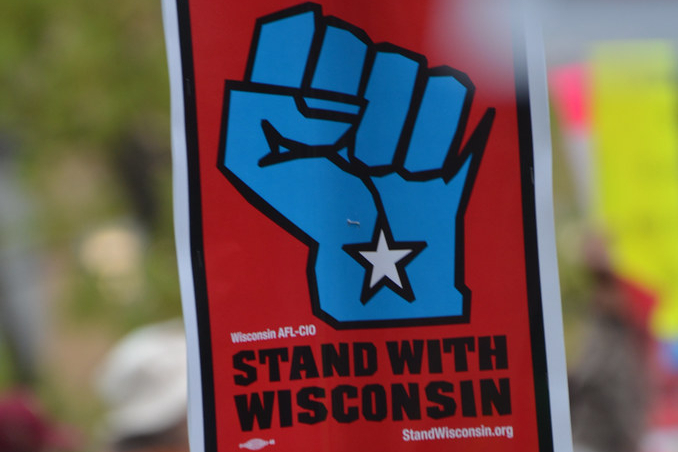
    The Wisconsin Uprising of 2011-12 was so unexpected, so inspired and inspiring, and the thumping defeat that followed so disheartening, that the whole series of events now threatened to become a phantom memory, almost unreal.

    The idea that crowds of 10,000, 25,000 or 125,000 and a few times upward of 200,000, could be protesting Act 10 (crafted to eliminate public unions through what amounted to the “right to work,” without being represented by them), that the Capitol building could be peacefully occupied during the first weeks of the demonstration, that people came from near and as far as New York or Los Angeles to join us—this was a moment for democratic socialism as well. It is easy to remember the firefighters entering the Capitol, led by bagpipers, or the singing with three generations of Wisconsin families sometimes joined together in chorus. I like to remember something else. Rank and filers from unions, especially health workers and public educators, brought very, very funny homemade signs satirizing Governor Walker and the Repugs. People would laugh, cheer the signs, and look forward to different ones on the days ahead.

    It was a spectacle of near-spontaneous ingenuity. And determination. 

    How this all came about and what it meant can be traced in John Nichols’ careful narrative history, Uprising. Or in the anthology of stories, photos and comics put together by Mari Jo Buhle and myself, It Started In Wisconsin: Dispatches from the Front Line of the New Labor Protests (2011).

    DSA members will want to read deeper than this brief recollection can offer. What needs to be said, briefly, is that the bipartisan approval of public unions can be traced all the way back to the 1930s and the (Wisconsin) origin of  the very non-radical AFSCME. The legislative approval of public employee unions, in 1959, was one of those developments making the 1960s-70s of Madison’s economics, politics and cultural life fairly unique, if fairly similar to some other college towns with an emerging left-of-center majority.

    The newer Republican leadership, emerging in the 1990s and later with the heavy financial backing of the Koch brothers, ended the semi-consensus on land conservation, public education and, of course, unions of any kind. Leading Democrats, having accepted and even supported NAFTA, saw their political base withering away, with the closure of factories and small downtowns, but seemed helpless to halt or even slow the process. Depressed rural areas fell under the spell of Fox News, while evangelical  white-flight zones, notably some Milwaukee suburbs, were already in political high gear. 

    A dozen Democrats walked out of the state Senate in January, 2011, sequestering themselves across the border in Rockford, Illinois (standard joke: worst vacation imaginable) so as not to provide the numbers needed to put Act 10 into effect. And the demonstrations began.

    We knew even then that the Republican intent was to destroy private-sector unions as well, despite Walker’s promise not to do so. Many union families, ill-educated by their unions as well as the media, seemed not to want to believe this. The “Right to Work” legislation for them followed, as expected.

    What is most memorable? Here, different participants will have different recollections. I remember the signs with Robert La Follette’s photo, a recollection of the great anti-war progressive and candidate for the presidency in 1924. I also remember the legions of senior citizens and retired unionists, from across Wisconsin and beyond: their unions were gone – along with the factories – but they wanted to go out with their boots on. And they did, old people in the bitter cold. They were joined on many days by crowds of teenagers, some of them from Madison schools, others coming from their neighborhoods and even other cities with their parents, grandparents and friends. Most of all, I remember the gendered nature of the workforce in the lead: women teachers and health workers. And the leadership role of my old union, the Teaching Assistants Association.

    We were to learn later that the union leaders of bigger unions, in suites of the Concourse Hotel, watched furiously, intent on gaining some bargain scraps from Walker but even more intent on getting us off the streets, to prepare for some future Democratic electoral sweep, the one that never came.

    Paul Buhle published the SDS magazine Radical America in Madison of the late 1960s and reported for several publications on the Uprising.

  • Homelessness: Austerity leads to Blindness

    Homelessness: Austerity leads to Blindness

    By Mary E. Croy

    Eight bills and not even a band aid in sight. As homelessness continues to soar in Wisconsin, the Republican led legislature refuses to take action. There have been eight bills proposed, and only one is even being considered in the current session. In the state budget, $3.7 million was allocated to fight this problem, but nothing has made it to the governor’s desk.

    Last June, the Assembly passed legislation, but it lingered in the Senate. Had it passed, more beds could’ve been provided before winter. However, excuses and dedication to austerity won the day. It is estimated that 20,000 children and adults are without a permanent residence in our state. In Madison an average of 225 people per day, including children, seek relief at the Beacon Shelter near downtown. 

    In Milwaukee, a tent city has begun under the Hoan Bridge. Ironic, since the bridge is named after a great Socialist mayor. 

    Homelessness exposes the racist nature of American society. For example, right here in Dane County, 5.1% of the population is African-American while 53% of the people who receive services for homelessness are African-American.

    Our state spending on the homeless population is approximately $3.3 million annually and it has been at this sum for decades. Neighboring Minnesota meanwhile spends $44.3 million.

    It is indeed a disgrace to our state and country to see people sleeping in the streets next to expensive restaurants, underneath the glaring lights of the capitol dome. 

    While Republicans and other neoliberals scream about cost, the statistics speak for themselves. It costs the public $35,600 every year to care for a homeless person, while that sum can be cut in half with decent, affordable housing.

    There’s a better way. In Vienna, Austria, public housing is considered the foundation for creating a livable and humane city. Socialists after World War I established a “social housing” policy that built not only apartments, but living spaces featuring kindergartens, health centers, playgrounds and workshops. They hired some of the leading architects to design beautiful buildings. Eligibility for public housing includes 80% of the population and this has led to a city where you cannot tell status by neighborhood. 

    How’s it funded? Sources are varied: the income tax, corporate tax and a payroll tax. In exchange, most citizens pay about 20 – 25% of their income on rent—a rate most Madisonians would kill for. 62% of Vienna’s citizens live in social housing. Because both middle class and lower income people can participate and you can keep your apartment even if your income goes up, a wide mix of people live in public housing without stigma. The city has panels that judge new developments, which means that energy efficiency, beauty and convenience for the residents can be emphasized. About one third of new apartment complexes in Vienna are publicly funded. The city owns about 25% of all housing, and indirectly controls another 200,000 units which are owned by limited profit companies that are strictly regulated with the city keeping final control over development. About 5,000 new, subsidized units are made available every year, and these are open to lower and middle income people. 

    It’s true that the problem of homelessness must be solved with a variety of tools, such as good mental health care, social support, innovative education and jobs, but affordable housing is essential in order to make our national disgrace a thing of the past. Red Vienna—the socialist movement that created one of the world’s most livable cities– can be a lesson for us as we build Red Madison.  

    Thanks to Madison Central Library Reference Desk for research assistance.

  • An Ecosocialist Madison Is an Equitable Madison

    An Ecosocialist Madison Is an Equitable Madison

    By Clare Michaud

    Imagining an ecosocially just world requires us to look at making radical changes to myriad aspects of our everyday (American) lives. Working toward an ecosocialist society would implicate everything from resource extraction and waste disposal to access to healthy food and clean water to the country’s approach to warfare, the consumption of goods, and treatment of indigenous people and lands. 

    Madisonians love to tout their commitment to sustainable lifestyle choices, and this ability to do so is bolstered by the City of Madison being recognized as the greenest city in the nation and appearing on several lists ranking it as a highly walkable city. Yet, these distinctions are pretty specific to Madison’s isthmus. Heading down South Park Street, or to Madison’s north side shows a very different way of life that does not as easily allow for bike commuting or accessing fresh food. The ability to make environmentally sustainable lifestyle choices is a class issue in Madison, and is something that is attainable for the residents who tend to be white, educated, and with a certain amount of wealth. 

    The ability to make environmentally sustainable lifestyle choices is a class issue in Madison, and is something that is attainable for the residents who tend to be white, educated, and with a certain amount of wealth. 

    The ability to live without a car on the isthmus, and instead rely on public transit, biking, and walking to get around, highlights the city’s concentration of resources to the downtown and near west- and east-side neighborhoods, where the cost of living is higher. Isthmus residents have bountiful access to various grocery store options: both supermarkets and smaller, more specialized food shops and co-ops are viable, in addition to a gamut of farmers’ market options that run on weekends and weekdays, throughout the spring and summer as well as with select winter options. 

    Purchasing food at smaller shops, the Willy Street Co-op, and directly from the producer at farmers’ markets is an excellent way of supporting local food producers and farmers; it helps to sustain those farmers’ and producers’ livelihoods during a time when farming as a profession is becoming less stable. Ten percent of Wisconsin dairy farms had to shut down in 2019 alone, due to China placing tariffs on U.S. agricultural exports as part of a 2018 trade war with the U.S. Ecosocial justice must address both the access to healthy living while also strengthening local economies; global capitalist gain has roots in imperialist exploration and exploitation, and this mindset lives on in actions such as trade wars for the sake of preserving global strength, which impact the livelihoods that are part of our local agricultural economy. Being limited to purchasing food from large-scale producers, too, has environmental impacts related to the shipping and transmission of goods; having better access to more local producers helps to support those producers while also leaving a smaller carbon footprint.

    With the city’s plan to expand Madison’s Beltline, Madison-area residents’ ability to access more resources will ease, but at what environmental cost? People who live in parts of the city where it’s necessary to drive to the nearest grocery store, for example, may benefit from the additional lanes, especially during evening commute times. However, building on the expressway encourages more individual drivers to be on the road. Instead of making changes to Madison’s transit options that promote having a car as a primary means of going between home, work, schools, and shopping centers, the city could take an approach that considers environmental impact, and create infrastructure that prioritizes buses, biking, and walking. During discussions about Beltline expansion, Alderman Grant Foster, from the 15th District, argued against the expansion and in favor of alternative transit options; he also brought up the point that if the Beltline is expanded, more traffic will be brought to city streets, an infrastructure that isn’t intended for that volume of traffic. Rather than expanding the Beltline, bus lines could be extended and added to better serve areas further from the isthmus. 

    Increased traffic on the Beltline means increased fuel emissions, creating a more prominent carbon footprint in Madison; it also means increased noise pollution. The upward trend toward living in urban areas is exacerbated by the way that modern cities are trending toward sprawl. Noise pollution contributes first and foremost to hearing health, but also is a strong factor in heart disease, learning problems in children, and in being a disturbance to sleeping, according to the World Heath Organization. 

    And Madison could become even noisier. Like expanding the Beltline, housing F-35 fighter jets at Truax Field would bring heavy noise pollution to the field’s surrounding neighborhoods, which are primarily occupied by minority and lower-income residents, including children. In the January issue of Red Madison, Allen Ruff wrote about the presence of F-35s driving the already-existing disparities between the community near Truax and the wealthy downtown and West-side communities. We must resist the use of the Truax Field for F-35s in order to put forth the effort to bridge the quality-of-life gap between Madison’s lower-income neighborhoods and its wealthier bubbles.

    The presence of F-35s poses serious and dangerous concerns for neighborhoods near Truax Field, and is also part of the larger problem of the U.S. military’s contribution to environmental destruction. The U.S. Department of Defense is the biggest contributor to pollution nationally and globally. Following in the history of imperialistic expansion and resource exploitation, the U.S. Military impacts environments all over the world, including in our backyard: bringing in F-53s alone would cause annual airfield CO2e emissions to increase by 135%. 

    Fostering an environmentally-centric society requires that we are able to advocate for fair and just use of the land. In November 2019, Governor Evers signed a bill (Assembly Bill 426) into law intended to criminalize and chill environmental protests and protect energy providers. The Center for Media and Democracy reported that “under the new law, peaceful protesters can now be charged with a felony punishable by up to six years in prison and a $10,000 fine if they trespass on property owned, leased, or operated by companies engaged in the distribution of oil or petroleum.” Wisconsin has followed nine other states in passing a bill that aims to prevent protests like the one that happened over the Dakota Access Pipeline. Assembly Bill 426 shows the Evers Administration’s prioritization for oil and gas companies over the environmental impact of natural resource extraction by these corporations, and is a strong step away from addressing this impact. The bill raised opposition from Tribal Nations, but these are cited as being largely disregarded during public hearings; an ecosocial society would prioritize Tribal Nations’ voices as a way to show respect for, solidarity with, and truly restore sovereignty to the Tribal Nations whose lands were seized and capitalized on by white settlers. 

    Fostering an environmentally-centric society requires that we are able to advocate for fair and just use of the land.

    Envisioning an ecosocialist future for Madison incorporates everything from transit to the consumption of goods to larger-scale initiatives being pushed forward by the U.S. Military and partnerships forged with oil and gas companies. An ecosocialist future should prioritize the health and livelihood of all people, rather than having opportunities to live without certain environmental stressors limited to the liberal bubble that is the isthmus. 

  • Socialists Must Fight the War Machine at Home

    Socialists Must Fight the War Machine at Home

    By: Allen Ruff 

    The Madison area’s current campaign to stop the stationing of twenty F-35 attack jets at Truax Field/Dane County Airport demands the active support of all socialists. The local and global issues related to the proposed base should readily engage all comrades as we fight for social, economic and environmental justice.  

    Sound Strikes

    At the local level, residents and activists on Madison’s north and east sides have raised numerous concerns. A serious issue involves the real threat of exponentially increased noise levels since, according to an Air National Guard (ANG)-mandated draft environmental impact study (EIS). The report details that  the increased decibel level of the F-35s at take-off will be some four times greater than that of the F-16s currently based at Truax. 

    According to the EIS, “…The increase in noise exposure near the airport would “disproportionately impact low-income areas” with minority populations, creating an “uninhabitable” inner ring of low- and middle income housing surrounding the airport. The East Side already faces significant neglect and injustice due to Madison and Dane County policies, and the proposed air base would only increase the disparity between this community and the rapidly-gentrifying downtown and West Side neighborhoods. In effect, the proposed air base would compound stress on impoverished communities and focus negative impacts on Madison’s communities of color.

    A separate City of Madison analysis also noted that the area close to, but just beyond the area deemed eligible for federal “mitigation” (soundproofing) funding will experience virtually identical noise levels with no federal support to address this issue.This will leave residents who already bear the brunt of racial, economic, and environmental injustice without the necessary resources to protect themselves from dangerous noise levels in their homes.  Additionally, soundproofing may not even be an option for the north side mobile home park close by the airport and within directly impacted area, since the Federal Aviation Administration (FAA) considers mobile homes non-permanent structures ineligible for “mitigation” funds.

    Even the areas that are eligible for “mitigation” funds would suffer, as soundproofing projects could take years to complete. Local homeowners in these areas, largely comprised of working class residents, are already anticipating losses in the values of their homes — for most a key asset. 

    The EIS also noted that the heavily impacted area currently has large numbers of children, childcare centers and public schools and that impacts to children associated with the increased noise levels would be considered “disproportionate and significant.”

    Overall, numerous low-income and working poor residents will be dispossessed at a time when Madison is experiencing pronounced, well-documented, and long-term crises in affordable housing and racial inequity.

    Chemical Warfare

    Environmental alarms have also been raised as highly toxic PFAS contaminants at levels thousands of times over the recommended standards by Department of Natural Resource monitors, have been found in Starkweather Creek leading to Lake Monona. Investigators have found that the dangerously harmful pollutant can be traced back to Truax, where PFAS-loaded foam has been used in Air National Guard (ANG) firefighting drills. While the DNR has posted warnings about human contact with the Creek’ water, the City of Madison has formally requested that the ANG remediate the situation, to little avail. Meanwhile, experts anticipate that the levels of ground and water contaminants will only increase as expansion at the airport’s facilities for the F-35s (at a projected cost of $90-$120 million) is expected to begin before existing problems are cleaned-up.

    The EIS also stated that with the arrival of the F-35s, projected annual airfield CO2e emissions would increase by approximately 12,478 tons or 135 percent — equivalent to adding an additional 2,438 passenger vehicles onto area roads with each driving an average 11,500 miles per year.

    Proponents

    Despite projected negative effects on Madison’s multi-racial, working class North and East sides, various interests elsewhere have come together to applaud and promote the proposed F-35 base. A key booster, the local Chamber of Commerce leadership has been busy promoting a false promise of area-wide economic growth and “more jobs” as a result of the base. However, while more temporary employment will result from constructing new facilities at Truax, the EIS study concluded that the resulting increases in employment and income to the Madison region would be “beneficial but negligible.” Other enthusiasts — among them numbers of observably well organized military personnel, veterans, and others — repeatedly claim the F-35s will provide for our “defense” and “security” and that  increased noise levels should be celebrated as “the sound of freedom.” 

    Most significantly, in a rare showing of bi-partisanship, a number of elected officials at the local, county and state levels along with local notables such as Paul Soglin and Rebecca Blank have applauded the planes’ anticipated arrival. Many of those who haven’t officially thrown their support behind the F-35s, including Madison Mayor Satya Rhodes-Conway and Congressman Mark Pocan,have sat on the fence, reluctant to come out firmly against the base. 

    The most notable proponent of the project has been Madison’s “progressive” Democrat, US Senator Tammy Baldwin. Her unabashed support of the F-35s, while draped in the rhetoric of “security,” “jobs” and “support for the military,” has been explained by some in vulgar economic terms: major weapons manufacturers contribute to her “war chest” and she must continue securing Pentagon contracts for in-state firms or risk losing support from in-state manufacturers and their workers.

    A Global War Machine

    Presently the costliest weapons project in history and a gigantic boondoggle of cost overrides, production of the F-35s provides a great illustration of how the military-industrial-congressional complex, or more accurately the Permanent War Economy, functions.

    The Pentagon purchases the F-35s from the gigantic military manufacturer Lockheed-Martin (LM) at a current estimated price of between $85 and $120 million per plane. With LM serving as the prime contractor, the plane is actually a multinational project as components and parts for it are provided through a series of global supply chains which provide parts or assemblies from a total of some 1600 US subcontractors residing in 46 states and 350 congressional districts as well as companies in a number of US allies – among them the United Kingdom, Italy, Netherlands,  Australia, Norway, and Denmark. Lockheed, which experienced a 58.3% increase in the price of its shares in 2019, has been selling the jets to those partners as well as to other client states including Israel, Japan, South Korea and Belgium.

    In part because there are so many “hands” and technologies involved in the planes’ production, and partly because of resulting design flaws and changes, there have been innumerable glitches and delays which have driven up the amount of budget overrides (currently at $200 billion) and resulting additional funding from the Pentagon. And of course, all this funding comes straight from the pockets of taxpayers in the form of discretionary spending diverted from domestic needs or deficit spending and deferred debt.

    Who Pays?

    The F-35 program’s projected long-term production cost is expected to top $1.5 trillion. However, the actual cost of the project becomes inestimable if one begins to contemplate the funds siphoned way from social needs and true security—funding for health care, education, mass transit, affordable housing for all, green technologies, etc.—the myriad productive development projects currently diverted away by the Permanent War Economy.

    The bottom line?  As fifty-four cents of each discretionary tax dollar goes to the Pentagon, working class folks in places like Madison are expected to bare additional costs and burdens as military-industrial giants such as Lockheed reap the benefits. Meanwhile, the only future “trickle down” resulting from the F-35’s arrival at Truax will likely be from the increase of pollutants into Starkweather Creek.  

  • Harassment and Grievance Officers and their Important Role in creating a Socialist Future

    Harassment and Grievance Officers and their Important Role in creating a Socialist Future

    By: Sarah Glomski, HGO

    Madison Area DSA (MADSA) is currently accepting nominations for a Harassment and Grievance Officer. Per our constitution and bylaws and in accordance with National DSA policy, our chapter has two Harassment and Grievance Officers (HGO), who are responsible for ensuring that the chapter is a safe space for our members and community. This is an extremely important role in building a socialist future.

    As socialists, we are working to create a better world. If we do not deliberately counteract problematic dynamics between ourselves, the same dynamics will occur in our chapter. Nearly everyone has a story about themselves or others being harrassed in a workplace situation, and finding that there was no one to turn to, or feeling that nothing would be done if misconduct was reported. This is especially true for women, LGBTQ folks, people of color, and others from oppressed and marginalized identity groups. Those same dynamics can appear in socialist and anticapitalist spaces, and if left unchecked can undermine the trust we need to have to organize with each other. Ultimately they can cause organizations to implode. These dynamics also contribute to underrepresentation of the aforementioned groups in socialist and other left spaces, which undermines our ability to do good political work. 

    The role of the HGO is to offer a solution to this problem.

    An HGO is a position in the chapter who DSA members can go to with an official complaint if someone has taken actions that make them feel unsafe or unwelcome in MADSA. All who participate in MADSA functions are expected to abide by our code of conduct (Available at https://madison.dsausa.org/resources/code-of-conduct/). If an individual in a DSA space has violated the code of conduct, the offended party may reach out to the HGOs through our confidential email address dsamsnhgo@gmail.com. Those without email are also welcome to speak to an HGO in person.

    As HGOs, our principles and processes are grounded in restorative justice, which seeks to center the rights of the offended, as well as to repair harm and prevent future harm. An important aspect of the work is educating the offending party as to why their behavior was harmful, including the principles of intent versus impact, and the way power dynamics and privileged and marginalized identities impact our interactions with each other.

    Madison DSA’s HGO team also sees our role as much more holistic than just responding to issues that are reported. We also seek to educate members and cultivate a space that is welcoming and vibrant. Some of the ways our team has worked to do this are by regularly giving brief announcements and presentations at general meetings reminding folks of how they can contact an HGO, what types of issues an HGO might be helpful on. HGOS have also provided brief education at chapter meetings, on topics such as bystander intervention and how to apply “step up/step back” being mindful of other comrades’ social cues and give all folks an equal chance to contribute in meetings.

    One of the HGO team’s goals for 2020 is to plan and execute a 3 hour long training on verbal de-escalation and harassment prevention. I have provided similar trainings my work as a mental health and substance abuse counselor, and have seen firsthand how equipping someone with tools around assertive communication and conflict de-escalation can be incredibly transformative. In an ideal solicaist world, all children would receive this type of training in the public schools, which would prevent a lot of problems that occur. As we work to build a socialist world, we will provide these tools and support to each other.

    How do I become an HGO?

    It is important that HGOs be democratically elected and accountable to the membership.  Interested parties should indicate their interest in candidacy by emailing a brief statement about themselves and why they would make a good HGO to dsamadison@gmail.com

    Some of the qualities that make a successful HGO are: good communication skills, understanding of the principles of restorative justice and a commitment to upholding them, ability to have difficult conversations with care for all involved, including being trauma-informed, and the ability to keep information confidential and uphold the code of conduct.

    Further questions about the HGO team? Feel free to contact HGO Sarah Glomski at sarahelizabethch@gmail.com 

  • A False State of Austerity

    A False State of Austerity

    By Dayna Long

    Over the last ten years, Republicans in the Wisconsin state legislature have severely undermined local control including barring state regional transit authorities and instituting levy-limits, leaving local governments with few options for raising funds. In response, county and city governments have adapted their budgets to fit these state-imposed constraints, meting out austerity measures on behalf of the Republican Party like a sharp stick in the eye to their constituents. Having accepted the sort-of true premise that our leaders have no choice, and with few prospects for resistance, we, their constituents, have adapted, too. We have accepted austerity and tough decisions, even in cities like Madison and Milwaukee, where the untapped wealth on display makes the new measures and the shrunken budgets all the more obscene. 

    In this new decade, socialists in Wisconsin should lead the charge for another way. 

    The Dynamic at Play

    In a recent example of the above dynamic, the Madison Common Council instituted a $40 “wheel tax” to raise funds for improvements to the city’s Metro Transit system, increasing the cost of vehicle registration for Madison residents to a steep $153. Unsurprisingly, many people were unhappy about the change. While anyone who said that the city doesn’t need to spend more money on Metro Transit is sorely mistaken, people aren’t wrong to be critical of what is essentially a regressive tax — every resident is charged $40, regardless of income. The wheel tax, like any flat tax, will be disproportionately hard on low-income residents, often living in far-flung neighborhoods where it’s hardest to go without a car due to insufficient transit service and a lack of nearby jobs and grocery stores. 

    A funding plan that requires everyone to contribute equally hides that we don’t all contribute equally to the need for public transit. For example, some employers require hundreds or even thousands of people to commute to and from their business five times a week to create wealth for them. Does it actually make sense for me to pay the same $40 wheel tax for transit as the millionaires and billionaires who own those businesses?

    Alders expressed a lot of reluctance to go through with the wheel-tax. But at the end of the day Metro Transit badly needed the funding and the state had them in a bind. They didn’t want to reach into our pockets, but the Republicans have blocked their access to other coffers. On top of that, you don’t have to look far to see how things might have played out had the Common Council rejected the wheel tax. Milwaukee County Executive Chris Abele didn’t get his wheel tax past the Milwaukee County Board in 2018. Since then, the county has made cuts to bus routes. Bus drivers in local ATU 998 went without a contract for over a year as the county claimed that the union’s demands exceeded the county’s budget. They only came to an agreement this past November, hours before a transit strike was set to commence. 

    There really are no good choices when you play the Republicans’ game. And to be fair to everyone, it can be hard to envision an alternative to playing. The labor movement is only beginning to recover from the impact of Act 10, and successful, sustained organizing has been sporadic at best since the Wisconsin Uprising. It can seem like there’s no way forward except to contort our values and goals to accommodate the Republican-imposed limitations. In fact, I will admit that I spent a whole week supporting the wheel tax, even writing a letter to the City Finance Committee urging them to adopt it. Transit in Madison is bad and needs to be better and yet there is no radical, grassroots movement in Madison calling for robust, fare-free transit. Transit advocates in Madison supported the wheel tax. Most of those who opposed the wheel tax don’t care about funding transit. I was (briefly) unable to see another way. 

    At the same time, it’s too easy to say that city and county leaders’ hands are tied and that they’d find a different way if only they could. Democrats are often not sorry to have a Republican-provided excuse to avoid making their friends and collaborators in the business class ante up. Neoliberalism is entirely compatible with local governments that are hamstrung in their ability to levy taxes, that are forced to shrink services and cede responsibility to individuals and control to private interests. Reducing the role of government and shifting more and more of the burden of caring for people onto individuals and families has been a bipartisan project for decades.

    And while greater funding for things like transit and housing are always a question mark, there seems to be no end to the amount of money cities will pour into policing. In the same budget that introduced the wheel tax, the city allocated funds to hire three more police officers in spite of a falling crime rate and the fact that Madison Police Department already has a higher than average officer to resident ratio for a city of Madison’s size. Even within the narrow confines set by the Republican party, city leaders get to make choices. In Madison, they choose to defund essential services to give more money to what is already the most expensive city agency

    A Losing Strategy

    It’s hard to say for certain how else the Common Council might have funded transit improvements in the confines of the existing city budget. That’s exactly the problem. Even Alders with the best politics and great intentions (there are several who come to mind) can’t win under the current conditions. Not only is the wheel tax itself a losing prospect, so are all strategies to fund services that accept this false state of austerity as an inevitable reality. 

    For one thing, the funding required to tackle the serious crises facing our state — from its longstanding segregation and appalling racial disparities to the infrastructure improvements needed to tackle carbon emissions and survive extreme weather events — won’t be found in working people’s shrinking bank accounts. Worse still, regressive funding measures obscure class divisions, taking from individuals equally as if we all profit equally from public investment. Our job as socialists is to expose the class interests that govern our communities, not to confuse them with bad policies. 

    Furthermore, when we treat Republican-imposed austerity as inevitable, we lower people’s expectations for the future at the very moment we should be raising prospects for the fights ahead. This might be a fine thing for Democrats who are not opposed to shrinking working people’s expectations about what the government should provide, and who have a long history of neutralizing movements. But for socialists, it is a terrible dead end. 

    Another Way

    Seattle socialist and city council member Kshama Sawant provides an excellent example of how socialists can relate to state-imposed funding restrictions. Washington is said to have the most regressive tax structure of any state in the country, creating inequality best characterized by a homelessness crisis in the same city where Amazon is headquartered. Instead of accommodating to these conditions, Sawant takes every opportunity to connect peoples’ hardship to the undertaxed opulence of the tech giants and other corporations. The connection is also reflected in the policies she’s fought for, including a $15/hr minimum wage and a per-employee head tax on big businesses to help ease the housing crisis. While state restrictions do limit what’s possible at the city level, whole movements have coalesced around the popular demands Sawant gives voice to, including unions. Her incredible electoral victory over an Amazon-financed candidate this past November speaks to the strength of the coalition amassed around her politics. It’s exciting to imagine what such a coalition might achieve next.  

    We can also learn from the successful teachers’ strikes of the past two years. As many of them demonstrated, it is possible to force change past red state legislatures. But teachers didn’t win by following the rules or by limiting their demands to what was possible according to their state governments. In fact, bucking the austerity that was hurting them and their students required defying conventional wisdom about what was possible, even when it came from their own timid union leadership.

    As socialists in Wisconsin, we have to be the first to insist that while there are still billionaires alive on earth (including right here in Dane County) it is wrong to ask working class people to pay a greater share, nor can we tolerate cuts to the services all of us rely on, be it bus routes or subsidized housing. Our job in this new decade is to share a vision of the future so inspiring that people are willing to fight to achieve it, which means thinking far beyond Republican-imposed levy limits and raising the prospects for the movements to defeat them.

  • Foxconn: We Want Our Money Back!

    Foxconn: We Want Our Money Back!

    By Mary E. Croy

    Trump trumpeted the technology manufacturing deal with Taiwanese company Foxconn as the “eighth wonder of the world” when company executives visited the White House, according to then Chief of Staff and Wisconsin GOP insider Reince Priebus. In 2017, Foxconn reached an agreement with the Walker administration, promising to invest $10 billion in the Mount Pleasant campus and hire up to 13,000 people. 

    •  2017:  The Walker administration offered up to $3 billion in handouts to entice Foxconn to build a factory in Wisconsin. It had also recently reneged on a deal in Pennsylvania where it originally promised to spend $30 million and create jobs for up to 500 people. But Wisconsin would be different: Foxconn claimed it would employ 3,000 people, and increase the workforce to 13,000 people as soon as 2022. Additionally, it promised to give $100 million to UW-Madison to create “innovation centers” and a research institute. The Walker administration pursued these initiatives despite Foxconn’s dark history of worker abuse in China: the company became notorious for employee suicides and for responding to the deaths by installing “suicide nets” outside of dorms at its facilities in China. 
    •  2018: Foxconn moved to evict families from land in neighboring Sturtevant. A dozen homes were destroyed in Mount Pleasant. The Department of Natural Resources approved a water diversion permit allowing up to 7 million gallons of water to be diverted from Lake Michigan. Restrictions were lifted and Foxconn was greenlighted to fill in 26 acres of wetlands in Racine County. At the same time the subsidy estimates ballooned to $4.5 billion. Foxconn scaled back plans—instead of a cutting-edge big screen TV plant, it was announced that the factory would build smaller panels, and the investment by the Taiwanese company shrank to $2.5 billion.
    •  2019:  Foxconn began hesitating on building any plant in Wisconsin. Meanwhile, taxpayers have spent at least $137 million on infrastructure, roads, and buying land for the project. The company hired 156 people during the year. The Wisconsin plant started work as an assembly facility that finishes production of TV displays made in Mexico. Starting pay is approximately $14 per hour with little or no benefits, despite Foxconn having promised that average pay would be $23 per hour when the deal was struck. Mount Pleasant’s bond rating has downgraded because of an anticipated increase in debts. The company also applied for and received a fire code variance to omit sprinklers in some areas of the building.
    • 2020: The company has 520 employees in Wisconsin. Foxconn promises to hire 1,500 people by May 2020. It releases figures that it has awarded around $370 million in construction, about 17% of the $2.1 billion laid out in the original application. Donations to UW-Madison are at $700,000 and the research institute has not yet been built.

    So far, Foxconn has refused to renegotiate the agreement. It claims to have fulfilled the goals for 2019, and if the subsidies are approved by the state, it could receive more than $50 million this year. So far the state has not certified the tax credits. As the state and the Taiwanese corporation wrangle, plans for what the factory will make and even if it will begin this May remain uncertain. 

    This whole mess shows the fatal flaws in the neoliberal obsession with “public-private partnerships” as ways of building healthy local economies. Instead of relying on the whims of a billionaire sitting behind a desk in Taipei, why not have direct public investment to build needed infrastructure and create services dictated by the will and interest of citizens? Our tax dollars would be more efficiently spent, critical improvements could be made, and our State and ordinary people would be the beneficiaries.

    Thanks to Madison Public Library Reference Services for research assistance.

  • No War With Iran

    No War With Iran

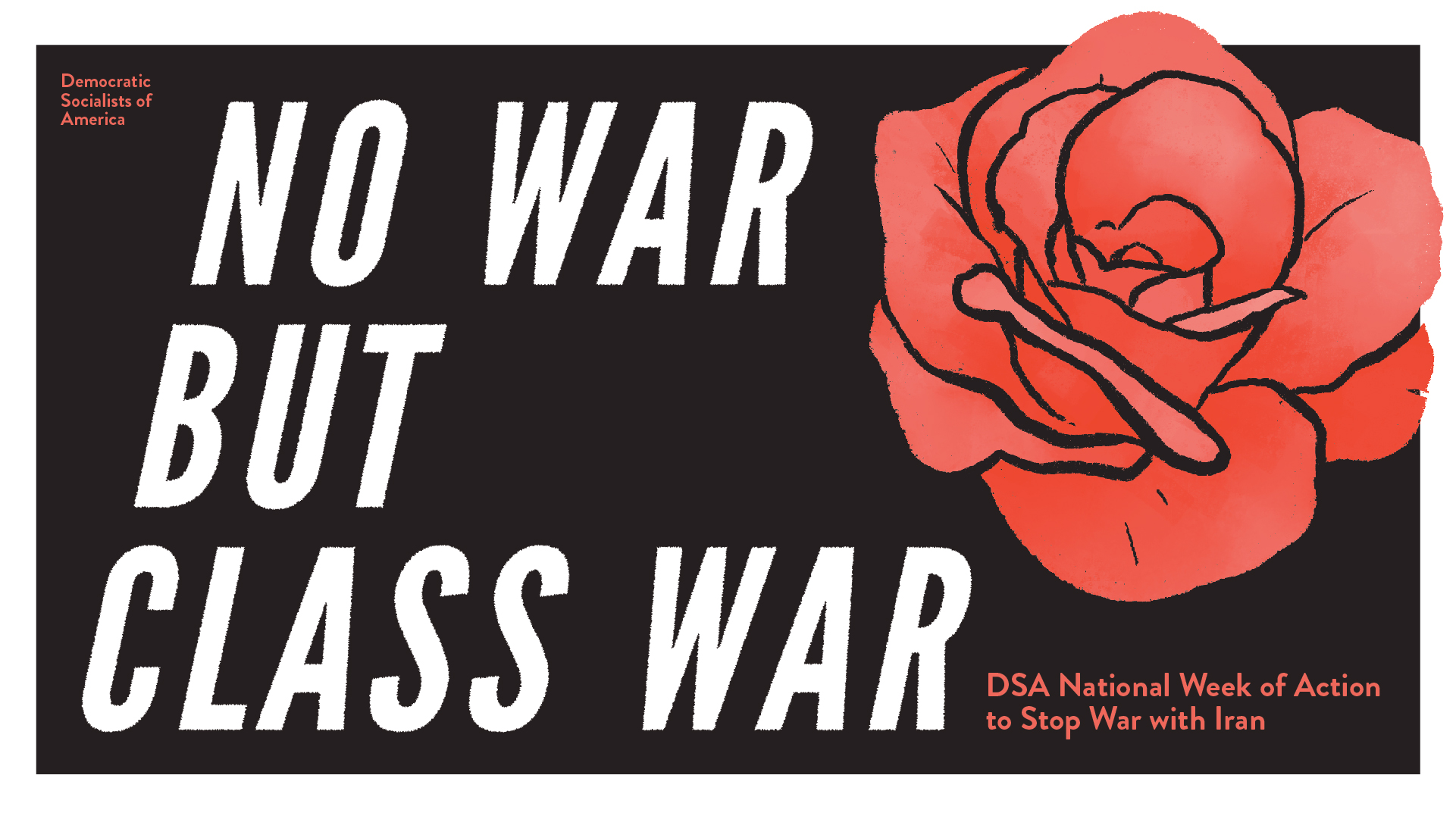
    Protestors expressed their shock, dismay and anger in response to the U.S. assassination of Iranian General Qasem Soleimani.  On Saturday, January 4th at noon, at least a hundred activists representing a cross section of anti-war and political groups gathered on the steps of the Capitol to oppose a potential war with Iran. The event was organized by several leftist organizations in Madison, including the DSA and featured speakers who took turns speaking out against the clear act of aggression against Iran.  The protesters held signs that were clear and to the point: “No war with Iran!”

    The turn-out was a quick response to the shocking action. A number of Madison-based organizations are building support for local participation in a global day of protest against war with Iran on Saturday, January 25 at 12 PM. Details can be found on Facebook.

    -Report by Kai Rasmussen

    Below, we share with permission a speech given by DSA member Shaadie Ali at the January 4 protest.


    “No war in Iran, yes, but also no sanctions against Iran, no extrajudicial killings in Iran or Iraq, and no supporting Jihadist movements that aim to kill Shias across the region.”

    The history of Iran-US relations is a story of horrific cruelty on the part of the Americans that dispossess and terrorize the Iranian people. From the start of the Cold War on, any meaningful attempt by the Iranian people to exert control over their political future was met with brutal repression on the part of the Americans, starting with the election of Mohammed Mossadegh in 1953. When the newly elected Prime Minister Mossadegh attempted to assert control over the ownership of oil production in 1952 (which nominally paid out 85% of profits to Great Britain and 15% to Iran, but in practice probably paid less), Great Britain imposed an embargo. President Truman agreed to this embargo, and in 1953, the CIA and Great Britain staged a coup d’état based out of the US Embassy. 

    The CIA and MI6 then reinstalled Shah Mohammed Reza Pahlavi as the Head of State, who Great Britain and the Soviet Union jointly deposed a decade earlier on the suspicion that he had Nazi sympathies. To consolidate the Shah’s tenuous position over an extremely resentful Iranian populace, the CIA helped develop and train a brutal secret police force named SAVAK. During the ‘60s and into the ‘70s, SAVAK tortured and killed thousands of political dissidents. According to the Federation of American Scientists, some of SAVAK’s favorite methods included “electric shock, whipping, beating, inserting broken glass and pouring boiling water into the body, and the extraction of teeth and nails.” Popular resistance to the Shah mostly took the form of either communism or Islamism. Though anyone who opposed the Shah was liable to be tortured, the worst forms were generally reserved for communists, with SAVAK and the Shah probably underestimating Islamism in retrospect. As popular resistance mounted in the late ‘70s, leftists and Islamists often joined coalitions to fight against the Shah. They struck hard and fast, catching both the Shah and his American allies completely off-guard. The Shah fled Iran and was granted entry to the United States for cancer treatment despite the request of revolutionaries that he be extradited. A group of revolutionary students, meanwhile, remembering that the US embassy was instrumental in the 1953 coup and many, many coups in Latin America, Africa, and Asia, retaliated by seizing the US embassy and holding the 52 Americans residing there hostage.

    The hostages were eventually released, and the Americans released some of the Iranian assets they froze in retaliation.

    The United States went on to support both Iran and Saddam’s Iraq in the Iran-Iraq war, an eight-year-long war lasting from 1980 to 1988 that cost hundreds of thousands of lives on both sides and included genocides. In the final weeks of the war, the US Navy shot down an Iranian commercial plane over Iranian airspace, killing 290 civilians. The United States never apologized for this. Over the coming days, you’ll hear discussion of Iranian “aggression” against American military targets, but none of those incidents produced as many civilian casualties as the murder of 290 people whose only crime was flying on an Iranian airline.

    I could go on, but I’d like to skip ahead to the present conditions imposed on Iran: the Obama administration was able to secure a deal with the Iranian government. The US would agree to lift the international sanctions on the Iranian economy that devalued their currency by 80% and a 30% decrease in drug imports from Europe and the United States. In exchange, Iran would agree to more stringent limits on their uranium enrichment and allow international inspectors to inspect their facilities on very short notice to ensure compliance. In 2018, Trump withdrew from the agreement and reimposed those sanctions despite Iranian compliance. The Senate then agreed in a 98-2 vote to impose further sanctions on Iran. The effects have been devastating. The cost of meat has gone up by 116%. Hundreds have been killed in food riots. People regularly die due to shortages in cancer treatment drugs. And now, the United States assassinates one of the most decorated generals in Iranian history.

    I know that was a lot, but my point is this: Iran isn’t perfect–no country is. And no, General Qassem Soleimani wasn’t perfect either. But at every turn regardless of President, Iran finds a United States government that is dishonest, cruel, violent, and acts in completely bad faith. Iran is dealing with a state which is free to bomb their airliners, overthrow their prime ministers and cripple their economy the second they attempt to control their national destiny. No war in Iran, yes, but also no sanctions against Iran, no extrajudicial killings in Iran or Iraq, and no supporting Jihadist movements that aim to kill Shias across the region. Thank you all, and solidarity with the people of Iran and Iraq.

    -DSA Member Shaadie Ali, speaking at an anti-war protest in Madison