“Yes to sanitizer and shield between cashier and customers, but no protection between the customer behind the cashier at the next register. Social distancing is a joke at this store. No gloves or masks provided.
I took a 2 week emergency sick leave for which I will be paid, but as of now I have to burn up all my sick and vacation time since I can’t work in these conditions being high risk. FMLA does not apply.”
“My mother works for this company. Multiple employees have tested positive for the virus, yet the company refuses to close despite their business not being essential. They have people working in close quarters. They’ve threatened that employees who do not come to work will lose all vacation time, and said that if they’re forced to close people may lose their jobs permanently. Management and HR staff are either barricaded in their offices and refusing to meet with employees, or staying home entirely—they’re clearly afraid for themselves but are putting their employees at risk every day.”
NORD Gear Corporation Phone: 888-314-6673 Fax: 800-373-6673 Email: info.us[at]nord[dot]com
These are people’s stories in their own words. Submissions are edited only for clarity. Submit to the Wall of Shame
“Haven’t paid April rent. They taped a bill for rent to my door and stickered my truck to be towed for “expired plates.”
This behavior is not uncharacteristic of them. In the past, they have gone through the park on the 6th of the month (after the 5 day grace period for rent) and stickered vehicles to be towed by Schmidt’s Towing. Pretty sure they get a cut off the impound fees.”
Oak Park Terrace Phone: (888) 817-5098 Email: oakpark[at]lakeshoremhc.com
These are people’s stories in their own words. Submissions are edited only for clarity. Submit to the Wall of Shame
“University Apartments is raising our rent at least $50 (depending on which style apartment) in July, as many people in my community have been laid off or their income severely limited by the public health crisis. This is unconscionable.”
The COVID-19 crisis is an opportunity for ruthless plunder by the rich. It could also be a catalyst for our side.
The year 2020 is not going as planned. Because of COVID-19, people cannot safely gather together in groups. Other safety concerns, real or pretended, have mostly taken a back seat to social distancing and supporting medical workers and other crucial jobs. These new political and social boundaries are both an opportunity and a threat as we work to broaden human rights. The window of what seems possible is wide open right now. We have the chance to make good changes permanent, but repressive regimes and large corporations worldwide also see this as a chance to advance their agendas. The virus has robbed us of our ability to gather, but people are finding other ways to be and work together. There will be opportunities to fight to make temporary gains permanent. But we need to learn to organize on this new turf.
COVID-19 has rattled our economic and political system to the roots, and the bullshit is starting to shake loose like rotten fruit. Signs are appearing everywhere, in good and bad ways. Parts of our system that go to great lengths to oppress or profit or deceive are dropping away for now. In many places, people who were jailed for minor probation violations or because they are too poor to pay bail are being allowed to live at home during the crisis. A few Italian men with a 3D printer fabricated $1 replacements for an $11,000 medical valve to save lives. When the company holding the patent for the valve sued them for helping in an emergency, it was ridiculed on a global scale. Human need is starting to come first in a lot of ways that it hasn’t in recent memory. Meanwhile, by fighting to preserve April’s so-called election, the Republican Party of Wisconsin has dropped all pretense of caring about the lives of anyone but themselves and their donors.
Healthcare is not an individual issue and it never has been.
In the first year of the presidential campaign, Joe Biden, Pete Buttigieg and friends spent much time and effort defending the private health insurance system. Our current system makes healthcare an individual responsibility, though the circumstance of needing healthcare makes a person more likely to fall short of paying for that care. Centrist democrats support that philosophy, but the virus has laid bare its flat falsehood. Healthcare is not an individual issue and it never has been. A person’s health is more tied to luck than personal responsibility. People have already died of this virus solely due to lack of coverage.
The gig economy was built on bullshit. Uber’s business model for its entire existence has been to ignore laws, pretend they are not ignoring those laws, run immense deficits, and eventually build a monopoly. It pretends its drivers are not employees, even in the face of laws specifically designed to make it act responsibly. Startups have replicated that business model all over the economy. Gig employers have bloated themselves on venture capital but kept their workers on the edge for years. The new situation has shifted this landscape greatly as well. Gig workers, though their app bosses claim they are not employees, are now eligible for coronavirus unemployment benefits. Instacart workers (who have become essential workers on the front lines as people stay home) have struck for benefits and safe working conditions.
There are people out there using the new rules of the game to concentrate unjust power further. Three major new factors reduce accountability for such actions: first, it is unsafe to gather for mass protest. Second, the biggest news story of the century is crowding out almost all other reporting. Third, emergency power can be invoked to justify all sorts of unjust acts. Viktor Orban has already gained dictatorial power in Hungary. Just a few examples of such acts: Amazon is likely to monopolize the gains from the death of many retail businesses. The Trump EPA is using the crisis as an opportunity to loosen environmental regulation once again. With opportunistic timing, the Trump administration is enacting cruel federal termination policy by taking land from the Mashpee Wampanoag people (against whom, not coincidentally, Trump has clashed recently due to business conflicts). This act demands a mass protest that cannot safely materialize in this moment, and the news cycle will have flushed it away by the time this article is published. ICE and CBP continue raids and detention policies that will literally have genocidal results when the disease reaches their already inhumane facilities. In general, this is the type of moment where strongmen can emerge to finish off dying democracies. The worst prospects for the next year are terrifying.
Most importantly, cracks are more visible than ever in the “human nature” argument that doubters always pull out against collective action. Mr. Rogers famously said, “look for the helpers.” I’m looking, and I see a lot of helpers around.
Because of the forces of concentrated capital, the bailout bill congress passed was predictably weighted in favor of large corporations. It did not come close to addressing the human needs that will continue through this crisis in the coming months. Joe Biden has changed his position on healthcare for this one disease, but maintains his defense of insurance companies. For coronavirus, he says, treatment should be covered. But for the person who needs chemotherapy, it’s tough luck. Maybe they should have chosen to catch the emergency disease if they wanted coverage. For the people laid off from their jobs specifically because of a public health crisis, well, they might lose their insurance. It is impossible to try to map consistency onto the old worldview while we are in the throes of a deadly pandemic. But as the powerful work to maintain the brutal system that compounds this crisis, other ideas are emerging. Governments and average people are suggesting and implementing solutions that were nowhere near the realm of possibility months ago: rent strikes, nationwide mail-in voting, mailing monthly support checks to every person, and more.
Regardless of the actions of congress and the president, new things are being written into the American psyche throughout this collective trauma. Many people are mobilizing to help one another out. Crucial workers whose value has been invisible to many people are now being seen as emergency first responders, rightfully gaining hazard pay and paid time off in some places. Most importantly, cracks are more visible than ever in the “human nature” argument that doubters always pull out against collective action. Mr. Rogers famously said, “look for the helpers.” I’m looking, and I see a lot of helpers around. If we come through this crisis by taking collective responsibility for our shared humanity, the new normal will have great potential for positive change. However, to beat out self-consolidating capital will take the conscious effort of many to strengthen and multiply our natural impulse to help one another.
How our world comes out on the other side of this dark time will have a strong influence on the way we approach the climate crisis, which still somehow dwarfs the huge crisis we face now. Will we weather this as individuals, or together? Will we find ways to organize for our rights and our needs, or will the oligarchs be able to show us outright just how expendable they think we are? Will the door of possibility open or close? We must answer these questions now, through our own actions.
A first person account by Mia Noel, with questions from Dayna Long
DL: Can you share a little bit about yourself? How long have you lived in Milwaukee and what do you do for work?
MN: I moved to Milwaukee when I was five and aside from college and a short time in North Carolina, have lived here since, so about 30 years. I manage a health education program for youth that are 11-19 years old. Thankfully, I still have my job, so I am working full-time through this pandemic.
DL: Tell me about your experience trying to vote in this Spring election from start to finish. When did you first try to get a hold of a ballot and how long did you ultimately spend waiting at the polls to vote in person? Any other challenges when it came to voting this year?
MN: Spring Election like today, April 7th? Because the whole year has been a farce. Wisconsin removed 200,000 voters from the rolls in January. I received a letter saying I was probably removed from the registered voters list. I re-registered online in January and my polling location moved.
On February 18th, the Spring Primary, I went to the website to check my polling location since it was my first time going there and the website was down. It crashed on election day. I shared a pic online and said “This does not bode well for electoral politics in 2020.”
For the April 7th election, I knew enough to ask for an absentee ballot back in the middle of March. It never came. Last week, Gov. Evers asked the legislature to meet and move the election, they did nothing so on Sunday, April 5th, I went to try to vote in the early voting drive-up option downtown. The line was 8 blocks long at 3 pm and voting closed at 5 pm. It was crawling along. I took a video to try and show people what was happening and left. I could have stayed but it would have been hours and I hoped Speaker Vos and Senator Fitzgerald would make an ethical decision, that somehow the election would be moved.
On Monday, April 6th, when Gov. Evers asked that the election be moved to June, I was so ridiculously relieved that finally something sensible was happening. Then the WI court met VIRTUALLY to decide that the election should continue. In one day, we went from a reasonable election date to needing to scramble to make a plan to vote “safely” (whatever that means) in the middle of a pandemic.
My partner and I argued about this, actually we are still arguing about this. Aside from grocery shopping for family and friends and walks, I have stayed home since March 13th. Going out in public around hundreds of people was not an easy decision. But even if I hadn’t voted, I would have gone to the polling location to see just how little this state cares about its people.
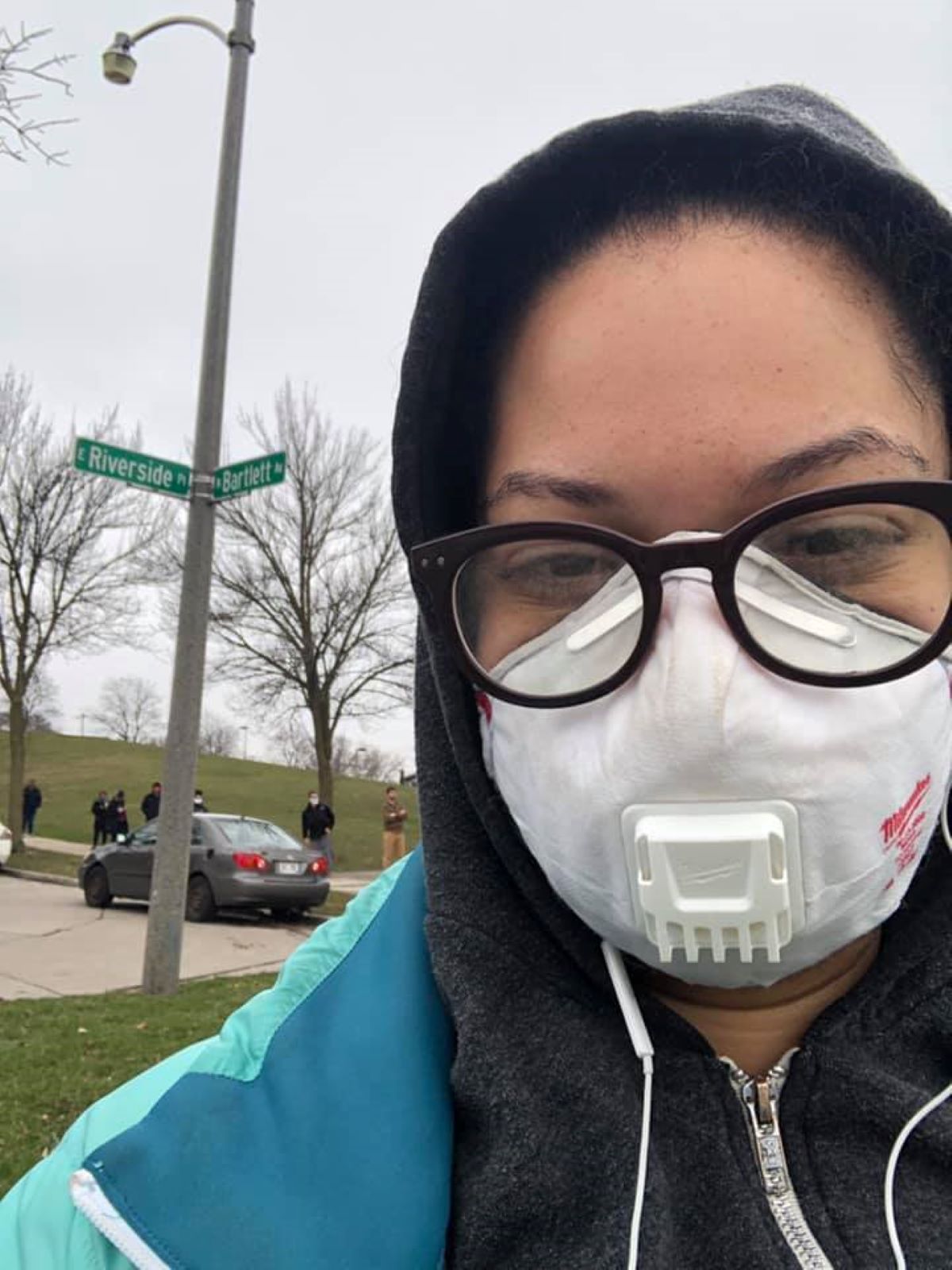
I wore a mask and some gloves. I wore clothes I could easily take off and wash when I got home. I got up early and tried to be one of the first in line. I got there a little after 7am, polls opened at 7. I had to find parking and walk to the end of the line, by the time I got there, the line was 6 blocks long. Everyone standing 6 feet apart. It was absurd. Most wearing masks, or some sort of scarf or fabric over their faces, gloves, all trying to keep themselves and others safe. I waited in line for about 3 hours. It moved really slowly at first. I saw a family carry a collapsible chair so that an older person in their group could sit sometimes.
Someone was playing music for us across the street from the park, which I appreciated so much. Poll workers and volunteers came down the line, checking that people were in the right location, that they knew their ward, that they had their own individual pens and masks. Everyone was pleasant and I made sure to tell them all thank you but overall it felt tense. I just was so mad and hopeless about the whole situation.
This isn’t brave, this isn’t what democracy is. This is unconscionable. This is an abomination. This is never what democracy should be.
Once I got to the front of the line, we entered the gym and the line moved much faster. There was obviously a system in place. You stood on an x so you kept 6 ft apart, the workers were efficient, and everything got wiped down between voters. I was probably inside the gym for less than 30 minutes. I tried to let everyone know on Facebook what was happening, I shared pictures and videos. I didn’t want to pressure folks to vote, it’s a risk going out in public today and lots of people could not take that risk. I didn’t want to discourage them either, but I did want them to know what was happening.
When I got home I was even angrier. Some folks wrote to me about being brave, this person went down the line at the polls shouting “This is what democracy looks like!” and I was just livid. This isn’t brave, this isn’t what democracy is. This is unconscionable. This is an abomination. This is never what democracy should be. Thousands of voters are being systematically disenfranchised and the ones that voted in person today risked their health and the health of their families, neighbors, roommates, friends. Wisconsin risked extending this health crisis for weeks longer, politicians risked a spike in cases after this, they risked the lives of very real people. I had to weigh risk for myself, but I should have never been in that position.
You know, this morning before I left the house, before all of that, I checked the mail, I was still hoping my absentee ballot would come.
DL: What was the scene at your polling place this morning? How many people and who did you see?
MN: I saw folks with canes walk blocks to vote. I saw plenty of older people out that I would have wanted to be safe at home. I saw an older black couple wait patiently in line with me for all three hours. I saw young people with bandanas covering their faces, and people with scarves wrapped around their mouth. I saw folks come to the line and then realize how far back it went and get encouragement from others who had been waiting for a while.
DL: Wisconsin is one of the worst states in the entire country when it comes to racism and racial disparities. How does the state’s decision to hold an in-person election in the middle of a pandemic play into that status and into the history of racist voter suppression in the US generally?
MN: Wisconsin’s history of voter suppression didn’t start today, or this year and it probably won’t end here either. The clearly biased and partisan redistricting of WI has been going on for years. This travesty of an election highlighted major disparities across the state. I heard that other cities were able to have all drive-up locations. Madison had 62 of their normal 90 polling locations. New Berlin, WI, a city of not even 40,000 mostly white people, had 7 locations open today.
Milwaukee has almost 600,000 people, majority people of color, and there were 5 polling locations open today. That’s thousands of people congregating and filing through a handful of locations.
Wisconsin effectively chose to put hundreds of thousands of people at risk of contracting Covid-19, threatening to overwhelm our already under prepared healthcare system. They are risking these lives because they don’t value them.
Additionally, now that Covid-19 is hitting the US, we are seeing the disproportionate impact its having on African-Americans. In Milwaukee, “African Americans have accounted for nearly half of the more than 1,300 confirmed COVID-19 cases in Milwaukee County, while making up about 27% of the county’s population.” Covid-19 is merely highlighting the various inequities that leave a population more vulnerable. The North side of Milwaukee, which has a high concentration of African-Americans, due to a history of redlining in this city and the surrounding wealthier suburbs, has seen a concerted reduction in healthcare access over the last decades while less populous areas have increased their clinics. Many folks don’t have access to a primary care doctor or regular healthcare and health insurance, which means their underlying health conditions go untreated or unaddressed.
Also, staying at home is a privilege. Most low wage workers can’t just stay at home and without financial resources they have to continue working and traveling to jobs that endanger them. Buses have reduced services meaning folks are going to be closer together. No one has received stimulus checks, rent was due, as usual, on April 1st. People need to be able to feed their families and not put their housing at risk in order to stay safely at home.
And then on top of all that to hold an election when every other state decided that public health was more important than holding the election on the original dates??! Wisconsin effectively chose to put hundreds of thousands of people at risk of contracting Covid-19, threatening to overwhelm our already under prepared healthcare system. They are risking these lives because they don’t value them.
DL:What went into your decision to participate in the election? How did you make your decision and why was it important to you to cast a ballot?
MN: I’ve been trying to vote all year and at every turn it’s been awful. I vote in every election. I argued with others about going to the polls and up until the time I left, I debated with myself about going. Whether or not it was worth putting my health at risk.
I have taken staying at home very seriously. Other than three trips to the grocery store, I haven’t been in an indoor public place since March 13th. No restaurants, no in-person hanging out, I haven’t seen my Mom closer than 6 feet away this whole time. That’s going on four weeks. This wasn’t an easy choice, it’s just all the choices were shitty choices. I tried absentee voting. I gave up on drive-up early voting, (which in retrospect was probably a mistake but I was hoping the election would be canceled.)
I went today because I could, because I live alone and I have a healthy immune system and I have a job that I could start at 10 am after spending three hours in line. I wanted to vote for local initiatives, Marsy’s Law was misleadingly worded and I worry people didn’t understand it. Extra funding for Milwaukee Public Schools was on the ballot. The County Executive race and Mayoral race were on the ballot. And honestly fuck Biden. Despite all the chicanery of the DNC, I wanted to vote for Bernie.
Voting isn’t the end all be all. I’m not mad at the folks that didn’t go. I’m mad at Speaker Vos and Senator Fitzgerald and Justices Roggensack, Hagedorn, Rebecca Bradley and Ziegler. I’m mad that the US in general failed to prepare for Covid-19 and my community is at risk. Politicians fail us all the time. I voted for Gov. Evers and it didn’t help. Voting is one piece of making people accountable, of identifying gaps and needs and problems, you have to continue after you leave the polls too.
Updates about the spread of COVID-19 in our community, the news stories about how it’s affecting Madison, Dane County, and Wisconsin, and information about how to help the situation come at us hard and fast every day. We’ve pulled together key resources and news about how COVID-19 is affecting our civic lives in Madison, and will update the page daily with new data about its spread in Wisconsin. A document with more in-depth news updates and available resources is available here.
Note: County and State data may not match due to being collected separately, and not shared and updated simultaneously.
State COVID-19 response bill would give the Joint Finance Committee the power to cut funding to schools, universities, healthcare, and safety-net programs
Charity wasn’t enough before the crisis. It won’t save the working class from COVID-19.
by Dayna Long
In one week following Governor Evers’ declaration of a Public Health Emergency in the state of Wisconsin, a group of businesses and wealthy donors amassed nearly a million dollars for a Dane County COVID-19 Community Emergency Fund. The fundraising was spearheaded by Michael Johnson, executive director of the Dane County Boys & Girls Club, which is acting as fiscal agent for the fund. On Friday, March 20th, Johnson appeared in a video press conference alongside Renee Moe, executive director of United Way. He explained that the fund will be used to award grants to individuals and organizations providing aid during the COVID-19 emergency. The process will be fast-tracked, with the intention of awarding grants and cutting checks by March 31st. Anyone familiar with grantmaking processes will recognize that this is lightning speed, which is laudable. Funds raised to address an emergency should be distributed as fast as possible.
Additionally, the need for aid and assistance right now is huge. Nearly 30,000 people filed for unemployment in Wisconsin last week. As whole industries shut down due to the recommended social isolation, layoffs have become commonplace. Our nation’s economic meltdown will make this worse. And at the same time that many workers have lost their income, some of the supports they might have relied on – like the free and reduced-cost meals their kids could eat at school – have been pulled out from under them. Workers who have kept their jobs, either working from home or commuting, are also struggling to find replacement childcare or to balance caring for their children with working full time, as daycares also close. Simultaneously, families are being advised to shell out for two weeks or even a month’s worth of groceries and toiletries to reduce their number of trips outside the home and prepare for eventual quarantine. For anyone living week to week or even day to day, this suggestion is an impossibility.
The fact is, people were struggling before any of us had even heard of COVID-19, when the economy was still booming. For some, the COVID-19 emergency is just the latest disaster in a series of events and systemic inequities that have left them homeless and hungry. For others, it will be the last straw that takes them over the edge from precarity to crisis.
Given the harsh reality so many people are facing, it makes sense that many are excited and relieved about the seemingly overnight creation of a Dane County COVID-19 Community Emergency Fund. And it is indisputably positive that people will be helped due to the creation of the fund. But that doesn’t mean that the entire situation is positive. In fact, there’s a lot for socialists to be critical and even wary of.
In the March 20th press conference, United Way Executive Director Renee Moe explained that United Way had been working closely with public health, the city, the county, the school districts, and its non-profit partner organizations to determine how best to fill community need during the COVID-19 emergency. That United Way sees public institutions like city and county government, public health, and the school district as partners is very telling. It shows that the Dane County COVID-19 Community Emergency Fund is another example of the transfer of responsibility for public welfare from the state to private philanthropy. In other words, instead of the city, county, and state government taking care of people in Dane County through robust social programs, we are now at the mercy of a class of businesses and donors and their favored non-profits for care, a neoliberal fantasy. This is wholly undesirable for a number of reasons.
In other words, instead of the city, county, and state government taking care of people in Dane County through robust social programs, we are now at the mercy of a class of businesses and donors and their favored non-profits for care, a neoliberal fantasy.
First, our public institutions are subject to public oversight and democracy, however limited and flawed. We choose alders, county board supervisors, and school board members. We elect our mayors, our county executive, and our state leaders, the people who have direct oversight of Public Health Madison & Dane County. When it comes to how the city and county provides services to the people who live here, there is at least the possibility that residents can have an influence.
On the other hand, residents of Dane County did not vote for Renee Moe or Michael Johnson, for the heads of local non-profits and service organizations, or for the members of the boards that often govern these organizations. We have no control over how the funds that were collected will be used and we do not get a say in the criteria that will be used to determine which individuals and organizations receive funding. This is fundamentally undemocratic, which is not just a problem of principles but actually undercuts the effectiveness of our response to this emergency. No one knows better what people need and how their needs can best be met than people themselves. There is no better authority on the circumstances and challenges facing individuals than an individual’s own lived experience. Even the best, most thoughtful food pantries are no substitute for giving people money and allowing them to decide how to use it. This is why socialists should be demanding a universal basic income as a part of the COVID-19 response.
But the fact is, many non-profits aren’t the best or most thoughtful. How could they be? While good non-profits often try to assemble a diverse board of directors that includes a range of experiences and perspectives, a criteria for many boards is the ability to give money and a social network that includes other people who can make substantial donations. This immediately excludes most working class people, the individuals with the most knowledge and experience about working class people’s needs. The result, at many organizations, is a board of directors that is older, whiter, and substantially wealthier than the rest of the society. These are the people who make decisions about the mission and priorities of non-profit organizations, including at least some of the organizations that will receive funding from the Dane County COVID-19 Community Emergency Fund.
In addition to the fact that farming out public welfare to private institutions is undemocratic and less effective than giving people the ability to care for themselves, there’s the funders themselves to consider. Among many big contributors to the Dane County COVID-19 Community Emergency Fund are Madison Gas & Electric and Alliant Energy Center, two organizations who actually harm our community by continuing to use dirty and expensive fossil fuels to supply our energy. One also has to wonder if a $100,000 donation from MG &E is getting off easy compared to measures that would lessen the financial burden on individuals and allow them to make different decisions about how to use their money during the COVID-19 crisis, such as waiving or steeply discounting families’ utility bills.
That really brings us to the fundamental problem with the non-profit industry as a whole. Non-profit organizations, which rely on private philanthropy, are fulfilling many needs that were previously met by the government and would be guaranteed in a socialist society. They have proliferated in the United States and around the world specifically because it is cheaper for businesses and wealthy individuals with family foundations and trusts to make a few major donations than it would be for them to pay the sorts of taxes that would fund a strong social safety net or better still, for them to pay all of their workers a living wage, with paid leave and full benefits. We are riddled with non-profits because they’re better for rich people, not because they’re good for the rest of us. They lend exorbitantly wealthy people, big corporations, and problematic industries a charitable veneer and help conceal a fundamental fact: that some families have so much money that they can give away $50,000 at the drop of a hat – more money than most Americans make in a year – is the reason that some families have no money and fell behind on their rent just one week into an international crisis.
Charity does not challenge the social order that has left so many families – families served by charities – in ruin. What we need instead of charity is solidarity.
Solidarity can take the form of mutual aid projects, like the one being so well operated by members of the IWW’s General Defense Committee of Madison. They provide assistance with no strings attached, not help through the lens of ruling class morality, with determinations about which people are actually deserving of care. It is a community project and people’s willingness to volunteer or give money is not conditional based on what sort of recognition they’ll receive at the end. It will leave Madison’s working class stronger by creating networks and empowering working people to help each other through their own self-organization. These are the kinds of projects that socialists should involve themselves in and support at this moment of crisis, especially because – perhaps unsurprisingly – the GDC Mutual Aid Project’s request for funding from Dane County COVID-19 Community Emergency Fund was rejected on the grounds that the GDC is not a 501(c)3.
We must also demonstrate solidarity in the most classic sense, workers supporting the struggles of other workers. We have to have the backs of workers who refuse unsafe working conditions.
We also have to recognize that mutual aid by itself won’t be enough. If working class people had the wealth to lift one another out of crushing poverty and crisis, we would have done it by now.
We must also demonstrate solidarity in the most classic sense, workers supporting the struggles of other workers. We have to have the backs of workers who refuse unsafe working conditions. We should support the demand that grocery workers be designated Emergency Workers. They should receive free childcare, free healthcare, hazard pay, and unlimited paid sick leave to use if they do become infected. And we have to fight for doctors and nurses. Hospitals are woefully unprepared for the coming crisis and healthcare workers are not being provided with the kinds of safety equipment that they need to do their jobs without getting sick. Making sure that healthcare workers have what they need to stay safe on the job is a question of life or death for them and for the entire working class that relies on these workers for care. Healthcare worker shortages will impact the working class first and worst.
Finally, this moment requires that we fight to win major concessions from government in order to save lives, keep people in housing, and pull folks back from the brink of financial disaster. This should include organizing around demands like a universal income (not a paltry one-time payment of $1,200), nationwide halts on rent and mortgage collection, and debt forgiveness, at the expense of the rich. They will take this crisis and use it to extract more profit from working people, while making inadequate gestures at generosity through NGOs managed by their friends. It’s time to turn the table to save ourselves.
Angelica Engel works at Willy Street Co-op’s East location in the deli and the juice bar. She is a member of the UE 1186 bargaining committee, which just negotiated the union’s first contract with Willy Street Co-op Management, ratified earlier this month. Engel is also a member of Madison Area DSA.
DL: How does it feel to work in a grocery store right now? How is morale for you and your co-workers and what are the biggest stressors?
AE: I would say that work at the grocery store feels more meaningful than it has ever felt before. It is really nice that there’s recognition that our work is important and that distributors of food have important jobs.
Morale has been mixed. Generally, people I’ve interacted with have been in pretty fine spirits. There’s a sense of camaraderie right now. But the people who are at work seem to be pleased to be there helping out.
However, many are not at work because they have some kind of illness, but nobody can get tested so we’re not sure. So it would be great to have more certainty about that. Many have taken anxiety related time off of work.
There’s also a lot more sudden emotional overhwhelm than ever before. Where it’s just – you just suddenly are crying. And then there’s a fear of getting sick obviously and anxiety – lots of anxiety – about how this is impacting our friends and our family members who also work in food service but not at a grocery store and who are now unemployed.
DL: Is it stressful to be interacting with the public as regularly as you are right now?
AE: At the beginning when we were just starting new measures – changing out deli services and enforcing occupancy rules, keeping under 50 people in the store at a time – there was more stress with interacting with the public. But that has changed over time as people have grown more accustomed to the new way we’re doing things.
DL: In a lot of workplaces, we’re seeing that it’s the workers who first recognized how COVID-19 was going to impact what they do and understood what changes need to be made to make the workplace safe. It makes sense because workers have firsthand experience that bosses and owners often lack. How do you think this played out in terms of preparation for COVID-19 at your workplace? Are there steps you want the Co-op to take that member-owners and shoppers can advocate for?
AE: Thus far, we have not heard about a plan for if and probably when a worker tests positive. Do we all drop what we’re doing and leave? Who’s going to work? I mean, we have the temporary agreement between the union and management related to COVID-19 that there would be temp workers and what not, but it’s hard to understand what would happen if we heard that somebody who had been at work just recently tested positive. And of course tests aren’t very available so maybe we don’t have to worry about that. But that’s messed up.
Also the bargaining committee needs to be more included in the decision making regarding this crisis. We’re standing in as the interim officers [of the union]. Stewards need to be more included in the decision making. So putting pressure on management regarding these features would be helpful.
It also seems like it would be really beneficial if there was more clear and thorough communication about sanitation standards. There’s a lot of new processes that are getting put in about how to clean things down at the end of the night but not everyone is getting this information. Better communication would be great. And I recognize that there’s mixed communications at all levels of government here.
The capacity of the store being decreased from before was helpful but it seems like it could be beneficial to decrease it even more. Even though we have the lines on the floor for social distancing from workers, it’s still very difficult to move around the store and maintain six feet of distance between people. Some of these aisles are barely six feet wide. So having less people in the store seems like it would help. Also I know that our curbside pickup and delivery options have been ramped up a bit. It would be great to see even more of that just to reduce that capacity of the store.
DL: You and your co-workers are coming off of a successful campaign to unionize and you just negotiated your first contract with co-op management. How are those efforts impacting the workforce during the COVID-19 crisis?
AE: I think there’s a sense that we feel better protected since we have the contract. Also a great sense that it got [ratified] just in time. It was right down to the wire. We weren’t able to properly celebrate our victory because that ten person limit [on gatherings] came in the day that our ratification meetings were happening. So we really got it done just in time.
I find it pretty poignant that our unionization campaign started with the no-fault attendance policy, with people being disciplined for calling in sick. So now we have our sick time and we won’t get disciplined for using it but there’s a sense that we need to protect it more than ever. We don’t want to deplete our sick banks because of COVID-19. There is protection against that with the legislation that went through and with the agreement with management we made on the fly that very Monday of the [contract] ratification. But there’s still so much confusion and anxiety and we would like more of an assurance that we’ll have a job if we have long-term impacts from this crisis.
DL: In states like Vermont and Minnesota, grocery store workers have been designated emergency workers during the COVID-19 crisis, which both allows grocery workers to keep reporting to work as other non-essential workers are ordered to stay at home, and makes them eligible for certain benefits, like free childcare. Do you think this designation would be helpful for grocery store workers in Wisconsin? What other policy changes would help grocery workers continue to provide the services that we’re all recognizing are essential to our communities?
AE: I think that absolutely it would be helpful in Wisconsin for grocery store workers to be emergency workers. A lot of people have kids and kids aren’t in school. And that’s definitely caused some people to already use the extra two weeks they got as a part of our agreement with management. But this obviously isn’t going away as fast as we thought it might. So that would absolutely help.
Generally, policy changes that would be very helpful for grocery store workers are the same things that would be beneficial to all workers. These obviously aren’t things that can necessarily happen immediately since there’s so much going on. But the same things that we always hear about – cancelling student debt, having universal basic income, higher wages, Medicare for all, so that we can be more flexible about how many hours we work and don’t get burned out as fast, so we don’t have as much exposure to pathogens, and so that we’d be able to have more flexibility in general and less stress. So that we could know that we won’t be financially ruined if we fall ill and can’t work for a while.
DL: Is there anything else you want people to understand about the experiences grocery workers are having right now?
AE: There’s anxiety about what we’ll be doing day to day. You know, you go into work and you don’t know what department you’re gonna be in necessarily. Things change from minute to minute and that’s not necessarily under anyone’s control. But just know that like all workers are having less predictability, less certainty, more stress, that impacts us maybe even more since we still have to go to work and there’s so much fear around [COVID-19]. Have some sensitivity and understanding that we’re doing the best we can. If our moods are off, there’s a reason.