Tag: feat-spring 2021

  • Voter Guide Partisan Primary 2022: August 9th

    Voter Guide Partisan Primary 2022: August 9th

    Partisan primary

    The election will be held Tuesday, August 9 2022 and is a partisan primary. You are allowed to vote for primary candidates in only one political party. Near the top of your ballot, you will see an option to select a party preference. While this is optional, it’s highly recommended that you mark your party preference to ensure your ballot isn’t rejected!

    Your ballot is completely secret, so no one but you will know which party primary you chose to vote in.

    Though running as socialists on the Democratic Party ballot line remains controversial, the Electoral Politics Working Group is operating on the assumption that DSA Madison members will have no interest in supporting candidates in the Republican, Libertarian, or Constitution Parties. We will only be providing advice on candidates running for the Democratic Party nomination.

    Candidate links below represent website, and social media links found for each candidate. If links are missing, we were not able to find them.

    (I) – Current incumbent

    United States Senator

    The primary for US Senator is a very crowded field with the winner expected to take on Ron Johnson.

    Mandela Barnes Web FB Flickr Insta Tiktok Twitter Youtube wiki

    Current Wisconsin Lieutenant Governor Mandela Barns seems to be monied interests least favorite candidate and has been getting lots of right wing style attacks from the other candidates. He has been endorsed by Bernie Sanders, State Senator Francesca Hong, MADSA-Endorsed Madison City Councilors Brian Benford and Yanette Figueroa Cole, and MADSA-Endorsed Madison School Board member Ananda Mirilli. Union endorsements: American Federation of State, County and Municipal Employees, American Federation of Teachers MATC Local 212 and Service Employees International Union Wisconsin Healthcare

    Tom Nelson Web FB Insta LinkedIn Twitter wiki Youtube

    Nelson has withdrawn from the race and endorsed Mandela Barns

    Sarah Godlewski Web FB Insta Twitter wiki

    Sarah Godlewski has no known endorsements from labor or progressive candidates.

    Alex Lasry Web FB Insta Twitter wiki Youtube 

    Lasry has very little prior political experience, he is best known as being the son of Marc Lasry, the owner of the Milwaukee Bucks basketball team. Lasry has been endorsed by the Teamsters Local 39, IATSE Local 18, Electrical Workers 494, IBW Local 890. 

    Kou C. Lee Web FB Insta Twitter Youtube

    Kou C. Lee has no known endorsements.

    Steven Olikara Web FB Instagram LinkedIn Twitter

    Steven Olikara has been endorsed by Andrew Yang and the singer Akon (who hopes to build a cryptocurrency-fueled city in Senegal).

    Peter Peckarsky Web FB Twitter

    Peckarsky has no known notable endorsements.

    Darrell Williams Web FB Instagram Twitter Youtube

    Williams states on his website he wants to support military and law enforcement and has no known notable endorsements. 

    Lt. Governor

    Peng Her Web FB

    Sara Rodriguez Web FB Twitter

    Both running on their credentials as supporters of small business

    Secretary of State

    Doug La Follette (I) Web Twitter LinkedIn Wiki

    Alexia Sabor Web FB Twitter

    Wants to use the position’s place on the board of commissioners of public lands (BPCL) to “consolidate assets” and create “larger tracts of forest for critical habitats”

    State Treasurer

    Gillian M. Battino Web FB Twitter 

    Aaron Richardson Web FB Twitter

    Angelito Tenorio Web FB Twitter Instagram

    Tenorio is endorsed by State Senator Francesca Hong

    Assembly District 43 (Oregon, Edgerton, Whitewater)

    League of Women Voters Questionnaire 

    Jenna Jacobson Web FB LinkedIn 

    Supports abortion and gender affirming care.

    Matt McIntyre 

    Ex-Mayor of Edgerton 

    Assembly District 46 (Sun Prairie, Cottage Grove, Stoughton)

    League of Women Voters Questionnaire 

    Syed Abbas Web, FB, LinkedIn, Twitter

    Madison City Council President Syed Abbas ran against MADSA-endorsed candidate Tessa Echevarria for city council in the last election.  Abbas has been endorsed by former mayor Paul Soglin.

    Analiese Eicher Web, FB, Twitter

    Dane County Board Supervisor (currently District 3, formerly District 5) Analiese Eicher has no known notable endorsements.

    Andrew Hysell Web, FB, Insta, LinkedIn, Twitter 

    Andrew Hysell has been endorsed by the Wisconsin Democratic Party, the American Constitution Society (which is currently headed by Russ Feingold), and the Wisconsin Cannabis Association.

    Mike Jacobs

    Mike Jacobs has no known endorsements.

    Melissa Ratcliff Web, FB, LinkedIn, Twitter

    Melissa Ratcliff has been endorsed by Dane County Executive Joe Parisi and former sheriff Dave Mahoney.  Ratcliff is known to be a supporter of the jail expansion project.

    Assembly District 79 (Middleton, Waunakee, northwest)

    League of Women Voters Questionnaire

    Alex Joers Web, FB, Insta, Twitter

    Dane County Board Supervisor (District 9) Alex Joers has been endorsed by Dane County Executive Joe Parisi.

    Brad Votava Web, LinkedIn

    Brad Votava has no known endorsements.

    Assembly District 80 (Belleville, Mt. Horeb, New Glarus)

    League of Women Voters Questionnaire 

    Mike Bare Web, FB, Insta, LinkedIn, Twitter 

    Dane County Board Supervisor Mike Bare has been endorsed by AFSCME.  Bare has also been notably consistently responsive to DSA members’ queries about criminal justice issues.

    Anna Halverson Web, FB, Insta, Twitter

    Anna Halverson has no known notable endorsements.

    Chad Kemp Web, FB, Twitter

    Chad Kemp has no known notable endorsements.

    Doug Steinberg

    Doug Steinberg has no known endorsements.

    Dale Edward Paul Yurs FB, Instagram

    Dale Edward Paul Yurs has no known notable endorsements.

    Unopposed Races

    Governor, Attorney General, US Congress Representative District 2, Dane County Sheriff as well as several State Senate and State Assembly Races only have one candidate.

  • Speeches from Stand up for Abortion

    Speeches from Stand up for Abortion

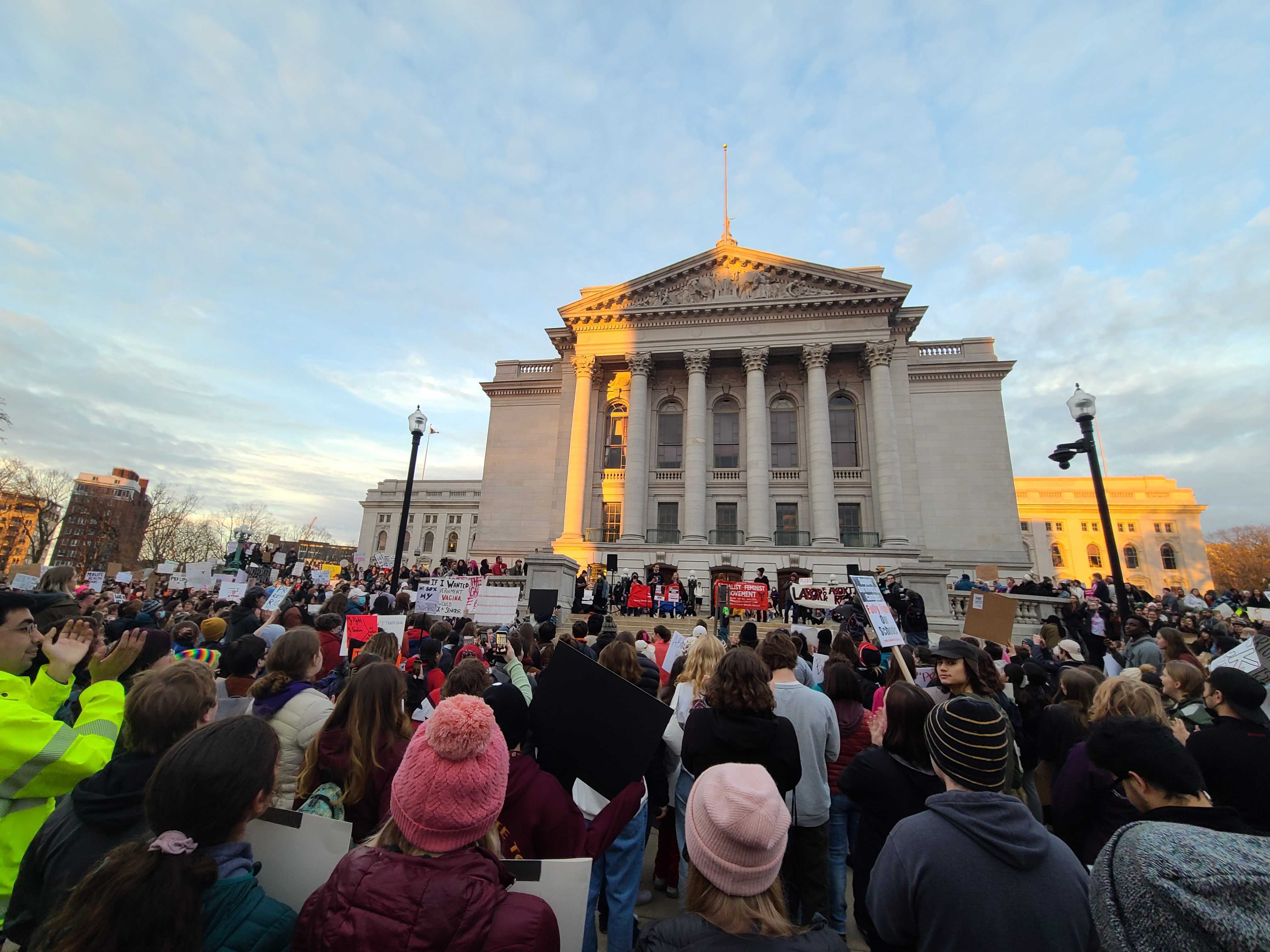
    The following 3 speech’s were given on the steps of the Capitol building in Madison on May 7th at the Stand Up For Abortion rally. Around a thousand people gathered to protest the leaked Supreme Court draft statement to overturn abortion access on a federal level.

    Speech by Julia T

    We are on the verge of losing the fundamental right to legal abortion, the right to control our own bodies and lives, in the United States. The Supreme Court’s assault on our rights is part of a global reaction to the force of feminist and queer struggles for freedom, dignity, and equality. In these times, we must find strength in solidarity with our feminist comrades around the world. We must demolish the borders constructed by our government and build powerful relationships based on care and trust in their place. 

    “The green wave washed over Mexico, where courts ruled in favor of abortion rights over the past year. Feminist organizers forced the courts to act by refusing to leave the streets, illegally distributing abortion pills, and winning legislative victories. “

    Julia

    A green tide is sweeping across Latin America, and the world. Millions of women and queer and trans folks rose up to end lethal gendered violence, including the state sanctioned violence of forced pregnancy and childbirth, beginning in Argentina in 2015. They wore green bandanas, a symbol of feminist resistance to the brutal US sponsored military dictatorship, as they organized their neighbors, coworkers, and student organizations into a massive movement for free, safe, and legal abortion. They followed in the footsteps of anti-fascist dissidents who resisted state oppression on the streets and in their homes. After years of demonstrations, strikes, and repression, on December 30 2020 in Argentina lawmakers passed a bill legalizing state funded abortions until the 14th week of pregnancy. 

    The green wave washed over Mexico, where courts ruled in favor of abortion rights over the past year. Feminist organizers forced the courts to act by refusing to leave the streets, illegally distributing abortion pills, and winning legislative victories. The tide of feminist resistance is rising in Chile, El Salvador, Honduras, and now in the United States. 

    Feminists around the world are harnessing the power of the transnational women’s strike. As strikers chanted in Argentina, “If we stop, we stop the world.” We know that every parent is a working parent, that our unpaid and paid labor inside and outside of the home is what keeps the economy running.  Thousands of Polish feminists ignited the global movement, and soon e a nationwide strike forced the Irish state to legalize abortion. The strike wave swept across 50 countries on March 8 2017 and 2018 and reinvigorated struggles against neoliberal, racist, and patriarchal violence on the streets and in neighborhoods and workplaces. 

    The strike is about our fundamental right to bodily autonomy, but it’s about more than that. Feminists are on strike for a life worth living. In Chile the feminist revolt of March 8th was a catalyst for the social revolution of 2019, and the creation of a new constitution in the place of the remnants of the Pinochet regime. In Madison and beyond we struggle in solidarity with anti racist movements to abolish police and prisons and build life affirming institutions in their place. The strike against moves against and beyond the forces of our oppression.

    Transnational feminism reveals the oppressive web of racial, economic, and patriarchal exploitation that governs our lives and weaves together our daily acts of resistance, in our relationships, our homes, our universities, our neighborhoods, and our workplaces into a common struggle for freedom and dignity. We must join our comrades around the world and change what is possible through our struggle. 

    “Roe v Wade being overturned is also just another way to keep the people who are in lower classes at that level.” 

    Sakari

    Speech by Sakari

    My name is Sakari. I am a high school student and I am also a rape and incest victim. I was lucky enough to not get pregnant from either of these situations, but many people are not that lucky. 

    Around 5% of people who are raped get pregnant. That is more than 32 thousand preganacies a year due to rape.

    If Roe v Wade is overturned this means more than 32 thousand people may have to carry the fetus from their rapist until it is born or will abort the baby unsafely and likely get injured. And that is complete fucking bullshit. 

    Right now the reproductive rights of more than 50% of the population in the United States is about to get ruled away. 

    Roe v Wade being overturned is also just another way to keep the people who are in lower classes at that level. 

    Wealthy people are able to just hop on a plane or drive to a state where abortions are legal while people who are already struggling because they work multiple jobs, already have kids to take care of, do not have the means of transportation, or are trapped in a relationship making them unable to travel will be stuck. 

    Abortion has been protected since roe v wade was passed in 1973. 

    Don’t get me wrong, I love throwback fashion and that its coming back as a huge trend, but we can not make a trend out of retrogressing to the time when we did not have rights over our own bodies. 

    Overturning roe v wade is basically saying your body,

    but you don’t have a choice to every person with a uterus. 

    We can not let this happen. We need to continue to come together to fight this and show them we will not stop until they stop trying to make decisions about our bodies. 

    Speech by Hayley A

    Thank you for being here today. I know that you are devastated and terrified. I am, too. But the fight is NOT over. 

    “It is not a coincidence that major constitutional decisions emerge during times of sustained movements – desegregating public schools, legalizing gay marriage, and the initial win of abortion rights, all of these resulted from sustained legal battles alongside grassroots struggles. “

    Hayley

    The stakes are high. We are facing one of the greatest civil rights defeats in our lifetime. If the Supreme Court overturns Roe, then abortion rights would be entirely up to the states.  If this is allowed, we will all suffer. But some people will feel the effects of restriction and criminalization more sharply and swiftly than others. From disproportionate arrest, to lack of access to medical care, inability to travel out of state or miss work, or fund abortion. It will be Black, brown, transgender, and poor people who will bear the most significant harm.

    In addition, the legal reasoning in the Supreme Court’s draft opinion is itself a threat. One of the arguments is that the rights in Roe are not “deeply rooted in this Nation’s history and tradition.”  The court could use the same reasoning to target LGBTQ rights, contraceptive rights, and much more. In other works, Our bodies, our families, and our lives are on the chopping block. 

    But the draft opinion is not the final decision.  And we are not alone. This week, all across the country, people have poured their outrage into the streets. I understand if part of your heart feels like this is a futile cry into the void. But I want you to hear me with an open mind. We can win this fight, but it will take a lot of work and time, and we have to do it ourselves. 

    As you well know, the Supreme Court has the ability to overturn abortion protections. Nine unelected judges with lifetime appointments will decide the fate of millions. Allegedly, they are shielded from public opinion. In other words, they don’t have to listen to us – in fact, they’re not really supposed to. But as a lawyer and an activist, I don’t buy it. History shows that the Court does, in fact, respond to the court of public opinion. Justice Sandra Day O’Conner wrote that “real change, when it comes, stems principally from attitudinal shifts in the population at large. Rare is the legal victory that is not a careful by-product of emerging social consciousness.”  It is not a coincidence that major constitutional decisions emerge during times of sustained movements – desegregating public schools, legalizing gay marriage, and the initial win of abortion rights, all of these resulted from sustained legal battles alongside grassroots struggles. 

    The majority of this country supports the right to have an abortion. Public outcry and sustained protest can shift this tide and save abortion. 

    The threat we face today is a big deal but it has been a big deal for a long time. But, the impending Fall of Roe is, at this point, more theoretical than actual for millions of people. For decades, targeted restrictions have shut down hundreds of clinics. Abortion is and has been inaccessible and unaffordable for millions of people. For those people, Roe has already fallen. It’s been a death by a thousand cuts. But still, this feels different. 

    y

    The leak has changed the atmosphere, the day we’ve been fearing – the day that’s been creeping up on us for decades – has arrived. We cannot wait and rely on politicians or the court to do the right thing. We must take our liberation into our own hands. 

    What does that mean? Where do we start? 

    I believe we need a multi-pronged strategy: legislative campaigns, mutual aid, and protest.

    1. Campaigns. We need unapologetically pro-abortion campaigns in every state. I do NOT mean throwing all of our time and efforts and money and genius into lobbying, begging, or waiting for experts to do the right thing. We’ve done that and it hasn’t worked. We need state-by-state grassroots campaigns. Target the trigger laws, target restrictions, and amend state constitutions. Join our campaign here to Strike the Ban on abortion in Wisconsin.
    2. Mutual aid. We need to help each other now—organizing rides for people to clinics, providing child care (low-cost or crowd-funded) to patients during their appointments, and raising money to pay for abortions. We must learn to rely on each other, hold each other accountable, and always have each other’s backs.
    3.  Protest. A lot of people are focusing entirely on Trump and the GOP’s state-level attacks on abortion. Don’t mistake me: Trump and the GOP and their contempt for us is monstrous. But the GOP’s agenda works hand in hand with a highly organized grassroots movement that targets clinics is very vocal, and is unapologetic in its anti-abortion message. By contrast, our side has been told to ignore the anti-choice protest, ignore the threats outside clinics, to focus on campaigning for democrats, donating, or voting. And we have. We have taken the lead from the experts. But it hasn’t stopped the attacks. The attacks did not start with Trump. For decades, the Democrats have not made good on campaign promises. I’m tired of the lip service. And I’m tired of apologizing about abortion. We must shore up our resources and organize collectively on our own behalf. When it comes to our lives, we ARE the experts. It’s time we take matters into our own hands and let the Democrats follow our lead. Protest can look like a rally, look like a march, but protest is also music, art, sitting in, social media actions, education, skill-sharing, and community building. Find your protest and do it with other people. 

     I am so sad and so angry and I know you are too. Like many of you, I saw this coming but I’m still shocked. I feel so much fear for us. But only in fear can we find courage. a fierce public response can lead the court to change course. What happens next is up to us. I promise you that I will never give up. I will never stop pushing until we win full reproductive justice for all. Promise me the same. Promise each other the same. 

    THIS FIGHT IS NOT OVER. 

  • All abortions are healthcare

    All abortions are healthcare

    In response to the leaked news of the Supreme Court’s plans to overturn Roe v. Wade, over 3,000 people came out in Madison Tuesday night for an Emergency Protest to Defend Abortion Rights. Catie Thoemke is the treasurer of the UW Madison chapter of the Young Democratic Socialists of America (YDSA), which was among the sponsors and organizers of the event. Below is Thoemke’s speech from the rally.

    —-

    Photo by Ryan W

    What is happening in our country right now is scary, it is unscientific and it is undemocratic.

    As many of you know, last night it was leaked that the Supreme Court intends to overturn Roe v Wade. In the state of Wisconsin, there is a 172-year-old law in place that would immediately ban all abortions in Wisconsin the second Roe v. Wade is overturned. Right now, the United States has a Democratic majority in the senate, the house, and the presidency, which means the Democratic Party has had the ability to codify the right to abortion into law, protecting its legality in all 50 states, and yet they have failed to do so. So we are all here today to make our voices heard and fight for the protection of our rights which are being denied to us by those in power.

    What is happening in our country right now is scary, it is unscientific and it is undemocratic. Even though the vast majority of Americans are in favor of Roe v. Wade, the nine people on the Supreme Court who were not elected by us to their positions of power have the ability to strip all of us of our rights to basic healthcare. 1 in 4 people with uteruses get an abortion at some point in their lifetime. Whether you know it or not, I guarantee everyone here knows someone who has or will get an abortion. This will affect everyone here, but it will especially affect the working class. While the wealthy will always have access to special care and the ability to travel to receive abortions elsewhere, working class people do not have this same privilege.

    75% of people who get abortions cannot afford a child, and 42% of people who get abortions live below the poverty line. The majority of people who get abortions already have at least one child. The majority of people who get abortions are Black, indigenous, and people of color. Banning abortions bans the termination of ectopic pregnancies which are never viable and often life threatening, it bans abortions for victims of assault, it bans abortions for minors.

    Anyone who is truly “pro-life” should be angry right now. Making abortion illegal doesn’t make abortions go away, it only makes them unsafe. For many people, a ban on abortion is a death sentence. Anyone who is truly “pro-life” should care about poor people, they should care about parents, they should care about survivors. All abortions are healthcare. We need to be fighting until abortions are not only legal, but easily accessible and free. And it is up to us to be angry and outspoken, because if we do not fight for our basic rights, the people in power certainly won’t.


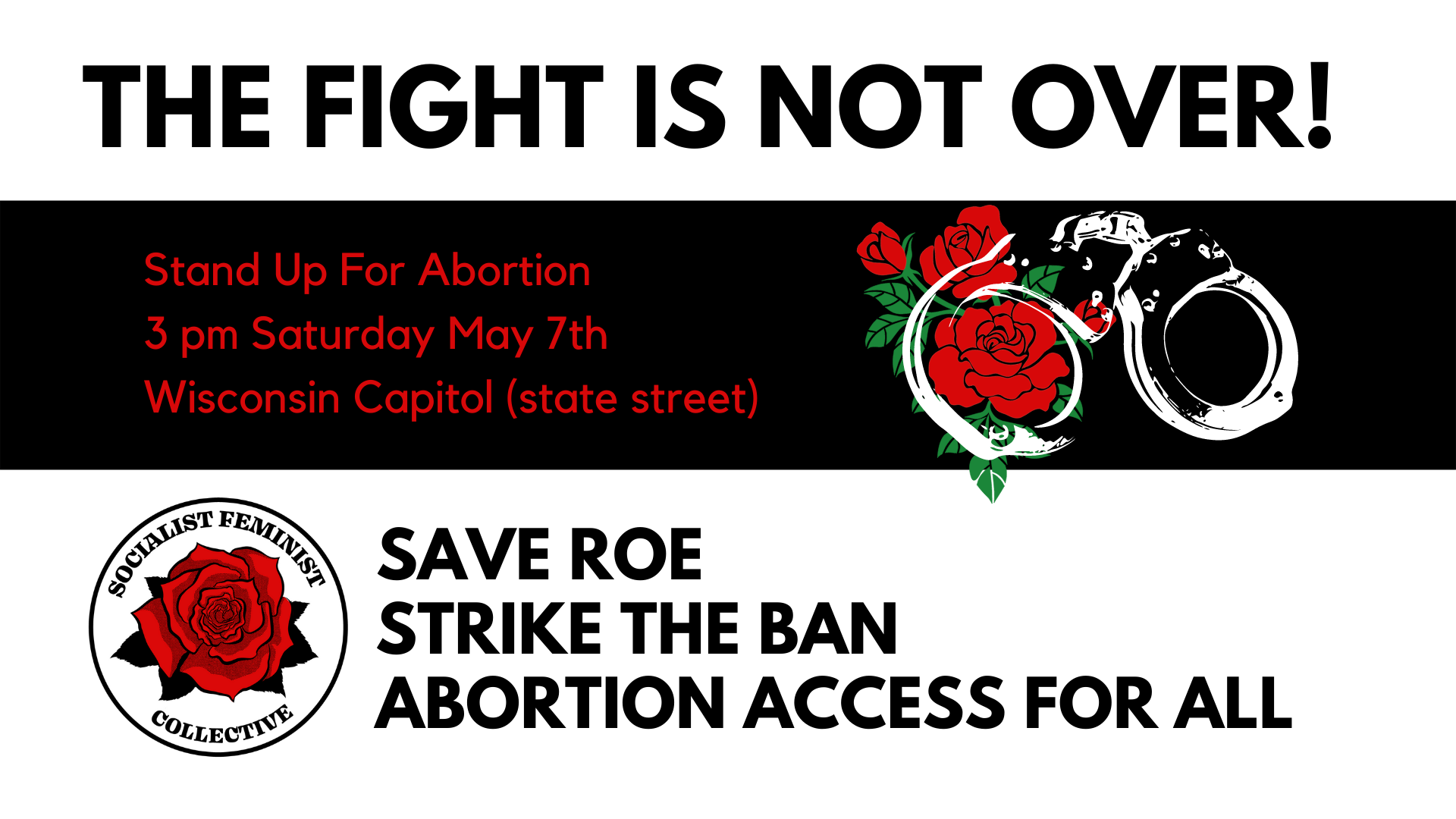
    Please join us back in the streets on Saturday at 3pm on the Capitol steps for a rally in support of reproductive justice and access to abortion. Being your rage, your heartbreak, and your commitment to protect the most vulnerable in our community impacted by an abortion ban. Facebook event: 

    Photos by Ryan W, Kevin C, and Tessa E

  • No Line 5, DNR public comment

    No Line 5, DNR public comment

    Since the struggle at Standing Rock in 2016 we have seen an interest in the resistance to fossil fuel pipelines. This has brought together the climate justice movement and the Indigenous liberation movement and the struggle for a livable planet. This past year the Anishinaabe people led resistance camps against Line 3 in northern Minnesota, which despite resistance was completed and is flowing tar sands oil from Alberta to Superior, Wisconsin. Now Enbridge is looking to “reroute” and “expand” another pipeline, Line 5. 

    Enbridge Line 5 Pipeline threatens Tribal land, Treaty Rights in the ceded territory, the Great Lakes, and the climate. The pipeline, which is long past its lifespan, is currently pumping tar sands oil under expired permits. Despite the Bad River Ojibwe’s request that Enbridge remove Line 5 and not put a pipeline in the Bad River watershed, Enbridge has moved forward with their reroute just south of the reservation. This expansion is within the watershed, and the risk to the treasured ecosystem remains.

    Currently Line 5 flows from Superior, Wisconsin through the Upper Peninsula of Michigan and ending in southeastern Michigan, all through Anishinaabe territory, 

    Below is a Madison DSA statement put together by People’s Green New Deal, Madison DSA’s ecosocialist working group. This statement was read at the DNR’s Draft Environmental Impact Statement hearing on February 2, 2022. 
    ​​The hearing ran 10 hours and of the 167 testifiers,147 spoke out against the pipeline. You can still send written comments to the DNR until March 18, 2022 by emailing DNROEEACOMMENTS@WI.GOV.

    Madison DSA Statement that was read: 

    I’m here representing the Madison Area chapter of the Democratic Socialists of America. Thank you for the opportunity to testify tonight on this critical issue.

    Madison DSA stands firmly with the Indigenous people of Wisconsin and for the water, land, and climate in our opposition to Enbridge’s Line 5 project. We ask that all permits for this project be denied.

    The construction and operation of the existing Line 5 pipeline has already caused irreparable harm to land, water, and those that live nearby. Line 5 has spilled a million gallons of oil and will continue to spill until it is shut down. Enbridge has a long history of pipeline leaks, frac outs, and aquifer breaches, proving time and again that they cannot be trusted to keep our people and land safe. During construction of the Line 3 expansion in Minnesota, Enbridge caused numerous frac outs and aquifer breaches, and there’s no reason to believe it will be different with the Line 5 expansion. 

    The DNR must uphold treaty rights and tribal sovereignty, and the Indigenous people of Wisconsin must be allowed to make decisions about projects that directly threaten their land, water, and wild rice. Their rights were denied to them when Line 5 was first built through the Bad River Ojibwe Reservation, and rerouting the pipeline to avoid the Reservation will not resolve the situation. Rather, the additional pipeline footprint would damage even more of their traditional homelands, waterways, and their treaty rights to hunt, fish and gather off reservation. Line 5 continues the legacy of colonization and environmental destruction that Indigenous people have been subjected to for centuries.

    But even if Line 5 could somehow be rerouted and operated without destroying ecosystems or threatening Indigenous sovereignty, which is clearly impossible, it will continue to play a role in propping up the fossil fuel industry and exacerbating global climate change. Wisconsin must rapidly break its reliance on fossil fuels and not allow Enbridge and similar firms engaged in their extraction to continue plundering the earth with impunity. It’s critical for life on the planet that we reject any new fossil fuel projects and end the use of existing ones.

    As socialists, we recognize that the crisis of climate change is not something that is inevitable or naturally occuring; but rather it is the result of a system that prioritizes private corporate profits over the well-being of all. Multinational corporations like Enbridge happily line their pockets while irreparably destroying ecosystems, polluting water that thousands depend upon, and contributing to global carbon emissions. This project is an explicit attack on the people of Wisconsin and on the climate.

    Line 5 is a threat to us all. It must be fully decommissioned and cleaned up, not rerouted to destroy even more delicate ecosystems and continue contributing to climate change. Listen to the people; listen to the water; listen to the future the ripple effects that this decision will have. Deny every permit that Enbridge is asking for. 

    Thank you again for listening. Water is Life. 

  • Quadren Wilson Statement

    Quadren Wilson Statement

    The Abolitionist Working Group of the Madison Area Democratic Socialists of America (MADSA) stands in solidarity with Quadren Wilson and his family as they reel and recover from the horrific abuse they have endured at the hands of the DCI (Department of Criminal Investigation). The nature of this so-called “arrest” is extremely disturbing.  On Thursday, February 3rd on Madison’s Far East Side, two unmarked vehicles sandwiched Quadren’s vehicle in the middle of traffic- jeopardizing safety for everyone in the vicinity.  Officers immediately jumped out and began shooting at Quadren.  It is an embarrassment and a disgrace that the law enforcement officials ambushed and shot Quadren multiple times; and on top of this; refused to keep the family in the loop about care and condition.  It is completely unprecedented to “arrest” someone in this manner. We as members of the Madison community demand answers and swift consequences of this egregious misconduct and absolute abuse of power.

    Traffic Camera Footage showing the aftermath of Officers ambushing Quadren Wilson
  • End of Year Roundup

    End of Year Roundup

    Red Madison contributors share the books, articles, podcasts, and shows that helped for us through 2021

    Kai

    Revolutionary Left Radio (AKA Rev Left)

    There comes a time in every young edgelord’s life where they have to stop listening to Chapo Trap House and actually listen to something with a little bit of substance.  If you’re still getting most of your political theory from memes I highly recommend you check out Rev Left, a great podcast that covers a wide variety of topics necessary for a revolutionary education.  Episodes range from “Mental health, Eco-Despair, & Revolutionary Optimism” to “Understanding the Mechanics of Libaral Co-Option and Rhetoric”.  If you don’t read theory you can at least listen to it with Rev Left.  

    K

    Remake The World by Astra Taylor:  Remake The World is a compilation of recent essays that span from deeply thoughtful treatments of common political matters such as debt, education, and technology alongside more unusually philosophical, yet eminently tangible, topics such as the act of listening in a democracy.  You can read one of my favorite chapters, “The Right to Listen” over at The New Yorker

    Holding Change by adrienne maree brown: WOW!  What a book!  This little, but deeply valuable, book is a collaboration with a group of Black feminists who explore the practice of attending to the health of social movements and the groups of people who constitute them.

    Tomorrow Sex Will Be Good Again by Katherine Angel: Pithy and incisive, provocative and considerate, this was one of the most intellectually exciting books that I’ve read in a while.  The Boston Review offers an excellent review of this book in contrast to some Angel’s contemporaries writing on topics of sex, consent, and justice.  Angel’s refusal to compromise a boldly ambiguous conception of desire is a refreshing approach and clears the way for a much clearer political analysis than many other thinkers.

    On The Media (WNYC Podcast): 2021 was a tumultuous year for On The Media during which longtime co-host Bob Garfield was summarily fired.  Nonetheless the year continues on a trend of spectacular media criticism and commentary led by Brooke Gladstone.  The newsletter is a must-read and is a reliable salve in anxious times.  Some standout episodes this year covered the history of May Day, the women who changed war reporting in Vietnam, the epistemology of library card catalogs, and the mechanics of the rust belt’s transition to a “healthcare economy.”

    Lux Magazine, which was founded this year, is a dream come true.  A socialist feminist periodical with endless style and absolutely zero shame, reading it is like oxygen for the socialist fire in your heart.

    Caste Does Not Explain Race by Charisse Burden-Stelly: Ok, so this was published in December 2020, but I’m going to include it anyway.  Isabelle’s Wilderson’s book Caste has been the subject of much uncritical acclaim as of late, this review makes use of the work of Oliver Cromwell Cox and Cedric Robinson to fill the dearth of criticism in exceptional fashion.  An uncommonly lucid article in its own right, it falls into the category of a review worth reading even if you have no interest in the book it reviews.

    Meanings of June Fourth, J. X. Zhang in New Left Review #128: I really love the book reviews in The New Left Review and this is an outstanding example of the genre, particularly since it is unlikely that I will ever be able to read the book that is the subject of this review.  Beyond providing an expansive account of the 1989 student movement, I love how the reviewer – and of course, the original author – explore the ambiguities of the in vivo politics of a protest movement.

    Mary

    Indian Nations of Wisconsin, Histories of Endurance and Renewal, Patty Loew, Wisconsin Historical Society Press, 2013. Patty Loew put together a comprehensive history of the Indian Nations of Wisconsin. It covers Native Americans’ arrival in what would become Wisconsin up until the 21st century. This is a living history, with the focus on the life of these nations today. Loew has drawn upon a wealth of sources, including those usually ignored by academics, oral histories and the stories of the people themselves. We learn about the many broken treaties and the constant drive to push the nations off their land to accommodate white settlers and interests such as mining and banking. Loew is a nuanced historian and doesn’t shy away from the complexities of native nations’ relationships with European settlers and between the nations themselves.If you want to understand Wisconsin, this book is a must.

    Squid Games, Netflix. The Korean series went viral this year and for good reason. Hwang Dong-hyuk is the writer and director, and his creation has struck a chord with viewers around the world. Debt peonage is the motivating force for desperate people to compete in a savage game to entertain a secret audience of blood thirsty one percenters. Dong-huyk creates suspense and characters the viewer can root for as we wonder how far our global society is from the Colosseum.

    Tessa

    Reservation Dogs is a show about teenagers growing up in rural Oklahoma. Notable for having the first all Indigenous writers and directors, as well as mostly Indigenous cast. I have enjoyed the dialogue between the teenagers as well as a Indigenous written view of growing up Indigenous in the modern day. Highly recommend a watch! 

    Cemetery Boys by Aiden Thomas is a fictional story about a boy coming of age as an immigrant in America. The main character is struggling with traditional culture of his family with being a trans boy, becoming a man. A great story about the growth of traditions, coming of age and finding a place. 

    Latin American Extractivism, edited by Steve Ellner is a series of articles about sustainability of using fossil fuels to fund socialism. How do we create a socialist future while ruining the environment and taking native peoples land? Lots to unpack in this book, but the essay format breaks it up into easy to read sections and gives the reader lots of different viewpoints on the issues of pink tide governments and how we ‘get to socialism’. 

  • Socialists and Strike Support: Perspectives and Politics

    Socialists and Strike Support: Perspectives and Politics

    By Joe Allen

    The current wave of strikes in the United States is a welcome change in the class struggle in the United States. As I wrote recently:

    The most obvious takeaway from this year’s wave of strikes is that large swaths of the working class are sick and tired of concessions, unsafe workplaces, and being worked to death. Some striking workers have referred to the endless workdays as “suicide shifts.” From the Hunts Point Terminal strike in January to the Nabisco strike in July through the John Deere strike in October, workers who’ve suffered and struggled through a year and a half of pandemic-inspired speedup have voted overwhelmingly against concessionary contracts and hit the picket lines.

    Strike votes have been taken across a myriad of industries and unions from transit workers to airline mechanics. What is driving the disparate groups of workers into action (at a scale bordering on a general unrest) are the long term decline in working conditions exacerbated by a year-and-a-half of pandemic hell during which time their bosses made record profits. The uptick in strike activity provides those of us in the DSA and the broader left with an opportunity to do strike support, in many cases, for the first time in our political lives.

    Our Power”

    Earlier this year veteran trade unionists Rand Wilson and Peter Olney put forward a perspective in Jacobin for upcoming contract negotiations and the political opportunities it represents for socialists and the labor movement. They wrote:

    This year, 450 collective bargaining agreements covering more than 200 union members apiece will expire, according to Bloomberg, which maintains the most comprehensive database of expiring agreements outside of the AFL-CIO. Of these, 160 agreements cover more than 1,000 workers. These 450 contracts, involving more than a million and a half workers, are an ideal opportunity for the labor movement to showcase our power and the advantages of collective bargaining.

    Strikes alone don’t convince workers to unionize. Clear victories by workers over the bosses propel organizing efforts forward. Even with the increased militancy, many of the contract settlements this year have been quite mediocre and are unlikely to entice nonunion workers. At Southwest Airlines, unionized mechanics won a significant 20% increase in wages without striking but also gave the company greater ability to outsource union jobs. In other cases, many settlements have left unresolved the issues that drove workers on to the picket lines. One of Heaven Hill distillery workers told a local news crew, “We are going back for exactly what we went on strike for.”

    Assessing the contract settlements coming out of this year’s wave of strikes can tell us about the direction of working class struggle. Though striking workers certainly won important gains in their contract during the most high profile industrial strike this year at John Deere, (despite repeated efforts by the UAW leadership to get them to accept two bad deals), a large number of strikers still voted no on the third and final contract offer including a clear no vote at the Waterloo, Iowa UAW local union. In the aftermath of the strike, John Deere updated its earnings and forecast for next year literally crowed that it could have afforded to give more to the UAW strikers. Bloomberg reported:

    The six-year agreement that the union voted to accept last week includes a 10% initial raise and is expected to result in incremental pre-tax costs of about $250 million to $300 million annually. That’s minor compared with the as much as $7 billion in net income Deere expects to generate next year alone.

    There’s the strike and then there’s the contract battle after returning to work. For groups of workers, like at Nabisco who won some gains on working conditions, big questions remain about contract enforcement and the union’s responsiveness. And even more seriously, in the case of the Bronx Terminal strike at Hunts Point in New York City, an unknown number of strikers have been fired since returning to work after the strike was settled.

    What could have the largest nationwide strike of the year by IATSE and the major Hollywood studios and streaming services was quashed by the union’s undemocratic voting procedures. Though a slim majority of members voted against the it (amid the background of the death and injuries on the film set of Rust), IATSE declared the contract passed by the undemocratic delegate system.

    One of the most important aspects of the mini-strike wave this year is that it largely driven by rank and file workers, not the union leaderships, who lag far behind their members. We are witnessing a labor movement struggling to get off its knees. Many of the striking unions have not been on strike for a generation or more: Nabisco’s last strike was in 1969; John Deere, 1986. A few DSA members have some experience as strikers and supporters here in Chicago from the teachers, hotel, and healthcare strikes during the past few years. But for the most part, the current strike wave is many DSA members’ first experience with the class struggle.

    For the foreseeable future strikes are likely to continue given the historic low unemployment and rising inflation. Looking into next year, the Cal State faculty and staff contract ends in June, and the West Coast Longshore union’s contract with the Pacific Maritime Association ends in July. Comrades should also keep an eye out for local contracts that expire throughout 2022 and strikes we can play an important role in supporting. Further off, a subject that has seen contentious debate during the recent Teamster election, is the National Master UPS-Teamster contract that expires in 2023.

    All of this makes a discussion of DSA’s approach to strike support important and relevant. There has been quite a lot written lately about strike support by our DSA members in Portland and by Teen Vogue.  Comrades should read them and write about their own experiences. I want to delve deeper into the politics of strike support to highlight from a Marxist perspective, the centrality of the working class in the struggle for socialism, and the importance of socialist organization. Strike support is central to our work: it is neither apolitical charity nor an opportunity to grandstand.

    Schools for Socialism

    A few years ago in my introduction to a reading list I compiled on the rank and file strategy, I wrote:

    Marxists are guided by one principle in all our work: “The emancipation of the working class must be the work of the working class itself.” It is this very democratic and liberatory concept—”self-emancipation”—that distinguishes Marxism from other rival ‘socialisms’ in Marx’s time, and has proven a resilient attraction to tens of millions since his death in 1883.

    The concept of self-emancipation informs our view of trade unions. Marx and Engels were the first socialists to support union, for example. Engels wrote:

    They [unions] are the military school of the workingmen in which they prepare themselves for the great struggle which cannot be avoided. And as schools of war, the Unions are unexcelled.

    Throughout the late 19th and early 20th Century, strikes because of the enormous state repression and organized vigilante violence paid for by the capitalists, such as the notorious Pinkertons, could lead to mass strikes that took on a revolutionary character. One German labor minister in the 19th Century declared: “Behind every strike lurks the hydra [monster] of revolution.”

    Now, it has been a long time since strikes took on these larger political characteristics. The rank and file rebellion of the 1960s and 1970s documented best by Stan Weir, provided a road map for radicals who made a turn to the working class after 1970. The rebellion may have demonstrated militant action by U.S. workers, but fell well-short of the revolutionary potential demonstrated during the same era in France in 1968, Italy in 1969, or the Portuguese working class after the fall of fascism in 1974.

    In the very early days of the Russian Marxist movement making its initial connection to striking Russian workers, Lenin had much more modest goals in mind but with important lessons to be learned, when he wrote in 1899:

    Strikes, therefore, teach the workers to unite; they show them that they can struggle against the capitalists only when they are united; strikes teach the workers to think of the struggle of the whole working class against the whole class of factory owners and against the arbitrary, police government.

    Socialist support strikes not only because we want a particular group of workers to beat their individual boss, but we hope the very struggle will deepen the class struggle and radicalize larger groups of workers. Solidarity is the way to win and should teach workers the need to overcome gender, racial, or ethnic divisions. All of this is necessary for us to build a working-class socialist movement in this country. We should not be shy about our politics, why we are supporting striking workers, and what we hope to achieve.

    Socialists should always seek to work as cooperatively as possible with the official union leadership bodies. We should approach local elected officials about the best way to support the strike, after all we want them to win. Socialists should also have a united front, ecumenical spirit in our solidarity work with other groups of radicals, activists, and unions. There’s nothing more bewildering to striking workers than what appears to be “turf” battles between their supporters. If there are political differences in solidarity committees, they need to be argued out openly and resolved democratically.

    However, open displays of bigotry by strikers, union officials or community supporters has to be confronted in the best possible way. They shouldn’t be given a pass that will only impede our ability to build support. I learned recently from a Minneapolis comrade that during the strike-then-lockout of Marathon refinery workers this past spring, a rally for community support a fascist “Proud Boy” was present. Not surprisingly, a Proud Boy may feel comfortable at refinery strike rally because Teamsters Local 120, which represents the Marathon workers is an overwhelming white local union, had endorsed a former cop union leader and Trump supporter for Congress. They also offered to host the National Guard in their union hall. This is not to put a litmus test on whether to support Marathon strikers, but for us to be aware of the local union’s politics and history, so as to know what we are getting into, and not be caught off-guard.

    Experiencing the Class Struggle

    During my four decades in the International Socialist Organization (ISO), we did a lot of strike solidarity for a pretty small socialist group during an era that most agree was one of the worst periods for the U.S. labor movement. From covering stories of strikes in Socialist Worker newspaper, (available here and here)to hosting “Road Warriors” during the Staley lockout, we took our work and politics seriously. But I think that the most important strike support work we did was for the 1997 UPS strike.

    We committed ourselves to campaign at the start of 1997 through the strike in August to a national contract campaign. The Teamsters under reform leadership of Ron Carey launched the Teamsters contract campaign the previous year at the 1996 Teamster convention. The Teamsters for a Democratic Union (TDU) chapters and the Labor Notes network devoted their resources to the upcoming battle at UPS. Lee Sustar, wrote in 2018 about the ISO’s perspective:

    The International Socialist Organization (ISO)–which was considerably smaller than it is today–threw itself into that effort…[A]s the 1997 contract approached, ISO members sold Socialist Worker outside UPS hubs in cities across the U.S. The paper featured analysis of the company and its greed, interviews with UPS workers, and exposure of the crimes–literally–of the Teamsters’ old guard officials.

    A special supplement on the UPS contract fight included interviews with veteran militants like Vince Meredith, a retired Louisville, Kentucky, driver who had been a central figure in UPSurge. Pete Camarata, a longtime leader of TDU and former ISO member, shared his analysis of Teamster politics in that issue.

    Debates about contract demands were reflected in the pages of SW–particularly the issues facing part-timers, who represented 60 percent of Teamsters UPS members, but who were often neglected, even in reform locals. The August 1, 1997 issue of Socialist Worker reported on the huge votes to authorize a strike–95 percent overall, including 1,000 to 10 in a Minnesota local.

    In several cities, the ISO organized many solidarity events that should have been done by the AFL-CIO. Here in Chicago, our solidarity panel had participants that ranged from veterans of the 1930s through Staley to one of the leaders of Teamsters 705. (You can watch the panel here.) The hands down victory of the Teamsters, unfortunately, was later overturned by the government witch hunt of Ron Carey.

    Yet, the strike had an enormous impact on the members of the ISO. In a report summarizing the impact of the strike, the ISO steering committee concluded: “The UPS strike allowed ISO members to experience the class struggle.” For me, this is one of the most important aspects of the current strike wave for DSA members, they get to experience the class struggle. The U.S. has had its heroic moments but the lack of continuity between different generations of the socialist movement is one of its biggest failures. Hopefully, we can build upon what our members are experiencing now for the bigger battles to come.

  • Speech from Mobilize Against Militarism

    Speech from Mobilize Against Militarism

    Speech by Ashley H

    Given at the Mobilize Against Militarism rally on 9/11/2021

    I’m not going to talk about where I was or what I was doing on this day, 20 years ago, because, frankly, it’s irrelevant. Today I’m going to talk about some of the costs of U.S. imperialism, how U.S. imperialism and endless war are maintained, and what, if anything, we can do to fight back.

    However, if we want to point fingers about terrorism, then we need not look further than our own back yards. Noam Chomsky correctly states that indeed, it is us — our gov’t — that are the terrorists. Chomsky also once suggested that every President since WWII could be tried for war crimes under the Nuremberg laws. This comment was pre-Obama, Trump and Biden — but none of them are exceptions to this rule. 

    The U.S. is involved in a number of proxy wars, as well. This is yet another list that is far too long to get through, but to name a couple: 

    • The U.S. directly supports Saudi Arabia in the war on Yemen, where the current humanitarian crisis that we caused is now so dire that a child in Yemen under the age of five dies every ten minutes from malnutrition. It has been estimated that at least 18 million in Yemen will die of starvation. 
    • In Palestine, illegally occupied by our closest ally, Israel, we directly fund an incremental genocide of the Palestinians. I could talk about Palestine, alone, for hours, to be honest.

    Some estimates suggest that there are around 800 known U.S. military bases in more than 70 countries around the world. U.S. imperialism, militarism, and the MIC is a cancer on our lives and to this entire planet, affecting every aspect of our society, including our personal lives, in ways that aren’t even immediately apparent. There’s not a chance I’ll have the time to discuss this fact in the detail that it deserves, but I’ll do my best to hit the highlights. 

    Costs of War & Maintaining the MIC

    The costs of U.S. imperialism and militarism cannot be overstated. However, like most other points in this speech, I’ll barely scratch the surface of the far-reaching costs, so I’ll hit some of the highlights:

    • The U.S., which spends more than one TRILLION dollars annually, spends more on the military than the next 11 countries combined. — and the budgets, which increase every year, are supported by both Democrats and Republicans.
    • The U.S. has killed at least 20 million people since WWII — and these are likely conservative estimates.
    • We’re constantly creating refugees and rarely and very conditionally accept them inside our borders. Our wars displace millions and of course we should absolutely accept and support the refugees that WE created — but this often tends to be the sole focus of the modern left when it comes to addressing U.S. imperialism, when we need to be doing whatever it takes to avoid creating refugees in the first place by standing firmly against U.S. militarism in all forms!
    • We discard our veterans like we discard our trash, to say nothing of the physical and mental health consequences for those directly and even indirectly affected by U.S. imperialism.
    • Rarely if ever do we talk about the fact that the MIC alone is the single greatest contributor to the seemingly inevitable climate apocalypse and that in order for the planet, current and future generations to stand any chance, THE MIC MUST BE DISMANTLED — NOT IN 5 YEARS, NOT IN 1 YEAR, RIGHT NOW!

    But how is it that this system of endless death and destruction is maintained? Why are we not in the streets every goddamned day demanding an end to the most powerful, genocidal machine in the world? 

    How U.S. Imperialism and Endless War is Maintained

    The war machine indoctrinates us from an early age — permeating all aspects of our lives — Active efforts of the U.S. war machine, which has its claws deeply embedded in our local, state, and federal elections and the two-party system, in the mainstream and even some indie media, in entertainment (tv shows, movies, etc), in social media, in our public school system…as with most things in this speech, I could go on. And here’s the thing — no one is immune. Collectively, we simply have not yet managed to outsmart those who manage to hold and keep power, generation after generation. If you think the powers that be haven’t figured out a way to sell imperialism to Gen Z & millennials then you really don’t understand the U.S. empire and the insatiable lust for money, power, and control by those who have the greatest ability to wield it. And this lust for money, power, and control is not a thing of the past. Sadly, it never really goes out of style, as these are innately human desires. 

    As I mentioned, our entire political system is crawling with the influence of MIC. And frankly, this may be an unpopular opinion, but continuing to support the sham that is the two-party system and those who uphold it directly empowers the war profiteers. 

    Most if not all U.S. Presidents are guilty of war crimes (side note — I refuse to give Biden credit for supposedly ending a war [and murdering a family of 10 in the process] which he literally voted for when he was a Senator) — but it isn’t just about Presidents, who are merely puppets of the war profiteers holding the real power. 

    Many of us are guilty of the soft bigotry of accepting far less than what is required for basic human rights (of which the list is very long) for the most vulnerable here in America and in the countries we continue to ravage. This looks like turning the other cheek if a well-liked politician does something objectively terrible, or rationalizing it away because other well-liked politicians did the very same thing or for other technocratic reasons. This soft bigotry looks like continuing to support those who refuse to do what is necessary to ensure the most vulnerable here and abroad are treated with dignity and afforded basic human rights. 

    This may be hard to hear, but wars persist because we allow them to. Kids go hungry because we allow them to. We don’t have healthcare or tuition-free college or student debt cancellation or housing for all or any end in sight on the road to climate apocalypse because we have allowed these things. The ONLY way to put an end to all of this is to do absolutely EVERYTHING in our power to hold the decision-makers accountable for their decisions (or lack-thereof). I refuse to vote for ANYONE, on either team, who continues to uphold these policies of death, through action or inaction — whether said support is wrapped in a pretty progressive bow or overt, shameless power-grabbing bigotry. We should NOT be afraid of our gov’t and our leaders — THEY should be afraid of US! And until they are, we will continue to suffer and inflict mass suffering on the countries our gov’t decides to target.

    Mark Pocan, for instance, recently voted to send over 3 billion to Israel, which commits war crimes daily against the Palestinians whose land they illegally occupy. Of course he wasn’t the only so-called progressive to do so — so I guess that makes it okay, right?

    U.S. imperialism is also maintained through our media

    Every time the U.S. wants to invade, occupy, or sanction a country, the media, doing the bidding of gov’t leaders, is fully complicit in what Noam Chomsky has referred to as the “manufacturing of consent” for war — I would even go so far as to refer to the media as the mouthpiece of the U.S. military industrial complex. 

    One of the biggest and most well-known media lies was the declaration and subsequent propaganda campaign that Iraq possessed weapons of mass destruction — the entire purported basis for the U.S. invasion of Iraq. 

    The media also tells us things like “we need to protect our allies” or that we need to “protect the women and children” — except here’s the thing — we have never once gone to war for “humanitarian” reasons. What makes anyone think that we’re going to do a goddamned thing out of the goodness of our hearts for those overseas when the U.S. is content to let its OWN PEOPLE go hungry, to deny us lifesaving medical treatment, to let us go unhoused, to drown us in student loan debt, to suffer the current and future consequences of climate change, to die at the hands of those sworn to protect us?! To say nothing of the genocides we’ve actively supported and continue to support around the world. I could sit here and list all the times that the media has lied to us — but even if I focused solely on the lies which led to or propped up the war machine, we’d be here literally all day.

    Of course Hollywood is also complicit. Many of our favorite shows and movies have both subtle and not-so-subtle references to American Exceptionalism and imperialism, and “low or high key” (as the kids say) demonization of countries and the people who make up the countries which the U.S. has targeted for sanctions or physical war — this is no short list. 

    Many of us are kept struggling, barely making ends meet, so that we have neither the time nor the energy to truly understand the horrors we inflict upon other countries and as such, we have neither the time nor the energy to hold the perpetrators accountable. How can we expect (especially) poor and working class Americans to care about horrors abroad when we’ve been living our own nightmares, every day, in the richest country in the world, when roughly 70,000 of us die preventable deaths, every single year (BEFORE the pandemic), because we don’t have a healthcare system which treats us as human beings but instead as dollar signs, profiting off our sickness? When at least half a million of us are chronically unhoused — a number which is likely to sharply increase since our electeds have allowed the eviction moratorium to expire. When at least 13 million kids in America go hungry every night. When we are collectively nearing 2 TRILLION in debt from student loans. When the families of those murdered by police never see justice?! 

    We live in a world where the working class and poor sign up to do the bidding of the ruling class, enlisting in the military more than anyone else because many of us feel like we have no other choice and no other options. This is just one of the many reasons why we’re not provided with the basic human right of healthcare in the U.S. and also why college will never be free (unless we really fight back). What incentives does a group with continuously growing consciousness about the U.S. war machine have to sign up and risk our lives if we’re actually able to see the doctor when we need to…and get a college education regardless of income? Of course there are other reasons (all of which serve the ruling class) for why we can’t have basic human rights and why education is made so inaccessible — but the Military Industrial Complex is a more than a trillion-dollar a year industry — one that cannot function without a desperate populace willing to risk their lives in order to have the basic rights that most other industrialized countries have.

    I’m probably over time so I’ll wrap up by reiterating that it is absolutely up to us to do absolutely whatever is necessary in standing against our own murderous regime — our electeds are the only ones who can make the critical decisions, and we have to do whatever it takes to force them to make the right ones. We’re not supposed to fear them — they’re supposed to fear us! It is not hyperbole to say that our lives and the lives of the most vulnerable are literally at stake. But also, if we want to be taken seriously, we have to fight just as hard if not harder for basic human rights here at home — the powers that be know that they’ve got us if they recognize that we’re willing to accept inhumane treatment for ourselves — they know there’s no way we’ll ever seriously fight for strangers for a seemingly intangible, abstract problem if our own needs aren’t even met. I know you’re tired. I know you’re depressed. But if we go back to sleep, like unfortunately I think many of us have, then we are tacitly supporting brutal U.S. militarism, both domestic and foreign. 

    One more thing. If you live in Dane County, there is a resolution for Palestine to be voted on next month, and we absolutely will need the support of the public to see it through. I have a QR code you can scan to sign a petition demanding action and to stay in the loop about actions surrounding the resolution. If you’d like to show your support for Palestine, I have bumper stickers you can purchase for whatever you are able to donate.

    Let’s stand together to end the damn wars!! Thank you.

  • Socialist Feminist Demands for Liberation

    Socialist Feminist Demands for Liberation

    by the Socialist Feminist Contingent of the Bans Off Our Bodies March

    The following statement and list of demands were crafted by members of the Socialist Feminist Contingent that will march together at the October 2 Bans Off Our Bodies March in defense of abortion access. We crafted this statement to offer a more expansive vision of liberation and reproductive justice than is usually on offer from liberal feminist organizations and reproductive rights groups, one that connects to the long-term aims of socialists. Our contingent includes members of Madison Area DSA, Socialist Alternative’s Madison branch, union members, and other unaffiliated activists. Come march with us! You can find us at Library Mall tomorrow starting at 12:45 – just look for the banner in the above photo.


    As socialist feminists, we are committed to reproductive justice as understood from an anti-capitalist, anti-sexist, anti-racist, anti-ableist perspective. For us, that means not just fighting for crumbs from mainstream politicians and nonprofits, but demanding more. We expand our fight to include both the right to abortion on demand and without restriction and the right to raise children we choose to have in a world that is free of oppression in all its forms. As articulated by Black feminists for decades, we affirm and commit to the belief that issues of reproductive freedom impact all people, and we reject any framework that exclusively focuses on cis white American women. The rights of trans people, BIPOC, and those impacted by US imperial politics and the global gag order on abortion access are central to our politics. We know that this struggle does not end with this march, and there is much more to do. We need to fight for a socialist transformation of society where working people have control over our bodies, communities, schools, and workplaces. We invite you to march with us on October 2nd, and to connect and organize with us moving forward. Our demands include, but are not limited to:

    • Protect and expand Roe v. Wade and Repeal the Hyde Amendment; free, safe, and legal abortion on demand without apology
    • Strike the abortion ban that has been in Wisconsin law since 1849
    • Trans-inclusive Medicare For ALL, including reproductive care and gender affirming care. 
    • Free, Universal Childcare 
    • Racial justice and reparations
    • Economic justice and workers’ rights, including strong unions, equal pay for all, compensation for domestic reproductive labor, and paid parental leave
    • Overturn state barriers to reproductive choices: for the right not to have children as well as the right to have children when you choose, in a safe, healthy world free of oppression
    • Fully funding social services to provide resources and assistance to working people and families
    • Tax the rich to fully fund free, quality public education from preschool through college
    • Robust sexual education for all students
    • No to caged kids, forced assimilation, & child welfare abuses. Reparations to indigenous peoples for the horrific abuses of boarding and residential schools.
  • A Socialist Perspective on the Fight for Abortion Rights

    A Socialist Perspective on the Fight for Abortion Rights

    by Dayna Long

    Photo by Corey Alexander

    On Friday, September 10, a small group of activists held an abortion rights speakout on Library Mall at the University of Wisconsin Madison to protest the barbaric new abortion ban in Texas. Roughly 150 people attended, most of them college students, with a sizable group of labor activists and union members in attendance as well. Though the demonstration was organized fast, its sizable turnout can be attributed to the way it was built, not only through social media but with in-person flyering on campus throughout the week and time spent calling allies one on one. It was a high energy event, with a number of speakers, lots of chants, and several pages worth of sign-ups for information about a planning meeting for a national day of action being called by the Women’s March on October 2

    I don’t know how many abortion rights demonstrations I have attended and spoken at because it is too many to count. But I remember attending my first ten years ago at the University of Illinois. Congressional attacks on abortion rights were coming fast and furious, so some activists on campus called for a protest against what we then referred to as “the war on women.” It was a small demonstration with a march through downtown Champaign. At the end, we gathered in a circle in the parking lot of a Planned Parenthood clinic where people spoke about their experiences with abortion. Someone talked about what it was like before abortion was legal, when it was difficult and at times frightening and even dangerous to get an abortion. I can clearly remember thinking that surely we would never get close to that reality again. Surely there would be some intervention by some political leader long before that point.

    Needless to say, there was no intervention. Then-President Obama had already reneged on his campaign promise to make federal legislation protecting abortion access a top priority during his first two years in office, when Democrats controlled the House and Senate. In later years, the Obama administration even fought the expansion of reproductive healthcare access when the Department of Health and Human Services attempted to block teens from accessing Plan B over the counter. Meanwhile, Republicans and the anti-choice movement changed tact, taking up an accelerated war against abortion access state by state. Their largely successful strategy has been a death by a thousand cuts for abortion access, leaving millions of people in states like Texas and Wisconsin to climb dozens of hurdles in order to access care at a shrinking number of abortion clinics. 

    Activists have been resisting these policies every step of the way, of course, but resistance has been complicated by faulty strategy from NGOs who need to appease conservative donors and who are afraid of alienating partners in the Democratic Party. There is so much more I could say about what’s happened over the last ten years and it’s extremely important that we understand how we got to this point, on the cusp of Roe v. Wade being overturned and with abortion already effectively illegal for almost 15 million women, trans men, and non-binary folk in Texas. I hope that socialists everywhere are studying this history and holding lengthy discussions about it.

    But after being at a demonstration with so many young people who are energized by this movement and ready to get involved, I realized there are several key points I want to emphasize in this moment about how we have to go about defending abortion rights. I am writing this article to share them in the hopes of stimulating discussion and even debate.

    First, we will never successfully defend and expand abortion access without openly discussing and embracing abortion, and using the word abortion. 

    NGOs like Planned Parenthood have done all manner of message testing and have developed euphemisms for abortion, emphasizing phrases like, “the right to choose,” and later “a decision between a woman, her family, and her doctor,” over slogans like Free Abortion on Demand, which actually articulates what we want. At one point, in Wisconsin, Planned Parenthood responded to a rash of explicit right-wing attacks on abortion access by accusing Republicans of “playing games with women’s health,” and delivering pink ping pong balls to legislators. In another instance, when Republicans introduced legislation that would prohibit UW Madison’s medical school from partnering with Planned Parenthood to provide abortion training for med students, Planned Parenthood discouraged activists who wanted to fight the legislation from talking about abortion. Instead we were told to focus on the fact that the legislation could cost the medical school its accreditation. Even now, language around the national day of action to defend abortion rights does not include the word abortion, instead adopting the slogan “Bans off our bodies,” which could just as easily be used by an anti-mask, anti-vaccine mandate demonstration as an abortion rights demonstration. 

    I think this strategy is a self-defeating dead-end, but I understand where it comes from. Many abortion rights advocates are convinced that abortion is actually a losing issue, or too unpopular to mention out loud. They feel that by talking about abortion, they will only whip up right wing fervor about the issue. Democrats worry that they will lose elections by talking about abortion and the abortion rights group who work closely with the Democratic Party follow their lead and conservatize their own language so as not to alienate their partners. The idea is, if we’re quiet about abortion long enough to get the right people elected, those people will act to defend abortion rights once they’re in office. 

    When abortion rights advocates resist talking about abortion, that means that the only people talking about abortion explicitly are the people seeking to ban it outright. We cede important ideological ground and contribute to the stigmatization of abortion.

    But the fact of the matter is that Republicans and their anti-choice supporters are never confused about what attacks on abortion are about. They know that they are talking about abortion and no amount of dancing around the subject on the part of abortion rights advocates will change that. Further, when abortion rights advocates resist talking about abortion, that means that the only people talking about abortion explicitly are the people seeking to ban it outright. We cede important ideological ground and contribute to the stigmatization of abortion. We increase the likelihood that people will develop negative opinions and ideas about abortion. And when Democrats who are resistant to talking about abortion get elected, they don’t pass legislation that defends and expands abortion access because they haven’t built the popular support necessary to accomplish it. For them, acting on abortion is still as much a liability to their careers once they’re in office as it is before they are elected. 

    We need abortion rights organizations and activists who are boldly and openly for abortion, with slogans and chants and signs that are about abortion. When Republicans introduce legislation that is intended to curb abortion access, we should not look for other elements of the legislation to emphasize but should defend abortion itself. 

    Second, we cannot limit our activity to mutual aid alone. 

    For years now, well meaning people have responded to attacks on abortion rights by suggesting that we form new, subteranean networks to provide abortions to people who need them and that we support abortion funds, which provide financial aid and support to people seeking abortions. To be clear, I think both of these suggestions are good and necessary. For a couple of years I took calls for Women’s Medical Fund, so I understand that every day in Wisconsin and around the country, there are people who desperately need support accessing abortion care. Their immediate need can’t be ignored. If you are pregnant and ready to end your pregnancy, you cannot wait for a mass movement to form and restore your rights.

    But I believe that these networks will develop best around existing infrastructure, such as abortion funds and through healthcare workers. I am concerned by the idea of energetic, dedicated activists sinking all of their time into developing many new, fractured networks, especially when we need activists to do so much more. We need people to organize planning meetings and demonstrations. We need study groups and public presentations about the history of abortion access and the fight for abortion in the United States and abroad. We need socialists to provide a framework for understanding why abortion rights are under attack and how these attacks are beneficial to the ruling class.

    We need strategy that is informed by history and a strong analysis of the world around us. This a moment when socialists in organizations like DSA should be taking a political lead.

    History and analysis in particular are contributions that socialists are uniquely positioned to make. So many people wonder why abortion is under attack. Is it because individual men are sexist and hate women? Is it because of religion? Strategy flows from these conclusions. The widely decried call for a “sex strike,” for example, rests on the idea that the attacks on abortion access are somehow the fault of men writ large, when in fact working class men are relatively powerless and are also deeply harmed by attacks on abortion access. 

    We need strategy that is informed by history and a strong analysis of the world around us. This is a moment when socialists in organizations like DSA should be taking a political lead. 

    Finally, NGOs and politicians will not win this battle for us. 

    While sympathetic politicians can advance legislation to defend and expand abortion access, it will take more than a handful of sympathetic politicians to actually pass legislation, expand the Supreme Court, and take all the other steps that would make abortion access more secure in the US. The fact of the matter is that sympathetic politicians are often matched, even in the Democratic party, by anti-abortion politicians whose obstinance and political betrayals have paved the way for the trajectory we’re on right now. Like investing all of our time into mutual aid, going all-in on campaigning for politicians also neglects the task of building a militant, pro-abortion movement in the streets. Worse still, campaigning for Democrats often means abandoning open support for abortion access out of the fear that it will cost Dems their election, as I mentioned earlier. 

    We need to organize independently of the Democratic Party and of NGOs like Planned Parenthood, which works hand-in-glove with the Democratic Party and has had a conservatizing effect on the abortion rights movement for over a decade. This doesn’t mean refusing to take part in the same demonstrations and organizing committees. We want to be active participants in mainstream movements. But it does mean holding fast to our analysis, our arguments, and our demands, and maintaining a clear vision of what we actually want, which includes free abortion on demand but is also much more expansive. Socialists are fighting for a full transformation of society. Any strategy that precludes further steps in that direction – whether it’s tempering radical slogans, pledging uncritical loyalty to politicians in capitalist parties, or opposing reforms like Medicare for All – is not a strategy we can follow.

    Roe v. Wade was decided by a conservative Supreme Court during Richard Nixon’s presidency. It was not the product of benevolent Democrats or a well-funded non-profit but a reaction to an extremely tumultuous moment in history, when militant, radical movements that scared the shit out of the ruling class were on the rise – the Black Power movement, the anti-war movement, the queer liberation movement, and the women’s movement, among a whole constellation of liberatory events and class conflicts around the globe that characterized the late 1960s. 

    Activists cannot recreate the conditions that led to this kind of upsurge in struggle, but we can study these movements as well as successful struggles for abortion rights in places like Argentina and Ireland. We can also trust that struggle will break out again in the US, as it did last summer and as it does over and over when people who are crushed by capitalism reach a breaking point. And we can build our organizations and political networks to be ready when it does.

    We are facing the potential for an upsurge in struggle now – and a big fight will be necessary if we are to preserve abortion access at all, much less expand it. Just this week the Supreme Court announced that it will hear arguments in a case from Mississippi that could spell doom for Roe v. Wade on December 1. Many reproductive rights supporters regarded SCOTUS’s refusal to intervene to stop the Texas ban from being enacted earlier this month as a grim signal of how the court intends to proceed. Activists in Madison are organizing for local march on the October 2 national day of action. Madison Area DSA will continue to share information about how our organization is getting involved in this important fight to defend abortion access.